Hindu Practice in the UAE: A Quiet Religious Renaissance
The opening of the BAPS Mandir in Abu Dhabi marked an inflection point, but the actual Hindu religious renaissance in the UAE has been longer, quieter and more household-level than the headlines captured.
The opening of the BAPS Mandir in Abu Dhabi marked an inflection point, but the actual Hindu religious renaissance in the UAE has been longer, quieter and more household-level than the headlines captured.
The February 2024 inauguration of the BAPS Hindu Mandir in Abu Dhabi was treated, with some justification, as a watershed for Hindu religious life in the United Arab Emirates. A purpose-built, hand-carved stone temple of that scale, opened by the prime minister of India on land granted by the UAE government, was the most visible symbol of a community presence that had been growing for fifty years. The headlines were correct about the symbolism. They were less complete about what they suggested was new versus what had been happening quietly for decades.
The Hindu religious renaissance in the UAE is, on closer inspection, a longer story than the BAPS Mandir headlines captured. The temple was an inflection point in visibility, not the beginning of the institutional history. By the time the Mandir opened, the UAE already had an established Hindu temple culture in Dubai, a thriving household religious life across the federation, and a community that had figured out how to maintain devotional life in a Muslim-majority country with conditions that the diaspora elsewhere does not face.
The earlier institutional layer: the Dubai temples
The longer story starts with the Hindu temples in Bur Dubai. The Krishna Temple, the Shiva Temple and the Gurudwara that operate in the older Bur Dubai neighbourhood have been there for decades — the original Krishna and Shiva mandirs were established in 1958, making them among the oldest active Hindu religious institutions in the entire Gulf region. They operate in repurposed buildings in a densely packed area, without the architectural grandeur of the BAPS Mandir, but with continuous daily worship that has run for more than sixty years.
These older temples are where the actual day-to-day Hindu religious life of UAE residents has happened for two generations. The morning aarti at the Bur Dubai Krishna temple, the Saturday Hanuman Chalisa recitations at the Shiva temple, the festival celebrations that draw thousands across the year — these were the established rhythms long before the BAPS Mandir opened. A 2026 Hindu resident of Dubai who has been in the UAE for thirty years has, for most of that period, lived a perfectly continuous religious life through these institutions.
The BAPS Mandir as inflection point, not foundation
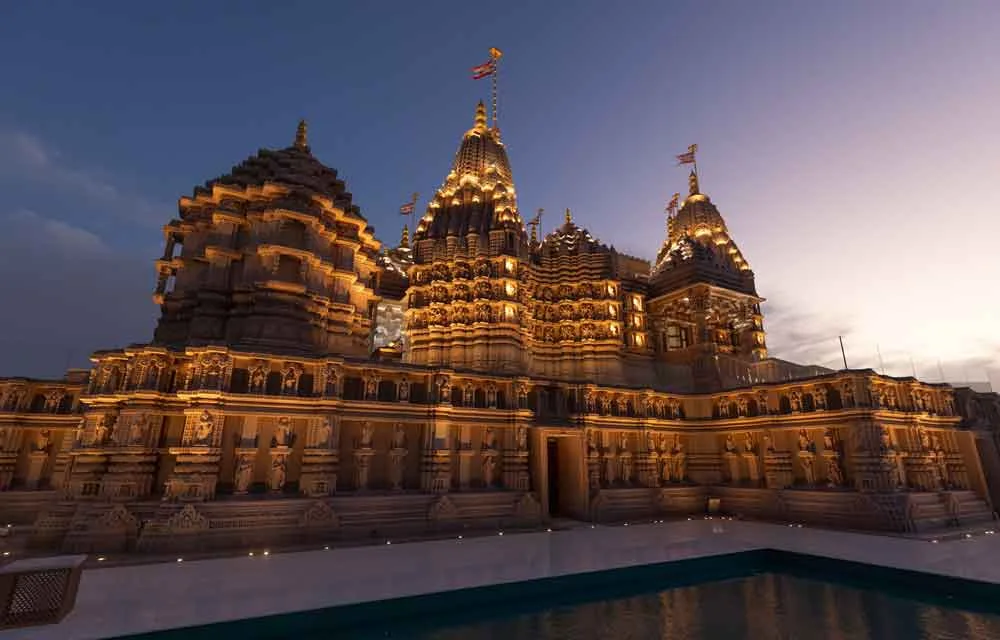
What changed with the BAPS Mandir was the symbolic ceiling, not the floor. The Mandir is a purpose-built stone temple constructed according to traditional Shilpa Shastra principles, with hand-carved sandstone elements, on twenty-seven acres of land in Abu Mureikha near Abu Dhabi. It is the largest Hindu temple in the Middle East and one of the most architecturally ambitious diaspora temples built anywhere. Its opening reset the perception of what is institutionally possible in the region — both for the Hindu community in the UAE and for the relationship between the Indian diaspora and the host country.
The Mandir also accelerated changes that were already underway. New temple-construction projects in other Emirates moved faster after the BAPS opening. Community programming expanded with greater institutional backing. The UAE's positioning of religious tolerance as a national policy received concrete expression that strengthened the diplomatic relationship with India. The Mandir was a downstream symbol of a relationship that was already deepening.
What the UAE household practice has actually been
Underneath the institutional history, the household-level Hindu religious life in the UAE has flourished in ways that are particular to the local context. Most UAE Hindu households are in apartment buildings; the puja space is usually a corner of the living room or a small alcove rather than a dedicated puja room. The daily and weekly rhythms — the morning lamp, the Tuesday-Saturday Hanuman observances, the Friday Mahalakshmi practice, the festival observances — are maintained at apartment scale across the federation.
The UAE's specific context shapes some details. The work-week structure (until late 2021, the official UAE work-week was Sunday to Thursday with Friday-Saturday weekend; the 2022 shift to Monday-Friday brought the UAE in line with most of the world) affected the timing of Friday Mahalakshmi observances and Saturday Hanuman practices in ways that long-term residents remember and that new arrivals do not always realise. The festival calendar accommodates Ramadan; during Ramadan periods, Hindu households participate in the broader cultural rhythm of the country (later evening activities, daytime food restraint in public spaces) while maintaining their own observances at home.
The festival calendar as it actually runs
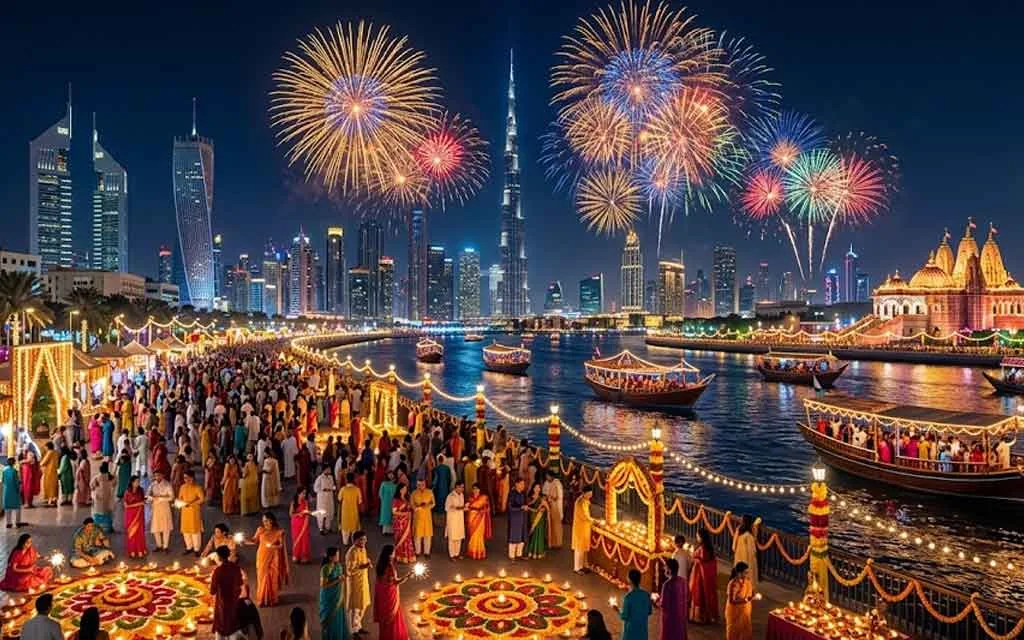
Major Hindu festivals in the UAE in 2026 are observed at three levels simultaneously. The household-level observance proceeds as it would anywhere else in the diaspora — the puja, the diyas at Diwali, the rituals at Navratri, the Janmashtami midnight cradle ritual. The temple-level programming, both at the Bur Dubai temples and now at the BAPS Mandir, organises large festival gatherings that draw thousands. The community-level events — the Indian associations' Diwali galas, the regional cultural associations' annual gatherings, the corporate Diwali celebrations that have become a feature of Dubai's business culture — provide the broadest social anchor.
What is distinctive about the UAE festival culture is the multi-layer participation. A Hindu resident of Dubai or Abu Dhabi can attend the household puja with family, the temple festival with the broader Hindu community, and an Indian-association event with cultural community — all on the same Diwali day. Few other diaspora geographies offer all three layers at the scale the UAE does. The result is a festival experience that is both deeply rooted (the household practice) and richly social (the temple and community events).
The food and ritual infrastructure
A practical dimension of religious life is the availability of ritual supplies. The UAE has a developed infrastructure for Hindu religious needs — specialty grocery stores stocking the puja items (haldi, kumkum, agarbatti, camphor, ghee lamps, specific flowers), florists who provide marigold garlands and jasmine strings for festival days, Indian sweet shops that prepare prashad-suitable mithai, priests available for household ceremonies. The mango leaves needed for door-toran at Diwali, the betel leaves for puja, the specific tulsi or rudraksha malas — all are reliably available in the major Indian-population neighbourhoods of Dubai, Abu Dhabi, Sharjah and other cities.
This infrastructure matters more than is obvious to non-residents. The household religious life that depends on these supplies is sustainable in proportion to how easily the supplies can be obtained. In the UAE in 2026, the supply chain is robust enough that a Hindu household can run a full traditional religious calendar without ever needing to import anything from India. This was not true in earlier decades; it is increasingly taken for granted by current residents.
The intergenerational picture
The Hindu population in the UAE includes a meaningful second generation now — children born and raised in the country, attending UAE schools, participating in the local religious infrastructure as their default. The second generation's relationship with the tradition is shaped by the specific UAE context: they have grown up in a Muslim-majority country with strong religious-tolerance policies, in a city culture that is internationally cosmopolitan, in an educational environment that often exposes them to multiple religious traditions deliberately.
What this produces is a second-generation NRI Hindu population in the UAE that is, on the whole, both well-rooted in their own tradition and culturally fluent in pluralistic religious life. The teenager who attends a school where most classmates are Muslim, who participates in the family's Diwali at home and the BAPS Mandir's festival programming, and who visits a friend's house during Ramadan, has an unusual breadth of religious experience that the same teenager would not necessarily have in a Hindu-majority country.
What 2026 looks like
The Hindu religious renaissance in the UAE in 2026 is what mature diaspora religious life looks like. The household practices are continuous and well-supported. The temple infrastructure spans a sixty-year history with a recent grand architectural addition. The community organisations are mature and self-sustaining. The host-country relationship is constructive and visible. The second generation is engaged.
Whether the renaissance continues at the current pace is the next question. The factors that have driven it — institutional accumulation, community demographics, host-country policy, the BAPS Mandir's symbolic role — are largely positive for the next decade. The slower question is what happens in the decades after, when the founding generation of UAE Hindu residents has retired or returned, and the second generation has fully taken over institutional life. The 2026 UAE Hindu community is in the position most diaspora communities reach a few decades into their history: the foundations are built, the institutions are running, and the question of intergenerational continuity is the one the next chapter will answer.
You might also like
Sanatan Dharma for Young NRIs: A Complete, Honest Guide for Hindus Growing Up in USA, UK, Canada, Australia & UAE
Hindu Events in GCC Countries 2026: Country-Wise Guide to Temple Festivals & Community Programs
Ganesh Chaturthi 2026 in the UAE: Temples, Home Puja, Permits & Visarjan