Dhyanajitasheshadevadeva
Dhyanajitasheshadevadeva (ध्यानजितशेषदेवदेव) is a Sanskrit-origin Hindu boy-name meaning “Lord of all gods, won by meditation alone”. Find pronunciation, origin, deity association, popularity and similar Hindu baby names.
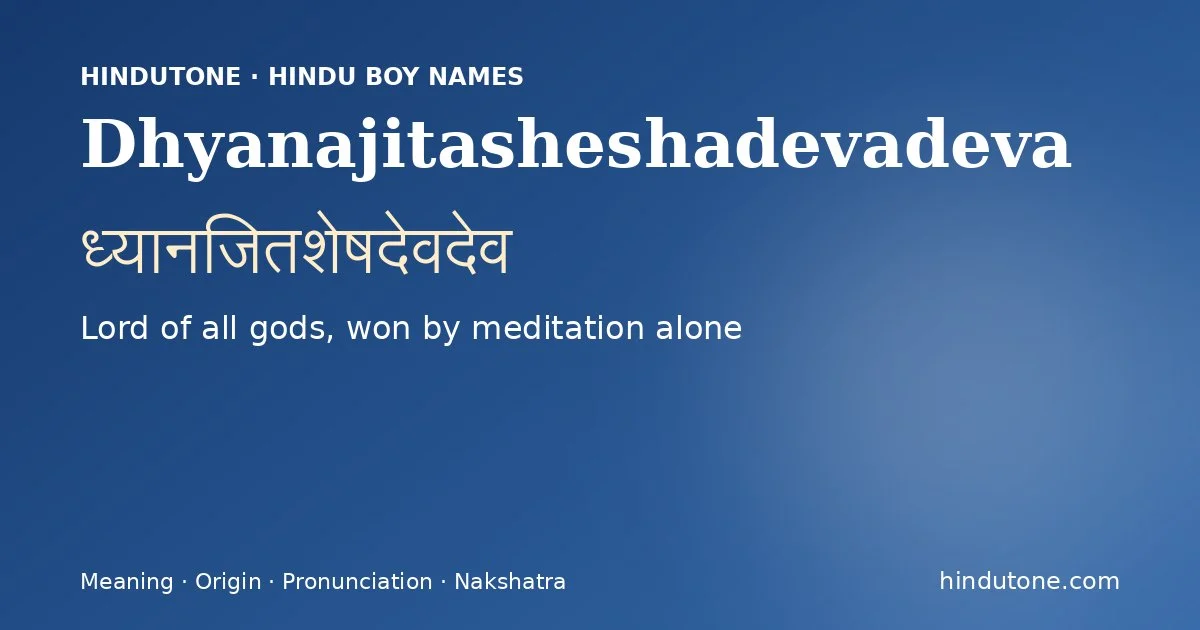
Dhyanajitasheshadevadeva (ध्यानजितशेषदेवदेव) is a Sanskrit-origin Hindu boy-name meaning “Lord of all gods, won by meditation alone”. Find pronunciation, origin, deity association, popularity and similar Hindu baby names.
Dhyanajitasheshadevadeva (ध्यानजितशेषदेवदेव, IAST: Dhyānajitāśeṣadevadeva) is a Sanskrit-origin Hindu boy-name meaning “Lord of all gods, won by meditation alone”. From dhyāna (meditation) + jita (conquered, won) + aśeṣa (all, without remainder) + devadeva (lord of all gods), this majestic epithet proclaims that the supreme Lord of all deities is accessible only through the path of deep, sustained meditation — He who cannot be seized by force or intellect alone yields to the pure, devoted gaze of the meditating heart.
Meaning, etymology & significance
The compound dhyānajita reveals a profound theological truth: while Viṣṇu as devadeva stands above the entire pantheon of gods, He willingly becomes 'conquered' — surrenders Himself, so to speak — to the devotee who approaches Him through sincere meditation. The qualifier aśeṣa (without exception, leaving nothing out) further emphasizes that every divine being, from Brahmā to Indra, is subsumed within His supremacy. This name thus glorifies both the Lord's unrivalled sovereignty and His tender accessibility to the meditative soul.
This epithet is deeply revered in the Yoga and Vedānta traditions as a declaration that dhyāna is the royal path to the divine presence; due to its elaborate compound form it functions as a devotional affirmation rather than a given name, though Devadeva may be drawn out as an independent name. Pronunciation: dhyā-na-ji-tā-śe-ṣa-de-va-de-va.
Scriptural source
Dhyanajitasheshadevadeva appears in the Vishnu Sahasranama, among the sacred names of Vishnu.
Dhyanajitasheshadevadeva — Name Facts
- Meaning
- Lord of all gods, won by meditation alone
- Gender
- Hindu boy name
- Nakshatra
- Purva Ashadha
- Rashi
- Dhanu (Sagittarius)
- Numerology
- 6
Frequently asked questions
What does the name Dhyanajitasheshadevadeva mean?
Dhyanajitasheshadevadeva is a Sanskrit-origin Hindu boy name meaning “Lord of all gods, won by meditation alone”.
Is Dhyanajitasheshadevadeva a boy or girl name?
Dhyanajitasheshadevadeva is traditionally a Hindu boy name.
Which nakshatra and rashi suit the name Dhyanajitasheshadevadeva?
By the first-syllable rule of Vedic naming, Dhyanajitasheshadevadeva aligns with the Purva Ashadha nakshatra, under the Dhanu (Sagittarius) rashi.
What is the numerology number of Dhyanajitasheshadevadeva?
The Chaldean name number of Dhyanajitasheshadevadeva is 6.
Explore more: Purva Ashadha nakshatra names · Dhanu rashi names · Hindu boy names with D · All Hindu names A–Z