Ekākin
Ekākin (एकाकिन्) is a Sanskrit-origin Hindu boy-name meaning “The eternally alone, the solitary and self-sufficient One”. Find pronunciation, origin, deity association, popularity and similar Hindu baby names.
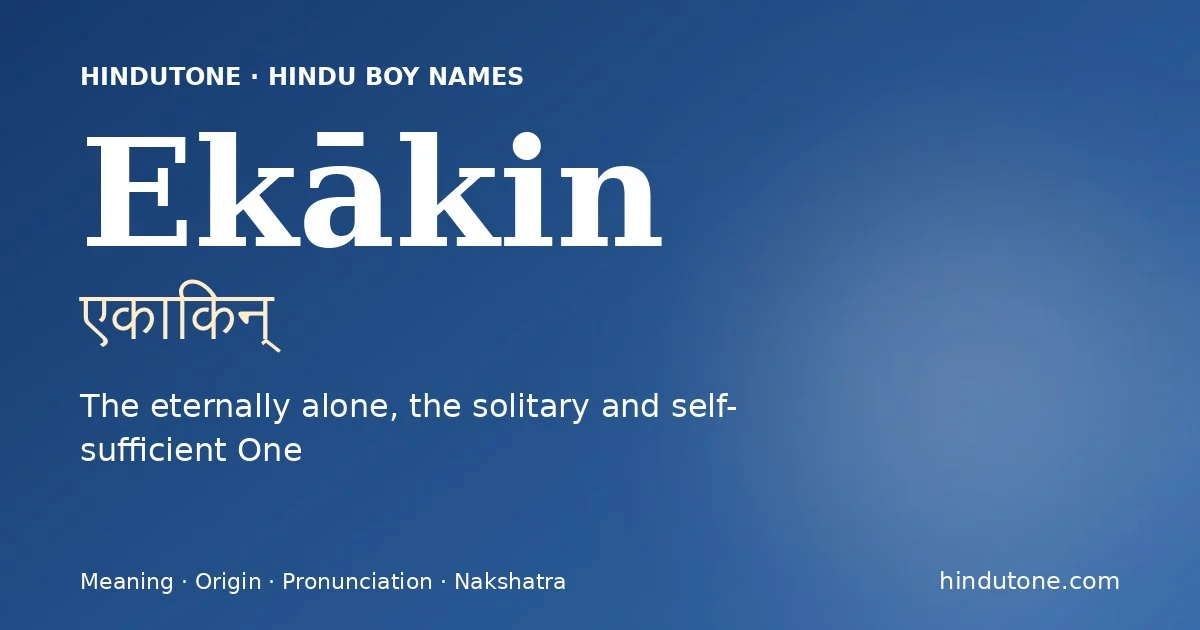
Ekākin (एकाकिन्) is a Sanskrit-origin Hindu boy-name meaning “The eternally alone, the solitary and self-sufficient One”. Find pronunciation, origin, deity association, popularity and similar Hindu baby names.
Ekākin (एकाकिन्, IAST: Ekākin) is an Sanskrit-origin Hindu boy-name meaning “The eternally alone, the solitary and self-sufficient One”. From eka (one, alone) and the suffix ākin (one who is characterized by being alone), Ekākin proclaims Vishnu as the singular, non-dual reality who exists as Himself without dependence on any other.
Meaning, etymology & significance
Eka means one in the deepest sense — not merely solitary but non-dual, the undivided Absolute — and the suffix ākin emphasizes an inherent quality of that aloneness, pointing to Vishnu's transcendence of all multiplicity and His self-sufficiency (svayambhū nature). In Vedāntic reflection, this name aligns with the Upaniṣadic declaration ekam eva advitīyam — the One without a second — affirming that Vishnu is the singular substratum of all existence. Meditating on Ekākin cultivates the quality of ātmanirbharatā, inner completeness, in the devotee.
Vishnu is called Ekākin to emphasize His transcendent, non-dual nature beyond creation; the name can be used as a boy's name in the display form Ekakin or Ekaaki in families with a philosophical bent, and is pronounced E-kā-kin.
Scriptural source
Ekākin appears in the Vishnu Sahasranama, among the sacred names of Vishnu.
Ekākin — Name Facts
- Meaning
- The eternally alone, the solitary and self-sufficient One
- Gender
- Hindu boy name
- Nakshatra
- Krittika
- Rashi
- Vrishabha (Taurus)
- Numerology
- 7
Frequently asked questions
What does the name Ekākin mean?
Ekākin is a Sanskrit-origin Hindu boy name meaning “The eternally alone, the solitary and self-sufficient One”.
Is Ekākin a boy or girl name?
Ekākin is traditionally a Hindu boy name.
Which nakshatra and rashi suit the name Ekākin?
By the first-syllable rule of Vedic naming, Ekākin aligns with the Krittika nakshatra, under the Vrishabha (Taurus) rashi.
What is the numerology number of Ekākin?
The Chaldean name number of Ekākin is 7.
Explore more: Krittika nakshatra names · Vrishabha rashi names · Hindu boy names with E · All Hindu names A–Z