Hayagriva
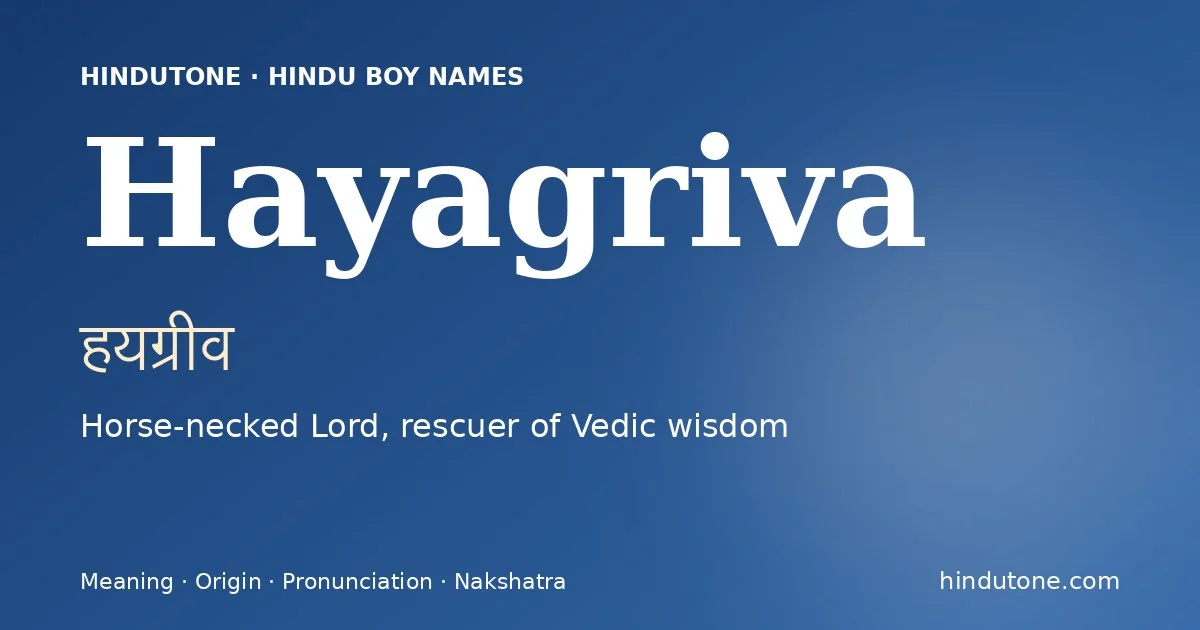
Hayagriva (हयग्रीव) is a Sanskrit-origin Hindu boy-name meaning “Horse-necked Lord, rescuer of Vedic wisdom”. Find pronunciation, origin, deity association, popularity and similar Hindu baby names.
Hayagriva (हयग्रीव) is a Sanskrit-origin Hindu boy-name meaning “Horse-necked Lord, rescuer of Vedic wisdom”. Find pronunciation, origin, deity association, popularity and similar Hindu baby names.
Hayagriva (हयग्रीव, IAST: Hayagrīva) is a Sanskrit-origin Hindu boy-name meaning “Horse-necked Lord, rescuer of Vedic wisdom”. From haya (horse) and grīva (neck), Hayagrīva names the horse-headed avatāra of Vishnu who retrieved the Vedas from the demon Śaṅkhāsura and restored sacred knowledge to Brahmā.
Meaning, etymology & significance
Hayagrīva is one of the most celebrated forms of Vishnu, worshipped especially as the deity of learning, scripture, and divine wisdom. According to the Purāṇas, when the demon Śaṅkhāsura stole the Vedas and hid them in the cosmic ocean, Vishnu assumed this horse-headed form, slew the demon, and restored the eternal texts to Brahmā. The horse symbolizes the swift, unstoppable power of sacred sound, and his white form represents the purity of revealed knowledge.
Hayagrīva is particularly revered in the Śrī Vaishnava tradition of South India, where a distinct Hayagrīva Stotra composed by Vedāntadeśika is recited daily by students. Pronounced ha-ya-GREE-va, with the long ī in grīva sustained for one count.
Scriptural source
Hayagriva appears in the Vishnu Sahasranama, among the sacred names of Vishnu.
Astrology — nakshatra, rashi & numerology
By the standard Vedic correspondence between a name’s first syllable and the lunar mansion, Hayagriva aligns with the Punarvasu nakshatra, under the Mithuna rashi (Moon sign). Its Chaldean name-number is 3.
Hayagriva — Name Facts
- Meaning
- Horse-necked Lord, rescuer of Vedic wisdom
- Gender
- Hindu boy name
- Nakshatra
- Punarvasu
- Rashi
- Mithuna (Gemini)
- Numerology
- 3
Frequently asked questions
What does the name Hayagriva mean?
Hayagriva is a Sanskrit-origin Hindu boy name meaning “Horse-necked Lord, rescuer of Vedic wisdom”.
Is Hayagriva a boy or girl name?
Hayagriva is traditionally a Hindu boy name.
Which nakshatra and rashi suit the name Hayagriva?
By the first-syllable rule of Vedic naming, Hayagriva aligns with the Punarvasu nakshatra, under the Mithuna (Gemini) rashi.
What is the numerology number of Hayagriva?
The Chaldean name number of Hayagriva is 3.
Explore more: Punarvasu nakshatra names · Mithuna rashi names · Hindu boy names with H · All Hindu names A–Z