Kaivalyapati
Kaivalyapati (कैवल्यपति) is a Sanskrit-origin Hindu boy-name meaning “Lord of liberation, sovereign of absolute aloneness”. Find pronunciation, origin, deity association, popularity and similar Hindu baby names.
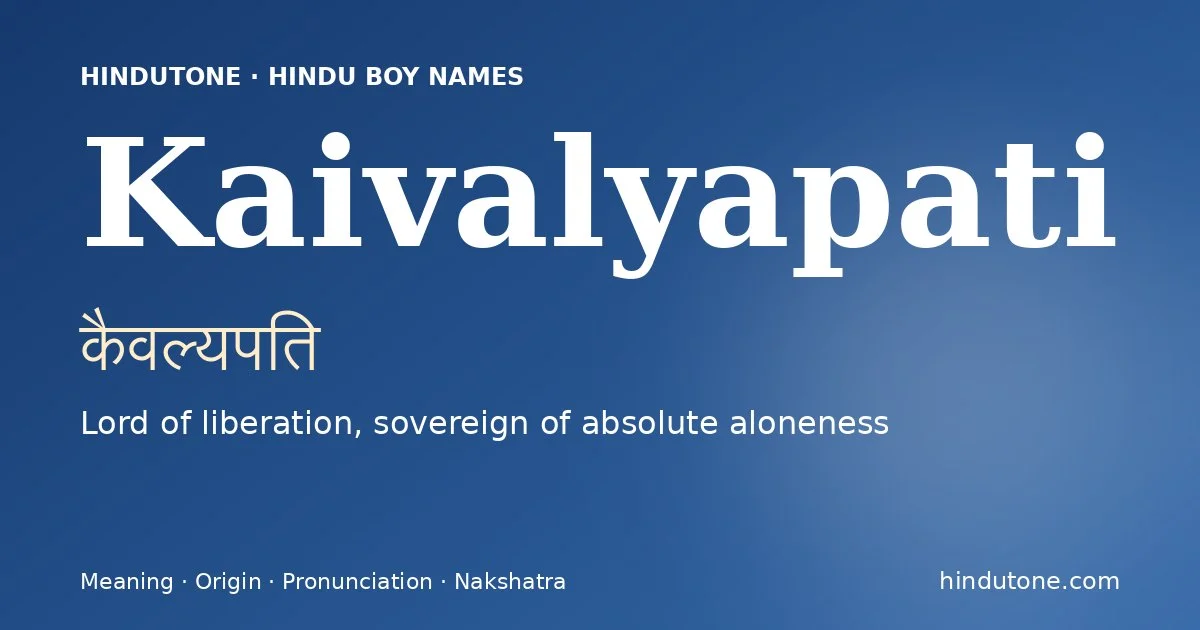
Kaivalyapati (कैवल्यपति) is a Sanskrit-origin Hindu boy-name meaning “Lord of liberation, sovereign of absolute aloneness”. Find pronunciation, origin, deity association, popularity and similar Hindu baby names.
Kaivalyapati (कैवल्यपति, IAST: Kaivalyapati) is a Sanskrit-origin Hindu boy-name meaning “Lord of liberation, sovereign of absolute aloneness”. From kaivalya (absolute liberation, the state of pure aloneness of the spirit, from kevala 'alone, pure') and pati (lord), this name crowns Viṣṇu as the supreme giver and governor of the highest spiritual liberation—the state where the soul rests in its own pristine perfection.
Meaning, etymology & significance
Kaivalya in Yoga philosophy, particularly in Patañjali's Yoga Sūtras, denotes the ultimate liberation where the Puruṣa abides in its own nature, free from all entanglement with Prakṛti; in Vaiṣṇava thought, it corresponds to the state of complete spiritual liberation (mukti) granted by the grace of Viṣṇu. As Kaivalyapati, the Lord is not merely a guide toward this liberation but its very sovereign—He grants it, presides over it, and is the eternal companion of the liberated soul. This name beautifully bridges the traditions of Yoga, Sāṃkhya, and Vaiṣṇava bhakti, placing Viṣṇu at the apex of all spiritual attainment.
Kaivalyapati is a theologically rich epithet of Viṣṇu found in Vaiṣṇava philosophical literature and is occasionally used as a given name in spiritually oriented Hindu families; the shorter Kaivalya is a more common name for boys. Pronunciation: kai-val-ya-pa-ti, with the diphthong kai clearly voiced at the start.
Scriptural source
Kaivalyapati appears in the Vishnu Sahasranama, among the sacred names of Vishnu.
Astrology — nakshatra, rashi & numerology
By the standard Vedic correspondence between a name’s first syllable and the lunar mansion, Kaivalyapati aligns with the Mrigashira nakshatra, under the Mithuna rashi (Moon sign). Its Chaldean name-number is 3.
Kaivalyapati — Name Facts
- Meaning
- Lord of liberation, sovereign of absolute aloneness
- Gender
- Hindu boy name
- Nakshatra
- Punarvasu
- Rashi
- Mithuna (Gemini)
- Numerology
- 3
Frequently asked questions
What does the name Kaivalyapati mean?
Kaivalyapati is a Sanskrit-origin Hindu boy name meaning “Lord of liberation, sovereign of absolute aloneness”.
Is Kaivalyapati a boy or girl name?
Kaivalyapati is traditionally a Hindu boy name.
Which nakshatra and rashi suit the name Kaivalyapati?
By the first-syllable rule of Vedic naming, Kaivalyapati aligns with the Punarvasu nakshatra, under the Mithuna (Gemini) rashi.
What is the numerology number of Kaivalyapati?
The Chaldean name number of Kaivalyapati is 3.
Explore more: Punarvasu nakshatra names · Mithuna rashi names · Hindu boy names with K · All Hindu names A–Z