Kr̥tāntavāhanāsahya
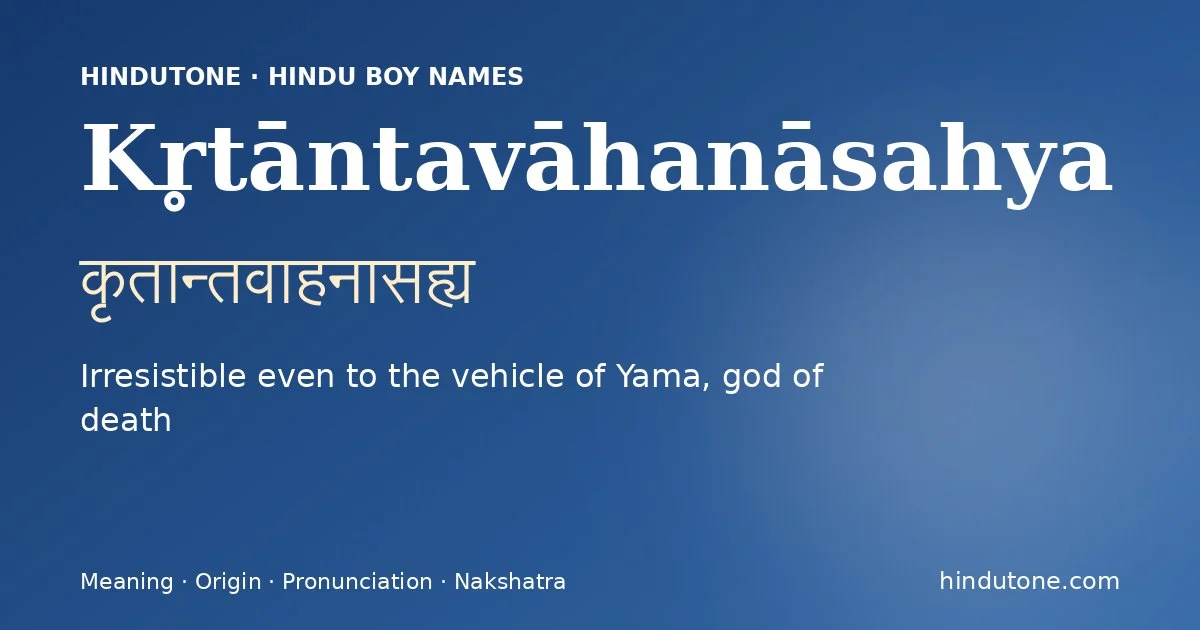
Kr̥tāntavāhanāsahya (कृतान्तवाहनासह्य) is a Sanskrit-origin Hindu boy-name meaning “Irresistible even to the vehicle of Yama, god of death”. Find pronunciation, origin, deity association, popularity and similar Hindu baby names.
Kr̥tāntavāhanāsahya (कृतान्तवाहनासह्य) is a Sanskrit-origin Hindu boy-name meaning “Irresistible even to the vehicle of Yama, god of death”. Find pronunciation, origin, deity association, popularity and similar Hindu baby names.
Kr̥tāntavāhanāsahya (कृतान्तवाहनासह्य, IAST: kṛtāntavāhanāsahya) is a Sanskrit-origin Hindu boy-name meaning “Irresistible even to the vehicle of Yama, god of death”. Composed of kṛtānta (Yama, the ender/decider of fate), vāhana (vehicle/mount — Yama's buffalo), and asahya (unbearable, irresistible, not to be endured), this epithet proclaims that even Death's own dreadful mount cannot withstand the power of Viṣṇu.
Meaning, etymology & significance
Kṛtānta literally means 'one who makes an end,' a common epithet for Yama, the lord of dharmic justice and death. His vāhana, the great buffalo, symbolises the unstoppable momentum of cosmic law that ends each life in due time. Yet Viṣṇu as Asahya to even this mount declares that the Supreme transcends the authority of death itself — a truth made manifest when He rescued Prahlāda, Mārkaṇḍeya, and others from Yama's domain.
This long compound is a theological statement rather than a personal name and belongs to elaborate Vaiṣṇava liturgical namāvalīs. Its component Asahya (irresistible) has occasionally been used as an independent epithet for the Lord.
Scriptural source
Kr̥tāntavāhanāsahya appears in the Vishnu Sahasranama, among the sacred names of Vishnu.
Kr̥tāntavāhanāsahya — Name Facts
- Meaning
- Irresistible even to the vehicle of Yama, god of death
- Gender
- Hindu boy name
- Nakshatra
- Mrigashira
- Rashi
- Mithuna (Gemini)
- Numerology
- 4
Frequently asked questions
What does the name Kr̥tāntavāhanāsahya mean?
Kr̥tāntavāhanāsahya is a Sanskrit-origin Hindu boy name meaning “Irresistible even to the vehicle of Yama, god of death”.
Is Kr̥tāntavāhanāsahya a boy or girl name?
Kr̥tāntavāhanāsahya is traditionally a Hindu boy name.
Which nakshatra and rashi suit the name Kr̥tāntavāhanāsahya?
By the first-syllable rule of Vedic naming, Kr̥tāntavāhanāsahya aligns with the Mrigashira nakshatra, under the Mithuna (Gemini) rashi.
What is the numerology number of Kr̥tāntavāhanāsahya?
The Chaldean name number of Kr̥tāntavāhanāsahya is 4.
Explore more: Mrigashira nakshatra names · Mithuna rashi names · Hindu boy names with K · All Hindu names A–Z