Mahashiva
Mahashiva (महाशिव) is a Sanskrit-origin Hindu boy-name meaning “The supremely auspicious, the great Shiva”. Find pronunciation, origin, deity association, popularity and similar Hindu baby names.
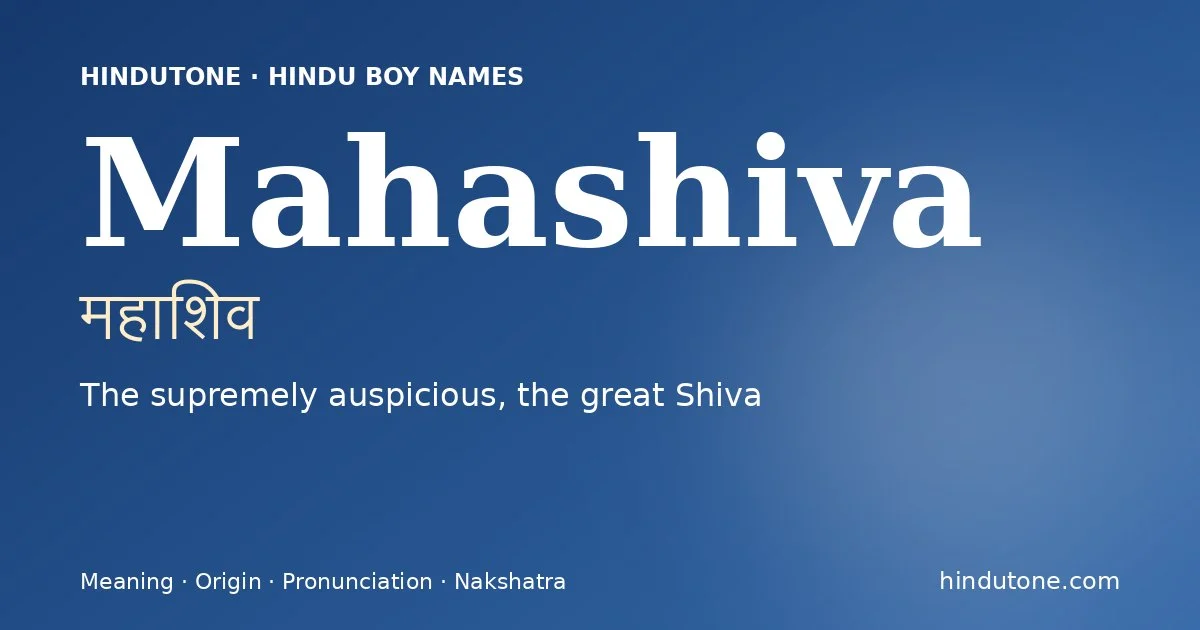
Mahashiva (महाशिव) is a Sanskrit-origin Hindu boy-name meaning “The supremely auspicious, the great Shiva”. Find pronunciation, origin, deity association, popularity and similar Hindu baby names.
Mahashiva (महाशिव, IAST: Mahāśiva) is a Sanskrit-origin Hindu boy-name meaning “The supremely auspicious, the great Shiva”. Built from mahā (great, supreme) and śiva (auspicious, benevolent), this name applied to Vishnu in the Sahasranāma proclaims that the greatest auspiciousness resides in Him, harmonizing the Vaiṣṇava and Śaiva streams of devotion.
Meaning, etymology & significance
The attribution of Mahāśiva to Vishnu reflects the profound theological unity articulated in texts such as the Skanda Purāṇa, where Viṣṇu and Śiva are declared to be ultimately one supreme reality. Śiva literally means 'that which is auspicious,' and the prefix mahā intensifies this quality to cosmic proportions. Bearing this name, a child carries the blessing of supreme auspiciousness that transcends sectarian boundaries.
The name is cherished across Vaiṣṇava and Śaiva households as a symbol of the Harihara synthesis, the unity of Hari (Viṣṇu) and Hara (Śiva). It is pronounced ma-haa-shi-va, with the retroflex 'ś' requiring a gentle palatal sound.
Scriptural source
Mahashiva appears in the Vishnu Sahasranama, among the sacred names of Vishnu.
Astrology — nakshatra, rashi & numerology
By the standard Vedic correspondence between a name’s first syllable and the lunar mansion, Mahashiva aligns with the Magha nakshatra, under the Simha rashi (Moon sign). Its Chaldean name-number is 9.
Mahashiva — Name Facts
- Meaning
- The supremely auspicious, the great Shiva
- Gender
- Hindu boy name
- Nakshatra
- Magha
- Rashi
- Simha (Leo)
- Numerology
- 9
Frequently asked questions
What does the name Mahashiva mean?
Mahashiva is a Sanskrit-origin Hindu boy name meaning “The supremely auspicious, the great Shiva”.
Is Mahashiva a boy or girl name?
Mahashiva is traditionally a Hindu boy name.
Which nakshatra and rashi suit the name Mahashiva?
By the first-syllable rule of Vedic naming, Mahashiva aligns with the Magha nakshatra, under the Simha (Leo) rashi.
What is the numerology number of Mahashiva?
The Chaldean name number of Mahashiva is 9.
Explore more: Magha nakshatra names · Simha rashi names · Hindu boy names with M · All Hindu names A–Z