Munīśvara
Munīśvara (मुनीश्वर) is a Sanskrit-origin Hindu boy-name meaning “Lord of sages; sovereign among ascetics”. Find pronunciation, origin, deity association, popularity and similar Hindu baby names.
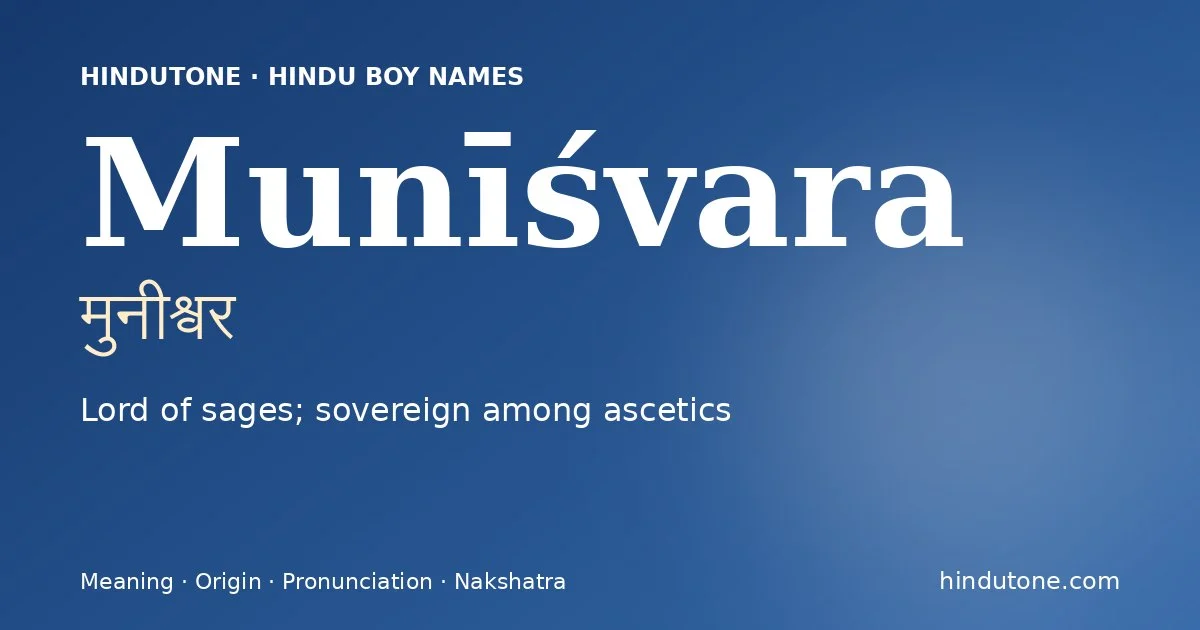
Munīśvara (मुनीश्वर) is a Sanskrit-origin Hindu boy-name meaning “Lord of sages; sovereign among ascetics”. Find pronunciation, origin, deity association, popularity and similar Hindu baby names.
Munīśvara (मुनीश्वर, IAST: Munīśvara) is a Sanskrit-origin Hindu boy-name meaning “Lord of sages; sovereign among ascetics”. From muni (silent sage, ascetic) and īśvara (lord, sovereign), this name proclaims Viṣṇu — particularly in His avatāra as Dattātreya — as the supreme among all contemplatives, the ultimate master of yogic wisdom.
Meaning, etymology & significance
Muni (from the root man, to reflect or be silent) refers to one who observes inner silence and deep meditation; īśvara from the root īś (to rule, to be capable) denotes absolute sovereign authority. Together they form a title of profound spiritual nobility, indicating not mere leadership among sages but ontological supremacy over the entire inner dimension of creation. This epithet is especially fitting for Dattātreya, who is the teacher of teachers and is said to have instructed even Paraśurāma and Kārtavīrya Arjuna.
Munīśvara is used as a given name in traditional Brahmin and Shaiva-Vaiṣṇava households, and also appears as a temple deity name at several South Indian shrines; its dual-root structure makes it both spiritually rich and phonetically pleasant. Pronounced moo-NEESH-vah-rah.
Scriptural source
Munīśvara appears in the Vishnu Sahasranama, among the sacred names of Vishnu.
Astrology — nakshatra, rashi & numerology
By the standard Vedic correspondence between a name’s first syllable and the lunar mansion, Munīśvara aligns with the Magha nakshatra, under the Simha rashi (Moon sign). Its Chaldean name-number is 7.
Munīśvara — Name Facts
- Meaning
- Lord of sages; sovereign among ascetics
- Gender
- Hindu boy name
- Nakshatra
- Magha
- Rashi
- Simha (Leo)
- Numerology
- 2
Frequently asked questions
What does the name Munīśvara mean?
Munīśvara is a Sanskrit-origin Hindu boy name meaning “Lord of sages; sovereign among ascetics”.
Is Munīśvara a boy or girl name?
Munīśvara is traditionally a Hindu boy name.
Which nakshatra and rashi suit the name Munīśvara?
By the first-syllable rule of Vedic naming, Munīśvara aligns with the Magha nakshatra, under the Simha (Leo) rashi.
What is the numerology number of Munīśvara?
The Chaldean name number of Munīśvara is 2.
Explore more: Magha nakshatra names · Simha rashi names · Hindu boy names with M · All Hindu names A–Z