Parashiva
Parashiva (परशिव) is a Sanskrit-origin Hindu boy-name meaning “The Supreme Auspiciousness beyond all good”. Find pronunciation, origin, deity association, popularity and similar Hindu baby names.
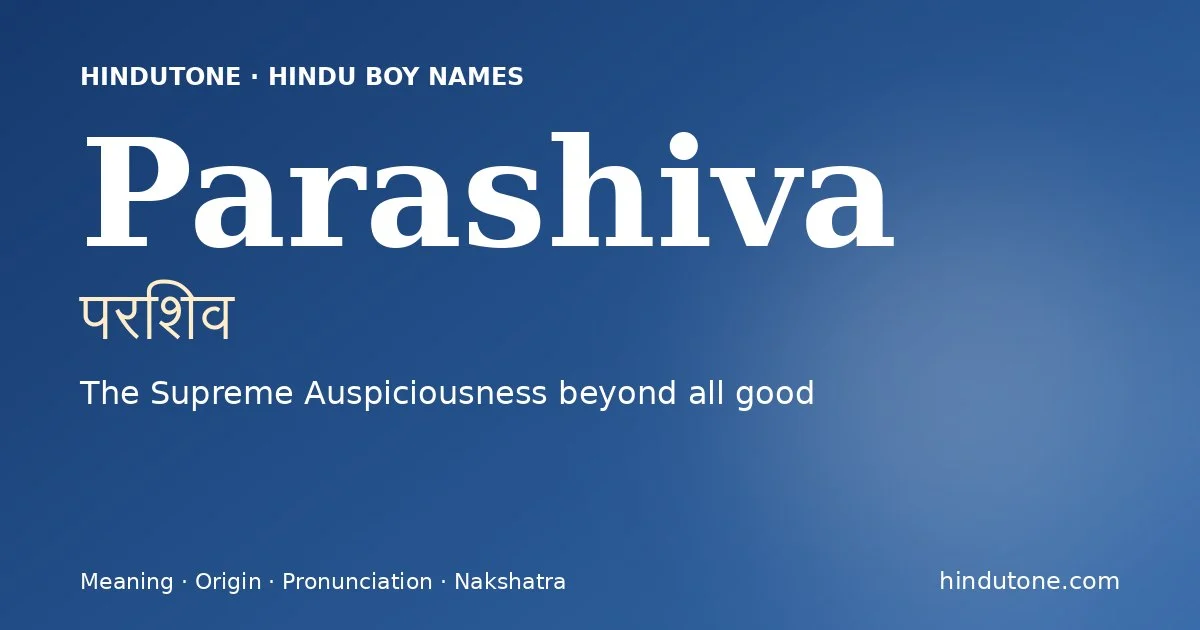
Parashiva (परशिव) is a Sanskrit-origin Hindu boy-name meaning “The Supreme Auspiciousness beyond all good”. Find pronunciation, origin, deity association, popularity and similar Hindu baby names.
Parashiva (परशिव, IAST: Paraśiva) is a Sanskrit-origin Hindu boy-name meaning “The Supreme Auspiciousness beyond all good”. Formed from 'para' (transcendent, supreme) and 'śiva' (auspicious, benevolent, gracious), this name declares Vishnu to be the ultimate source of all grace and beneficence, himself being the ground of auspiciousness.
Meaning, etymology & significance
While 'Shiva' is most commonly used as a name for the Destroyer-God of the Shaiva tradition, the word itself is a common Sanskrit adjective meaning 'auspicious' and 'benevolent.' The Vishnu Sahasranama employs Paraśiva to affirm that Vishnu embodies the highest form of this quality — a grace and goodness so complete that it transcends even its own expression.
In Vaishnava theology this epithet emphasizes the harmonious relationship between the qualities of grace attributed to both great deities, showing Vishnu as the supreme ground of auspiciousness itself. The name is used occasionally in devotional families; pronounced pa-ra-SHI-va, with a soft palatal 'ś' at the start of 'shiva.'
Scriptural source
Parashiva appears in the Vishnu Sahasranama, among the sacred names of Vishnu.
Astrology — nakshatra, rashi & numerology
By the standard Vedic correspondence between a name’s first syllable and the lunar mansion, Parashiva aligns with the Uttara phalguni nakshatra, under the Kanya rashi (Moon sign). Its Chaldean name-number is 1.
Parashiva — Name Facts
- Meaning
- The Supreme Auspiciousness beyond all good
- Gender
- Hindu boy name
- Nakshatra
- Uttara Phalguni
- Rashi
- Kanya (Virgo)
- Numerology
- 1
Frequently asked questions
What does the name Parashiva mean?
Parashiva is a Sanskrit-origin Hindu boy name meaning “The Supreme Auspiciousness beyond all good”.
Is Parashiva a boy or girl name?
Parashiva is traditionally a Hindu boy name.
Which nakshatra and rashi suit the name Parashiva?
By the first-syllable rule of Vedic naming, Parashiva aligns with the Uttara Phalguni nakshatra, under the Kanya (Virgo) rashi.
What is the numerology number of Parashiva?
The Chaldean name number of Parashiva is 1.
Explore more: Uttara Phalguni nakshatra names · Kanya rashi names · Hindu boy names with P · All Hindu names A–Z