Ramadvitiya
Ramadvitiya (रामद्वितीय) is a Sanskrit-origin Hindu boy-name meaning “He who has Rama as his second, inseparable companion”. Find pronunciation, origin, deity association, popularity and similar Hindu baby names.
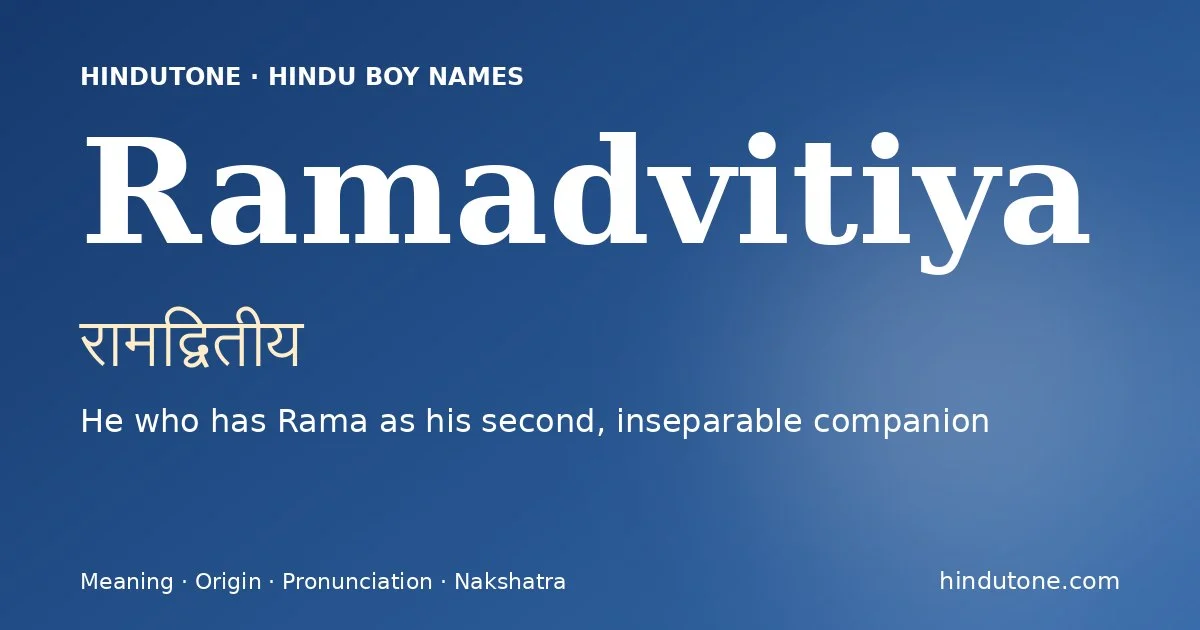
Ramadvitiya (रामद्वितीय) is a Sanskrit-origin Hindu boy-name meaning “He who has Rama as his second, inseparable companion”. Find pronunciation, origin, deity association, popularity and similar Hindu baby names.
Ramadvitiya (रामद्वितीय, IAST: rāmadvitīya) is a Sanskrit-origin Hindu boy-name meaning “He who has Rama as his second, inseparable companion”. From 'Rāma' (the beloved avatāra, from rām, to delight) and 'dvitīya' (second, another, companion), this epithet of Lakshmana proclaims that he never existed apart from Rama — his identity itself is defined by constant, loving companionship with his elder brother.
Meaning, etymology & significance
The name 'Rāmadvitīya' eloquently captures Lakshmana's spiritual essence: he is he for whom Rama is the inseparable second self, the ever-present other half of his being. In Vaishnava theology, Lakshmana is considered an avatāra of Ādiśeṣa, the divine serpent who eternally supports Vishnu — and so his companionship with Rama mirrors the eternal bond of Shesha and Narayana. The dvandva relationship encoded in 'dvitīya' suggests not subordination but sacred union.
This epithet is borne by Lakshmana, the devoted younger brother of Lord Rama, and celebrates the defining quality of his divine character. As a given name, Ramadvitiya is unusual in modern usage but carries profound devotional weight; 'Dvitiya' alone is sometimes used.
Scriptural source
Ramadvitiya appears in the Vishnu Sahasranama, among the sacred names of Vishnu.
Astrology — nakshatra, rashi & numerology
By the standard Vedic correspondence between a name’s first syllable and the lunar mansion, Ramadvitiya aligns with the Chitra nakshatra, under the Tula rashi (Moon sign). Its Chaldean name-number is 8.
Ramadvitiya — Name Facts
- Meaning
- He who has Rama as his second, inseparable companion
- Gender
- Hindu boy name
- Nakshatra
- Chitra
- Rashi
- Tula (Libra)
- Numerology
- 8
Frequently asked questions
What does the name Ramadvitiya mean?
Ramadvitiya is a Sanskrit-origin Hindu boy name meaning “He who has Rama as his second, inseparable companion”.
Is Ramadvitiya a boy or girl name?
Ramadvitiya is traditionally a Hindu boy name.
Which nakshatra and rashi suit the name Ramadvitiya?
By the first-syllable rule of Vedic naming, Ramadvitiya aligns with the Chitra nakshatra, under the Tula (Libra) rashi.
What is the numerology number of Ramadvitiya?
The Chaldean name number of Ramadvitiya is 8.
Explore more: Chitra nakshatra names · Tula rashi names · Hindu boy names with R · All Hindu names A–Z