Ravaníghna
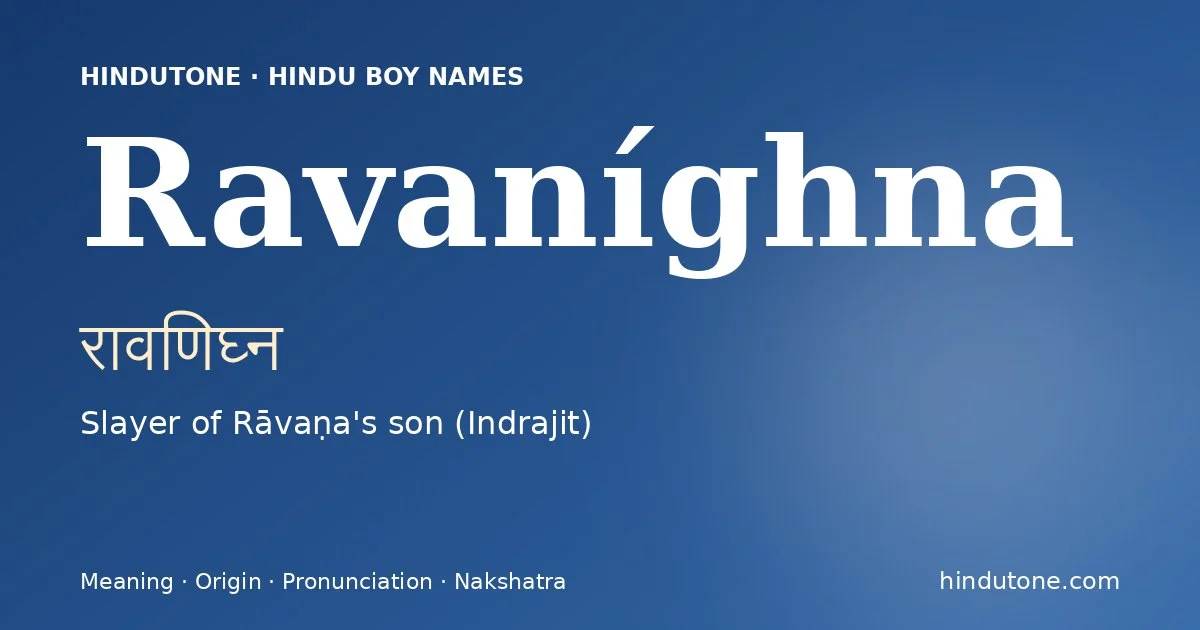
Ravaníghna (रावणिघ्न) is a Sanskrit-origin Hindu boy-name meaning “Slayer of Rāvaṇa's son (Indrajit)”. Find pronunciation, origin, deity association, popularity and similar Hindu baby names.
Ravaníghna (रावणिघ्न) is a Sanskrit-origin Hindu boy-name meaning “Slayer of Rāvaṇa's son (Indrajit)”. Find pronunciation, origin, deity association, popularity and similar Hindu baby names.
Ravaníghna (रावणिघ्न, IAST: Rāvaṇighna) is a Sanskrit-origin Hindu boy-name meaning “Slayer of Rāvaṇa's son (Indrajit)”. From Rāvaṇi (son of Rāvaṇa, i.e., Indrajit/Meghanāda) + ghna (slayer, destroyer), this name honours the divine agency — specifically Lakshmana acting under Rama's grace — that destroyed the most formidable of Rāvaṇa's offspring.
Meaning, etymology & significance
Rāvaṇi is a patronymic meaning 'son of Rāvaṇa,' referring to Indrajit (Meghanāda), the fearsome warrior who had conquered even Indra in battle. The suffix ghna (from the root han, to strike or slay) designates the destroyer of this invincible foe. In the Rāmāyaṇa, Lakshmana, empowered by divine grace, slew Indrajit — an act celebrated as one of the pivotal turningpoints of the war. The epithet is attributed to Vishnu-Rama as the ultimate source of that victory.
This name is applied to Lord Vishnu in the context of the Rāma-avatāra's victory over Lanka; it is occasionally found as a traditional given name in devotional communities. Pronounced raa-va-ni-gh-na.
Scriptural source
Ravaníghna appears in the Vishnu Sahasranama, among the sacred names of Vishnu.
Astrology — nakshatra, rashi & numerology
By the standard Vedic correspondence between a name’s first syllable and the lunar mansion, Ravaníghna aligns with the Chitra nakshatra, under the Tula rashi (Moon sign). Its Chaldean name-number is 2.
Ravaníghna — Name Facts
- Meaning
- Slayer of Rāvaṇa's son (Indrajit)
- Gender
- Hindu boy name
- Nakshatra
- Chitra
- Rashi
- Tula (Libra)
- Numerology
- 3
Frequently asked questions
What does the name Ravaníghna mean?
Ravaníghna is a Sanskrit-origin Hindu boy name meaning “Slayer of Rāvaṇa's son (Indrajit)”.
Is Ravaníghna a boy or girl name?
Ravaníghna is traditionally a Hindu boy name.
Which nakshatra and rashi suit the name Ravaníghna?
By the first-syllable rule of Vedic naming, Ravaníghna aligns with the Chitra nakshatra, under the Tula (Libra) rashi.
What is the numerology number of Ravaníghna?
The Chaldean name number of Ravaníghna is 3.
Explore more: Chitra nakshatra names · Tula rashi names · Hindu boy names with R · All Hindu names A–Z