Sahasranama
Sahasranama (सहस्रनामन्) is a Sanskrit-origin Hindu boy-name meaning “He who bears a thousand sacred names”. Find pronunciation, origin, deity association, popularity and similar Hindu baby names.
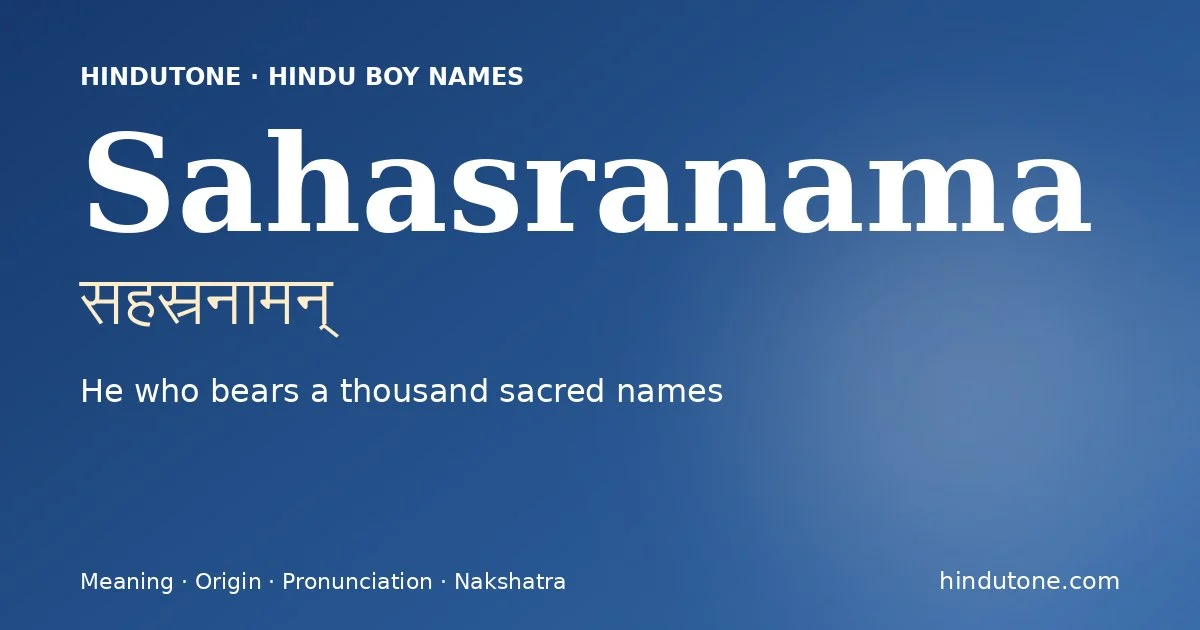
Sahasranama (सहस्रनामन्) is a Sanskrit-origin Hindu boy-name meaning “He who bears a thousand sacred names”. Find pronunciation, origin, deity association, popularity and similar Hindu baby names.
Sahasranama (सहस्रनामन्, IAST: Sahasranāman) is a Sanskrit-origin Hindu boy-name meaning “He who bears a thousand sacred names”. From sahasra (thousand, innumerable) and nāman (name), this self-referential epithet crowns Viṣṇu within the very hymn that enumerates his names, affirming that his glories are boundless and inexhaustible.
Meaning, etymology & significance
This extraordinary name appears within the Viṣṇu Sahasranāma itself, functioning as both a divine attribute and a meta-declaration: the Lord who is being praised by a thousand names is himself named Sahasranāman, the bearer of those very names. In Indian philosophical thought, a name is not arbitrary but carries the essence of its bearer — and so a thousand names means a thousand facets of one infinite reality. The recitation of this name is held to encapsulate the merit of the entire stotra.
Sahasranāman is unique among the Sahasranāma epithets in its self-referential majesty; though rarely given as a personal name in its full form, the element Sahasra appears in several Indian names. Pronounced sa-has-ra-nā-man, with careful attention to the long ā in nāman.
Scriptural source
Sahasranama appears in the Vishnu Sahasranama, among the sacred names of Vishnu.
Astrology — nakshatra, rashi & numerology
By the standard Vedic correspondence between a name’s first syllable and the lunar mansion, Sahasranama aligns with the Shatabhisha nakshatra, under the Kumbha rashi (Moon sign). Its Chaldean name-number is 9.
Sahasranama — Name Facts
- Meaning
- He who bears a thousand sacred names
- Gender
- Hindu boy name
- Nakshatra
- Shatabhisha
- Rashi
- Kumbha (Aquarius)
- Numerology
- 9
Frequently asked questions
What does the name Sahasranama mean?
Sahasranama is a Sanskrit-origin Hindu boy name meaning “He who bears a thousand sacred names”.
Is Sahasranama a boy or girl name?
Sahasranama is traditionally a Hindu boy name.
Which nakshatra and rashi suit the name Sahasranama?
By the first-syllable rule of Vedic naming, Sahasranama aligns with the Shatabhisha nakshatra, under the Kumbha (Aquarius) rashi.
What is the numerology number of Sahasranama?
The Chaldean name number of Sahasranama is 9.
Explore more: Shatabhisha nakshatra names · Kumbha rashi names · Hindu boy names with S · All Hindu names A–Z