Saptatalayadhakrshtadhvastapataladanava
Saptatalayadhakrshtadhvastapataladanava (सप्तताळव्यधाकृष्टध्वस्तपातालदानव) is a Sanskrit-origin Hindu boy-name meaning “Who pierced seven Tala trees and destroyed the netherworld demon”. Find pronunciation, origin, deity association, popularity and similar Hindu baby names.
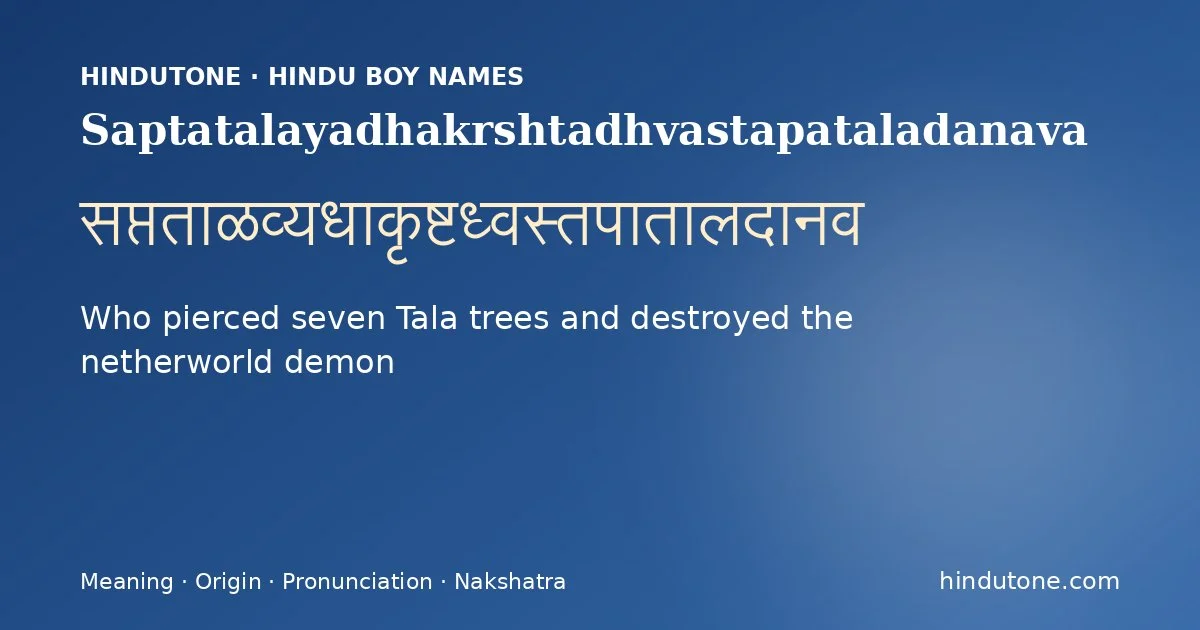
Saptatalayadhakrshtadhvastapataladanava (सप्तताळव्यधाकृष्टध्वस्तपातालदानव) is a Sanskrit-origin Hindu boy-name meaning “Who pierced seven Tala trees and destroyed the netherworld demon”. Find pronunciation, origin, deity association, popularity and similar Hindu baby names.
Saptatalayadhakrshtadhvastapataladanava (सप्तताळव्यधाकृष्टध्वस्तपातालदानव, IAST: Saptatālavyadhākṛṣṭadhvastapātāladānava) is a Sanskrit-origin Hindu boy-name meaning “Who pierced seven Tala trees and destroyed the netherworld demon”. This epithet of the Lord as Rama commemorates his feat of piercing seven sala (or tala) trees with a single arrow, which then struck through to the netherworld and destroyed a demon there, proving his might to Sugriva.
Meaning, etymology & significance
To further establish his strength before entering alliance with Sugriva, Rama shot a single arrow that passed through seven great trees and penetrated to the Patala (netherworld), vanquishing the demon dwelling there. 'Saptātāla-vyadha' (piercing seven palm trees), 'ākṛṣṭa' (drawn, pulled — the arrow drawn from the bow), and 'dhvasta-pātāla-dānava' (destroyer of the netherworld demon) together paint a picture of power that is at once grounded in the narrative and transcendent in its implications. This demonstration convinced Sugriva that Rama alone could slay Vali.
This is an elaborate liturgical epithet of Vishnu as Rama, narrating the famous Kishkindha Kanda episode. It is unsuitable as a personal given name but is a cherished Sahasranama address for devotees of the Ramayana tradition.
Scriptural source
Saptatalayadhakrshtadhvastapataladanava appears in the Vishnu Sahasranama, among the sacred names of Vishnu.
Astrology — nakshatra, rashi & numerology
By the standard Vedic correspondence between a name’s first syllable and the lunar mansion, Saptatalayadhakrshtadhvastapataladanava aligns with the Shatabhisha nakshatra, under the Kumbha rashi (Moon sign). Its Chaldean name-number is 7.
Saptatalayadhakrshtadhvastapataladanava — Name Facts
- Meaning
- Who pierced seven Tala trees and destroyed the netherworld demon
- Gender
- Hindu boy name
- Nakshatra
- Shatabhisha
- Rashi
- Kumbha (Aquarius)
- Numerology
- 7
Frequently asked questions
What does the name Saptatalayadhakrshtadhvastapataladanava mean?
Saptatalayadhakrshtadhvastapataladanava is a Sanskrit-origin Hindu boy name meaning “Who pierced seven Tala trees and destroyed the netherworld demon”.
Is Saptatalayadhakrshtadhvastapataladanava a boy or girl name?
Saptatalayadhakrshtadhvastapataladanava is traditionally a Hindu boy name.
Which nakshatra and rashi suit the name Saptatalayadhakrshtadhvastapataladanava?
By the first-syllable rule of Vedic naming, Saptatalayadhakrshtadhvastapataladanava aligns with the Shatabhisha nakshatra, under the Kumbha (Aquarius) rashi.
What is the numerology number of Saptatalayadhakrshtadhvastapataladanava?
The Chaldean name number of Saptatalayadhakrshtadhvastapataladanava is 7.
Explore more: Shatabhisha nakshatra names · Kumbha rashi names · Hindu boy names with S · All Hindu names A–Z