Ajā
Ajā (अजा) is a Sanskrit-origin Hindu girl-name meaning “The unborn; the eternal one beyond birth and death”. Find pronunciation, origin, deity association, popularity and similar Hindu baby names.
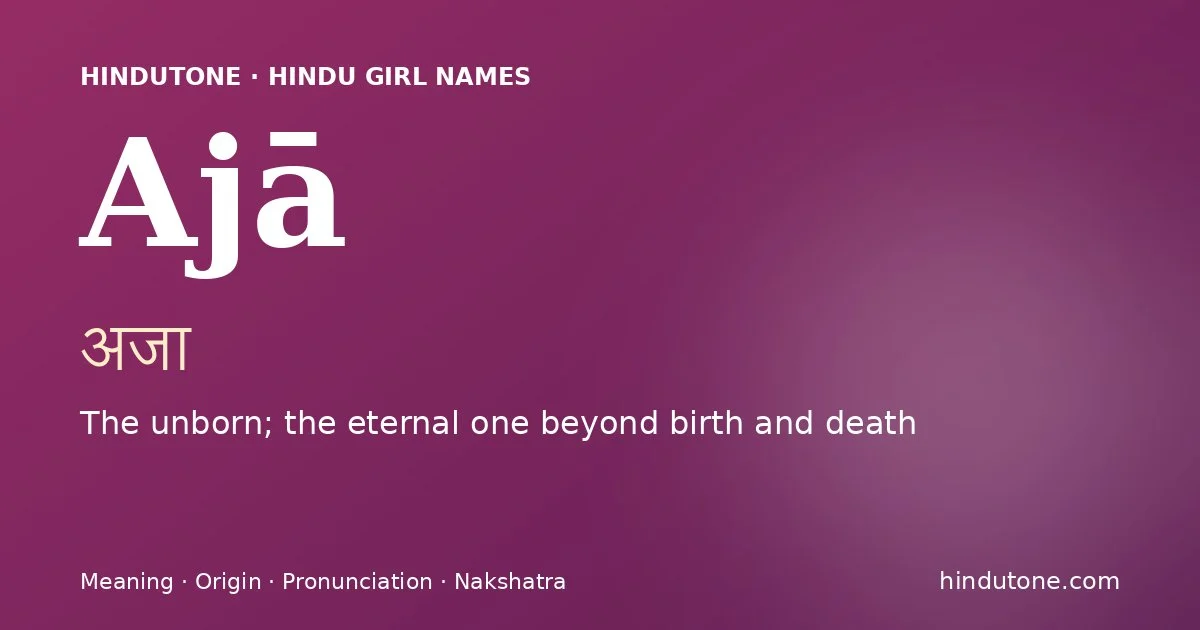
Ajā (अजा) is a Sanskrit-origin Hindu girl-name meaning “The unborn; the eternal one beyond birth and death”. Find pronunciation, origin, deity association, popularity and similar Hindu baby names.
Ajā (अजा, IAST: Ajā) is an Sanskrit-origin Hindu girl-name meaning “The unborn; the eternal one beyond birth and death”. From a- (not) and jan/jā (born, arising), Ajā declares that Lalitā is utterly uncreated and unborn — she precedes and encompasses every cycle of origination, standing as the eternal source from which all else arises.
Meaning, etymology & significance
The root jan means to be born or to come into being, and the feminine form jā carries this sense of arising. The prefix a- negates it entirely, producing a name of profound theological weight: the Goddess is not subject to the cycle of birth that governs all conditioned existence. She is Prakṛti in her primordial aspect — the eternal, unmanifest ground that was never born and will never cease.
Ajā appears as a name for both the Supreme Goddess and for primordial nature in the Upaniṣads and Purāṇas, making it one of the most philosophically resonant single-syllable names in the tradition. Pronounced ah-jaa, it is simple, elegant, and timelessly meaningful as a girl's name.
Scriptural source
Ajā appears in the Lalitha Sahasranama, among the sacred names of Lalitha.
Astrology — nakshatra, rashi & numerology
By the standard Vedic correspondence between a name’s first syllable and the lunar mansion, Ajā aligns with the Krittika nakshatra, under the Mesha rashi (Moon sign). Its Chaldean name-number is 2.
Ajā — Name Facts
- Meaning
- The unborn; the eternal one beyond birth and death
- Gender
- Hindu girl name
- Nakshatra
- Krittika
- Rashi
- Mesha (Aries)
- Numerology
- 3
Frequently asked questions
What does the name Ajā mean?
Ajā is a Sanskrit-origin Hindu girl name meaning “The unborn; the eternal one beyond birth and death”.
Is Ajā a boy or girl name?
Ajā is traditionally a Hindu girl name.
Which nakshatra and rashi suit the name Ajā?
By the first-syllable rule of Vedic naming, Ajā aligns with the Krittika nakshatra, under the Mesha (Aries) rashi.
What is the numerology number of Ajā?
The Chaldean name number of Ajā is 3.
Explore more: Krittika nakshatra names · Mesha rashi names · Hindu girl names with A · All Hindu names A–Z