Ksharakshara
Ksharakshara (क्षराक्षरात्मिका) is a Sanskrit-origin Hindu girl-name meaning “The self whose nature is both perishable and imperishable”. Find pronunciation, origin, deity association, popularity and similar Hindu baby names.
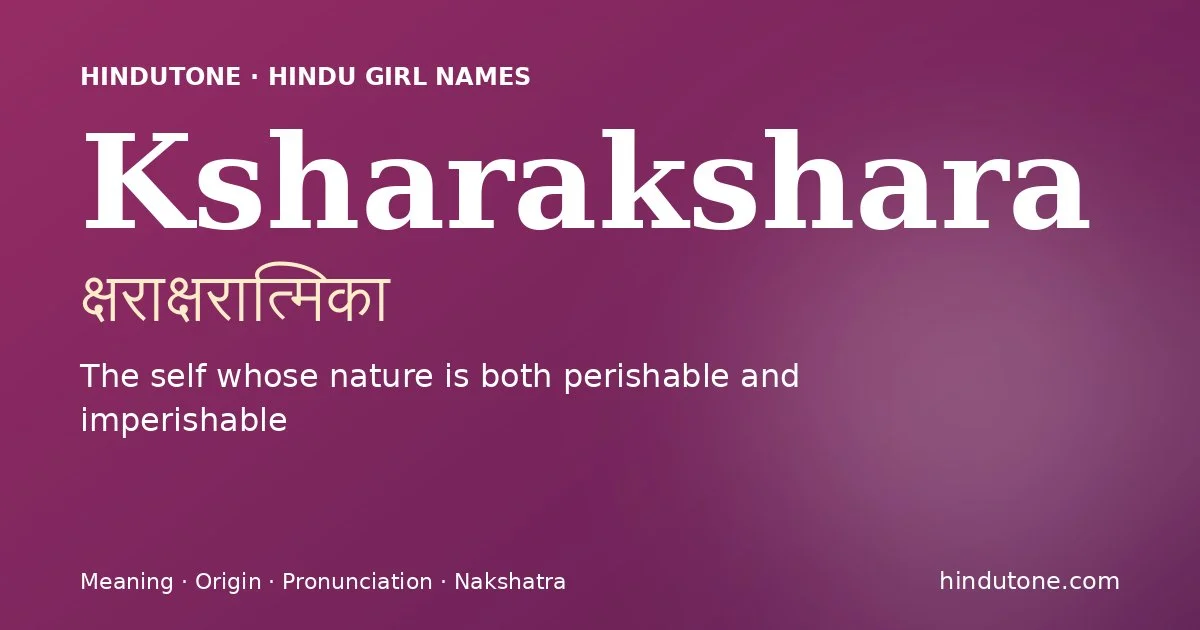
Ksharakshara (क्षराक्षरात्मिका) is a Sanskrit-origin Hindu girl-name meaning “The self whose nature is both perishable and imperishable”. Find pronunciation, origin, deity association, popularity and similar Hindu baby names.
Ksharakshara (क्षराक्षरात्मिका, IAST: Kṣarākṣarātmikā) is a Sanskrit-origin Hindu girl-name meaning “The self whose nature is both perishable and imperishable”. From kṣara (that which flows or perishes), akṣara (that which does not perish, the eternal syllable), and ātmikā (whose very self is), this name proclaims that Lalitā encompasses both the transient manifest world and the eternal unmanifest reality.
Meaning, etymology & significance
The Bhagavad Gītā distinguishes between the kṣara (perishable, the world of change) and the akṣara (imperishable, the unchanging ground of being), and Lalitā as Kṣarākṣarātmikā transcends both as their innermost self. She is not merely a resident within creation or beyond it; she is the very substance of both states simultaneously, which is the hallmark of supreme non-dual awareness. This epithet aligns with the Devī's identity as the Parābrahman itself.
This compound epithet of Lalitā reflects profound Upaniṣadic philosophy and is more meaningful in its meditative context than as a personal name. Pronounced ksha-raak-sha-RAAT-mi-kaa, the conjunct consonants require care.
Scriptural source
Ksharakshara appears in the Lalitha Sahasranama, among the sacred names of Lalitha.
Ksharakshara — Name Facts
- Meaning
- The self whose nature is both perishable and imperishable
- Gender
- Hindu girl name
- Nakshatra
- Mrigashira
- Rashi
- Mithuna (Gemini)
- Numerology
- 1
Frequently asked questions
What does the name Ksharakshara mean?
Ksharakshara is a Sanskrit-origin Hindu girl name meaning “The self whose nature is both perishable and imperishable”.
Is Ksharakshara a boy or girl name?
Ksharakshara is traditionally a Hindu girl name.
Which nakshatra and rashi suit the name Ksharakshara?
By the first-syllable rule of Vedic naming, Ksharakshara aligns with the Mrigashira nakshatra, under the Mithuna (Gemini) rashi.
What is the numerology number of Ksharakshara?
The Chaldean name number of Ksharakshara is 1.
Explore more: Mrigashira nakshatra names · Mithuna rashi names · Hindu girl names with K · All Hindu names A–Z