Mulakuutatrayakalevara
Mulakuutatrayakalevara (मूलकूटत्रयकलेवरा) is a Sanskrit-origin Hindu girl-name meaning “Whose body consists of the three root Kutas”. Find pronunciation, origin, deity association, popularity and similar Hindu baby names.
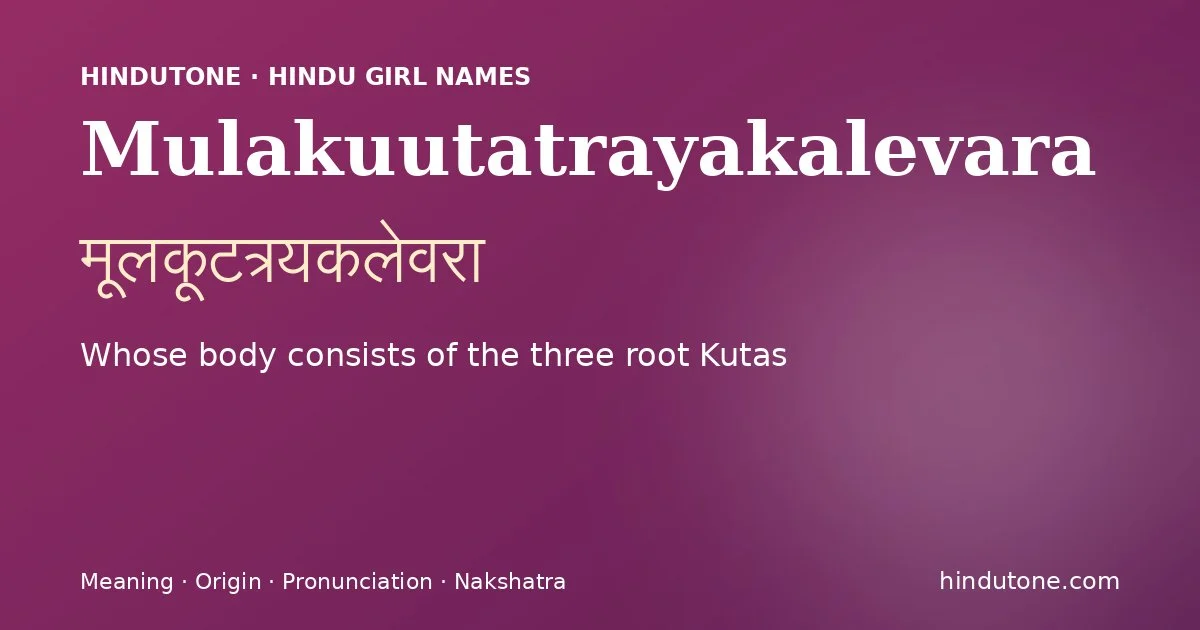
Mulakuutatrayakalevara (मूलकूटत्रयकलेवरा) is a Sanskrit-origin Hindu girl-name meaning “Whose body consists of the three root Kutas”. Find pronunciation, origin, deity association, popularity and similar Hindu baby names.
Mulakuutatrayakalevara (मूलकूटत्रयकलेवरा, IAST: Mūlakūṭatrayakalevarā) is a Sanskrit-origin Hindu girl-name meaning “Whose body consists of the three root Kutas”. She is Kalevarā — She whose physical body — is constituted by the three kūṭas (Vāgbhava, Kāmarāja, and Śakti) of the Mūlamantra, affirming that the sacred syllables of Śrī Vidyā are not merely sounds but are literally the flesh and form of the living Goddess.
Meaning, etymology & significance
Mūla means root or primal, kūṭa means peak or syllabic cluster, traya means the triad or three, and kalevara means body or physical form. Building upon the three preceding names (85–87), this name crystallizes the entire meditative doctrine: the Devī's body is the mantra-body, and the mantra-body is the Devī. This identity — known as mantra-devatā-abheda — is the cornerstone of Śrī Vidyā initiation.
This name is recited in Śrī Cakra pūjā during aṅga-nyāsa, the ritual of placing mantra-syllables on the body of the worshipper as an identification with the Devī's form. Kalevara is rarely used as a given name on its own; Trikuuta or simply Kūṭā are poetic alternatives.
Scriptural source
Mulakuutatrayakalevara appears in the Lalitha Sahasranama, among the sacred names of Lalitha.
Astrology — nakshatra, rashi & numerology
By the standard Vedic correspondence between a name’s first syllable and the lunar mansion, Mulakuutatrayakalevara aligns with the Magha nakshatra, under the Simha rashi (Moon sign). Its Chaldean name-number is 9.
Mulakuutatrayakalevara — Name Facts
- Meaning
- Whose body consists of the three root Kutas
- Gender
- Hindu girl name
- Nakshatra
- Magha
- Rashi
- Simha (Leo)
- Numerology
- 9
Frequently asked questions
What does the name Mulakuutatrayakalevara mean?
Mulakuutatrayakalevara is a Sanskrit-origin Hindu girl name meaning “Whose body consists of the three root Kutas”.
Is Mulakuutatrayakalevara a boy or girl name?
Mulakuutatrayakalevara is traditionally a Hindu girl name.
Which nakshatra and rashi suit the name Mulakuutatrayakalevara?
By the first-syllable rule of Vedic naming, Mulakuutatrayakalevara aligns with the Magha nakshatra, under the Simha (Leo) rashi.
What is the numerology number of Mulakuutatrayakalevara?
The Chaldean name number of Mulakuutatrayakalevara is 9.
Explore more: Magha nakshatra names · Simha rashi names · Hindu girl names with M · All Hindu names A–Z