
Chappan Bhog List — 56 Dishes for Govardhan Puja 2026
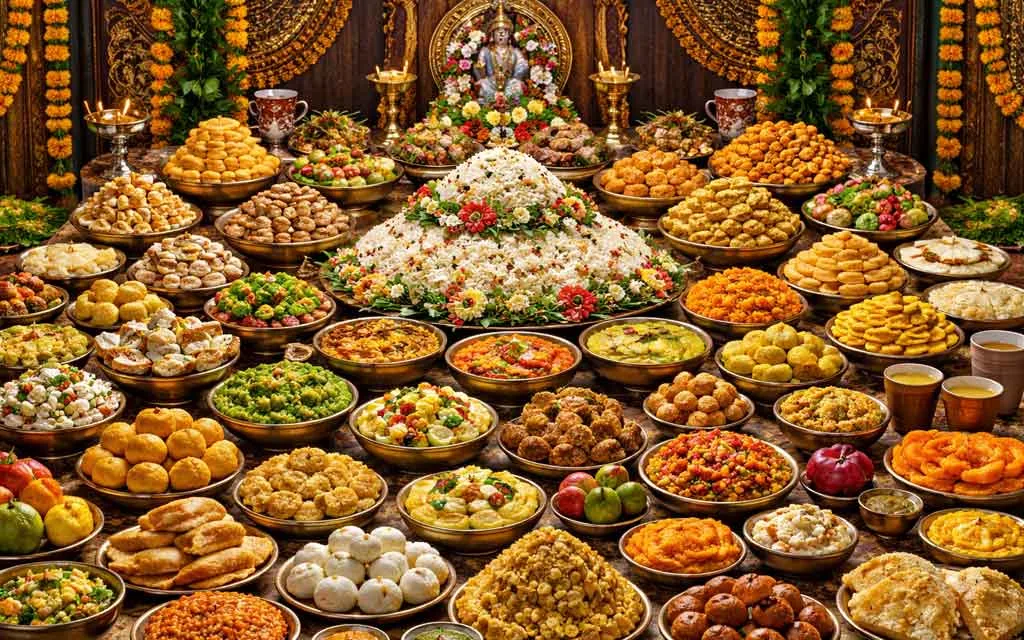
Introduction: The Divine Mountain of Food – Annakut and Chappan Bhog Govardhan Puja, also known as Annakut (mountain of food) or Annakoot, is a joyous…
Introduction: The Divine Mountain of Food – Annakut and Chappan Bhog Govardhan Puja, also known as Annakut (mountain of food) or Annakoot, is a joyous…
Introduction: The Divine Mountain of Food – Annakut and Chappan Bhog
Govardhan Puja, also known as Annakut (mountain of food) or Annakoot, is a joyous celebration dedicated to Lord Krishna. It falls on the first day of the Shukla Paksha (bright fortnight) in the Hindu month of Kartik, immediately after Diwali. In 2026, Govardhan Puja is celebrated on Tuesday, November 10, 2026 in India (Monday, November 9 in the USA, Canada and the UK, where the tithi falls a day earlier). Devotees perform puja to a small mound of cow dung or a Govardhan Parvat replica, offer prayers, and circumambulate it while singing devotional songs.
The highlight of the festival is Chappan Bhog (or Chhappan Bhog) — the offering of 56 different dishes to Lord Krishna. This elaborate feast, known as Annakut, symbolizes abundance, gratitude, and Krishna’s divine protection. The number 56 is deeply symbolic: Krishna is believed to have had eight meals a day. During the seven days he held up Govardhan Hill to shield the people of Vrindavan from Indra’s torrential rains, the villagers prepared 8 meals × 7 days = 56 dishes as an expression of thanks once the rains stopped.
Chappan Bhog includes a balanced mix of six rasas (tastes): sweet, sour, salty, bitter, pungent, and astringent. It features milk-based sweets, savory snacks, rice and dal preparations, vegetable sabzis, breads, chutneys, pickles, fruits, dry fruits, and drinks. The arrangement follows a traditional sequence: milk products closest to the deity, followed by besan items, salty foods, and others.
This comprehensive guide for www.hindutone.com provides a complete, practical Chappan Bhog list of 56 dishes, categorized for easy preparation. It draws from North Indian traditions (popular for Govardhan Puja) with notes on regional variations and adaptations suitable for Hindus in the USA, UK, Canada, and Australia. Whether preparing a full 56-item spread at a temple or a simplified home version, this list helps devotees offer with love and devotion.
The Story Behind Govardhan Puja and Chappan Bhog
According to the Bhagavata Purana, Lord Indra, angered when the people of Vrindavan stopped his worship under Krishna’s advice, sent heavy rains and storms to destroy the village. Young Krishna lifted the entire Govardhan Hill with his little finger, holding it like an umbrella for seven days and nights to protect humans, animals, and the land. When Indra realized Krishna’s divinity, he surrendered and the rains stopped.
In gratitude, the villagers prepared a grand feast with whatever they had — grains, vegetables, milk products, and sweets — piling it into a “mountain of food” (Annakut) for Krishna. This tradition continues today as a reminder of Krishna’s compassion, the importance of environmental respect (Govardhan represents nature), and the power of collective devotion and simple living.
Chappan Bhog is also offered on Janmashtami and other Krishna festivals. It teaches that true devotion includes sharing abundance and balancing all tastes and nutrients.
Significance of Offering 56 Dishes
- Gratitude: Thanking Krishna for protection and sustenance.
- Abundance: Symbolizing that divine grace multiplies resources.
- Community: In temples, families contribute different dishes, fostering unity.
- Health and Balance: Incorporating all six tastes and diverse ingredients for holistic well-being.
- Eco-Spiritual Message: Many use seasonal, local, and sattvik ingredients without onion/garlic.
For diaspora communities, Annakut strengthens cultural bonds. Temples in New Jersey (USA), Leicester (UK), Toronto (Canada), or Sydney (Australia) organize large-scale Chappan Bhog displays, often with hundreds participating. Home celebrations adapt by preparing 10–20 key items or grouping similar dishes creatively.
Complete Categorized List of 56 Dishes for Chappan Bhog
Here is a practical, traditional-inspired list of 56 dishes. Variations exist across regions (North Indian, Gujarati, Odia, etc.), but this compilation balances sweets, savories, staples, and accompaniments. Many items can be prepared sattvik (no onion/garlic). Quantities are symbolic — even small portions suffice for bhog.
Milk Products & Basics (Near the Deity)
- Makhan Mishri (Fresh butter with rock sugar)
- Dahi (Plain yogurt/curd)
- Ghee (Clarified butter)
- Malai (Fresh cream)
- Shrikhand (Sweetened strained yogurt)
- Mathha / Chaas (Spiced buttermilk)
- Lassi (Sweet or salted yogurt drink)
- Paneer (Fresh cottage cheese, plain or lightly seasoned)
Sweets & Desserts (Mithai) – 20+ Items
- Kheer (Rice pudding with saffron and nuts)
- Rabri (Thickened sweetened milk)
- Rasgulla (Spongy cheese balls in syrup)
- Gulab Jamun (Fried milk solids in rose syrup)
- Malpua (Sweet fried pancakes)
- Jalebi (Crispy spiral sweets in syrup)
- Moong Dal Halwa
- Sooji Halwa (or Mohanbhog)
- Besan Ladoo
- Boondi Ladoo
- Rava Ladoo
- Peda (Milk fudge)
- Kalakand
- Sandesh
- Barfi (Coconut, Kesar, or Badam)
- Ghewar
- Shakkarpara (Sweet version)
- Murabba (Fruit preserve, e.g., Aam or Gajar)
- Coconut Burfi / Nadia Kora
- Milk Cake
Savories & Snacks (Namkeen)
- Poori (Puffed fried bread)
- Kachori (Stuffed savory pastries)
- Mathri / Matthi (Crispy savory crackers)
- Papad (Roasted or fried)
- Pakode / Pakora (Vegetable fritters – potato, spinach, etc.)
- Samosa (Vegetable or paneer)
- Namakpara
- Sev or Bhujia
- Dhokla (Steamed gram flour cakes)
- Chila / Cheela (Gram flour pancakes)
- Khichdi (Moong dal or mixed)
Rice & Grain Preparations
- Plain Steamed Rice / Chawal
- Peas Pulao
- Curd Rice
- Lemon Rice or Tamarind Rice
- Sweet Saffron Rice / Kanika
Dal & Curries
- Plain Dal (Moong, Arhar, or Urad)
- Kadhi (Gram flour and yogurt curry)
- Panchmel Dal or Mixed Dal
- Dal Baati (or Dal with Baati, symbolic)
Vegetable Sabzis (Seasonal & Mixed)
- Annakut Sabzi / Mix Veg (Brinjal, potato, peas, beans, tinda, lauki, etc.)
- Aloo Jeera / Jeera Aloo
- Saag (Spinach or mixed greens)
- Brinjal Bharta or Sabzi
- Lauki (Bottle gourd) Sabzi
- Bhindi (Okra) or other seasonal vegetable
Accompaniments, Fruits & Others
- Chutney (Coriander, Mint, or Coconut)
- Fresh Fruits (Banana, Apple, Orange, Pomegranate, etc.) + Dry Fruits (Almonds, Cashews, Raisins) + Honey + Pickle
Note: This reaches exactly 56 with common inclusions. Some lists expand by adding varieties (e.g., different pakoras as separate items, multiple halwas, or specific regional dishes like Dhaniya Panjeeri, Modak, or Rasabali). In practice, devotees often prepare core items and count variations creatively (e.g., different flavored laddoos or sabzis).
Traditional Arrangement Tips
- Place milk products (makhan, dahi, ghee, malai) closest to Krishna’s idol or Govardhan mound.
- Follow with sweets, then savories, rice/dal, sabzis, and accompaniments.
- Decorate the Annakut as a “mountain” with fruits and flowers at the base.
- Offer with bhajans like “Govardhan Ki Pooja” or “Yashomati Maiya Se Bole Nandlala”.
Practical Preparation Guide for 2026
- Sattvik Rules: Use fresh, seasonal ingredients. Avoid onion, garlic, and excessive spices. Many items can be made with ghee and milk products.
- Batch Cooking: Prepare staples like poori, halwa, and sabzi in advance. Sweets like laddoos and barfi store well.
- Time-Saving Tips: Use pressure cookers for khichdi and dal; instant mixes for some snacks (with devotion).
- Quantity: Even small bowls of each item are sufficient. Focus on variety and love rather than volume.
- Eco-Friendly: Use banana leaves or reusable plates for serving. Opt for biodegradable decorations.
Adaptations for Hindus in USA, UK, Canada, and Australia
In the diaspora, full 56-item Chappan Bhog is often a community effort at temples (e.g., ISKCON or BAPS centers in New York, London, Toronto, or Melbourne). Families contribute 2–5 dishes each.
- Sourcing Ingredients: Indian grocery stores (Patel Brothers in USA, Tesco Asian sections in UK, or similar in Canada/Australia) stock most items. Use local substitutes for seasonal vegetables (e.g., zucchini for lauki).
- Time Zone & Work-Life: Prepare over the weekend before Govardhan Puja (Mon 9 Nov in North America and Europe; Tue 10 Nov in India and Australia). Many temples hold evening events for working professionals.
- Simplified Home Version: Choose 16–28 items (e.g., makhan mishri, kheer, poori-sabzi, halwa, fruits) and count variations. Virtual Annakut sharing via video calls connects with family in India.
- Vegan Options: Increasingly popular — use plant-based milk/yogurt for kheer, rabri, and dahi. Many temples now offer vegan bhog sections.
- Children’s Involvement: Let kids help with simple tasks like shaping laddoos or arranging fruits. Teach the Govardhan story through storytelling or coloring.
- Community Events: Check local temple websites for 2026 schedules. Large displays often feature live music, Rasa Lila performances, and prasad distribution.
- Health Note: Balance rich sweets with lighter items. Offer mindfully and distribute prasad generously.
Additional Tips for a Meaningful Celebration
- Govardhan Parvat: Make a small mound with cow dung (or clay/model) and worship with flowers, tulsi, and circumambulation (parikrama).
- Charity: Donate food or funds to shelters, embodying Krishna’s care for all beings.
- Mantras: Chant “Om Namo Bhagavate Vasudevaya” or Govardhan-specific stotras while offering bhog.
- Visarjan/Conclusion: After puja, distribute prasad to family, neighbors, and the needy.
Conclusion: Offering Abundance with Devotion
On Govardhan Puja 2026 (November 10 in India; November 9 in North America and the UK), as devotees pile delicacies into the Annakut, remember Krishna’s message: sincere love and gratitude please the Lord more than elaborate rituals. Whether a grand 56-dish spread in a temple hall in Toronto or a humble home offering in Sydney, Chappan Bhog nourishes the soul and strengthens community bonds.
May Lord Krishna bless you with protection, prosperity, and joy. Jai Shri Krishna! Jai Govardhan!
This guide serves as a complete resource for www.hindutone.com. Recipes for individual dishes can be found in traditional cookbooks or online sattvik sources. Adapt the list according to regional customs and personal capacity while maintaining the spirit of devotion. Always prepare with clean hands, pure intention, and love.
Shubh Govardhan Puja 2026!
Share the Diwali 2026 blessing
When young Krishna lifted Govardhan Hill to shelter Vrindavan, the grateful villagers answered with a mountain of food, as commonly told. As we prepare the Chappan Bhog this Annakut, may each dish be an offering of love, and may the diya beside it awaken the inner light of gratitude. May Maa Lakshmi's grace fill our kitchens and homes, as light overcomes darkness. Share one of these blessings with your family as you arrange the bhog.
Deepa shloka: the lamp prayer
शुभं करोति कल्याणम् आरोग्यं धनसम्पदा। शत्रुबुद्धिविनाशाय दीपज्योतिर्नमोऽस्तु ते॥
Shubham karoti kalyanam arogyam dhana-sampada, shatru-buddhi-vinashaya deepa-jyotir namostu te.
Meaning: I bow to the light of the lamp, which brings what is auspicious and good, health and prosperity, and destroys ill-will. Many families recite it as they light the evening diya.
Lakshmi mantra for Diwali
ॐ श्रीं महालक्ष्म्यै नमः॥
Om Shreem Mahalakshmyai Namah.
Meaning: Salutations to Mahalakshmi. Shreem is the seed syllable traditionally associated with Lakshmi.
Diwali 2026 messages to share
🪔 Happy Govardhan Puja to our dear family! May the Annakut we offer together fill our home with gratitude, harmony and Lord Krishna's loving protection. 🙏 Share on WhatsApp
🙏 Dear Maa and Papa, every dish of our Chappan Bhog carries the love you taught us. May Lord Krishna bless you with health and peace this Annakut. 🪔 Share on WhatsApp
✨ Happy Annakut, dear friends! May your plates be full, your hearts be grateful and your homes be sheltered by Govardhandhari's grace. 🌸🪔 Share on WhatsApp
🪔 Warm Govardhan Puja wishes to our colleagues and clients. May this festival of gratitude bring good health, honest success and friendship that lasts. ✨ Share on WhatsApp
🌸 May Maa Lakshmi bless every kitchen that prepares bhog with love, keeping it full of grace, nourishment and the joy of sharing with others. 🙏🪔 Share on WhatsApp
🙏 As Ayodhya glowed to welcome Lord Rama home, may Diwali 2026 and Govardhan Puja light your home with peace, and may Lord Ganesha bless every step. 🪔✨ Share on WhatsApp
A short Diwali prayer
Maa Lakshmi and Lord Ganesha, on this day of Govardhan Puja I offer this simple bhog with a grateful heart. Thank you for the food on our table and the hands that prepared it. Bless my family with good health and our home with harmony. Teach me to share what I have, to respect the earth that feeds us, and to work with honesty and right effort. Let your light shelter us always.
Use the share buttons on this page to send these blessings to your family and friends.
Frequently Asked Questions
What is the Chappan Bhog List?
Introduction: The Divine Mountain of Food – Annakut and Chappan Bhog Govardhan Puja , also known as Annakut (mountain of food) or Annakoot , is a joyous celebration dedicated to Lord Krishna . It falls on the first day of the Shukla Paksha (bright fortnight) in the Hindu month of Kartik, immediately after Diwali .
How many times should the Chappan Bhog List be chanted?
It is traditionally chanted 108 times using a rudraksha or tulsi mala. Even 11 or 21 sincere repetitions daily are considered beneficial — steady, focused practice matters more than the count.
What is the best time to chant the Chappan Bhog List?
Dawn (Brahma Muhurta) after a bath is considered ideal, though it may be chanted any time with a calm, focused mind. Many devotees keep a fixed daily time to build consistency.
Who can chant the Chappan Bhog List?
Anyone may chant it with faith and a pure mind, regardless of age, gender or background. Beginners benefit from first hearing the correct pronunciation and understanding its meaning.
What are the benefits of chanting the Chappan Bhog List?
It is believed to calm the mind, dissolve negativity, and draw divine grace, protection and clarity to the devotee.
You might also like
Powerful Mantras for Students & Parents Before Joining School
Powerful Hindu Mantras for Purushottam Maas 2026: Vishnu Bhakti, Chanting Guide & Global Devotion

Sacred Hindu Festivals & Temple News: Divine Week — May 2026
