




Why Tulasi Vivaham is Celebrated – Date & Rituals 2025
Tulasi Vivaham 2025 Date
Primary Date: Sunday, November 2, 2025
- Dwadashi Tithi Begins: 07:31 AM on November 2, 2025
- Dwadashi Tithi Ends: 05:07 AM on November 3, 2025
Alternative Date: November 13, 2025 (Prabodhini Ekadashi)
The date varies by region and tradition. Some communities celebrate on Prabodhini Ekadashi (the 11th lunar day), while others observe it on Dwadashi (the 12th lunar day) of Kartik Shukla Paksha. Please consult your local panchang for the exact muhurat in your area.
What is Tulasi Vivaham?
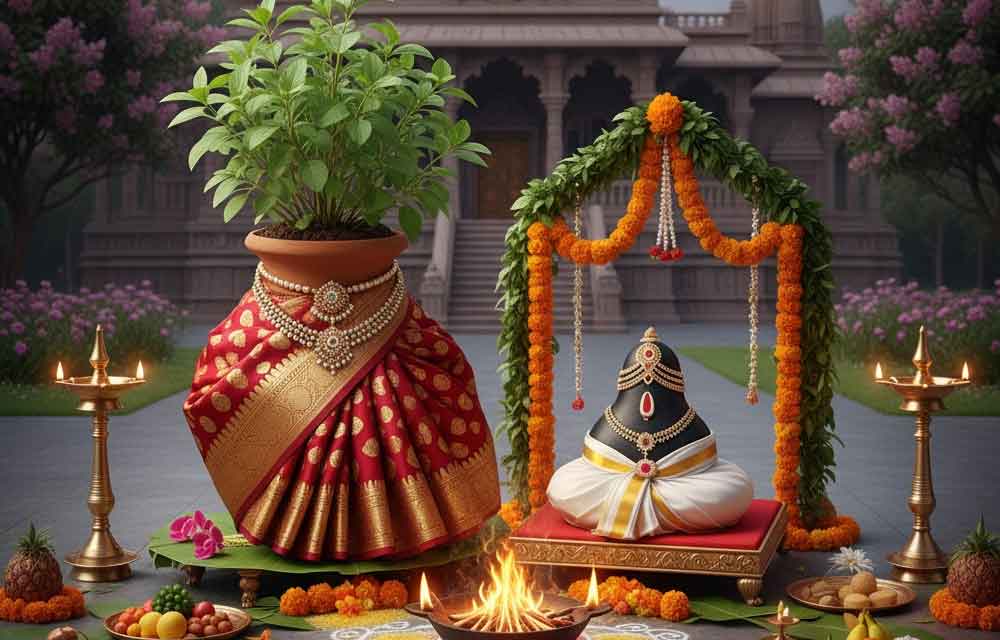
Tulasi Vivaham, also known as Tulsi Vivah, is one of the most sacred Hindu festivals that marks the ceremonial marriage of the Holy Basil plant (Tulasi) to Lord Vishnu or his avatar, Shaligram. This divine wedding ceremony is performed with complete traditional Hindu wedding rituals and holds immense spiritual significance across India, particularly in Vaishnava households.
The festival falls in the auspicious month of Kartik and marks the end of Chaturmas, a four-month period considered inauspicious for marriages and auspicious ceremonies. After Tulasi Vivaham, the Hindu wedding season officially begins.
The Sacred Story of Tulasi Vivaham
The Legend of Vrinda and Jalandhara
The most popular legend associated with Tulasi Vivaham is the divine tale of Vrinda (Tulsi) and the demon king Jalandhara, as described in the Padma Purana and other sacred texts.
In ancient times, there lived a powerful demon king named Jalandhara who had become invincible and unconquerable, even by the gods. The secret of his extraordinary power lay in the unwavering chastity and devotion of his wife, Vrinda. She was the epitome of pativrata dharma (devotion to one’s husband), and her purity created an impenetrable shield of protection around Jalandhara.
As Jalandhara’s tyranny grew unbearable and threatened the balance of creation, the gods approached Lord Vishnu for help. They realized that as long as Vrinda remained devoted to Jalandhara, he could not be defeated.
To protect the universe and end Jalandhara’s reign of terror, Lord Vishnu took on the form of Jalandhara and approached Vrinda while the real Jalandhara was away in battle. In this disguise, he broke her chastity, which immediately weakened Jalandhara’s protective shield, allowing the gods to defeat him.
When Vrinda discovered the deception, she was heartbroken and filled with righteous anger. In her grief and fury, she cursed Lord Vishnu to turn into a stone (Shaligram). However, moved by her unparalleled devotion, purity, and the injustice done to her, Lord Vishnu blessed Vrinda with a divine boon.
He declared that she would be worshipped throughout the world as the sacred Tulasi plant, considered a manifestation of Goddess Lakshmi. Furthermore, Lord Vishnu promised to marry her every year on Kartik Ekadashi, thus honoring her devotion for eternity. This is why Tulasi is worshipped alongside Shaligram (the stone form of Vishnu), and their annual marriage is celebrated as Tulasi Vivaham.
The Spiritual Symbolism
This story teaches profound spiritual lessons:
- Unwavering devotion is always recognized and rewarded by the Divine
- The union represents the soul’s eternal connection with the Supreme
- Purity and faith transform tragedy into divine blessing
- The marriage symbolizes the sacred union between nature and divinity
Spiritual Significance of Tulasi Vivaham
Religious Importance
- End of Chaturmas: The festival marks the awakening of Lord Vishnu from his cosmic sleep (Yoga Nidra) that lasts during the four months of Chaturmas (Ashadha to Kartik).
- Beginning of Wedding Season: After Tulasi Vivaham, it becomes auspicious to perform marriages and other sacred ceremonies that were suspended during Chaturmas.
- Kanya Daan Merit: Performing or witnessing Tulasi Vivaham is considered equivalent to performing kanya daan (giving away a daughter in marriage), which grants immense spiritual merit (punya).
- Household Prosperity: The ceremony invites divine blessings of prosperity, harmony, health, and spiritual growth into the home.
- Nature Worship: It represents the beautiful synthesis of nature worship and devotional practice in Hinduism, where a plant is revered as a divine manifestation.
Benefits of Celebrating Tulasi Vivaham
- Removal of obstacles and sins
- Blessing of a happy married life
- Prosperity and abundance in the household
- Protection from negative energies
- Spiritual elevation and divine grace
- Health benefits from the sacred Tulasi plant
Complete Tulasi Vivaham Rituals & Puja Vidhi
Pre-Puja Preparations
1. Cleaning and Decoration:
- Clean the area around the Tulasi plant thoroughly
- Create beautiful rangoli designs around the base
- Decorate the worship area with flowers, mango leaves, and festive lights
2. Setting Up the Mandap:
- Use four sugarcanes or banana shoots to create a square mandap (wedding canopy)
- Tie them together at the top with sacred thread
- Decorate with flowers, garlands, and mango leaves
- Hang a cloth canopy if possible
3. Arranging the Chowkis (Platforms):
- Place two low wooden platforms (chowkis) side by side under the mandap
- Cover the right chowki with a red cloth
- Cover the left chowki with a yellow or white cloth
- Place the Tulasi plant (bride) on the right chowki
- Place the Shaligram stone or idol of Lord Vishnu/Krishna on the left chowki
Puja Items Required (Samagri)
For the Bride (Tulasi):
- Red or yellow saree for draping
- Turmeric (haldi) and kumkum (sindoor)
- Jewelry (small bangles, necklace, nose ring)
- Small blouse piece
- Haldi-kumkum for tilak
- Fresh flowers and garlands
For the Groom (Vishnu/Shaligram):
- Yellow or white dhoti
- Sacred thread (janeu)
- Sandalwood paste
- Fresh flowers and garlands
- Tulasi leaves
General Puja Items:
- Kalash (water pot) with water, betel nut, coins, and mango leaves
- Coconut for kalash
- Incense sticks (agarbatti) and dhoop
- Camphor (kapoor)
- Ghee lamps (diyas)
- Betel leaves and nuts (paan-supari)
- Fruits and sweets for bhog
- Sacred thread (moli/kalava)
- Rice grains (akshat)
- Panchamrit (mixture of milk, curd, honey, ghee, and sugar)
- Sacred water (Ganga jal if available)
- Small container of sindoor
- Small mirror
- Flowers: roses, marigolds, jasmine
- Sugarcane pieces (small)
Step-by-Step Puja Vidhi
1. Purification (7:00 AM – Morning)
- Take a bath early in the morning
- Wear clean, preferably new clothes
- Clean the puja area and light incense
2. Kalash Sthapana (Morning)
- Fill the kalash with water, place betel nut, coins, and mango leaves
- Place coconut on top
- Install it near the mandap
3. Ganesh Puja (Morning)
- Begin by invoking Lord Ganesha
- Chant: “Om Gan Ganapataye Namah” (108 times)
- Offer flowers, sweets, and prayers for obstacle-free ceremony
4. Dressing the Bride and Groom (Afternoon)
- Lovingly drape the Tulasi plant with a red or yellow saree
- Adorn with jewelry, flowers, and garland
- Apply turmeric and kumkum as tilak
- Dress the Shaligram/Vishnu idol with dhoti and sacred thread
- Apply sandalwood paste and offer flowers
5. Invocation and Sankalp (Evening – Sunset Time)
- Light the ghee lamps
- Sprinkle holy water around the area
- Take sankalp (sacred resolution) by holding rice and flowers:
Sankalp Mantra:
Om Vishnu Vishnu Vishnu
Adya Shri Bhagavato Mahapurushasya Vishnor Aagnya Praptaye
Shri Tulasi Vivaham Karishye
(I am performing this Tulasi marriage to please Lord Vishnu)
6. Main Wedding Ceremony
a) Ganesh Sthapana:
- Invoke Lord Ganesha at the mandap
- Offer prayers for a blessed ceremony
b) Matruka Pujan:
- Invoke and worship the divine mothers
c) Kalash Pujan:
- Worship the kalash representing cosmic waters
d) Navagraha Pujan:
- Offer prayers to the nine planets
- Chant: “Om Navagraha Devataabhyo Namah”
e) Tulasi Pujan:
- Offer flowers, turmeric, kumkum to Tulasi Mata
- Chant Tulasi mantras (see mantra section below)
f) Vishnu Pujan:
- Worship the Shaligram/Vishnu idol
- Chant Vishnu mantras and offer Tulasi leaves
g) Kanyadaan (Giving Away the Bride):
- The head of the family symbolically gives away Tulasi to Lord Vishnu
- Pour water from the right palm while chanting:
Kanyadaan Mantra:
Om Tulasi Devi Pratigrhana Vishnu-prityartham
Karishye Swaha
h) Hasta Milap (Joining of Hands):
- Tie the sacred thread (moli) connecting Tulasi plant to Shaligram/Vishnu idol
- This represents the binding of the couple
i) Mangal Sutra Dharanam:
- If culturally appropriate, place a small mangalsutra around the Tulasi plant
j) Sindoor Daan:
- Apply sindoor in the parting of the Tulasi (symbolic)
k) Saptapadi (Seven Sacred Steps):
- Circle the mandap seven times while chanting wedding mantras
- Light a ghee lamp and carry it around
7. Havan/Agni Puja (Optional but Recommended)
- Light the sacred fire
- Offer ghee, grains, and herbs
- Chant Vivah Sukta from Rigveda
8. Aarti
- Perform aarti of both Tulasi and Vishnu together
- Sing Tulasi Aarti (see aarti section below)
- Ring bells and play conch
9. Pushpanjali (Flower Offering)
- All family members offer flowers while chanting mantras
10. Prasad Distribution
- Offer bhog of sweets, fruits, and specially prepared dishes
- Distribute prasad to all present
11. Pradakshina (Circumambulation)
- Take seven rounds around the Tulasi plant
- Each round represents a sacred vow
12. Conclusion
- Seek blessings by touching feet of elders
- Sprinkle holy water on all present
- Share the divine blessings with neighbors and community
Sacred Mantras for Tulasi Vivaham
Tulasi Dhyana Mantra
Om Yaa Devii Sarvbhuteshu Tulasi Rupen Sansthitaa
Namastasyei Namastasyei Namastasyei Namo Namah
(Salutations to the goddess who resides in all beings in the form of Tulasi)
Tulasi Ashtottara Shatanamavali (108 Names – Selected)
1. Om Shri Tulasyai Namah
2. Om Nandinyai Namah
3. Om Devyai Namah
4. Om Surasarchitaayai Namah
5. Om Narayani Namah
6. Om Vishnu Priyaayai Namah
7. Om Bilvake Namah
8. Om Kalyani Namah
9. Om Shri Vishnu Vallabhaayai Namah
10. Om Shyaamaayai Namah
...
107. Om Shri Krishnakantaayai Namah
108. Om Shri Tulasyai Namah
During Wedding Ceremony
Vivah Sankalp Mantra:
Om Namo Bhagavate Vaasudevaaya
Tulasi Kalyanam Sampoornam Kuru
Hasta Milap Mantra:
Om Mangalam Bhagwan Vishnu
Mangalam Garuda Dhvajah
Mangalam Pundarikakshah
Mangalayatano Harih
Pradakshina Mantra:
Yani Kani Cha Papaani Janmaantara Kritaani Cha
Taani Taani Vinashyanti Pradakshina Pade Pade
(With each circumambulation, sins of many lifetimes are destroyed)
Tulasi Mata Aarti
Traditional Tulasi Aarti (Hindi/Sanskrit)
Jaya Jaya Tulasi Mata, Sabaki Sukhadata Vara Mata
Saba Yogon Ke Upara, Saba Rogon Ke Upara,
Ruja Se Raksha Karake Bhava Trata
Jaya Jaya Tulasi Mata

Tulasi Mata Hari Priya, Hariko Tum Pe Preet
Hari Ki Tum Charanon Ki, Hari Kare Tum Beet
Tulasi Mata Jaya Jaya, Sabaki Sukhadata Vara Mata

Dhanya Dhanya Shri Tulasi Mata
Mahima Agama Sada Shruti Gata
Hari Ke Pranahu Se Tuma Pyari
Harihin Hetu Kinho Tapa Bhari

Jaya Jaya Tulasi Mata, Sabaki Sukhadata Vara Mata
Meaning:
Glory to Mother Tulasi, the giver of happiness to all. You are above all yogas and protect us from all diseases. You are beloved of Lord Hari (Vishnu). Your glory is described in the Vedas. You are dearer to Hari than His own life force.
Types of Tulasi Plants
Understanding the different varieties of Tulasi adds depth to the worship:
1. Rama Tulasi (Shri Tulasi/Lakshmi Tulasi)
- Appearance: Green leaves, lighter stems
- Scientific Name: Ocimum tenuiflorum
- Significance: Associated with Lord Rama and Goddess Lakshmi
- Properties: Sweet aroma, gentler medicinal properties
2. Krishna Tulasi (Shyama Tulasi)
- Appearance: Purple or dark green leaves, darker stems
- Scientific Name: Ocimum sanctum
- Significance: Associated with Lord Krishna
- Properties: Stronger aroma, more potent medicinal qualities
3. Vana Tulasi (Wild Tulasi)
- Appearance: Found in wild, untamed habitats
- Significance: Represents raw, natural divine energy
- Properties: Powerful medicinal qualities
4. Kapoor Tulasi
- Appearance: Heavy flowers, camphor-like scent
- Significance: Abundant blossoms symbolize prosperity
- Properties: Strong aromatic leaves
Traditional Foods for Tulasi Vivaham Bhog
Prasad Offerings:
- Panchamrit: Mixture of milk, curd, honey, ghee, and sugar
- Kheer: Sweet rice pudding made with milk and sugar
- Ladoos: Sweet balls made from gram flour or semolina
- Fresh Fruits: Bananas, pomegranates, coconuts
- Chana: Chickpeas offered to Tulasi
- Sweet Pongal: South Indian sweet made from rice and jaggery
- Betel Leaves and Nuts: Traditional offering
- Sugar Candy: Pure and sweet offering
Special Wedding Feast Items:
- Puris (fried bread)
- Various vegetable curries
- Rice with ghee
- Dal (lentil preparation)
- Papad (thin crispy wafers)
- Pickles and chutneys
- Multiple sweet dishes
Regional Variations in Celebration
North India:
- Elaborate mandap decorations
- Community celebrations in temples
- Emphasis on the wedding ceremony aspects
- Distribution of prasad to entire neighborhood
South India:
- Family-centered celebrations
- Traditional kolam (rangoli) designs
- Offering of pongal as prasad
- Recitation of Tamil or Telugu hymns
Maharashtra:
- Special emphasis on Kartik month observances
- Lighting of lamps around Tulasi
- Community singing of bhajans
- Distribution of shakar pongal (sweet)
Gujarat:
- Integration with Kartik celebrations
- Elaborate decoration of Tulasi vrindavan
- Group aarti in housing societies
- Special sweets like mohanthal
Important Do’s and Don’ts
Do’s:
✓ Perform the ceremony with pure devotion and sincerity ✓ Maintain cleanliness around the Tulasi plant ✓ Include all family members, especially children ✓ Offer fresh flowers and clean water ✓ Chant mantras with proper pronunciation if possible ✓ Share prasad with neighbors and community ✓ Document the ceremony for family memories ✓ Keep the Tulasi plant healthy year-round ✓ Water the Tulasi after ceremony ✓ Light a lamp near Tulasi for at least 11 days after marriage
Don’ts:
✗ Don’t perform the ceremony with impure thoughts ✗ Don’t use artificial flowers if fresh ones are available ✗ Don’t neglect the Tulasi plant after the ceremony ✗ Don’t consume non-vegetarian food on this day ✗ Avoid plucking Tulasi leaves on the wedding day ✗ Don’t argue or use harsh words during the ceremony ✗ Avoid performing the ceremony during inauspicious muhurat ✗ Don’t forget to invite Lord Ganesha first
Scientific and Medicinal Importance of Tulasi
Beyond its spiritual significance, Tulasi (Holy Basil) is recognized for numerous health benefits:
Medicinal Properties:
- Immunity Booster: Rich in antioxidants
- Respiratory Health: Helps in cough, cold, and asthma
- Stress Relief: Adaptogenic properties reduce stress
- Anti-inflammatory: Reduces inflammation in the body
- Antimicrobial: Fights bacteria and viruses
- Blood Purifier: Cleanses blood and improves circulation
- Digestive Aid: Helps in digestion and metabolism
- Skin Health: External application benefits skin
Daily Consumption:
- Tulasi tea for immunity
- Chewing fresh leaves (2-3) on empty stomach
- Tulasi kadha (decoction) during cold season
- Tulasi seeds in beverages
Modern Adaptations
For Apartment Living:
- Use decorative pots for Tulasi plant
- Create mini mandaps using bamboo sticks
- Invite neighbors for community celebration
- Live stream the ceremony for distant family
Eco-Friendly Celebrations:
- Use biodegradable decorations
- Natural dyes for rangoli
- Minimize plastic usage
- Compost flower offerings
During Travels:
- If away from home, perform mental worship
- Visit a temple for darshan
- Offer prayers virtually
- Plan the main ceremony upon return
Connecting with Divine Through Tulasi Vivaham
Tulasi Vivaham is more than a ritual—it’s a spiritual practice that connects us with:
- Nature: Recognizing divinity in plants and environment
- Tradition: Continuing ancient wisdom and practices
- Family: Bonding through shared spiritual activities
- Devotion: Deepening our relationship with the Divine
- Values: Teaching children about faith and culture
The ceremony reminds us that the Divine permeates all creation, and that true devotion transcends form to recognize the eternal spiritual reality. As we celebrate the marriage of Tulasi and Vishnu, we celebrate the eternal union of the individual soul (Jivatma) with the Supreme Soul (Paramatma).
Conclusion
Tulasi Vivaham 2025 offers a beautiful opportunity to connect with ancient spiritual traditions while invoking divine blessings for your home and family. Whether you perform an elaborate ceremony or a simple worship at home, the key lies in the purity of intention and devotional spirit.
This sacred ceremony embodies the essence of devotion, nature worship, and spiritual union. By celebrating Tulasi Vivaham with sincerity, you invite prosperity, harmony, and divine grace into your life.
Mark your calendars for November 2, 2025 (or November 13, 2025 based on your regional tradition), and prepare to witness or participate in this divine wedding that has been celebrated for millennia.
May Tulasi Mata and Lord Vishnu bless you and your family with health, happiness, prosperity, and spiritual growth.
Jai Tulasi Mata Ki Jai! Jai Shri Vishnu!
For more authentic information on Hindu festivals, rituals, and spiritual practices, visit www.hindutone.com – Your trusted source for dharmic wisdom.
Quick Reference Guide
Date: November 2, 2025 (Dwadashi) or November 13, 2025 (Ekadashi) Time: Evening after sunset (most auspicious) Duration: 2-3 hours for complete ceremony Fasting: Optional, but recommended Dress: Traditional attire, preferably new clothes Can be performed: At home, by any family member Priest needed: Not mandatory, but beneficial for proper mantras
Share this article with family and friends to spread awareness about this beautiful tradition. Happy Tulasi Vivaham 2025!






 ︎
︎

