

Somnath Temple
Shiva temple · Prabhas Patan (Somnath), near Veraval, Gir Somnath, Gujarat, India
Somnath Temple is a shrine to Shiva at Prabhas Patan, near Veraval, on the Arabian Sea coast of Gir Somnath district, Gujarat. Shiva is worshipped here as Somnath, 'Lord of the Moon'. The opening verse of the traditional Dwadasha Jyotirlinga Stotram names Somnath first, and Shree Somnath Trust, which manages the temple, calls it the first of the twelve Aadi Jyotirlingas.
The temple is equally known for its history. Raiders sacked it several times, it was rebuilt again and again, and the present temple was consecrated on 11 May 1951 after a reconstruction effort led by Sardar Vallabhbhai Patel.
Faith & Tradition
Religious Significance of Somnath Temple
According to the Puranic tradition the Trust repeats, Chandra, the Moon god, was cursed by his father-in-law Daksha Prajapati to lose his light. He was freed from the curse by worshipping Shiva at this tirtha, and the shrine takes its name from him (Soma). Devotees link the moon's waxing and waning to this story, and the Kartik Purnima observance here centres on the moon.
Prabhas Patan is also associated with the last days of Krishna. Nearby sites such as Bhalka Tirth and the Triveni Sangam ghat are visited together with Somnath. For many Indians the 1951 rebuilding also carries national meaning as a symbol of cultural renewal after Independence. In 2026 the Government of India marked both 1,000 years since Mahmud of Ghazni's raid and 75 years since the reopening with the Somnath Swabhiman Parv.
Heritage
History of Somnath Temple
In tradition: the Trust records the Puranic belief that the Moon god first built a temple of gold here, Ravana one of silver, and Krishna one of sandalwood. These are sacred accounts, not archaeological findings.
In the historical record: Mahmud of Ghazni sacked the temple in the winter of 1025–26. Encyclopaedia Britannica dates the raid to 1024–25, while the Government of India's 2026 commemoration dates the first recorded attack to January 1026. Britannica says the temple was rebuilt in 1169 and destroyed again during the invasions of the late 13th century, then rebuilt and destroyed several more times. In 1782, according to the Trust, Queen Ahilyabai Holkar of Indore built a separate Somnath temple near the ruins so that worship could continue. That temple still stands.
On 12 November 1947 (Diwali, Kartak Sud 1), Sardar Vallabhbhai Patel visited the ruins and resolved to rebuild the temple, with K. M. Munshi among those closely involved. The new temple was consecrated on 11 May 1951, when President Rajendra Prasad performed the pran-pratishtha. Its fiftieth anniversary was marked on 31 October 2001, and in January 2026 the Somnath Swabhiman Parv (8–11 January) commemorated both milestones.
Architecture and sacred features
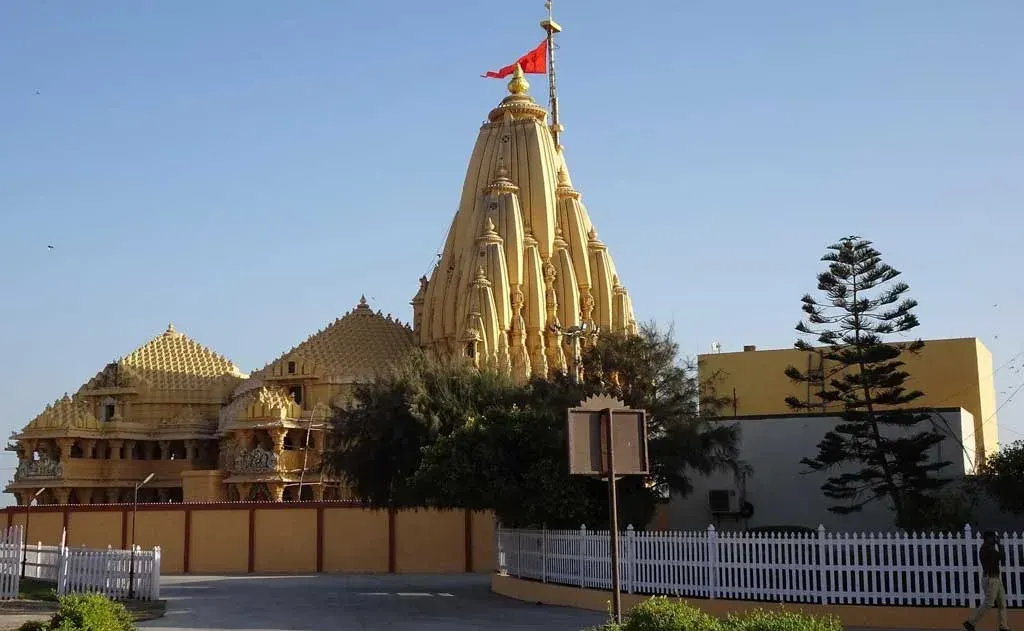
The present temple is built in what the Government of India describes as the Kailash Mahameru Prasad style, within the western Indian (Chaulukya / Maru-Gurjara) temple tradition. It has a garbhagriha (sanctum), a sabhamandap (assembly hall) and a nritya mandap (dance hall), and stands right beside the sea. According to the Press Information Bureau, the shikhara rises about 150 feet and carries a kalash weighing about 10 tonnes, with a 27-foot flagpole.
On the sea wall stands the Baan Stambh (arrow pillar). Its Sanskrit inscription says that there is no land along the straight line from this point south to the South Pole. The pillar belongs to the modern temple complex. Popular claims that it is ancient have not been confirmed by any official or archaeological source.
Plan Your Visit
Darshan and Visitor Information
According to Shree Somnath Trust, visitors should dress modestly (mini skirts and other disrespectful clothing are not allowed), remove footwear before entering, and not smoke anywhere near the temple. Mobile phones, cameras and all other electronic devices are banned inside, and the Trust provides free lockers. Photography inside is not allowed.
The Trust lists darshan from early morning to late evening, with three daily aartis (morning, noon and evening) and an evening sound-and-light show outside the monsoon season (as listed by Shree Somnath Trust, checked October 2026). Confirm current arrangements with Shree Somnath Trust (somnath.org) before travelling. Book rooms and pujas only through the official website, because the Trust has warned about fraud via WhatsApp, phone and UPI.
Timings and arrangements change with seasons and festivals. Confirm current details with Shree Somnath Trust (official website) before travelling. Last reviewed 5 October 2026.
Sacred Calendar
Festivals at Somnath Temple
Maha Shivaratri
The Trust holds four-prahar puja through the night, a maha-abhishek, a maha-aarti and cultural programmes. Gujarat Tourism also runs a Somnath Mahotsav around Shivaratri.
Kartik Purnima fair (Kartak Poonam Lokmela)
Shree Somnath Trust has held a five-day public fair from Dev Diwali to Kartik Purnima for about seven decades. Devotees believe that during the midnight maha-puja on the full moon, the Moon god takes his seat on the temple's peak.
Pran-Pratishtha anniversary
This date marks the 1951 consecration of the present temple. The fiftieth anniversary was observed in 2001 and the seventy-fifth in 2026.
Location
How to Reach Somnath Temple
Shree Somnath Trust lists Somnath railway station as about 0.5 km from the temple and Veraval as about 7 km away. Veraval has trains to Rajkot, Ahmedabad and other Gujarat cities.
The Trust lists Diu Airport at about 85 km, Rajkot at about 200 km and Ahmedabad at about 390 km. Keshod and Porbandar are other regional airports, but their flights are limited, so check current schedules. Gujarat state transport (GSRTC) and private buses connect Somnath with towns across Saurashtra.
Location: Prabhas Patan (Somnath), near Veraval, Gir Somnath, Gujarat, India
Nearest airport: Diu Airport (about 85 km, per Shree Somnath Trust)
Nearest railway station: Somnath (about 0.5 km); Veraval (about 7 km)
More in Hindu temples in Gujarat · Shiva temples
Photographs
Somnath Temple Photos
Questions
Somnath Temple: Frequently Asked Questions
Why is Somnath called the first Jyotirlinga?
Somnath comes first in the traditional Dwadasha Jyotirlinga Stotram ('Saurashtre Somanatham…'). Shree Somnath Trust describes it as the first of the twelve Aadi Jyotirlingas.
What does the name Somnath mean?
It means 'Lord of Soma', the Moon. According to tradition, the Moon god was freed from Daksha's curse by worshipping Shiva here.
When was the present Somnath Temple built?
Reconstruction began after Sardar Patel's visit in November 1947. President Rajendra Prasad consecrated the present temple on 11 May 1951.
When was Somnath attacked by Mahmud of Ghazni?
In the winter of 1025–26. Britannica gives 1024–25, while the Government of India dates the first recorded attack to January 1026.
Who built the old Somnath temple next to the main shrine?
Queen Ahilyabai Holkar built it in 1782, according to Shree Somnath Trust, so that worship could continue near the ruined main temple.
Are mobile phones allowed inside Somnath Temple?
No. The Trust bans phones, cameras and other electronic devices inside and provides free lockers.
What is the Baan Stambh at Somnath?
It is an arrow-topped pillar on the temple's sea wall. Its Sanskrit inscription says no land lies on the straight line from Somnath to the South Pole.
Which is the nearest railway station to Somnath?
Somnath station, about 0.5 km from the temple according to the Trust. Veraval, about 7 km away, has more trains.
Sources and attribution
- Shree Somnath Trust — Shree Somnath Trust — official website
- Shree Somnath Trust — Somnath Darshan
- Shree Somnath Trust — Frequently Asked Questions
- Press Information Bureau, Government of India — Somnath Swabhiman Parv: A Thousand Years of Deep-rooted Faith and Civilisational Pride
- Encyclopaedia Britannica — Somnath
- Incredible India, Ministry of Tourism — Somnath Kartak Poonam Fair
- Incredible India, Ministry of Tourism — Somnath Mahotsav 2027
- Utsav, Ministry of Tourism — Mahashivratri at Somnath
Spotted an error? Write to info@hindutone.com — see our editorial policy.
Pilgrim Circuit