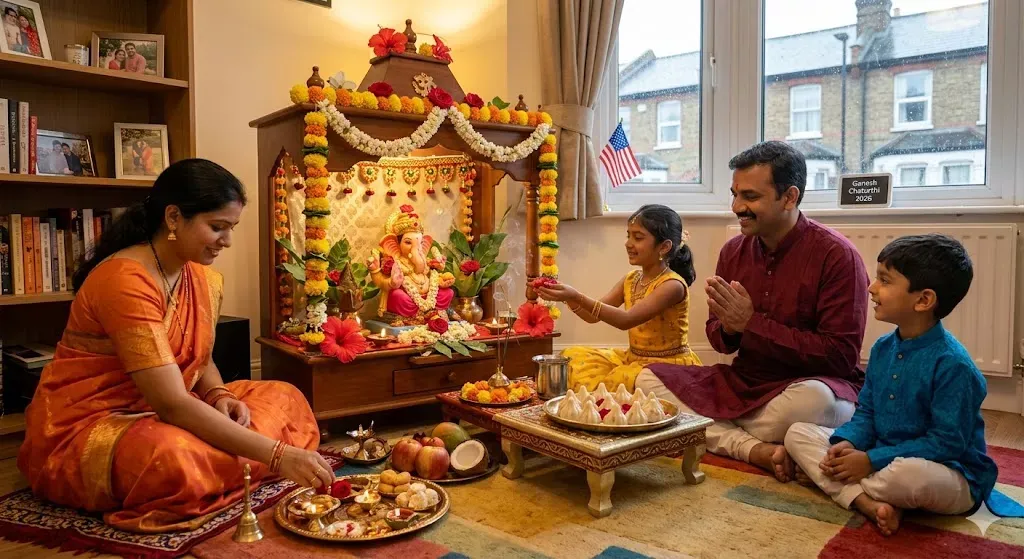
Ganesh Mandapam Design in the USA 2026: Innovative Ideas + Every Permit You Actually Need
How to design a beautiful, compliant Ganesh mandapam in the USA for Ganesh Chaturthi 2026 (14 Sep) — reusable structure and lighting ideas, eco-friendly clay murtis, the full permit stack, and legal visarjan options.
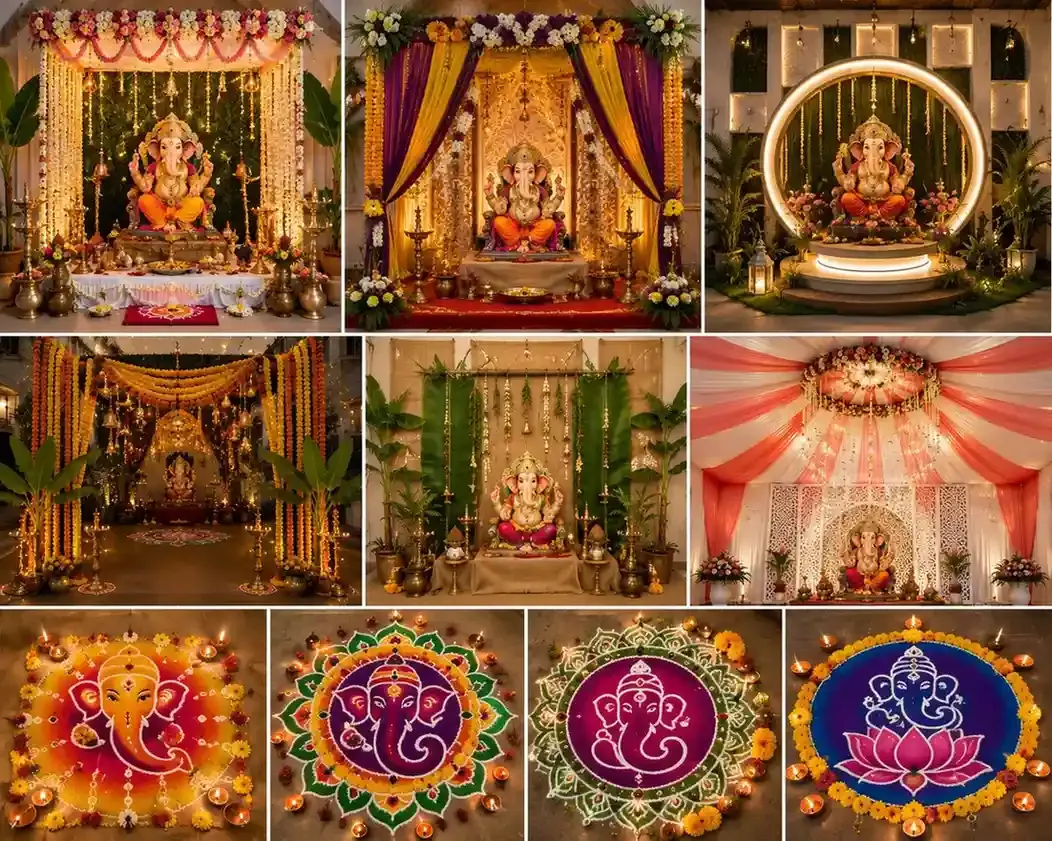
How to design a beautiful, compliant Ganesh mandapam in the USA for Ganesh Chaturthi 2026 (14 Sep) — reusable structure and lighting ideas, eco-friendly clay murtis, the full permit stack, and legal visarjan options.
Quick answer: For Ganesh Chaturthi 2026 (Monday 14 September; visarjan Friday 25 September) in the USA, a home puja generally needs no permit, but a public pandal needs local event, temporary-structure and fire approvals — and a home immersion tank is the simplest legal visarjan.
Every September, somewhere between Edison and Fremont, a family clears the garage, a temple committee books a school gym, and a group of engineers become set designers. That is Ganesh Chaturthi in America — where the festival involves something no pandal in Pune worries about: paperwork.
Quick answer: Ganesh Chaturthi 2026 falls on Monday, 14 September 2026, with Ganesh Visarjan on Anant Chaturdashi, Friday, 25 September 2026; shorter cycles immerse on day 1½, 3, 5 or 7. For a home puja you generally need no permit; a public pandal needs a stack of city permits and, above all, a home immersion tank solves nearly all of it.
Why designing a mandapam in the USA is different
- You are almost always indoors — community halls, gyms, ballrooms; low ceilings and a strict "no permanent modification" rental clause (no drilling).
- Everything must come down fast within the venue’s load-out window.
- Storage is the hidden cost — the best US mandapams flat-pack into a 4×8 ft footprint for eleven months.
- Fire code is not a suggestion — every fabric in a public assembly space must meet NFPA 701 flame-spread standards.
The design foundation — three zones
| Zone | Traditional name | Function |
|---|---|---|
| The seat | Peetham / Vedika | Raised platform for the murti — height, stability, dignity |
| The frame | Torana / Prabhavali | Arch or backdrop that frames the deity — visual focus, symmetry |
| The approach | Mandapa proper | Where devotees stand or sit — flow, sightlines, accessibility |
Place the murti’s eyes at or slightly above standing-adult eye level (roughly 58–66 inches / 148–168 cm from the floor); for a 24-inch murti that is a platform of about 36–42 inches. Keep a strong central axis. Palettes that photograph well: saffron + deep maroon + gold; peacock blue + gold; white + marigold orange; deep green + copper for eco themes. The murti should be the only complex thing in the frame.
Innovation ideas that work in the USA
- Modular aluminium truss (10×10/10×20) — assembles in 45 min, packs into a car, lasts 15 years ($400–1,200).
- PVC flat-pack torana arch for homes (under $80); label each pipe for 10-minute reassembly.
- The garage-door mandapam — garage becomes the sanctum, driveway the courtyard.
- Reusable CNC-cut gopuram panels (MDF/PVC foam), backlit to read as carved stone.
- Three-point deity lighting (three $25 LED pucks beat $500 of string lights) and short-throw projection backdrops.
- Seed-embedded shadu-clay murti + a home visarjan tank (stock tank / inflatable pool) — the single most important idea, removing nearly all legal complexity.
- QR storytelling stations and a fixed live-stream rig for family in India.
Permits and legal requirements in the USA
Permit requirements are set at city and county level, not federally — Fremont differs from Edison or Sugar Land. A private home puja with family and invited guests generally needs no permit at all. Watch these five for home events, then the full stack for public pandals:
- Home: HOA/CC&R rules on exterior décor and driveway tents; lease open-flame bans (use LED diyas); guest parking (the #1 enforcement trigger); noise ordinances (quiet hours ~10 PM–7 AM); driveway tents over ~400 sq ft.
- Public — Special Event Permit (city clerk/parks; apply 30–90 days ahead) as the umbrella.
- Temporary Structure/Tent Permit (IFC: tents >400 sq ft or canopies >700 sq ft) with a site plan.
- Fire Marshal approval — the decisive check: NFPA 701 flame certificates for all fabric, posted occupancy load, clear exit paths, open-flame rules (aarti/havan often outdoors with a fire watch), extinguishers, nothing within 18 inches of a sprinkler.
- Temporary Food Establishment permit (county health) if serving prasad to the public; certificate of liability insurance ($1M/$2M); amplified-sound permit; parking/street-closure via police/DOT.
Ganesh Visarjan in the USA: the legal reality
Immersing a murti in a US public waterway collides with the Clean Water Act, state environmental agencies, municipal parks rules and the Army Corps of Engineers. PoP murtis with chemical paints are a genuine regulatory concern, not a technicality. Eco note: choose natural shadu-clay murtis with natural colours (order by mid-August — they sell out); never immerse plaster-of-Paris or chemically painted murtis in any public water body.
- Home / on-site immersion tank (strongly recommended) — no permit anywhere; full ritual integrity; dissolved clay to the garden. Now the majority practice.
- Municipally organised immersion sites — several cities (NJ, CA, TX, IL, GA) run permitted, clay-only sites; check parks dept by early August.
- Symbolic immersion while retaining a permanent metal/stone murti.
- Natural water body with permits (parks + environmental clearance, clay-only, full cleanup) — start in July, not September.
Planning timeline & budget
Timeline: 12 weeks out book venue + start the special-event permit + order the clay murti; 8 weeks secure insurance + food/sound permits + IFR drape; 6 weeks confirm the fire-marshal inspection; 4 weeks test-build in a garage; 2 weeks confirm all permits in writing. Budget: home $150–600; premium home $600–1,800; small community (100–200) $2,500–6,000; large pandal (500+) $12,000–40,000+. Reusable truss/drape/CNC panels pay for themselves by year two.
A fire marshal checking your exit paths is protecting two hundred people in your community; an environmental officer asking about your murti is protecting the lake your children swim in. Design well, plan early, file the paperwork. Ganpati Bappa Morya.
This article is for general information only. Permit requirements vary by locality and change over time — always confirm current rules with your local authorities before finalising plans.
Frequently Asked Questions
When is Ganesh Chaturthi 2026 and when is visarjan?
Ganesh Chaturthi 2026 is Monday, 14 September 2026; Ganesh Visarjan on Anant Chaturdashi is Friday, 25 September 2026. Shorter cycles immerse on day 1½, 3, 5 or 7.
Do I need a permit to celebrate Ganesh Chaturthi at home in the USA?
Generally no — a private religious observance in your own home does not require a permit. Mind local rules on open flame, decorations, parking and noise.
What permits do I need for a public Ganesh pandal in the USA?
Typically a special event permit, a temporary structure/tent permit, fire-marshal approval, liability insurance, and a temporary food establishment permit if serving food. Requirements are set city/county-level.
Can I immerse a Ganesh idol in a lake, river or the sea in the USA?
Not without permission — public waterways are regulated under the Clean Water Act and state agencies. The standard is a home or on-site immersion tank with a natural clay murti; some cities offer permitted sites.
What fabric can I use for a mandapam in a rented hall?
Only fabric meeting NFPA 701 flame-propagation standards ("IFR" event drape); keep the certificate for the fire marshal.
Where can I buy an eco-friendly clay Ganesh murti?
From Indian handicraft shops and, increasingly, larger grocery stores from early August. Order by mid-to-late August — natural shadu-clay murtis sell out before the festival.
You might also like

Raksha Bandhan 2026 in the USA: Date, Rakhi Muhurat in Your Time Zone & How to Celebrate

Gowri Vratam 2026: Importance, Rituals & How to Perform Swarna Gowri Vratam at Home
Asha Dashami 2026: Sravana Shukla Dashami — Fulfil Dharmic Wishes with Chandana Abhishekam