International Day of Yoga 2026: Hindu Significance & Global Events
International Day of Yoga 2026 on June 21 — Hindu origins from Vedas + Patanjali + Bhagavad Gita, 2026 theme Yoga for Healthy Ageing, global UN events, simple NRI home practice, temple celebrations worldwide.
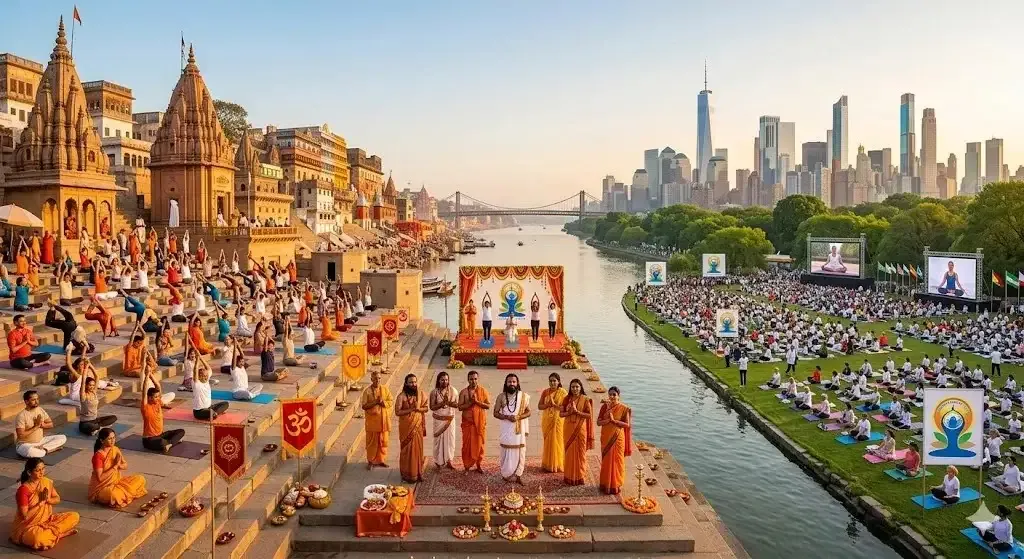
International Day of Yoga 2026, observed worldwide on Sunday, June 21, will be the 12th annual UN-recognised celebration of yoga since 2015. The 2026 theme — "Yoga for Healthy Ageing" — invites Hindu families and the global diaspora to rediscover yoga as the gift Sanatana Dharma gave the world: not just a fitness routine, but a complete science of body, breath, mind and spirit rooted in the Vedas, Upanishads, and the Patanjali Yoga Sutras.
Whether you are in India, USA, UK, Canada, Australia, UAE or Singapore, this guide walks you through yoga's dharmic origins, the 2026 theme, simple home practices for the day, and how NRI Hindu families can connect with the global celebration without leaving home.
Origins of Yoga in Sanatana Dharma
Yoga is not a 20th-century health trend. It is one of the six Astika darshanas (orthodox schools) of Hindu philosophy, with its earliest references in the Rig Veda (circa 1500 BCE) — the word "yuj" (root of yoga) appears across Vedic hymns meaning "to unite, to yoke." The Katha Upanishad gives one of the earliest direct teachings: "When the five senses, along with the mind, remain still, and the intellect itself does not stir, that is the highest state" (Katha 2.3.10-11).
The Bhagavad Gita (circa 5th century BCE) dedicates entire chapters to yoga — Karma Yoga (path of selfless action), Jnana Yoga (path of knowledge), Bhakti Yoga (path of devotion), and Dhyana Yoga (path of meditation). Lord Krishna himself defines yoga to Arjuna as "samatvam yoga uchyate" — equanimity of mind is yoga (Gita 2.48).
The systematised codification of yoga came from Maharshi Patanjali in his Yoga Sutras (circa 2nd century BCE), which defines the Ashtanga (eight-limb) path: Yama, Niyama, Asana, Pranayama, Pratyahara, Dharana, Dhyana, Samadhi. The asanas (physical postures) we associate with modern yoga are just one of these eight limbs — the others are equally essential.
2026 Theme: Yoga for Healthy Ageing
The 2026 International Day of Yoga theme — "Yoga for Healthy Ageing" — recognises a deepening global crisis: aging populations across India, USA, UK, Japan, Europe with rising chronic disease, dementia, and loneliness. Yoga, with its scientifically validated effects on cardiovascular health, cognitive function, balance, flexibility, immunity and emotional well-being, offers a low-cost, evidence-based path to dignified aging.
For Hindu families across generations, this theme reconnects modern fitness language with ancient dharma: the Charaka Samhita, our foundational Ayurveda text, classifies yogic practice as the highest form of "rasayana" (rejuvenation). The Yoga Vasishta describes yoga as "manolaya" — the dissolution of mental disturbance — which medical science now correlates with reduced cortisol, lower inflammation, and slower telomere shortening.
- Yoga improves balance and reduces fall-related injuries in seniors (Journal of Geriatrics studies)
- Pranayama lowers blood pressure and improves heart rate variability
- Meditation practices reduce dementia risk by an estimated 50%+ (multiple long-cohort studies)
- Asana practice maintains joint mobility and prevents sarcopenia (muscle loss with age)
- The bhakti-meditation combination addresses the loneliness epidemic in aging populations abroad
Global Events & Celebrations on June 21, 2026
Over 180 countries observe International Day of Yoga. Key events:
- India: PM-led main event at a major venue (location to be announced), live on Doordarshan and DD India. Lakhs of citizens participate from public parks and stadia. Ayush Ministry runs the Y-Break short campaign across central government offices.
- UN Headquarters New York: Sunrise yoga ceremony on UN Plaza, attended by ambassadors and the Permanent Mission of India to the UN.
- Major diaspora cities: Times Square New York, Trafalgar Square London, Sydney Opera House forecourt, BAPS temples across North America, Hindu Temple Society of North America (Flushing NY), Hindu Heritage Centre Toronto.
- Online: Sadhguru, Sri Sri Ravi Shankar, BKS Iyengar institutions, Bihar School of Yoga and Ramamani Iyengar Yoga Institute Pune all stream guided 30-60 minute classes — most are free.
- Indian missions abroad: Every Indian embassy and consulate organises a free 45-minute Common Yoga Protocol session. Check your local Indian consulate website for time and location.
Simple Home Yoga Practices for NRIs on June 21, 2026
If you cannot attend a public event, this 30-minute home sequence aligns with the official Common Yoga Protocol (CYP) developed by the Ministry of Ayush. Suitable for ages 16-75; modify or skip any asana that causes pain.
- Opening prayer (3 min): Sit cross-legged. Chant Om three times. Recite the universal yoga prayer: "Yogena chittasya padena vacham, malam sharirasya cha vaidyakena, yopakarottam pravaram muninam, patanjalim pranjalir-anato'smi" (salutation to Patanjali who gave us yoga for the mind, grammar for speech, and Ayurveda for the body).
- Loosening exercises (5 min): Neck rotations, shoulder rolls, wrist and ankle circles, hip rotations.
- Surya Namaskar — 5 rounds (8 min): The classic 12-pose sequence. If unable, do the seated chair version.
- Standing asanas (5 min): Trikonasana (triangle), Vrikshasana (tree pose for balance — essential for healthy aging).
- Seated asanas (5 min): Vajrasana, Paschimottanasana (forward fold), Bhujangasana (cobra).
- Pranayama (3 min): Nadi Shodhana (alternate nostril breathing) — 10 rounds.
- Meditation (1 min): Sit quietly observing the breath. End with Om.
How Hindu Temples Abroad Are Celebrating
- BAPS Swaminarayan temples (USA, UK, Australia, Africa): free 90-minute group yoga sessions in the morning at most major temples.
- Hindu Temple Society of North America (Flushing, NY): community yoga class on the temple grounds; vegetarian breakfast after.
- Hindu Heritage Centre Toronto: Yoga + Vedic chanting combo session.
- ISKCON temples worldwide: Bhakti-yoga focused sessions emphasising the kirtan-meditation connection.
- Sri Venkateswara Temple (Pittsburgh, USA): typically organises a community Surya Namaskar event with prasad.
- Telugu and Tamil community associations: many organise free yoga camps for seniors specifically — check your local cultural association.
Spiritual Benefits Beyond Physical Health
The Yoga Sutras open with "yogah chitta vritti nirodhah" — yoga is the stilling of the modifications of the mind. Beyond the physical benefits, daily yoga practice grants:
- Deeper concentration and the steadiness needed for serious sadhana
- Resolution of accumulated samskaras (subconscious impressions) through pratyahara and dharana
- The capacity to remain centred during life crises — particularly valuable for the NRI experience of cultural displacement
- A direct pathway to bhakti — devotion deepens when the mind is steady
- Ultimately, samadhi (absorption in the Divine), the goal that Patanjali, the Gita and the Upanishads all share
Frequently Asked Questions
Is yoga a Hindu practice or a universal one?
Yoga emerged from Sanatana Dharma (Hinduism) and is one of its six classical philosophical systems. It is also universally accessible — anyone, of any background, can practise yoga and benefit. The dharmic roots and the universal applicability are not in conflict; they are complementary. International Day of Yoga celebrates both.
What is the best time to practise yoga on June 21?
Brahma muhurta — the 45-90 minute window before sunrise — is traditionally the most powerful. For most NRIs that is 04:30-06:00 AM local time. If that is impractical, any time before noon works well. Evening practice should focus on relaxation rather than energising sequences.
I am a senior with arthritis — can I still practise on Yoga Day?
Absolutely — the 2026 theme "Yoga for Healthy Ageing" is specifically for you. Focus on chair yoga, gentle pranayama, and meditation. Most temples and seniors centres in the diaspora offer modified senior-friendly classes on Yoga Day. Check with your doctor before starting any new practice.
Are children encouraged to participate in International Day of Yoga?
Yes — this is one of the most powerful ways for NRI families to transmit dharmic culture to children born abroad. Many countries have school programmes; participate as a family. Children love Surya Namaskar when learned playfully.
Where can I find authentic yoga classes (not just gym yoga) abroad?
Look for teachers trained at Bihar School of Yoga, Ramamani Iyengar Yoga Institute Pune, Krishnamacharya Yoga Mandiram Chennai, Sivananda Yoga Vedanta Centres, or the various Patanjali, BAPS, ISKCON or Art of Living centres worldwide. Authentic teachers emphasise the eight limbs, not just asana.
🕉 May the 12th International Day of Yoga awaken steadier minds, healthier bodies and deeper bhakti in homes across the world. Yoga is the gift Sanatana Dharma gave humanity — practise it daily, share it with your children. 🕉
Share this with family and friends
Send it on WhatsApp, post it, or copy the link.
More from Festivals
- Masik Shivaratri 2027 Dates: Monthly Shivaratri List, Nishita Kaal Times and Dates Abroad
- Sankashti Chaturthi 2027 Dates and Moonrise Times: Full List for India and Abroad
- Pradosh Vrat 2027 Dates: All 25 Pradosham Days, Pradosh Kaal Times and Dates Abroad
- Amavasya 2027 Dates: New Moon Days, Darsha Amavasya, Tithi Times and Dates Abroad
- Purnima 2027 Dates: Full Moon Vrat Days, Snan-Daan Days, Tithi Times and Dates Abroad
You might also like
International Day of Yoga 2026 (June 21): US Hindu Temples & NRIs Celebrate “Yoga for Healthy Ageing”
International Yoga Day 2026: Date, Meaning & Diaspora Guide

Diwali as an International Festival of Light: UN & Global Recognition