Narsimha
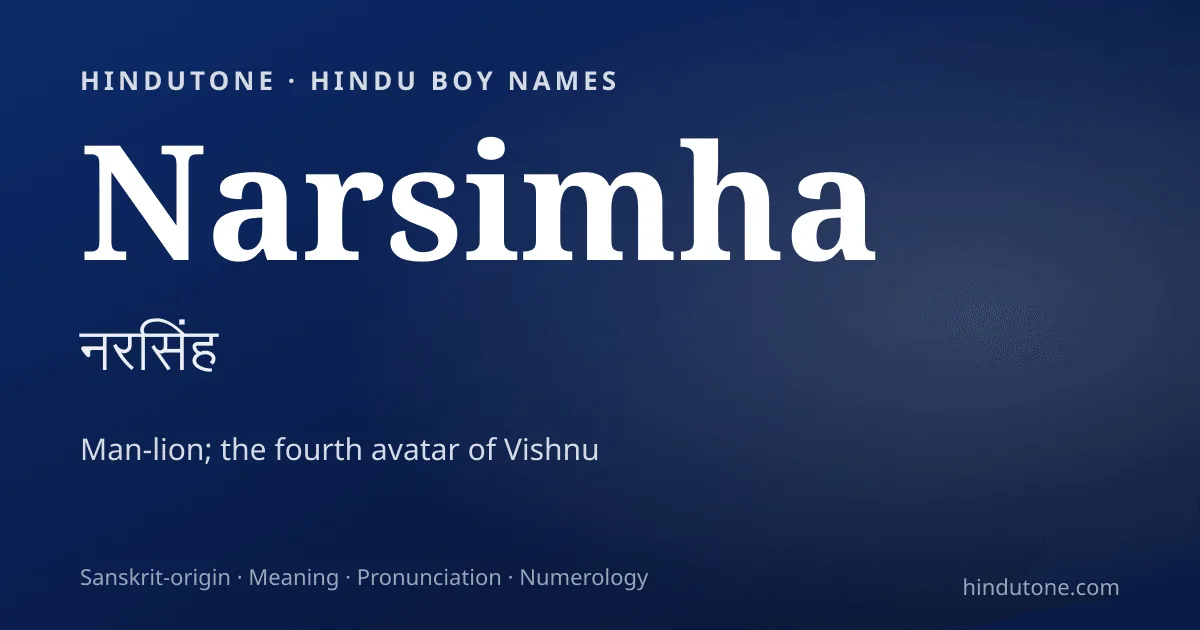
Narsimha (नरसिंह) is a Sanskrit-origin Hindu boy-name meaning “Man-lion; the fourth avatar of Vishnu”. Find pronunciation, origin, deity association, popularity and similar Hindu baby names.
Narsimha (नरसिंह) is a Sanskrit-origin Hindu boy-name meaning “Man-lion; the fourth avatar of Vishnu”. Find pronunciation, origin, deity association, popularity and similar Hindu baby names.
Narsimha (नरसिंह, IAST: narasiṃha) is a Sanskrit-origin Hindu boy-name meaning “Man-lion; the fourth avatar of Vishnu”. The half-man, half-lion form of Vishnu who slew the demon Hiranyakashipu to protect the child-devotee Prahlada.
Meaning, etymology & significance
Narsimha (नरसिंह) is one of the most awe-inspiring names in the Hindu pantheon — the half-man, half-lion form taken by Lord Vishnu to slay the demon-king Hiranyakashipu. Hiranyakashipu had obtained a boon that he could be killed neither by man nor beast, neither by day nor night, neither inside nor outside, neither on the ground nor in the air, and by no weapon. Narsimha — neither man nor beast — appeared at twilight at the threshold of a pillar, took the demon onto his lap, and tore him apart with his claws, fulfilling every clause of the boon.
The story is the supreme Puranic illustration of the principle that bhakti can summon the divine in any form needed to protect the devotee. The young Prahlada, son of Hiranyakashipu, never wavered from his devotion to Vishnu — and Vishnu came when called.
Lakshmi-Narasimha temples are central to South Indian Vaishnava worship; the great Yoganarasimha Swamy temple at Melkote, the Ahobilam Nava-Narasimha shrines, and the Simhachalam temple are pilgrimage centres of immense power.
A boy named Narsimha is named with a wish for fearless protection — for himself and for those he loves. Pair with surnames or middle names from the Vaishnava tradition (Das, Acharya, Iyengar).
Astrology — nakshatra & rashi
By the standard Vedic correspondence between the first syllable of a name and the lunar mansion (nakshatra), Narsimha aligns with the Anuradha nakshatra, under the Vrischika rashi (Moon sign).
Similar names
Hindu names with a similar feel or meaning include: Narasimha, Lakshminarasimha, Yoganarsimha. Each is a distinct choice with its own etymology — explore them on their own pages for fuller context.
Frequently Asked Questions
What does the name Narsimha mean?
Narsimha ( नरसिंह , IAST: narasiṃha ) is a Sanskrit-origin Hindu boy-name meaning “Man-lion; the fourth avatar of Vishnu” . The half-man, half-lion form of Vishnu who slew the demon Hiranyakashipu to protect the child-devotee Prahlada.
Is Narsimha a good Hindu baby name?
Yes — it is a traditional Hindu name with an auspicious meaning, suitable for a baby and rooted in Sanatana Dharma values.
What is the origin of the name Narsimha?
It has Sanskrit/Hindu origins; its roots, deity association and significance are detailed above.
Are there variations or similar names to Narsimha?
Related and similarly-themed Hindu names, along with their meanings, are listed in the guide above to help you choose.
Narsimha — Name Facts
- Meaning
- Man-lion; the fourth avatar of Vishnu
- Gender
- Hindu boy name
- Nakshatra
- Anuradha
- Rashi
- Kanya (Virgo)
- Numerology
- 4
Frequently asked questions
What does the name Narsimha mean?
Narsimha is a Sanskrit-origin Hindu boy name meaning “Man-lion; the fourth avatar of Vishnu”.
Is Narsimha a boy or girl name?
Narsimha is traditionally a Hindu boy name.
Which nakshatra and rashi suit the name Narsimha?
By the first-syllable rule of Vedic naming, Narsimha aligns with the Anuradha nakshatra, under the Kanya (Virgo) rashi.
What is the numerology number of Narsimha?
The Chaldean name number of Narsimha is 4.
Explore more: Anuradha nakshatra names · Kanya rashi names · Hindu boy names with N · All Hindu names A–Z