Sahasraksha
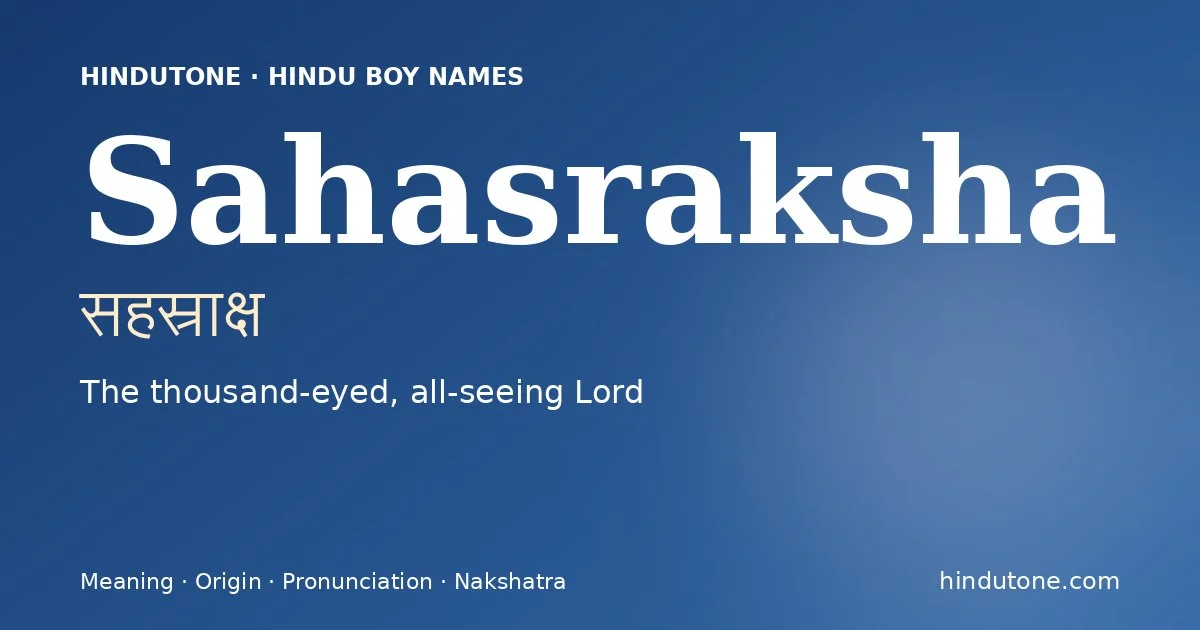
Sahasraksha (सहस्राक्ष) is a Sanskrit-origin Hindu boy-name meaning “The thousand-eyed, all-seeing Lord”. Find pronunciation, origin, deity association, popularity and similar Hindu baby names.
Sahasraksha (सहस्राक्ष) is a Sanskrit-origin Hindu boy-name meaning “The thousand-eyed, all-seeing Lord”. Find pronunciation, origin, deity association, popularity and similar Hindu baby names.
Sahasraksha (सहस्राक्ष, IAST: Sahasrākṣa) is a Sanskrit-origin Hindu boy-name meaning “The thousand-eyed, all-seeing Lord”. From sahasra (thousand) and akṣa (eye), this celebrated Vedic epithet declares that Vishnu perceives all things in all directions simultaneously, his vision encompassing the entire cosmos without limitation.
Meaning, etymology & significance
Sahasrākṣa is one of the most ancient divine epithets in the Vedic tradition, appearing in the Ṛgveda and Atharva Veda. The thousand eyes symbolise omniscience—the Lord witnesses every act, thought, and moment across all realms of existence. In the Vishnu Sahasranāma, this name affirms that no event in creation escapes the sight of the Supreme.
Though also an epithet of Indra in early Vedic texts, within the Sahasranāma it refers to Vishnu's all-pervading awareness; it is pronounced sa-has-raak-sha and is a usable traditional name.
Scriptural source
Sahasraksha appears in the Vishnu Sahasranama, among the sacred names of Vishnu.
Astrology — nakshatra, rashi & numerology
By the standard Vedic correspondence between a name’s first syllable and the lunar mansion, Sahasraksha aligns with the Shatabhisha nakshatra, under the Kumbha rashi (Moon sign). Its Chaldean name-number is 9.
Sahasraksha — Name Facts
- Meaning
- The thousand-eyed, all-seeing Lord
- Gender
- Hindu boy name
- Nakshatra
- Shatabhisha
- Rashi
- Kumbha (Aquarius)
- Numerology
- 9
Frequently asked questions
What does the name Sahasraksha mean?
Sahasraksha is a Sanskrit-origin Hindu boy name meaning “The thousand-eyed, all-seeing Lord”.
Is Sahasraksha a boy or girl name?
Sahasraksha is traditionally a Hindu boy name.
Which nakshatra and rashi suit the name Sahasraksha?
By the first-syllable rule of Vedic naming, Sahasraksha aligns with the Shatabhisha nakshatra, under the Kumbha (Aquarius) rashi.
What is the numerology number of Sahasraksha?
The Chaldean name number of Sahasraksha is 9.
Explore more: Shatabhisha nakshatra names · Kumbha rashi names · Hindu boy names with S · All Hindu names A–Z