Ugrasenadi Rajyavyaparitapara
Ugrasenadi Rajyavyaparitapara (उग्रसेनादिराज्यव्यापारितापर) is a Sanskrit-origin Hindu boy-name meaning “Wholly devoted to restoring Ugrasena's kingdom”. Find pronunciation, origin, deity association, popularity and similar Hindu baby names.
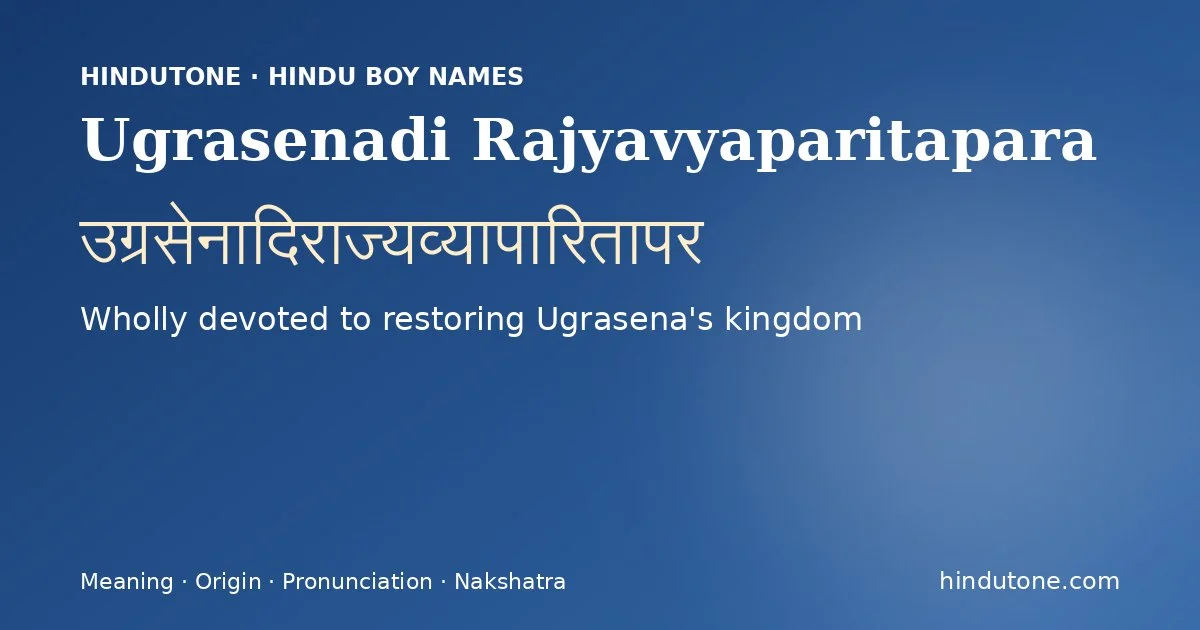
Ugrasenadi Rajyavyaparitapara (उग्रसेनादिराज्यव्यापारितापर) is a Sanskrit-origin Hindu boy-name meaning “Wholly devoted to restoring Ugrasena's kingdom”. Find pronunciation, origin, deity association, popularity and similar Hindu baby names.
Ugrasenadi Rajyavyaparitapara (उग्रसेनादिराज्यव्यापारितापर, IAST: Ugrasenādirājyavyāpāritāpara) is an Sanskrit-origin Hindu boy-name meaning “Wholly devoted to restoring Ugrasena's kingdom”. Composed of Ugrasena (Kaṃsa's righteous father, the deposed king), ādi (and others), rājya (kingdom), vyāpārita (engaged/reinstated), and apara (supreme/absorbed), this name honors Kṛṣṇa's selfless act of reinstating legitimate rule after slaying the usurper Kaṃsa.
Meaning, etymology & significance
After killing Kaṃsa, Kṛṣṇa did not claim the throne of Mathurā for Himself; instead, He immediately restored the kingdom to the elderly Ugrasena, Kaṃsa's own father whom the tyrant had imprisoned. This gesture—captured in this compound name—reveals Kṛṣṇa's fundamental selflessness and His commitment to dharmic governance over personal power. The word vyāpārita (set in motion, reinstated) and apara (wholly absorbed, beyond measure) together suggest that restoring righteous kingship was itself a divine vocation for the Lord.
This elaborate compound is more a theological descriptor found in Sahasranāma commentaries than a personal name, though it enshrines a deeply meaningful political and moral teaching about Kṛṣṇa's character. Scholars who interpret the Viṣṇu Sahasranāma, such as Ādi Śaṅkarācārya and Parāśara Bhaṭṭar, cite this name to illustrate Kṛṣṇa's complete absence of ego in wielding power.
Scriptural source
Ugrasenadi Rajyavyaparitapara appears in the Vishnu Sahasranama, among the sacred names of Vishnu.
Astrology — nakshatra, rashi & numerology
By the standard Vedic correspondence between a name’s first syllable and the lunar mansion, Ugrasenadi Rajyavyaparitapara aligns with the Krittika nakshatra, under the Vrishabha rashi (Moon sign). Its Chaldean name-number is 2.
Ugrasenadi Rajyavyaparitapara — Name Facts
- Meaning
- Wholly devoted to restoring Ugrasena's kingdom
- Gender
- Hindu boy name
- Nakshatra
- Krittika
- Rashi
- Vrishabha (Taurus)
- Numerology
- 2
Frequently asked questions
What does the name Ugrasenadi Rajyavyaparitapara mean?
Ugrasenadi Rajyavyaparitapara is a Sanskrit-origin Hindu boy name meaning “Wholly devoted to restoring Ugrasena's kingdom”.
Is Ugrasenadi Rajyavyaparitapara a boy or girl name?
Ugrasenadi Rajyavyaparitapara is traditionally a Hindu boy name.
Which nakshatra and rashi suit the name Ugrasenadi Rajyavyaparitapara?
By the first-syllable rule of Vedic naming, Ugrasenadi Rajyavyaparitapara aligns with the Krittika nakshatra, under the Vrishabha (Taurus) rashi.
What is the numerology number of Ugrasenadi Rajyavyaparitapara?
The Chaldean name number of Ugrasenadi Rajyavyaparitapara is 2.
Explore more: Krittika nakshatra names · Vrishabha rashi names · Hindu boy names with U · All Hindu names A–Z