Avalokita
Avalokita (अवलोकिता) is a Sanskrit-origin Hindu girl-name meaning “Seen with compassion; the gazed-upon”. Find pronunciation, origin, deity association, popularity and similar Hindu baby names.
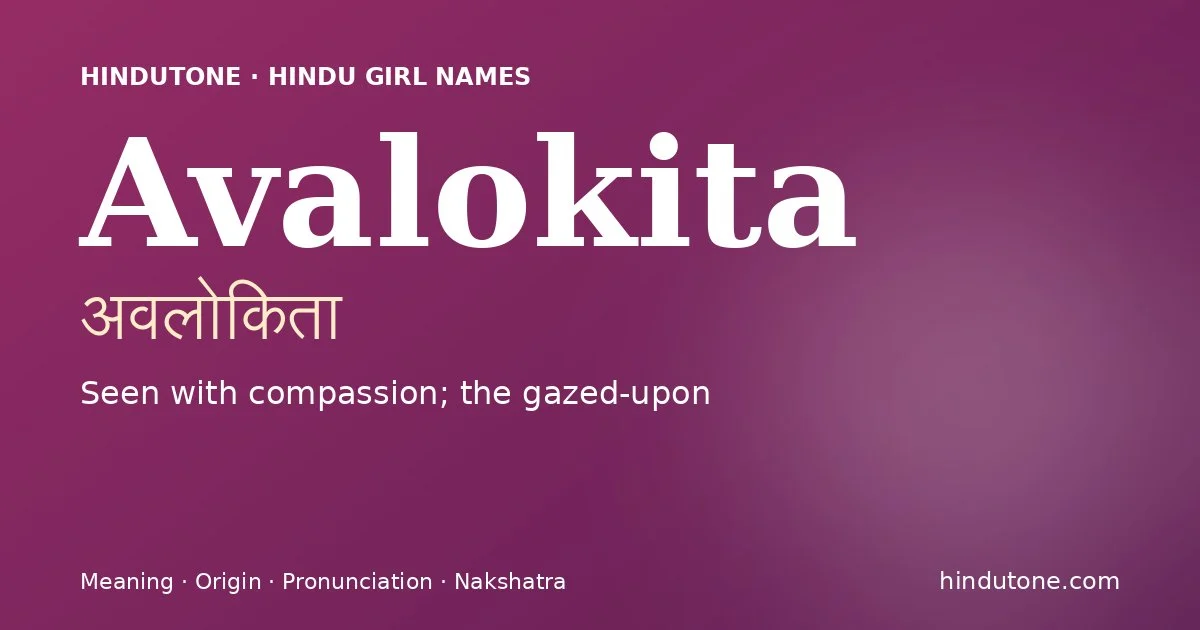
Avalokita (अवलोकिता) is a Sanskrit-origin Hindu girl-name meaning “Seen with compassion; the gazed-upon”. Find pronunciation, origin, deity association, popularity and similar Hindu baby names.
Avalokita (अवलोकिता, IAST: avalokitā) is an Sanskrit-origin Hindu girl-name meaning “Seen with compassion; the gazed-upon”. Feminine of avalokita — looked upon with compassion (related to Avalokiteshvara).
Meaning, etymology & significance
Avalokita (अवलोकिता) is built from the Sanskrit avalokita — "looked upon, gazed at with attention." The literal sense is "she who is seen, the compassionately-regarded." The masculine Avalokiteśvara is the Mahayana Buddhist bodhisattva of compassion — "the lord who looks down with compassion."
In Hindu tradition the word carries the gentler sense of "the one looked-upon by the deity" — the bhakta who has earned the divine gaze. A daughter named Avalokita is therefore named with this divine-gaze quality as her keynote.
The name is rare in 2026 and unmistakably Sanskrit. It pairs especially well with classical surnames.
Pronunciation: a-va-LO-ki-taa. Pair with traditional surnames where the compassion-resonance is welcome.
Astrology — nakshatra & rashi
By the standard Vedic correspondence between the first syllable of a name and the lunar mansion (nakshatra), Avalokita aligns with the Krittika nakshatra, under the Mesha rashi (Moon sign).
Similar names
Hindu names with a similar feel or meaning include: Aaradhya, Karuna, Avalokana. Each is a distinct choice with its own etymology — explore them on their own pages for fuller context.
Quick Facts
Attribute: Details
AdvertisementGender: Girl
Origin: Sanskrit
Meaning: Seen with compassion; the gazed-upon
Pronunciation: ah-vah-LOH-kee-taa
Syllables: 5
Lucky Number: 6
AdvertisementRashi: Mesha (Aries)
Nakshatra: Krittika
Sanskrit Etymology & Devanagari
The Devanagari spelling is अवलोकिता. In IAST transliteration: avalokitā. The name derives from the Sanskrit root लोक् (lok), meaning "to see, behold, perceive." The prefix अव (ava) adds the nuance of "down" or "toward," giving avalokita the sense of "looked upon, beheld, observed with care."
The feminine suffix -आ (-ā) transforms the participial adjective into a feminine noun, yielding "she who is looked upon." In classical Sanskrit literature, avalokita carries connotations of attentive regard, compassionate observation, and divine watchfulness. The word appears in Buddhist texts describing the bodhisattva Avalokiteśvara, whose name means "the lord who looks down [with compassion]." While that figure is primarily Buddhist, the Sanskrit root and its emotional resonance—compassion, protective gaze, divine attention—are shared across Hindu devotional traditions.
In Hindu bhakti poetry, the concept of being "seen" by the deity is central: the devotee longs for the darśana (sacred sight) of the divine, and reciprocally, to be held in the divine gaze is to be blessed, protected, and loved. A girl named Avalokita thus embodies the quality of being cherished and watched over, as if perpetually under the compassionate eye of the divine.
Mythological & Historical Figures
There are no documented Hindu mythological or Puranic figures bearing the exact name Avalokita. The name's primary historical association is with the Buddhist bodhisattva Avalokiteśvara (masculine), revered across Mahayana traditions as the embodiment of infinite compassion. In Hindu contexts, the verbal root avalok appears in devotional hymns and philosophical texts to describe the act of the deity beholding the devotee. For instance, the Bhagavad Gita and various Puranas use forms of lok and avalok to describe divine vision and grace. While no epic heroine carries this name, the semantic field—divine gaze, compassionate regard—resonates deeply with the archetype of the protected and beloved daughter in Hindu tradition.
Regional Popularity in India
Avalokita remains an exceptionally rare name across India as of 2026. It is most likely to be chosen by families in urban centers with a strong affinity for classical Sanskrit nomenclature—particularly among Bengali, Maharashtrian, and South Indian (Tamil, Telugu, Kannada) Brahmin communities where Sanskrit revival and literary names are valued. In West Bengal, where both Hindu and Buddhist heritage intertwine, parents with an interest in pan-Indic spiritual traditions may find the name appealing. Similarly, in Maharashtra and Karnataka, where classical education and Vedic scholarship are prized, Avalokita may be selected for its lyrical sound and profound meaning. The name is virtually unknown in North Indian Hindi-belt states and Punjab, where shorter, more colloquial names dominate. Among the diaspora—especially in the United States, Canada, and the United Kingdom—Avalokita may attract parents seeking a unique, meaningful name that bridges Hindu and Buddhist spiritual aesthetics.
Numerology & Astrology
The name Avalokita is commonly associated with the lucky number 6 in Indian numerology. Number 6 is ruled by Venus (Shukra) and is believed to confer artistic sensibility, harmony, nurturing instincts, and a love of beauty and balance. Individuals with this number are often seen as compassionate, responsible, and family-oriented—qualities that align well with the name's meaning of compassionate regard.
Astrologically, Avalokita falls under the Mesha rashi (Aries) and the Krittika nakshatra. Krittika, ruled by the Sun, spans the end of Aries and the beginning of Taurus. It is symbolized by a flame or razor, representing purification, courage, and the cutting away of ignorance. Those born under Krittika are often believed to possess strong will, leadership qualities, and a protective nature. The combination of the name's gentle, compassionate meaning with Krittika's fiery, protective energy creates a balanced profile: a girl who is both tender-hearted and strong, capable of both nurturing and defending.
Personality Traits
Compassionate and empathetic: The name's core meaning—"looked upon with compassion"—suggests a girl who naturally extends kindness and understanding to others.
Spiritually inclined: The Sanskrit and devotional roots of the name point to a contemplative, introspective nature and an early interest in philosophy or spirituality.
Observant and thoughtful: "Gazed upon" implies both being seen and seeing; Avalokita may be a keen observer of people and situations, with a reflective temperament.
Graceful and poised: The lyrical, classical sound of the name evokes elegance, refinement, and a quiet dignity.
Protective and nurturing: Aligned with the Krittika nakshatra's symbolism, she may exhibit a strong protective instinct toward family and friends.
Unique and confident: Bearing a rare, meaningful name, Avalokita is likely to develop a strong sense of individuality and self-worth.
Variants & Similar Names
Avalokita has no widely recognized spelling variants, but phonetically and semantically similar Hindu names include: Avalokana, Aaradhya, Karuna, Daya, Kripa, Anukampa, Preksha, Darshana, Avani, Alaknanda. Each of these names shares either the Sanskrit literary quality, the theme of compassion and divine grace, or a similar melodic structure.
FAQ
How do you pronounce Avalokita correctly?
Avalokita is pronounced ah-vah-LOH-kee-taa, with the stress on the third syllable (LOH). The "a" sounds are open, as in "father," and the final "ā" is slightly elongated. In casual Indian English, it may be shortened to "ah-vah-LOH-ki-ta" with a lighter final vowel.
Is Avalokita appropriate for Hindu families, given its Buddhist associations?
Yes. While the masculine form Avalokiteśvara is a Buddhist bodhisattva, the Sanskrit root avalokita is shared across Hindu and Buddhist traditions and simply means "looked upon with compassion." Hindu devotional literature frequently uses the concept of divine gaze and compassionate regard. The name is entirely appropriate for Hindu families and carries no sectarian conflict; it is a classical Sanskrit name celebrating compassion and divine grace.
Is Avalokita a practical name for a child growing up in the diaspora?
Avalokita is distinctive and may require occasional spelling and pronunciation guidance in Western contexts. However, it shortens easily to nicknames like Ava or Loki, both of which are familiar and easy for non-Indian peers. For families who value a deeply meaningful, unique name and are comfortable with its classical roots, Avalokita offers both cultural richness and modern adaptability.
Frequently Asked Questions
What does the name Avalokita mean?
Avalokita ( अवलोकिता , IAST: avalokitā ) is an Sanskrit-origin Hindu girl-name meaning “Seen with compassion; the gazed-upon” . Feminine of avalokita — looked upon with compassion (related to Avalokiteshvara).
Is Avalokita a good Hindu baby name?
Yes — it is a traditional Hindu name with an auspicious meaning, suitable for a baby and rooted in Sanatana Dharma values.
What is the origin of the name Avalokita?
It has Sanskrit/Hindu origins; its roots, deity association and significance are detailed above.
Are there variations or similar names to Avalokita?
Related and similarly-themed Hindu names, along with their meanings, are listed in the guide above to help you choose.
Avalokita — Name Facts
- Meaning
- Seen with compassion; the gazed-upon
- Gender
- Hindu girl name
- Nakshatra
- Krittika
- Rashi
- Mesha (Aries)
- Numerology
- 8
Frequently asked questions
What does the name Avalokita mean?
Avalokita is a Sanskrit-origin Hindu girl name meaning “Seen with compassion; the gazed-upon”.
Is Avalokita a boy or girl name?
Avalokita is traditionally a Hindu girl name.
Which nakshatra and rashi suit the name Avalokita?
By the first-syllable rule of Vedic naming, Avalokita aligns with the Krittika nakshatra, under the Mesha (Aries) rashi.
What is the numerology number of Avalokita?
The Chaldean name number of Avalokita is 8.
Explore more: Krittika nakshatra names · Mesha rashi names · Hindu girl names with A · All Hindu names A–Z