Kritajna
Kritajna (कृतज्ञा) is a Sanskrit-origin Hindu girl-name meaning “She who is grateful; the knower of all deeds”. Find pronunciation, origin, deity association, popularity and similar Hindu baby names.
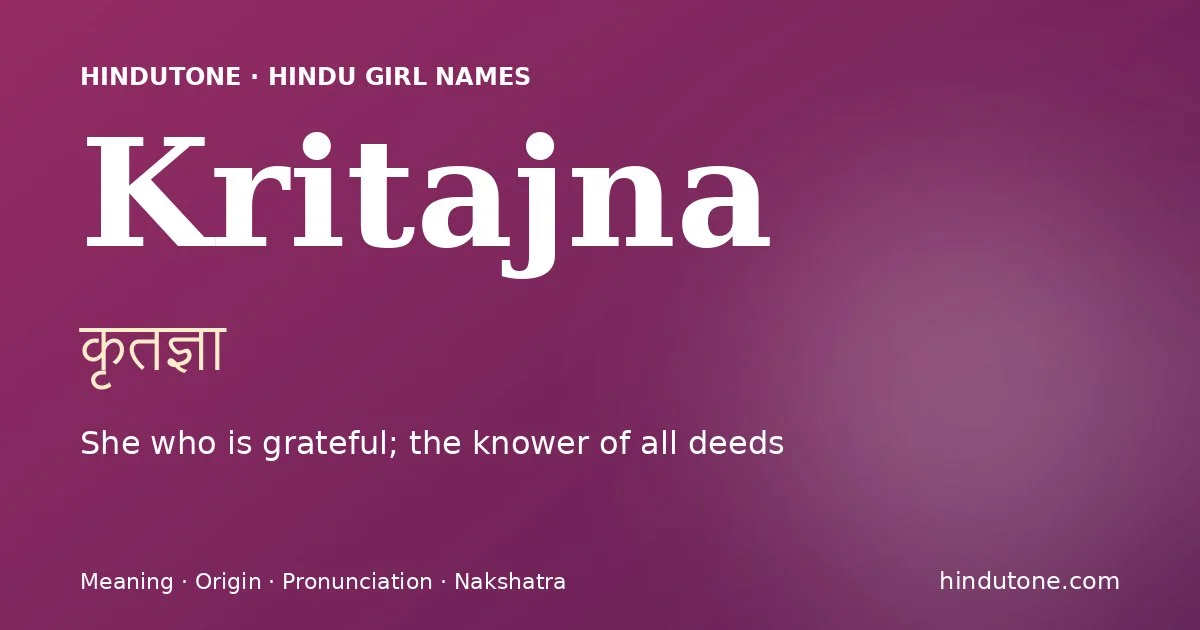
Kritajna (कृतज्ञा) is a Sanskrit-origin Hindu girl-name meaning “She who is grateful; the knower of all deeds”. Find pronunciation, origin, deity association, popularity and similar Hindu baby names.
Kritajna (कृतज्ञा, IAST: Kṛtajñā) is a Sanskrit-origin Hindu girl-name meaning “She who is grateful; the knower of all deeds”. Kṛtajñā unites kṛta (done, performed) and jñā (knower), denoting simultaneously 'she who knows what has been done' — omniscient witness of all karma — and 'she who is grateful,' recognising and honouring the devotion her bhaktas have offered.
Meaning, etymology & significance
The quality of kṛtajñatā (gratitude) in the Goddess is a remarkable theological statement: the Divine is not an indifferent cosmic machine but a responsive personal presence who acknowledges and treasures the sincere offerings of her devotees. On the omniscience reading, Kṛtajñā emphasises that Lalitā, as the inner witness (antaryāmin), is perfectly aware of every act, thought, and prayer without exception, and no devotion ever goes unseen. Holding both meanings together — the grateful Goddess who sees all — this name offers immense devotional reassurance: every flower placed at her feet, every tear shed in her name, is received and remembered by her.
Kṛtajñā is an epithet shared by Lalitā, Viṣṇu (as Kṛtajña in the Viṣṇu Sahasranāma), and Śiva, indicating its pan-Hindu resonance as a name of the Supreme who honours devotion; as a given name, Kritajna or Krithagya is used occasionally in Andhra Pradesh and Telangana. Pronunciation: kri-TAG-nyaa, with the jña rendered as 'gnya' or 'gya' depending on regional tradition.
Scriptural source
Kritajna appears in the Lalitha Sahasranama, among the sacred names of Lalitha.
Kritajna — Name Facts
- Meaning
- She who is grateful; the knower of all deeds
- Gender
- Hindu girl name
- Nakshatra
- Mrigashira
- Rashi
- Mithuna (Gemini)
- Numerology
- 8
Frequently asked questions
What does the name Kritajna mean?
Kritajna is a Sanskrit-origin Hindu girl name meaning “She who is grateful; the knower of all deeds”.
Is Kritajna a boy or girl name?
Kritajna is traditionally a Hindu girl name.
Which nakshatra and rashi suit the name Kritajna?
By the first-syllable rule of Vedic naming, Kritajna aligns with the Mrigashira nakshatra, under the Mithuna (Gemini) rashi.
What is the numerology number of Kritajna?
The Chaldean name number of Kritajna is 8.
Explore more: Mrigashira nakshatra names · Mithuna rashi names · Hindu girl names with K · All Hindu names A–Z