Maheshvari
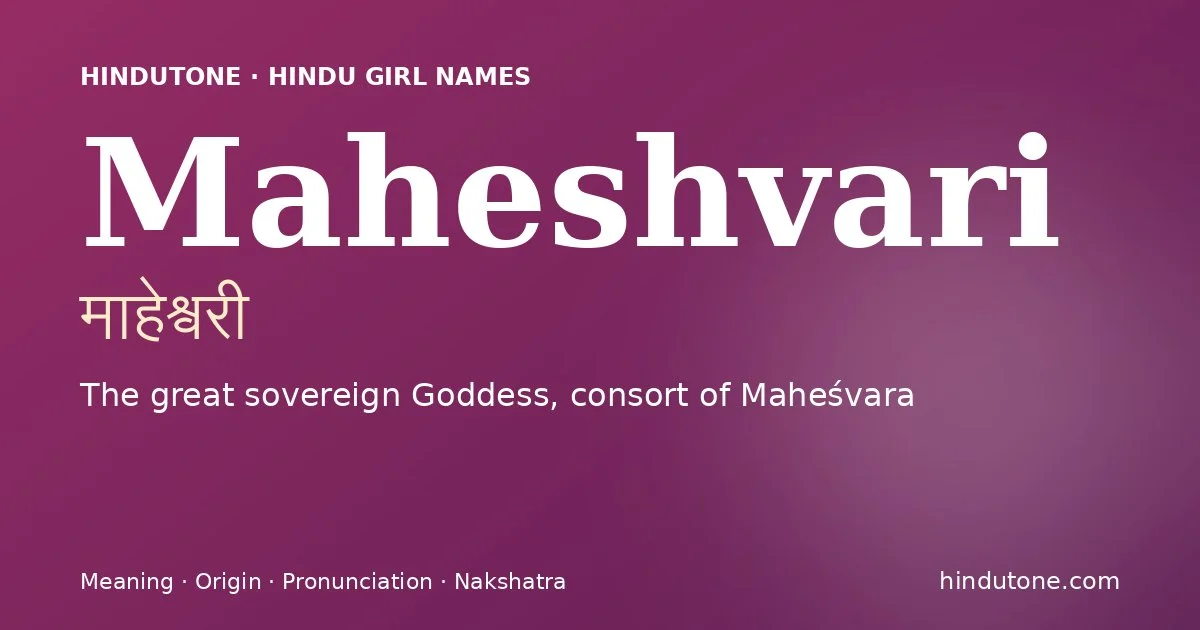
Maheshvari (माहेश्वरी) is a Sanskrit-origin Hindu girl-name meaning “The great sovereign Goddess, consort of Maheśvara”. Find pronunciation, origin, deity association, popularity and similar Hindu baby names.
Maheshvari (माहेश्वरी) is a Sanskrit-origin Hindu girl-name meaning “The great sovereign Goddess, consort of Maheśvara”. Find pronunciation, origin, deity association, popularity and similar Hindu baby names.
Maheshvari (माहेश्वरी, IAST: Māheśvarī) is a Sanskrit-origin Hindu girl-name meaning “The great sovereign Goddess, consort of Maheśvara”. Derived from Maheśvara (the Great Lord, Śiva) with the feminine suffix ī, Māheśvarī is the supreme feminine power belonging to and co-equal with the Absolute Lord, the Śakti who is inseparable from Śiva.
Meaning, etymology & significance
Māheśvarī is among the most august of the Goddess's names. Maha (great) + Īśvara (Lord) yields Maheśvara, one of Śiva's highest epithets; the feminine form Māheśvarī thus means 'She who is the great Sovereign herself.' She is listed among the Saptamātṛkās (seven divine mothers) and is venerated across all major Śākta and Śaiva traditions as the supreme feminine principle of lordship.
Māheśvarī is worshipped independently as a deity, as one of the Mātṛkās, and here as an epithet of Lalitā, uniting Śrīvidyā and Śaiva streams of devotion. Pronounced maa-hesh-va-ree.
Scriptural source
Maheshvari appears in the Lalitha Sahasranama, among the sacred names of Lalitha.
Astrology — nakshatra, rashi & numerology
By the standard Vedic correspondence between a name’s first syllable and the lunar mansion, Maheshvari aligns with the Magha nakshatra, under the Simha rashi (Moon sign). Its Chaldean name-number is 6.
Maheshvari — Name Facts
- Meaning
- The great sovereign Goddess, consort of Maheśvara
- Gender
- Hindu girl name
- Nakshatra
- Magha
- Rashi
- Simha (Leo)
- Numerology
- 6
Frequently asked questions
What does the name Maheshvari mean?
Maheshvari is a Sanskrit-origin Hindu girl name meaning “The great sovereign Goddess, consort of Maheśvara”.
Is Maheshvari a boy or girl name?
Maheshvari is traditionally a Hindu girl name.
Which nakshatra and rashi suit the name Maheshvari?
By the first-syllable rule of Vedic naming, Maheshvari aligns with the Magha nakshatra, under the Simha (Leo) rashi.
What is the numerology number of Maheshvari?
The Chaldean name number of Maheshvari is 6.
Explore more: Magha nakshatra names · Simha rashi names · Hindu girl names with M · All Hindu names A–Z