Pashahantri
Pashahantri (पाशहन्त्री) is a Sanskrit-origin Hindu girl-name meaning “She who destroys the bonds of bondage”. Find pronunciation, origin, deity association, popularity and similar Hindu baby names.
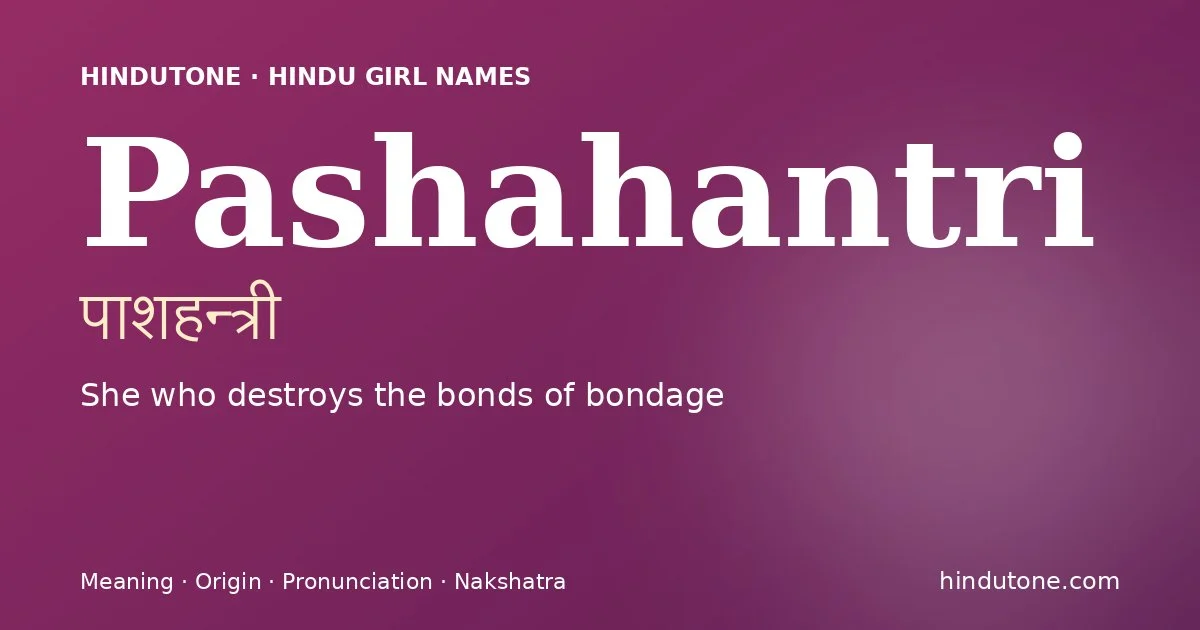
Pashahantri (पाशहन्त्री) is a Sanskrit-origin Hindu girl-name meaning “She who destroys the bonds of bondage”. Find pronunciation, origin, deity association, popularity and similar Hindu baby names.
Pashahantri (पाशहन्त्री, IAST: Pāśahantrī) is a Sanskrit-origin Hindu girl-name meaning “She who destroys the bonds of bondage”. From pāśa (noose, bondage) and hantrī (feminine destroyer), this epithet reveals Lalitā's grace in severing the three bonds—āṇava, māyīya, and kārma—that tether the soul to saṃsāra.
Meaning, etymology & significance
The Sanskrit root han (to strike, to slay) with the feminine agentive suffix -trī forms hantrī, meaning 'she who destroys.' Pāśa refers to the cosmic nooses of ignorance and karma that bind the jīva. Together, Pāśahantrī celebrates Lalitā as the liberating Goddess who, with a single act of grace, cuts every cord of worldly entanglement.
This epithet appears in the Lalitā Sahasranāma as a core name of the Devī in her liberating aspect; it is closely related to the iconographic detail of her holding a pāśa (noose) that she simultaneously wields and dissolves. Pronounced paa-sha-HAN-tree, with a long first vowel and stress on the third syllable.
Scriptural source
Pashahantri appears in the Lalitha Sahasranama, among the sacred names of Lalitha.
Astrology — nakshatra, rashi & numerology
By the standard Vedic correspondence between a name’s first syllable and the lunar mansion, Pashahantri aligns with the Uttara phalguni nakshatra, under the Kanya rashi (Moon sign). Its Chaldean name-number is 9.
Pashahantri — Name Facts
- Meaning
- She who destroys the bonds of bondage
- Gender
- Hindu girl name
- Nakshatra
- Uttara Phalguni
- Rashi
- Kanya (Virgo)
- Numerology
- 9
Frequently asked questions
What does the name Pashahantri mean?
Pashahantri is a Sanskrit-origin Hindu girl name meaning “She who destroys the bonds of bondage”.
Is Pashahantri a boy or girl name?
Pashahantri is traditionally a Hindu girl name.
Which nakshatra and rashi suit the name Pashahantri?
By the first-syllable rule of Vedic naming, Pashahantri aligns with the Uttara Phalguni nakshatra, under the Kanya (Virgo) rashi.
What is the numerology number of Pashahantri?
The Chaldean name number of Pashahantri is 9.
Explore more: Uttara Phalguni nakshatra names · Kanya rashi names · Hindu girl names with P · All Hindu names A–Z