Pashahasta
Pashahasta (पाशहस्ता) is a Sanskrit-origin Hindu girl-name meaning “She who holds the noose of bondage in her hand”. Find pronunciation, origin, deity association, popularity and similar Hindu baby names.
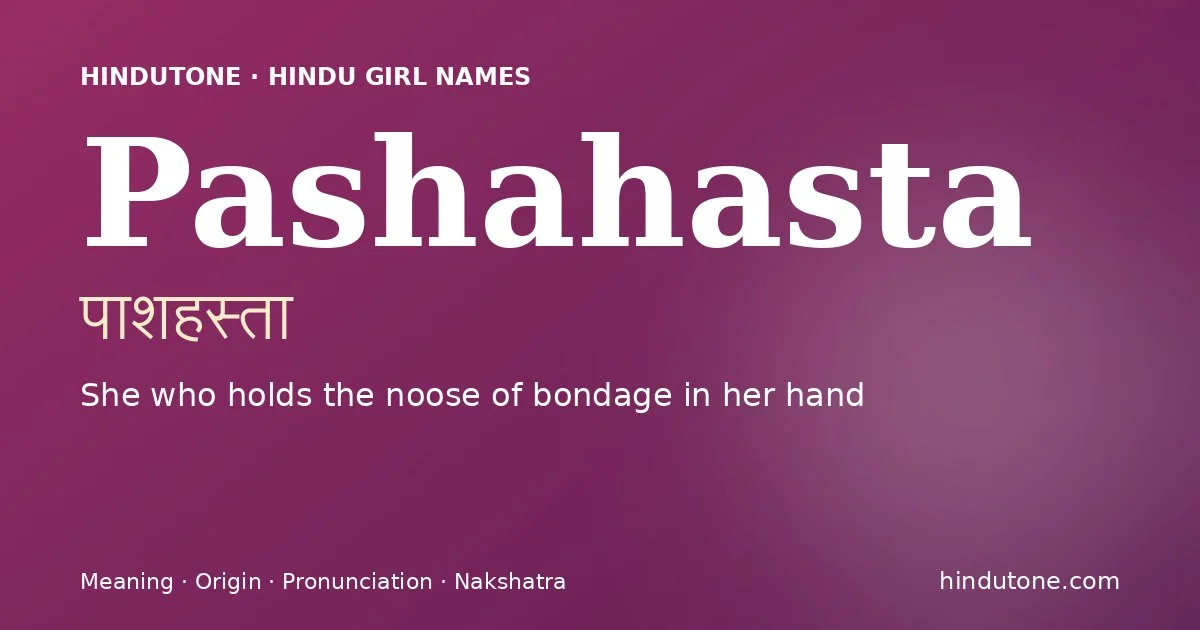
Pashahasta (पाशहस्ता) is a Sanskrit-origin Hindu girl-name meaning “She who holds the noose of bondage in her hand”. Find pronunciation, origin, deity association, popularity and similar Hindu baby names.
Pashahasta (पाशहस्ता, IAST: Pāśahastā) is a Sanskrit-origin Hindu girl-name meaning “She who holds the noose of bondage in her hand”. From pāśa (noose, cord of bondage) and hasta (hand), this iconographic epithet names Lalitā as the Goddess who wields the pāśa as one of her four weapons, symbolising her power to bind and liberate souls.
Meaning, etymology & significance
In the iconography of Lalitā Mahātripurasundarī, she holds four implements in her four hands: the pāśa (noose), the aṅkuśa (goad), a sugarcane bow, and five flower arrows. The pāśa binds the restless mind and ego, reining in those forces that lead the soul away from liberation; yet in the hands of the Goddess, the very instrument of bondage becomes the means of drawing the devotee irresistibly toward her lotus feet. Lalitā as Pāśahastā is thus both the one who binds and the one whose binding is an act of supreme compassion.
This name is central to the dhyāna (meditative visualisation) of Lalitā described in the Lalitopākhyāna and related Śrīvidyā texts. As a given name, Pāśahastā is iconographically specific and more commonly used in ritual invocation than as a personal name; pronounced paa-sha-has-taa.
Scriptural source
Pashahasta appears in the Lalitha Sahasranama, among the sacred names of Lalitha.
Astrology — nakshatra, rashi & numerology
By the standard Vedic correspondence between a name’s first syllable and the lunar mansion, Pashahasta aligns with the Uttara phalguni nakshatra, under the Kanya rashi (Moon sign). Its Chaldean name-number is 5.
Pashahasta — Name Facts
- Meaning
- She who holds the noose of bondage in her hand
- Gender
- Hindu girl name
- Nakshatra
- Uttara Phalguni
- Rashi
- Kanya (Virgo)
- Numerology
- 5
Frequently asked questions
What does the name Pashahasta mean?
Pashahasta is a Sanskrit-origin Hindu girl name meaning “She who holds the noose of bondage in her hand”.
Is Pashahasta a boy or girl name?
Pashahasta is traditionally a Hindu girl name.
Which nakshatra and rashi suit the name Pashahasta?
By the first-syllable rule of Vedic naming, Pashahasta aligns with the Uttara Phalguni nakshatra, under the Kanya (Virgo) rashi.
What is the numerology number of Pashahasta?
The Chaldean name number of Pashahasta is 5.
Explore more: Uttara Phalguni nakshatra names · Kanya rashi names · Hindu girl names with P · All Hindu names A–Z