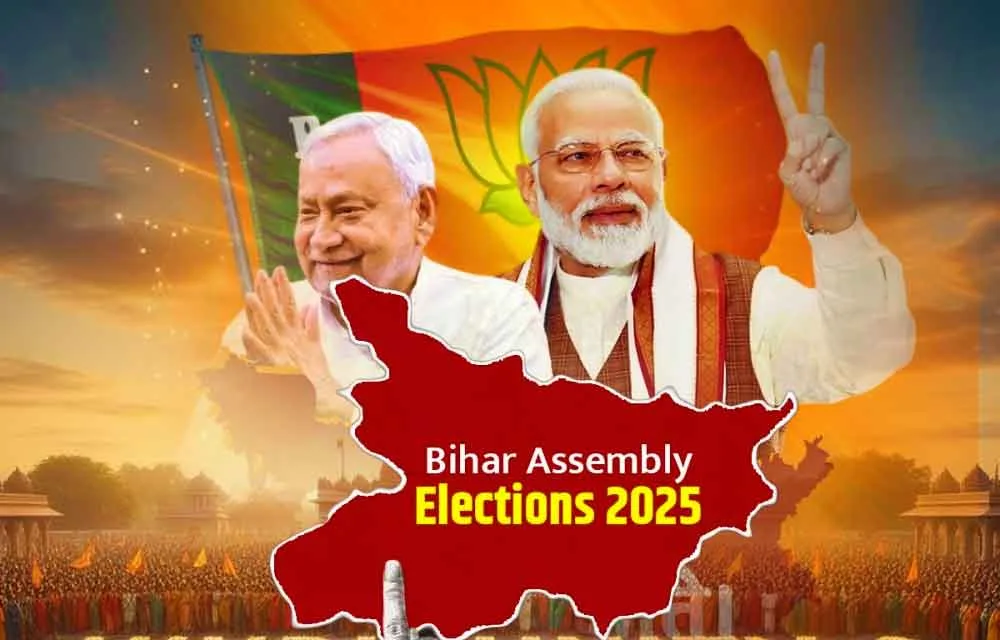
Bihar Assembly Elections 2025: NDA Leads in Early Trends
As of 9:30 AM IST on November 14, 2025, counting for the 243-seat Bihar Legislative Assembly is underway across 46 counting centers in 38 districts.
As of 9:30 AM IST on November 14, 2025, counting for the 243-seat Bihar Legislative Assembly is underway across 46 counting centers in 38 districts. Polling took place in two phases on November 6 and 11, witnessing a record turnout of 66.91–67.13%, the highest since 1951. Notably, women outvoted men with 71.6% female participation compared to 62.8% for males.
A total of 7.45 crore voters chose among 2,616 candidates from major alliances, smaller parties, and independents. Counting began at 8:00 AM with postal ballots, followed by EVM rounds from 8:30 AM, amid tight security, CCTV monitoring, and a three-layered protection system.
NDA Takes Early Lead, Crosses Majority Mark
Early trends from the Election Commission of India (ECI) and major news networks indicate that the National Democratic Alliance (NDA)—comprising the BJP, JD(U), HAM, LJP(RV) and others—has crossed the majority figure of 122 seats.
The opposition Mahagathbandhan (MGB/INDIA Bloc)—spearheaded by the RJD, with the Congress, Left parties, and allies like VIP—is trailing.
Prashant Kishor’s Jan Suraaj Party (JSP) is performing modestly, defying exit poll predictions of zero impact.
No final results have been declared yet; all numbers represent early-round trends. A clearer picture is expected by afternoon.
Exit Poll Recap
Exit polls (Axis My India, Today’s Chanakya, Matze) predicted:
- NDA: 121–209 seats
- MGB: 32–118 seats
- JSP: 0–5 seats
Interestingly, RJD has emerged as the single largest party in early counts, echoing its 2020 dominance (75 seats).
Early Seat Trends (Approx. 9:30 AM IST)
Aggregated from NDTV, Times Now, CNN-News18, ABP News, and India Today:
Key Leaders: Who’s Leading?
Nitish Kumar (JD(U), NDA)
NDA’s lead sets the stage for a potential 10th term for Nitish Kumar. JD(U) leaders credit welfare schemes and PM Modi’s backing.
Tejashwi Yadav (RJD, MGB CM Face)
Leading comfortably in Raghopur.
Exit polls showed 32% support for him as CM, slightly above Nitish (30%).
Chirag Paswan (LJP-RV, NDA)
Party ahead in five seats. Remains a key NDA figure.
Jitan Ram Manjhi (HAM)
Expected to retain influence with 1–2 strongholds.
Prashant Kishor (Jan Suraaj Party)
Debut performance stronger than predicted; positioned as a reformist alternative.
Major Trends, Highlights & Surprises
Key Trends
- NDA gains driven by:
- Upper caste consolidation (Bhumihar-Brahmin clusters)
- Strong women-centric schemes
- Retention of EBC support
- MGB performing well in minority-heavy Seemanchal.
- High youth turnout (3.7 crore Gen-Z voters), though fragmented.
Surprises
- JSP’s unexpected early leads despite “flop” predictions.
- AAP showing presence in Begusarai.
- Jailed JD(U) candidate Anant Singh leading from Mokama.
- Tej Pratap Yadav’s bounce-back in Mahua.
- Initial RJD edge later overtaken by NDA.
Broader Context
- NDA targeting 200+ seats post-Lok Sabha setbacks.
- MGB campaigning heavily on employment and exam leak issues.
- High security with international observers from 6 nations monitoring.
Note on HinduTone.com
No dedicated Bihar 2025 election article was found on the website as of this update.
What drove Bihar's record 66.91% turnout — and why women voters made the decisive difference
Bihar's voter participation in 2025 surpassed every state assembly election since the 1951 general elections, a benchmark that election analysts have attributed to a convergence of factors: expanded polling booth infrastructure, the Election Commission's 'Har Booth Utsav' mobilisation drive, and tangible beneficiary-linked welfare delivery under both the state and central governments. The Election Commission of India added over 11,000 new polling stations compared to 2020, specifically in remote Seemanchal and Kosi belt constituencies where turnout had historically lagged.
The gender gap reversal — 71.6% female turnout against 62.8% male — is historically significant. Political observers link this directly to the Nitish Kumar government's Jal-Jeevan-Hariyali scheme, the state's Cycle Yojana for girl students, and the central government's PM Ujjwala Yojana LPG distribution, all of which created a measurable household-level visibility of state intervention. In constituencies such as Sitamarhi, Muzaffarpur, and Darbhanga, women's self-help groups affiliated with JEEViKA reportedly ran voter awareness campaigns that directly boosted female booth-level turnout figures.
The Nitish Kumar factor: Can NDA's early lead translate into a stable tenth term
Nitish Kumar, who has served as Bihar's Chief Minister for most of the period since 2005, is seeking a record tenth term — a feat without parallel in the post-1977 political history of any major Indian state. His political longevity rests on a coalition of extremely backward castes (EBCs), Mahadalit communities formally recognised under the Mahadalit Aayog framework he established, and a significant section of women voters. JD(U)'s seat-sharing arrangement within NDA, giving the party a proportionally larger share of winnable constituencies compared to 2020, reflects BJP's strategic decision to lean on Kumar's local administrative credibility.
The Saat Nischay (Seven Resolves) scheme — covering piped water, pucca roads to every village, electricity connections, and higher education support — has been the centrepiece of JD(U)'s campaigning across all 243 seats. Candidates in rural constituencies of Bhagalpur, Banka, and Jamui districts specifically cited completion certificates under Saat Nischay Part 2 as their primary door-to-door canvassing material. Whether the early trends consolidate into a full majority for NDA will depend heavily on JD(U)'s conversion rate in central Bihar's mixed-caste constituencies.
Tejashwi Yadav and MGB's strategy: Why RJD emerging as single largest party may not be enough
Tejashwi Yadav's Mahagathbandhan fought this election on a platform anchored in the promise of ten lakh government jobs — the same plank that nearly brought MGB to power in 2020, when the alliance fell short despite winning more votes than NDA in aggregate. In 2025, MGB expanded its seat-sharing to include the VIP (Vikassheel Insaan Party) of Mukesh Sahani, targeting the Nishad and Mallah communities of north Bihar's riverine districts, and maintained its alliance with the Congress and CPI(ML) Liberation, the latter being particularly strong in Arwal and Jehanabad.
RJD's emergence as the single largest party in early counts mirrors its 2020 performance, when it won 75 seats — more than any single party — yet could not form the government due to the fragmented nature of the opposition's total tally versus NDA's combined numbers. The structural challenge for MGB remains arithmetic: even strong RJD performances in Yadav-concentrated belts of Saran, Siwan, and Gopalganj cannot fully compensate for Congress's persistent underperformance in its allocated seats. Tejashwi's personal lead in Raghopur, the constituency also held by his father Lalu Prasad Yadav for many years, is symbolically important but does not alter the broader seat equation.
Jan Suraaj Party's modest showing: What Prashant Kishor's electoral debut reveals
Prashant Kishor, the political strategist-turned-activist who launched the Jan Suraaj Party (JSP) after an extensive padyatra across Bihar's 38 districts between 2022 and 2024, fielded candidates across all 243 constituencies — a logistical undertaking that no new party had attempted in Bihar since the Samata Party's early years. Exit polls unanimously predicted zero to negligible impact, and early trends show a modest but non-zero seat count, which JSP is presenting as a proof-of-concept for what it calls 'jan shakti' over established caste consolidation blocs.
Kishor's campaign explicitly targeted first-time voters and urban youth in Patna Sahib, Patna City, and Gaya constituencies, arguing that Bihar's development deficit — in per-capita income, secondary education outcomes, and healthcare infrastructure — persists despite two decades of relatively stable governance. While JSP's seat tally appears unlikely to reach double digits based on current trends, any seats won by a zero-cadre party in its debut election will be scrutinised closely as an indicator of anti-incumbency sentiment that neither NDA nor MGB was able to fully absorb.
The counting process: How 46 counting centres manage 7.45 crore votes under three-tier security
The Election Commission of India deployed a three-layered security architecture at all 46 counting centres spread across Bihar's 38 districts: an outer perimeter managed by Central Armed Police Forces (CAPF), a middle cordon of Bihar Police, and an inner hall supervised exclusively by returning officers and authorised counting agents. EVM strongrooms had been under continuous CCTV surveillance since polling day, with live feeds accessible to candidates' representatives — a protocol introduced after the Supreme Court's directions in the Subroto Bagchi vs Union of India case guidelines on EVM custody transparency.
Counting began with postal ballots at 8:00 AM IST, as mandated by the Conduct of Elections Rules, 1961, followed by EVM rounds from 8:30 AM. Each counting table handles one assembly segment at a time, with results from individual rounds announced via the ECI's Voter Turnout App and Results portal before being aggregated. The sheer volume — 2,616 candidates across 243 seats — means that in closely contested constituencies such as Aurangabad and Nawada, final declarations may extend into late evening even as major alliance totals become clear by early afternoon.
Historical parallels: How Bihar's 2025 verdict compares to the landmark elections of 2005 and 2015
Bihar has been a bellwether for coalition politics in India since the 1990s. The February 2005 assembly election, which resulted in a hung assembly and President's Rule, followed by the October 2005 election that gave Nitish Kumar his first clear mandate, marked the transition from the RJD era of Lalu Prasad Yadav to a new governance paradigm. The 2005 realignment was driven by the same EBC-Mahadalit-women voter coalition that NDA is relying on in 2025, suggesting a structural continuity across two decades.
The 2015 election offered the opposite lesson: when JD(U), RJD, and Congress formed the Mahagathbandhan under the 'Lalu-Nitish' banner, NDA was reduced to 58 seats despite Modi's personal campaign blitz, demonstrating that caste arithmetic in Bihar can override developmental narratives when opposition unity is complete. The 2025 contest, with MGB intact but JSP fragmenting a sliver of non-traditional votes, more closely resembles the 2020 configuration than 2015 — and the 2020 result, NDA winning 125 seats, is the closest historical template for what the current early trends appear to be heading toward.
Frequently Asked Questions
When did counting for the Bihar Assembly Elections 2025 begin?
Counting began at 8:00 AM on November 14, 2025 with postal ballots, followed by EVM rounds from 8:30 AM across 46 counting centers in 38 districts.
What was the voter turnout in the 2025 Bihar elections?
Turnout was a record 66.91-67.13%, the highest since 1951. Women outvoted men, with 71.6% female participation against 62.8% for males.
How many seats does a party need to win a majority in Bihar?
The Bihar Legislative Assembly has 243 seats, so the majority mark is 122. Early trends showed the NDA crossing that figure.
Who were the main alliances in the Bihar election?
The NDA includes the BJP, JD(U), HAM and LJP(RV). The opposition Mahagathbandhan is led by the RJD with the Congress, Left parties and VIP, while Prashant Kishor's Jan Suraaj Party also contested.
Were the early counting trends final results?
No. Early trends are not final results, and no final results had been declared at the 9:30 AM update. A clearer picture was expected by afternoon.
What security arrangements were used at the counting centers?
Counting took place under tight security with CCTV monitoring and a three-layered protection system at all 46 centers.
Share this with family and friends
Send it on WhatsApp, post it, or copy the link.
More from News
- Aurora Hindu Temple Shooting Plot Foiled: Illinois Teen Charged After Rifle Jammed, Police Say
- Hindu Temples Abroad News, October 2026: Neasden's 42-Foot Tapomurti, Maha Annakut, Paris Mandir Hosts UNESCO Diplomats, Abu Dhabi Prayers
- Hindu Temple News, October 2026: Tirumala Navaratri Brahmotsavam, Sabarimala Security, Kashi's New CEO and Puri Updates
- Hindu Festival News, October 2026: Kullu Dussehra, Bastar, Delhi Ramlila, Gujarat Garba, Bathukamma, Chhath and Ayodhya Deepotsav
- Festival Special Trains 2026: Dasara, Diwali and Chhath Specials Announced So Far, Route by Route
You might also like
NDA's Historic Triumph in Muslim-Dominated Areas of Bihar 2025
Empowering Hindu Voters in Bihar: Rise and Vote for a Stronger India in 2025 Elections
Bihar NDA Victory: A Historic Boost to Hindu Unity and Empowerment