Cyber Complaint Filed Against Singer Chinmayi Over Tweet Row
Cyber Complaint Filed Against Singer Chinmayi Sripaada Over Controversial Epstein Tweet: Outraging Hindu Sentiments Alleged Hyderabad, February 3, 2026:…
Cyber Complaint Filed Against Singer Chinmayi Sripaada Over Controversial Epstein Tweet: Outraging Hindu Sentiments Alleged Hyderabad, February 3, 2026:…
Cyber Complaint Filed Against Singer Chinmayi Sripaada Over Controversial Epstein Tweet: Outraging Hindu Sentiments Alleged
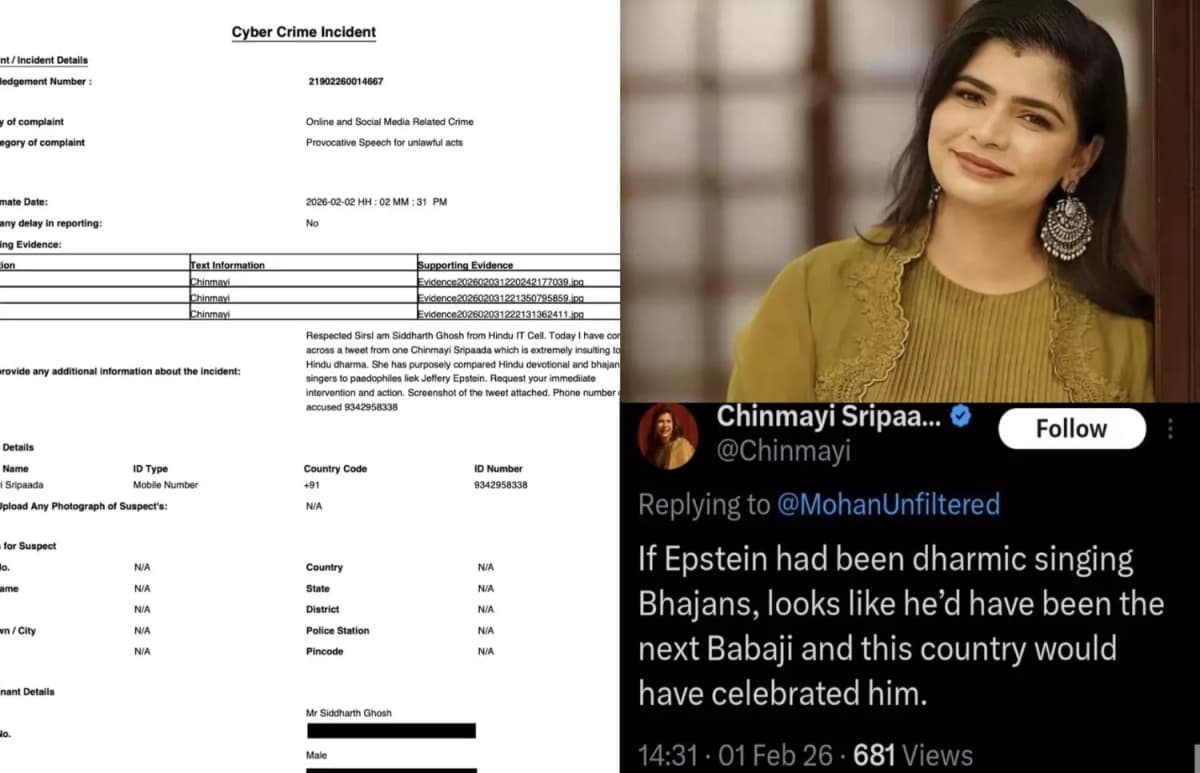
Hyderabad, February 3, 2026: Playback singer and voice artist Chinmayi Sripaada finds herself at the center of a fresh controversy after a cyber complaint was lodged against her for allegedly hurting Hindu religious sentiments through a tweet comparing protections for spiritual leaders to those for convicted sex offender Jeffrey Epstein.
The complaint, registered on February 3 with reference number 21902801467 on the cybercrime portal, accuses the singer of violating BNS Sections 299 (deliberate and malicious acts intended to outrage religious feelings) and 302 (related provisions under the new Bharatiya Nyaya Sanhita). Complainant Siddharth Ghosh claimed that Chinmayi's February 1 reply on X (formerly Twitter) drew an offensive parallel between Hindu devotional singers (bhajan performers) and pedophiles like Epstein, implying hypocrisy in how society shields certain "godmen."
The tweet in question was a reply to a post discussing moral bankruptcy and generalizations. Chinmayi reportedly wrote: "If Epstein had been dharmic singing Bhajans, looks like he'd have been the next Babaji and this country would have celebrated him." Critics interpreted this as a derogatory comparison equating revered Hindu spiritual figures or devotional singers with the notorious Epstein, known for his crimes involving underage girls.
Hindu IT Cell, a group focused on protecting Dharma legally, amplified the issue by sharing the complaint acknowledgment on X and calling for stricter action. They described Chinmayi as an "ultra-woke self-loathing feminist" and vowed to pursue the matter further, stating she would get opportunities "in courts and prison" to address her alleged desperation for relevance.
As of now, no FIR has been registered, and no arrest has taken place. Complaints filed via the national cybercrime portal undergo preliminary review by police authorities before escalation. Sources indicate the matter remains under assessment.
Divided Reactions in Telugu Film and Social Circles
The incident has sparked polarized responses:
- Critics from the Telugu film industry and some social media users celebrated the complaint, viewing Chinmayi's comment as part of a pattern of anti-Hindu or provocative statements.
- Supporters defended it as sharp satire targeting hypocrisy among certain self-styled godmen who face allegations of misconduct yet retain societal protection and reverence. They argued the tweet was hypothetical and not a direct insult to all Hindu devotional singers or Hinduism itself.
Chinmayi Sripaada, known for her playback singing in Telugu, Tamil, and other languages, as well as her vocal activism on issues like women's safety and industry harassment, has faced online backlash and legal scrutiny in the past—often related to abuse directed at her rather than complaints against her.
This latest development highlights ongoing tensions around free speech, satire, and religious sensitivities on social media in India. The Bharatiya Nyaya Sanhita's provisions on outraging religious feelings continue to be invoked in such cyber disputes.
Hindutone will monitor further updates, including any police action or response from Chinmayi Sripaada.
Tags: Chinmayi Sripaada, Jeffrey Epstein tweet, cyber complaint, Hindu IT Cell, BNS 299 302, outraging religious feelings, godmen hypocrisy, Telugu singer controversy
What do BNS Sections 299 and 302 actually say, and how do they apply here?
The Bharatiya Nyaya Sanhita (BNS), which replaced the Indian Penal Code in 2023, carries forward protections for religious sentiments under Section 299, which criminalises deliberate and malicious acts intended to outrage the religious feelings of any class by insulting its religion or religious beliefs. The key operative word in courts has consistently been 'deliberate and malicious' — prosecutors must establish that the accused intended to wound religious sentiment, not merely that some members of a community felt offended by the content.
Section 302 of the BNS covers related provisions concerning statements that promote enmity between groups. Together, these two sections form the twin statutory basis on which the cybercrime complaint against Chinmayi Sripaada was registered. Legal observers note that in online speech cases, courts typically examine the full context of a post — including the thread it appeared in, the specific words used, and whether a reasonable reader would interpret it as targeting a religion rather than critiquing social hypocrisy. No FIR has yet been registered, meaning police have not formally determined that a cognisable offence occurred.
The national cybercrime portal (cybercrime.gov.in) functions as a first-level reporting interface; complaints submitted there are forwarded to the jurisdictionally competent police unit for preliminary review. Registration of a complaint on the portal does not carry the same legal weight as an FIR filed at a police station, and many portal complaints are closed after initial scrutiny without proceeding to investigation.
What is the religious and cultural significance of bhajan performance in Sanatana Dharma?
Bhajan — from the Sanskrit root 'bhaj,' meaning to revere or to share — occupies a central place in the devotional life prescribed by texts such as the Bhagavata Purana and the Narada Bhakti Sutras. The Bhagavata Purana (7.5.23-24) enumerates nine forms of bhakti, among which kirtana (congregational singing of the Lord's names and glories) is listed as one of the most accessible paths to liberation, available to all regardless of caste, gender, or learning.
The sant-tradition that produced composers such as Mirabai, Kabir, Tukaram, and Tyagaraja treated bhajan singing not as entertainment but as sadhana — spiritual discipline. Tyagaraja's Pancharatna Kritis, still performed at the annual Tyagaraja Aradhana at Thiruvaiyaru in Tamil Nadu every January, exemplify how a composer's entire life can be structured as an act of devotion. For practitioners, the bhajan singer (kirtankar or bhajana-sampradaya-gaayaka) is understood to be a vehicle for the divine name, and their role carries inherent sanctity in this framework.
Critics of Chinmayi's tweet argue that the comparison collapsed this theological and cultural specificity into a cynical equivalence, treating the social reverence extended to devotional singers as mere cover for misconduct. Defenders of the tweet contend that it was directed at societal blind spots around accountability, not at the devotional tradition itself. This interpretive dispute sits at the heart of the legal question of intent.
Who is Chinmayi Sripaada, and what is her track record on social commentary?
Chinmayi Sripaada is a National Award-winning playback singer and a highly trained Carnatic vocalist who has recorded songs in Telugu, Tamil, Kannada, Malayalam, Hindi, and several other Indian languages. Beyond her musical career, she is widely recognised as one of the most prominent voices of the #MeToo movement in South India, having publicly named lyricist Vairamuthu in 2018 as an alleged harasser — a disclosure that led to her being reportedly sidelined from the Tamil film industry for a period.
Her public social media presence is characterised by sharp commentary on gender, caste, and institutional accountability. She has previously drawn both praise and criticism for posts challenging what she describes as the selective moral policing of women while powerful men escape scrutiny. This pattern of commentary is relevant context for the tweet in question, which her supporters argue was a continuation of that same critical tradition rather than an attack on Hindu devotional practice per se.
Chinmayi has not, as of the time of this report, issued a formal public statement specifically addressing the cybercrime complaint, though she has remained active on social media. Her legal team has not made any public filing in response to the complaint.
What is the Hindu IT Cell, and what legal avenues is it pursuing?
The Hindu IT Cell is a digital-rights and legal-advocacy group that describes its mandate as protecting Dharma through online mobilisation and formal legal mechanisms. The organisation has previously filed complaints or petitions in matters involving alleged defamation of Hindu figures, derogatory depictions of Hindu deities in media, and perceived anti-Hindu bias in public discourse. It operates primarily through social media amplification and coordinated complaint filing on cybercrime and other government portals.
In this instance, the Hindu IT Cell shared the complaint acknowledgment number (21902801467) on X, urging followers to also register their own complaints about the tweet. This tactic of encouraging mass complaint filing is legally permissible; however, it does not accelerate the police review process or increase the likelihood of an FIR, as each complaint is assessed individually on its merits by the relevant police authority.
The group has indicated it may pursue the matter further if the cybercrime complaint does not result in action, potentially including filing a private complaint before a magistrate under Section 223 of the Bharatiya Nagarik Suraksha Sanhita (BNSS), which allows an individual to approach a court directly when police decline to register an FIR. Whether that step will be taken remains to be seen.
How have Indian courts previously handled similar social media complaints touching on religious sentiment?
Indian courts have a mixed but increasingly nuanced record on Section 295A (the predecessor to BNS Section 299) cases arising from social media posts. The Supreme Court of India, in Shreya Singhal v. Union of India (2015), struck down Section 66A of the Information Technology Act precisely because it criminalised online speech too broadly, and held that advocacy, discussion, and criticism — even when offensive to some — do not automatically constitute incitement. This judgment continues to influence how lower courts read religion-related speech offences.
In several High Court decisions since 2015, judges have quashed FIRs registered under Section 295A where the complaint arose from a tweet or Facebook post that, on a full reading, appeared to critique social behaviour rather than attack a religion's core tenets. Courts have distinguished between satire aimed at human conduct and statements that directly vilify a deity, scripture, or religious symbol. The Chinmayi tweet, by not naming any specific deity, temple, or sacred text, may fall into the former category — though that determination rests with the police and, if necessary, a court.
Legal scholars note that the threshold for 'deliberate and malicious' intent is high, and that prosecutions under this section which proceed to trial and result in conviction are relatively rare. The social and reputational consequences of a public complaint, however, can be significant for the accused regardless of the legal outcome, a dynamic that critics of such complaint strategies argue has a chilling effect on legitimate public discourse.
Frequently Asked Questions
What is Cyber Complaint Filed Against Singer Chinmayi Over?
Cyber Complaint Filed Against Singer Chinmayi Sripaada Over Controversial Epstein Tweet: Outraging Hindu Sentiments Alleged Hyderabad, February 3, 2026: Playback singer and voice artist Chinmayi Sripaada finds herself at the center of a fresh controversy after a cyber complaint was lodged against her for allegedly hurting Hindu religious sentiments through a
What are the key points about Cyber Complaint Filed Against Singer Chinmayi Over?
Complainant Siddharth Ghosh claimed that Chinmayi's February 1 reply on X (formerly Twitter) drew an offensive parallel between Hindu devotional singers (bhajan performers) and pedophiles like Epstein, implying hypocrisy in how society shields certain "godmen." The tweet in question was a reply to a post discussing moral bankruptcy and ge
Why does Cyber Complaint Filed Against Singer Chinmayi Over matter in Hinduism?
It reflects core values of Sanatana Dharma and offers practical and spiritual guidance that remains relevant across generations.
How can devotees apply Cyber Complaint Filed Against Singer Chinmayi Over in daily life?
By reflecting on its teaching, incorporating the related practices or observances into daily routine, and approaching it with sincere devotion and understanding.
You might also like

Shani Deva Temples Worldwide & Must-Performed Rituals — Complete Devotee's Guide

ISKCON to Serve Pure Sattvik Mid-Day Meals to School Children in Bengal | Suvendu Adhikari Initiative

The Resolve of a Monk – A Divine Incident Showcasing Kanchi Paramacharya’s Compassion