Ayodhya Ram Janmabhoomi Case: How Hindus Won — ASI Evidence & 2019 Supreme Court Verdict
The complete account of how Hindus won the Ayodhya Ram Janmabhoomi case: scriptures, foreign-traveller accounts, the ASI 2003 excavation & the Vishnu Hari inscription that shaped the historic 2019 Supreme Court verdict.
For over 500 years, the sacred soil of Ayodhya waited in silent agony — the birthplace of Maryada Purushottam Shri Rama, where a temple stood for centuries until it was reduced to ruins and a mosque raised over its remnants.
On 9 November 2019, the Supreme Court of India delivered a unanimous five-judge verdict awarding the entire disputed land to Hindus for the construction of the grand Shri Ram Janmabhoomi Mandir. It was a moment when faith met irrefutable evidence, and justice aligned with truth. Here is the complete account of how Hindus won the case, exactly what proofs they submitted, and how science, history and devotion came together in the courtroom.
The Sacred Claim: Ayodhya, the Eternal Janmabhoomi of Lord Rama
Hindus have always held — through the Valmiki Ramayana, Skanda Purana, Brihad-dharmottara Purana and Ayodhya Mahatmya — that Ayodhya is the birthplace of Shri Rama, described in these texts with precision. Through every period of foreign rule, devotees continued to worship at the Ram Chabutra in the outer courtyard, believing the inner sanctum marked the Janmasthan. This living, unbroken tradition of worship formed the spiritual foundation of the case.
Centuries of Pain and Resistance
Historical records corroborated what Hindus asserted:
- Joseph Tieffenthaler (Jesuit priest, 1766–1771) described a "Bedi" (cradle) where Rama was born, black stone pillars of an ancient temple, and continuing Hindu worship despite the mosque.
- The Ain-i-Akbari (Abul Fazl, Akbar’s court) records Ayodhya as the residence of Ramachandra, avatar of Vishnu.
- British gazetteers and traveller accounts (William Finch, John De Laet and others) repeatedly call the site Janmasthan or Ram Janmabhoomi.
- A 1717 land grant by Raja Jai Singh vested the property in the deity Himself.
Despite this, a mosque was raised in 1528–29 by Mir Baqi (under Babur’s orders) using material from the earlier temple — a fact later corroborated by archaeology.
The Legal Battle: A Marathon of Dharma
The modern legal fight began in the 1950s and intensified after 1992. Multiple suits were filed, reaching the Allahabad High Court, which in 2010 gave a split verdict dividing the land. The matter finally reached the Supreme Court in 2019, where Hindus presented a mountain of evidence.
How Hindus Submitted Irrefutable Proofs
1. Ancient Scriptures & Literary Evidence
The Valmiki Ramayana, Skanda Purana, Brihad-dharmottara Purana and Ayodhya Mahatmya were presented to establish Ayodhya as Rama’s birthplace since time immemorial. The Court noted the Hindu belief in the site as Janmasthan was backed by centuries of tradition.
2. Foreign Traveller Accounts & Historical Chronicles
Independent, non-Hindu sources were powerful: Tieffenthaler’s description of temple remnants and ongoing worship; accounts from the times of Jahangir and Shah Jahan; and British-era gazetteers and revenue records explicitly naming the site Ram Janmabhoomi or Janmasthan.
3. Revenue Records, Land Grants & Official Documents
The 1717 documents vesting the site in the deity, British records showing Hindus in continuous possession of the outer courtyard, and official references treating the site as sacred to Hindus for centuries.
4. Living Tradition of Worship & Possession
Through 88 witness depositions and documentary evidence, Hindus showed open, continuous and exclusive possession of the outer courtyard — worship at the Ram Chabutra, Sita Rasoi and other sacred spots — even when the inner structure was under mosque control. The Court observed that namaz had not been offered continuously or exclusively in the inner part before 1857, and that Hindus held the stronger possessory claim.
5. The Decisive Blow: the ASI Excavation Report (2003)
Ordered by the Allahabad High Court, the Archaeological Survey of India excavated the site in 2003 (under Hari Manjhi and B.R. Mani, building on Prof. B.B. Lal’s earlier 1968–77 work, which included the archaeologist K.K. Muhammed). Its findings included:
- A massive pre-existing structure (at least ~50m × 30m) directly beneath the Babri structure.
- Over 50 pillar bases arranged in 17 rows — classic North Indian temple architecture.
- Pillar bases and reused black-stone pillars bearing Hindu motifs — Poorna Kalasha, Ashta-Mangala symbols, lotuses, Kirtimukha and Yaksha-Yakshi figures.
- Temple architectural elements: Kalash, Amalaka, Grivah and Shikhara sections, a Makara Pranali (water spout) and an octagonal Yagna Kund.
- 263 terracotta figurines of deities, divine figures and animals.
- A Sanskrit inscription — the "Vishnu Hari" stone slab — dedicating a temple to Vishnu’s incarnation who slew Bali and the ten-headed Ravana.
- Material predating Babur’s era (1528), with Northern Black Polished Ware indicating civilisational continuity back to roughly the 7th century BCE.
The Supreme Court relied heavily on this report, concluding that the mosque was not built on vacant land and that a structure "that was not Islamic" underlay it. Combined with Hindu possession of the outer courtyard, the balance tilted decisively in favour of Hindus.
The Historic 2019 Supreme Court Verdict
On 9 November 2019, the five-judge bench delivered its judgment:
- The entire disputed land (~2.77 acres) was awarded to Hindus for the Shri Ram Janmabhoomi Mandir.
- A separate 5-acre plot in Ayodhya was allotted to the Sunni Central Waqf Board for a mosque.
- A trust was to be formed for temple construction — later the Shri Ram Janmabhoomi Teerth Kshetra Trust.
- The Court recognised Ram Lalla (the deity) as a juristic person with legal rights.
- Hindus had established a possessory title through long, continuous worship, reinforced by the ASI evidence.
The Court also condemned the 1992 demolition as illegal, while prioritising restoration of the site on the basis of evidence and title.
A New Era for Sanatan Dharma
The Ayodhya verdict is not about one temple alone. The ASI report turned long-held belief into archaeological reality; the "Vishnu Hari" inscription spoke across centuries; the ground itself revealed what time had buried. Today the Shri Ram Mandir stands in Ayodhya — a symbol of cultural renaissance and the steadfastness of faith. Jai Shri Ram.
Frequently Asked Questions
What was the single most important evidence in the Ayodhya case?
The ASI 2003 excavation report — it scientifically established that a massive pre-existing, non-Islamic (temple-like) structure lay beneath the mosque, with pillar bases, Hindu motifs, a Yagna Kund and the "Vishnu Hari" inscription.
Did the Supreme Court say a temple was demolished to build the mosque?
The Court held that a large non-Islamic structure predated the mosque and that the mosque was not built on vacant land. Combined with the evidence of Hindu possession and worship, this was decisive.
What proofs did Hindus submit besides archaeology?
Ancient scriptures (Valmiki Ramayana, Puranas, Ayodhya Mahatmya), foreign traveller accounts (Joseph Tieffenthaler and others), British gazetteers and revenue records calling the site Janmasthan, land grants, and continuous oral/witness testimony of worship (88 witnesses deposed).
How long did the legal battle last?
Suits began in the 1950s and intensified after 1992; the Allahabad High Court gave a split verdict in 2010, and the final Supreme Court verdict came on 9 November 2019 — spanning nearly seven decades of legal struggle.
Can I visit the Ram Mandir now?
Yes — the Shri Ram Janmabhoomi Mandir in Ayodhya is open for darshan. Plan your pilgrimage to experience this living chapter of faith and history.
See also our Ayodhya Ram Mandir — history & significance and the 500-year struggle.
Share this with family and friends
Send it on WhatsApp, post it, or copy the link.
More from Temples
- Famous Temples in West Bengal: A Source-Checked Guide to Kalighat, Dakshineswar, Tarapith, Bansberia, Bishnupur and More
- Famous Temples in Gujarat: A Source-Checked Guide to Somnath, Dwarka, Dakor, Ambaji, Modhera and More
- Famous Temples in Madhya Pradesh: A Source-Checked Guide to Mahakaleshwar, Omkareshwar, Khajuraho, Orchha and Datia
- Famous Temples in Kerala: A Source-Checked Guide to Guruvayur, Padmanabhaswamy, Vadakkunnathan, Attukal, Sabarimala and 70 More
- Famous Temples in Andhra Pradesh: A Source-Checked Guide from Tirumala and Simhachalam to Srikurmam, Lepakshi and Kanipakam
You might also like
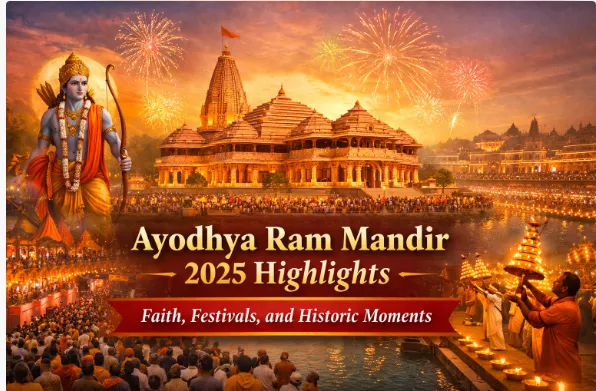
Ayodhya Ram Mandir 2025 Highlights: Faith, Festivals, and Historic Moments
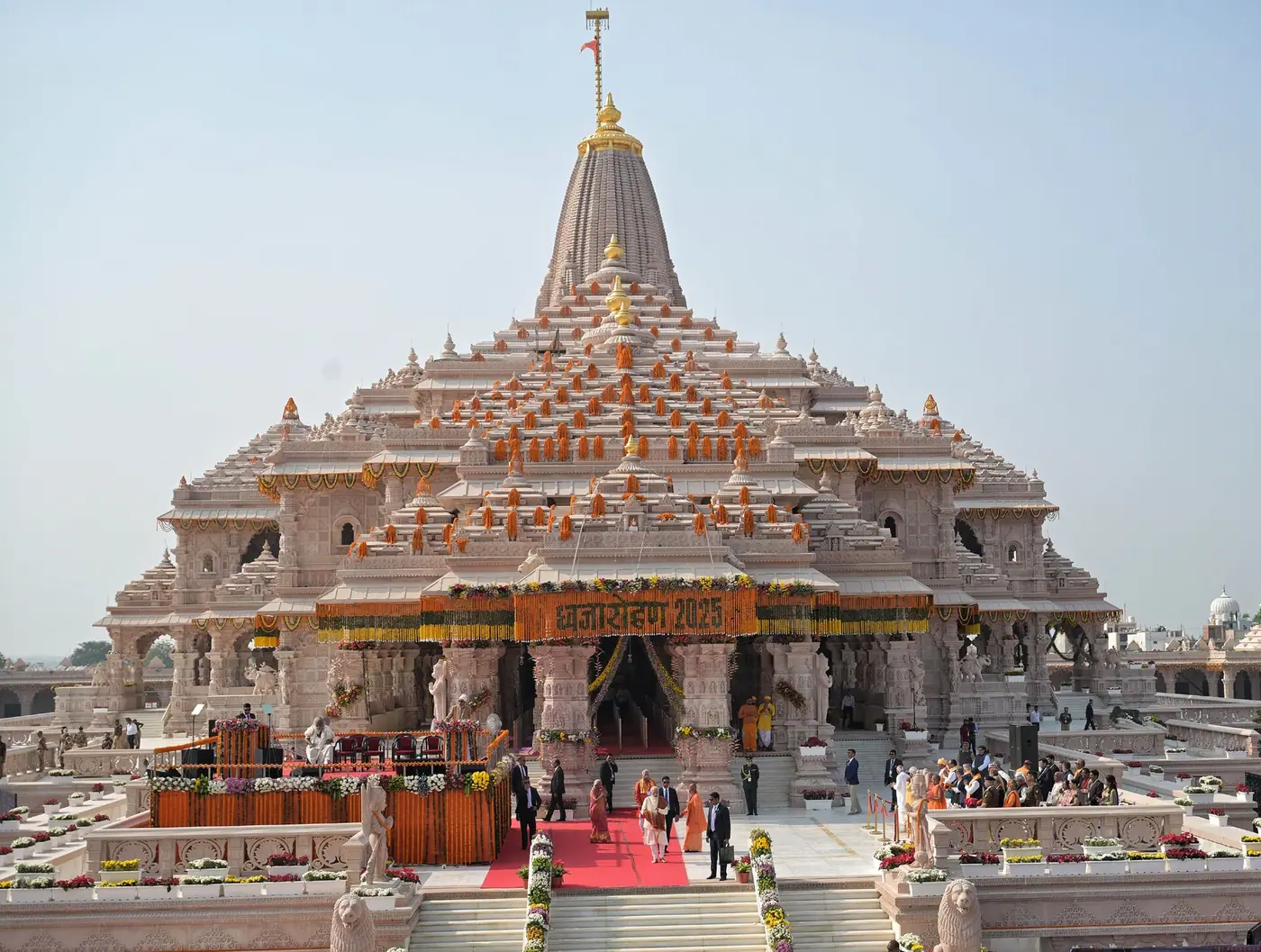
Famous Temples in Uttar Pradesh: A Source-Checked Guide to Kashi, Ayodhya, Mathura-Vrindavan, Gorakhpur and Kanpur
Famous Temples in Uttarakhand: A Source-Checked Guide to Kedarnath, Badrinath, Tungnath, Haridwar, Almora and More