
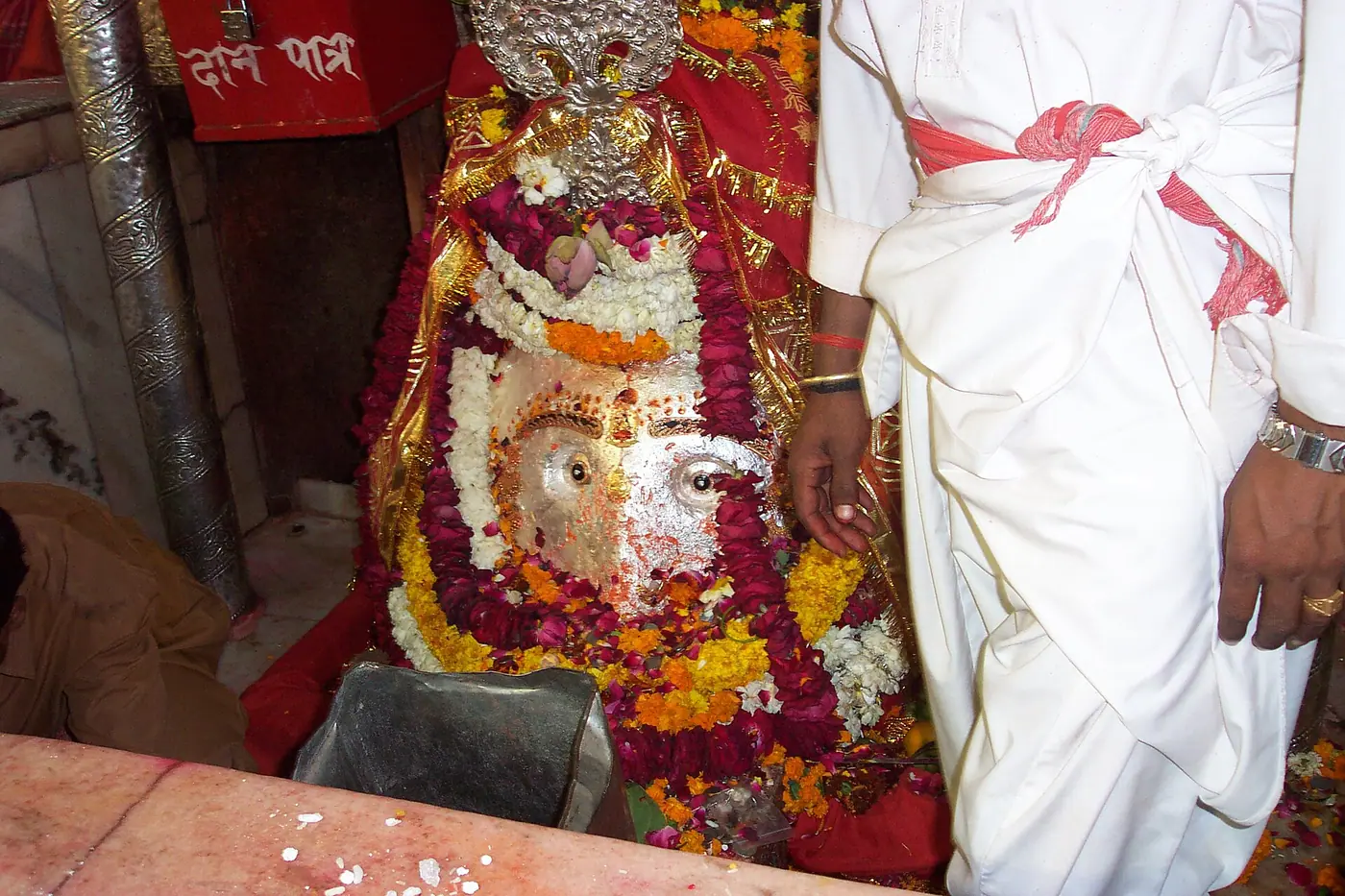
Kalkaji Mandir
Devi (Kali) temple · New Delhi (Kalkaji), South East Delhi, Delhi, India
Photo: Unknown author · Public domain · via Wikimedia Commons
Kalkaji Mandir is a temple to the goddess Kali, worshipped here as Kalka Devi, in the Kalkaji area of South Delhi, opposite Nehru Place. The locality takes its name from the temple. Devotees believe the image of the goddess is self-manifested (svayambhu), and the temple is one of Delhi's most visited Devi shrines, especially during the two Navratri festivals each year.
The temple stands on a rocky outcrop of the Delhi ridge. The oldest parts of the present building date from the 18th century, with additions in the early 19th century.
Faith & Tradition
Religious Significance of Kalkaji Mandir
According to tradition, as recorded by the South East Delhi district administration, the goddess appeared here in an earlier age (the Satya Yuga) to destroy demons, among them Raktabija. Devotees believe that Kalka Devi grants the wishes of those who pray to her, and the temple is known locally as a Manokamna Siddha Peetha, a seat where wishes are fulfilled.
Some devotional writings call Kalkaji a Shakti Peetha (sometimes 'Jayanti Peetha'). It does not appear in the most commonly cited lists of Shakti Peethas, and these lists differ, so HinduTone does not class it as one.
Heritage
History of Kalkaji Mandir
Historical accounts generally date the oldest surviving parts of the present building to no earlier than 1764, when the Marathas held influence in Delhi. In 1816 Mirza Raja Kidar Nath, a peshkar (official) at the court of the Mughal emperor Akbar II, is recorded as funding additions, including a ring of outer rooms and a tall pyramidal roof over the shrine. Much of the surrounding complex is later still.
There is evidence of much older activity nearby: a Minor Rock Edict of the emperor Ashoka (3rd century BCE) was found in 1966 at Bahapur, close to the temple. This shows the area's antiquity but says nothing directly about the age of worship at the shrine.
The temple has no single statutory board. It has long been served by hereditary priestly families known as baaridars, who take turns (baari) in conducting worship. Because of disputes among them, the Delhi High Court appointed an administrator in September 2021 and approved a redevelopment plan. In a September 2025 order, however, the court recorded that the administrator had stopped functioning and that the temple was again being run by baaridar and pujari groups, with redevelopment held up by a Supreme Court status-quo order.
Architecture and sacred features
The core shrine is a twelve-sided chamber, about 24 feet across, surrounded by a verandah with scalloped arched openings, in a style that combines Mughal and Maratha features. Marble and red sandstone are used around the sanctum.
Plan Your Visit
Darshan and Visitor Information
Crowds are very large during Chaitra and Ashvin Navratri, and queues and access routes are often changed for these days. Management arrangements are subject to ongoing court proceedings, so confirm current arrangements with the temple management or the South East Delhi district administration before visiting.
Timings and arrangements change with seasons and festivals. Confirm current details with Hereditary baaridars and pujaris; subject to Delhi High Court proceedings (court-appointed administrator 2021–2024) (official website) before travelling. Last reviewed 5 October 2026.
Sacred Calendar
Festivals at Kalkaji Mandir
Chaitra Navratri
One of the two Navratris that bring the largest crowds of the year, as devotees come to seek Kalka Devi's blessing.
Sharad (Ashvin) Navratri
The autumn Navratri is the temple's busiest season, when devotees queue in large numbers for darshan of Kalka Devi.
Location
How to Reach Kalkaji Mandir
Kalkaji Mandir station on the Delhi Metro is next to the temple. The South East Delhi district administration lists Indira Gandhi International Airport as the nearest airport and Hazrat Nizamuddin as the nearest major railway station; Okhla station is also nearby. By road the temple is reached from Ma Anandmayee Marg, near the Nehru Place bus terminal.
Location: New Delhi (Kalkaji), South East Delhi, Delhi, India
Nearest airport: Indira Gandhi International Airport, New Delhi
Nearest railway station: Hazrat Nizamuddin (also Okhla); Delhi Metro: Kalkaji Mandir
More in Hindu temples in Delhi · Devi (Kali) temples · Temples in South East Delhi District
Questions
Kalkaji Mandir: Frequently Asked Questions
Which goddess is worshipped at Kalkaji Mandir?
The temple is dedicated to Kali, worshipped as Kalka Devi. Devotees believe the image is self-manifested.
How old is Kalkaji Mandir?
Tradition holds that worship here is very ancient. The oldest surviving parts of the present building are dated to no earlier than 1764, with additions made in 1816 by Mirza Raja Kidar Nath, an official at the court of Akbar II.
Is Kalkaji Mandir a Shakti Peetha?
Some devotional writings call it one, but it is not in the most commonly cited Shakti Peetha lists, and these lists vary. Locally it is known as a Manokamna Siddha Peetha, where wishes are believed to be granted.
Which Metro station is nearest to Kalkaji Mandir?
Kalkaji Mandir station on the Delhi Metro is next to the temple, near Nehru Place.
Who manages Kalkaji Mandir?
Worship is carried out by hereditary priestly families (baaridars) in turns. The Delhi High Court appointed an administrator in 2021, but a September 2025 order recorded that management had returned to baaridar and pujari groups while related cases continue in the Supreme Court.
When is Kalkaji Mandir most crowded?
The temple is busiest during Chaitra Navratri (March–April) and Sharad Navratri (September–October).
Sources and attribution
- © OpenStreetMap contributors — location data © OpenStreetMap contributors (ODbL)
- Wikidata Q6353337 — structured data (CC0)
- Wikipedia — Kalka Mandir, Delhi — text facts from Wikipedia, licensed CC BY-SA 4.0
- District Magistrate, South East Delhi (Government of NCT of Delhi) — Kalka Mandir, Delhi
- High Court of Delhi — Neeta Bhardwaj & Ors. v. Kamlesh Sharma, FAO 36/2021, order dated 19 September 2025
- LiveLaw — Supreme Court Halts Dispossession Of Pujaris For Kalkaji Temple Redevelopment
- Wikipedia — Kalkaji Mandir (pointer; cites National Mission on Monuments and Antiquities record)
- The Statesman — Temples in Delhi to visit this Navratri
Further reading: Kalkaji Mandir on Wikipedia (CC BY-SA 4.0).
Spotted an error? Write to info@hindutone.com — see our editorial policy.
Pilgrim Circuit