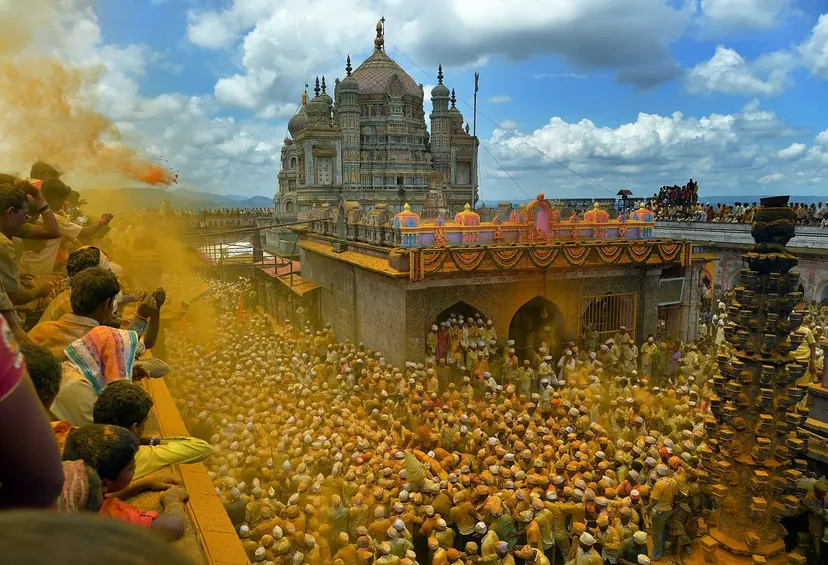
Kailasa Temple (Cave 16), Ellora
Shiva temple · Ellora (Verul), Chhatrapati Sambhajinagar (Aurangabad), Maharashtra, India
The Kailasa temple, also called Kailasanatha and Cave 16, is a monolithic rock-cut Hindu temple to Shiva at Ellora (Verul), about 30 km north-west of Aurangabad in Maharashtra. It is part of the Ellora Caves World Heritage Site, where UNESCO describes it as the largest monolithic temple and the culmination of rock-cut architecture.
Faith & Tradition
Religious Significance of Kailasa Temple (Cave 16), Ellora
The temple represents Mount Kailasa, the Himalayan abode of Shiva (LiveHistoryIndia). Unlike earlier Deccan cave temples, it is a rock-hewn rendering of a free-standing structural temple in a large open court, about 32 metres high and 78 metres long, ThePrint's book excerpt notes.
It belongs to the Brahmanical group of caves at Ellora (caves 13–29), excavated between the 7th and 10th centuries, alongside the Buddhist and Jain groups that UNESCO cites as evidence of religious co-existence.
Heritage
History of Kailasa Temple (Cave 16), Ellora
Current scholarly consensus attributes the temple to about two decades of work under the Rashtrakuta kings Dantidurga and Krishna I in the late 8th century CE, with some halls and sculptures added into the early 9th century, according to the book excerpt published by ThePrint. It was carved from the top of the rock downward. The Mughal emperor Aurangzeb visited the temple, and the Maratha queen Ahilyabai Holkar later sponsored renovation and repainting of some sections.
Architecture and sacred features
To carve it, three deep trenches were first cut into the basalt, after which artisans worked downward to shape the main temple, shikhara, free-standing pillars and statues (LiveHistoryIndia). Sculptures on the upper sabhamandapa show the abduction of Sita and the battle of Vali and Sugriva on the south wall and forms of Shiva on the north (ThePrint).
Plan Your Visit
Darshan and Visitor Information
The Ellora Caves are a protected monument; check current opening days and entry rules with the Archaeological Survey of India before visiting.
Timings and arrangements change with seasons and festivals. Confirm current details with the temple administration before travelling. Last reviewed 5 October 2026.
Location
How to Reach Kailasa Temple (Cave 16), Ellora
Ellora is about 30 km north-west of Aurangabad (Chhatrapati Sambhajinagar), Maharashtra.
Location: Ellora (Verul), Chhatrapati Sambhajinagar (Aurangabad), Maharashtra, India
More in Hindu temples in Maharashtra · Shiva temples
Questions
Kailasa Temple (Cave 16), Ellora: Frequently Asked Questions
Where is the Kailasa temple?
At Ellora, about 30 km north-west of Aurangabad, Maharashtra; it is Cave 16 of the Ellora Caves.
Who built the Kailasa temple?
The Rashtrakuta kings, attributed by current scholarship to Dantidurga and Krishna I in the late 8th century CE.
Why is it famous?
UNESCO calls it the largest monolithic temple at Ellora; it was carved from a single rock, from the top downward.
How big is it?
About 32 metres high and 78 metres long.
Is it a UNESCO World Heritage Site?
Yes, as part of the Ellora Caves World Heritage Site.
Sources and attribution
- © OpenStreetMap contributors — location data © OpenStreetMap contributors (ODbL)
- Wikipedia — Kailashnath Temple, Ellora — text facts from Wikipedia, licensed CC BY-SA 4.0
- UNESCO World Heritage Centre — Ellora Caves
- LiveHistoryIndia — Ellora's Kailasa Temple: Built from the Top (archived)
- ThePrint — Kailasanatha Temple's rock-cut glory even attracted Aurangzeb
Further reading: Kailasa Temple (Cave 16), Ellora on Wikipedia (CC BY-SA 4.0).
Spotted an error? Write to info@hindutone.com — see our editorial policy.