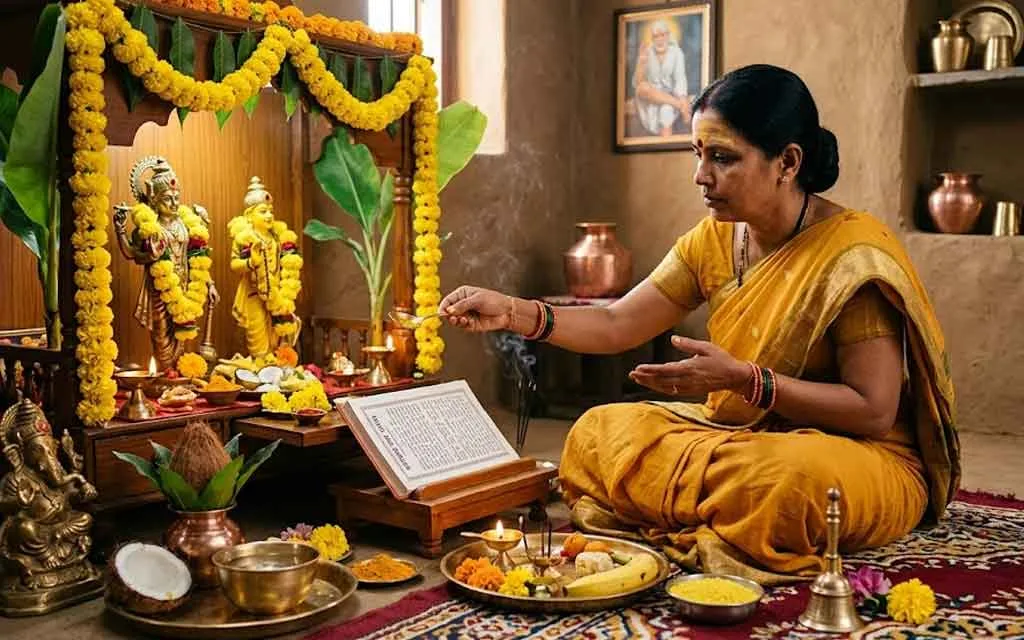
Vishnu Ashtottara Shatanamavali: 108 Names of Lord Vishnu with Meaning
The Sri Vishnu Ashtottara Shatanamavali, the 108 names of Lord Vishnu beginning 'om sri vishnave namah, om jishnave namah, om vashatkaraya namah', in full: every name in Devanagari and IAST from sanskritdocuments.org (the list of the Shaktapramoda, checked against its verse form), with a plain-English meaning for each name and how to offer them on Thursdays and Ekadashi.
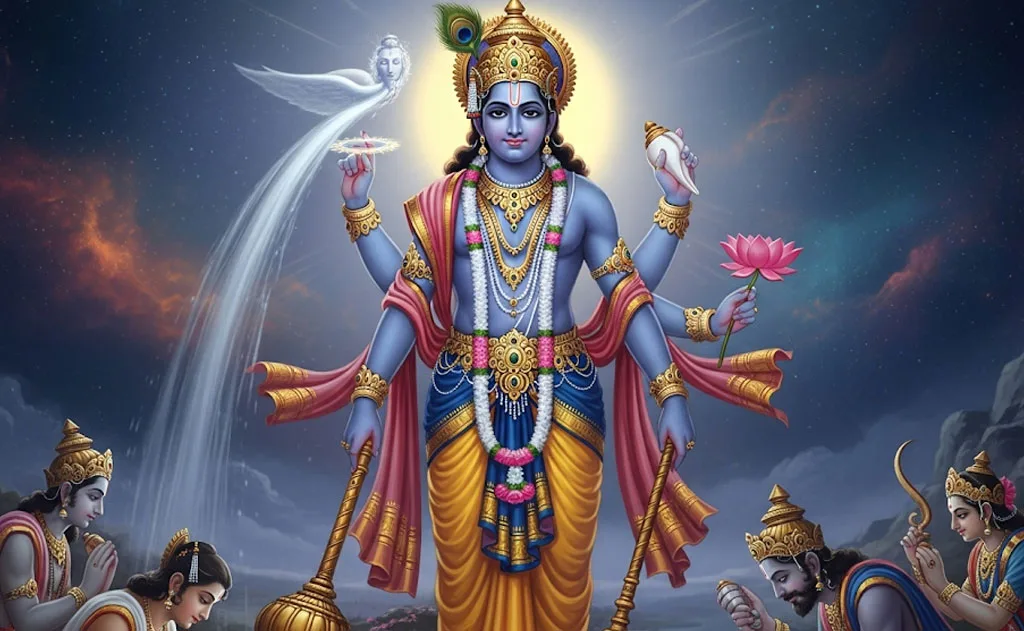
Quick answer: The Vishnu Ashtottara Shatanamavali is a list of 108 names of Lord Vishnu, each offered as 'om ... namah', beginning 'om śrīviṣṇave namaḥ, om jiṣṇave namaḥ' and ending 'om maṅgaḻapradāya namaḥ'. It is chanted in Vishnu puja, especially on Thursdays and Ekadashi, with a flower, a tulasi leaf or akshata offered at each name.
Last updated: 21 October 2026. The Sanskrit below is the complete text published by sanskritdocuments.org (file viShNvaShTottarashatanAmAvaliH4.itx, transliterated and proofread by Chandrasekhar Karumuri; no Author field), converted to Devanagari and IAST by software from the source, with no name typed by hand; three names are corrected as explained in the editor's note. Our own plain-English meaning follows every group of nine names.
Vishnu Ashtottara Shatanamavali: all 108 names
The names are given in groups of nine, first in Devanagari and then in IAST transliteration, followed by the meaning of each name, numbered. Each name is in the dative form ('to Vishnu') framed by 'om' and 'namah' (salutation). The source prints a running count after every tenth name; we leave the counts out.
Names 1 to 36
Names 1 to 9
ॐ श्रीविष्णवे नमः ।
ॐ जिष्णवे नमः ।
ॐ वषट्काराय नमः ।
ॐ देवदेवाय नमः ।
ॐ वृषाकपये नमः ।
ॐ दामोदराय नमः ।
ॐ दीनबन्धवे नमः ।
ॐ आदिदेवाय नमः ।
ॐ अदितेस्सुताय नमः ।
oṃ śrīviṣṇave namaḥ |
oṃ jiṣṇave namaḥ |
oṃ vaṣaṭkārāya namaḥ |
oṃ devadevāya namaḥ |
oṃ vṛṣākapaye namaḥ |
oṃ dāmodarāya namaḥ |
oṃ dīnabandhave namaḥ |
oṃ ādidevāya namaḥ |
oṃ aditessutāya namaḥ |
Meaning: 1 Sri Vishnu: the glorious all-pervading one. 2 Jishnu: the ever-victorious. 3 Vashatkara: the sacred call 'vashat' of the fire offering. 4 Devadeva: god of the gods. 5 Vrishakapi: who lifted the earth as the Boar; a Vedic name of the Lord. 6 Damodara: bound at the waist by Yashoda's cord. 7 Dinabandhu: friend of the helpless. 8 Adideva: the first god. 9 Aditeh suta: son of Aditi (as Vamana).
Names 10 to 18
ॐ पुण्डरीकाय नमः ।
ॐ परानन्दाय नमः ।
ॐ परमात्मने नमः ।
ॐ परात्पराय नमः ।
ॐ परशुधारिणे नमः ।
ॐ विश्वात्मने नमः ।
ॐ कृष्णाय नमः ।
ॐ कलिमलापहारिणे नमः ।
ॐ कौस्तुभोद्भासितोरस्काय नमः ।
oṃ puṇḍarīkāya namaḥ |
oṃ parānandāya namaḥ |
oṃ paramātmane namaḥ |
oṃ parātparāya namaḥ |
oṃ paraśudhāriṇe namaḥ |
oṃ viśvātmane namaḥ |
oṃ kṛṣṇāya namaḥ |
oṃ kalimalāpahāriṇe namaḥ |
oṃ kaustubhodbhāsitoraskāya namaḥ |
Meaning: 10 Pundarika: the lotus, pure and radiant. 11 Parananda: supreme bliss. 12 Paramatma: the supreme Self. 13 Paratpara: higher than the highest. 14 Parashudhari: who bears the axe (as Parashurama). 15 Vishvatma: the Self of the universe. 16 Krishna: the dark one who draws all hearts. 17 Kalimalapahari: who removes the impurity of the Kali age. 18 Kaustubhodbhasitoraska: whose chest shines with the Kaustubha gem.
Names 19 to 27
ॐ नराय नमः ।
ॐ नारायणाय नमः ।
ॐ हरये नमः ।
ॐ हराय नमः ।
ॐ हरप्रियाय नमः ।
ॐ स्वामिने नमः ।
ॐ वैकुण्ठाय नमः ।
ॐ विश्वतोमुखाय नमः ।
ॐ हृषीकेशाय नमः ।
oṃ narāya namaḥ |
oṃ nārāyaṇāya namaḥ |
oṃ haraye namaḥ |
oṃ harāya namaḥ |
oṃ harapriyāya namaḥ |
oṃ svāmine namaḥ |
oṃ vaikuṇṭhāya namaḥ |
oṃ viśvatomukhāya namaḥ |
oṃ hṛṣīkeśāya namaḥ |
Meaning: 19 Nara: the eternal person. 20 Narayana: the refuge of all beings. 21 Hari: who takes away sorrow. 22 Hara: the remover. 23 Harapriya: dear to Shiva. 24 Svami: the master. 25 Vaikuntha: lord of Vaikuntha. 26 Vishvatomukha: whose faces are everywhere. 27 Hrishikesha: lord of the senses.
Names 28 to 36
ॐ अप्रमेयाय नमः ।
ॐ आत्मने नमः ।
ॐ वराहाय नमः ।
ॐ धरणीधराय नमः ।
ॐ धर्मेशाय नमः ।
ॐ धरणीनाथाय नमः ।
ॐ ध्येयाय नमः ।
ॐ धर्मभृतांवराय नमः ।
ॐ सहस्रशीर्षाय नमः ।
oṃ aprameyāya namaḥ |
oṃ ātmane namaḥ |
oṃ varāhāya namaḥ |
oṃ dharaṇīdharāya namaḥ |
oṃ dharmeśāya namaḥ |
oṃ dharaṇīnāthāya namaḥ |
oṃ dhyeyāya namaḥ |
oṃ dharmabhṛtāṃvarāya namaḥ |
oṃ sahasraśīrṣāya namaḥ |
Meaning: 28 Aprameya: the immeasurable. 29 Atma: the Self. 30 Varaha: the Boar who raised the earth. 31 Dharanidhara: who upholds the earth. 32 Dharmesha: lord of dharma. 33 Dharaninatha: lord of the earth. 34 Dhyeya: the one to be meditated on. 35 Dharmabhritam vara: best of those who uphold dharma. 36 Sahasrashirsha: the thousand-headed (as in the Purusha Sukta).
Names 37 to 72
Names 37 to 45
ॐ पुरुषाय नमः ।
ॐ सहस्राक्षाय नमः ।
ॐ सहस्रपादे नमः ।
ॐ सर्वगाय नमः ।
ॐ सर्वविदे, सर्वाय नमः ।
ॐ शरण्याय नमः ।
ॐ साधुवल्लभाय नमः ।
ॐ कौसल्यानन्दनाय नमः ।
ॐ श्रीमते नमः ।
oṃ puruṣāya namaḥ |
oṃ sahasrākṣāya namaḥ |
oṃ sahasrapāde namaḥ |
oṃ sarvagāya namaḥ |
oṃ sarvavide, sarvāya namaḥ |
oṃ śaraṇyāya namaḥ |
oṃ sādhuvallabhāya namaḥ |
oṃ kausalyānandanāya namaḥ |
oṃ śrīmate namaḥ |
Meaning: 37 Purusha: the cosmic Person. 38 Sahasraksha: the thousand-eyed. 39 Sahasrapat: the thousand-footed. 40 Sarvaga: who goes everywhere. 41 Sarvavit, Sarva: the all-knowing, who is everything (printed as one entry). 42 Sharanya: the refuge. 43 Sadhuvallabha: beloved of the good. 44 Kausalyanandana: Kausalya's son (Rama). 45 Shriman: the glorious, with Shri.
Names 46 to 54
ॐ रक्षःकुलविनाशकाय नमः ।
ॐ जगत्कर्त्रे नमः ।
ॐ जगद्धर्त्रे नमः ।
ॐ जगज्जेत्रे नमः ।
ॐ जनार्तिघ्ने नमः ।
ॐ जानकीवल्लभाय नमः ।
ॐ देवाय नमः ।
ॐ जयरूपाय नमः ।
ॐ जलेश्वराय नमः ।
oṃ rakṣaḥkulavināśakāya namaḥ |
oṃ jagatkartre namaḥ |
oṃ jagaddhartre namaḥ |
oṃ jagajjetre namaḥ |
oṃ janārtighne namaḥ |
oṃ jānakīvallabhāya namaḥ |
oṃ devāya namaḥ |
oṃ jayarūpāya namaḥ |
oṃ jaleśvarāya namaḥ |
Meaning: 46 Rakshahkulavinashaka: who ended the race of the rakshasas. 47 Jagatkarta: maker of the world. 48 Jagaddharta: supporter of the world. 49 Jagajjeta: conqueror of the world. 50 Janartighna: who destroys the suffering of people. 51 Janakivallabha: beloved of Janaki (Sita). 52 Deva: the shining god. 53 Jayarupa: whose form is victory. 54 Jaleshvara: lord of the waters.
Names 55 to 63
ॐ क्षीराब्धिवासिने नमः ।
ॐ क्षीराब्धितनयावल्लभाय नमः ।
ॐ शेषशायिने नमः ।
ॐ पन्नगारिवाहनाय नमः ।
ॐ विष्टरश्रवसे नमः ।
ॐ माधवाय नमः ।
ॐ मधुरानाथाय नमः ।
ॐ मुकुन्दाय नमः ।
ॐ मोहनाशनाय नमः ।
oṃ kṣīrābdhivāsine namaḥ |
oṃ kṣīrābdhitanayāvallabhāya namaḥ |
oṃ śeṣaśāyine namaḥ |
oṃ pannagārivāhanāya namaḥ |
oṃ viṣṭaraśravase namaḥ |
oṃ mādhavāya namaḥ |
oṃ madhurānāthāya namaḥ |
oṃ mukundāya namaḥ |
oṃ mohanāśanāya namaḥ |
Meaning: 55 Kshirabdhivasi: who dwells in the ocean of milk. 56 Kshirabdhitanayavallabha: beloved of the daughter of the milk ocean (Lakshmi). 57 Sheshashayi: who rests on the serpent Shesha. 58 Pannagarivahana: whose mount is Garuda, enemy of serpents. 59 Vishtarashrava: whose fame spreads far. 60 Madhava: consort of Ma (Lakshmi). 61 Madhuranatha: lord of Mathura. 62 Mukunda: giver of liberation. 63 Mohanashana: destroyer of delusion.
Names 64 to 72
ॐ दैत्यारिणे नमः ।
ॐ पुण्डरीकाक्षाय नमः ।
ॐ अच्युताय नमः ।
ॐ मधुसूदनाय नमः ।
ॐ सोमसूर्याग्निनयनाय नमः ।
ॐ नृसिंहाय नमः ।
ॐ भक्तवत्सलाय नमः ।
ॐ नित्याय नमः ।
ॐ निरामयाय नमः ।
oṃ daityāriṇe namaḥ |
oṃ puṇḍarīkākṣāya namaḥ |
oṃ acyutāya namaḥ |
oṃ madhusūdanāya namaḥ |
oṃ somasūryāgninayanāya namaḥ |
oṃ nṛsiṃhāya namaḥ |
oṃ bhaktavatsalāya namaḥ |
oṃ nityāya namaḥ |
oṃ nirāmayāya namaḥ |
Meaning: 64 Daityari: enemy of the demons. 65 Pundarikaksha: lotus-eyed. 66 Achyuta: who never falls. 67 Madhusudana: slayer of the demon Madhu. 68 Somasuryagninayana: whose eyes are the moon, the sun and fire. 69 Nrisimha: the Man-Lion. 70 Bhaktavatsala: tender towards his devotees. 71 Nitya: the eternal. 72 Niramaya: free from all illness.
Names 73 to 108
Names 73 to 81
ॐ शुद्धाय नमः ।
ॐ नरदेवाय नमः ।
ॐ जगत्प्रभवे नमः ।
ॐ हयग्रीवाय नमः ।
ॐ जितरिपवे नमः ।
ॐ उपेन्द्राय नमः ।
ॐ रुक्मिणीपतये नमः ।
ॐ सर्वदेवमयाय नमः ।
ॐ श्रीशाय नमः ।
oṃ śuddhāya namaḥ |
oṃ naradevāya namaḥ |
oṃ jagatprabhave namaḥ |
oṃ hayagrīvāya namaḥ |
oṃ jitaripave namaḥ |
oṃ upendrāya namaḥ |
oṃ rukmiṇīpataye namaḥ |
oṃ sarvadevamayāya namaḥ |
oṃ śrīśāya namaḥ |
Meaning: 73 Shuddha: the pure. 74 Naradeva: god among men. 75 Jagatprabhu: lord of the world. 76 Hayagriva: the horse-headed form, lord of knowledge. 77 Jitaripu: who has conquered all enemies. 78 Upendra: younger brother of Indra (as Vamana). 79 Rukminipati: husband of Rukmini. 80 Sarvadevamaya: in whom all the gods are contained. 81 Shrisha: lord of Shri (Lakshmi).
Names 82 to 90
ॐ सर्वाधाराय नमः ।
ॐ सनातनाय नमः ।
ॐ सौम्याय नमः ।
ॐ सौम्यप्रदाय नमः ।
ॐ स्रष्ट्रे नमः ।
ॐ विष्वक्सेनाय नमः ।
ॐ जनार्दनाय नमः ।
ॐ यशोदातनयाय नमः ।
ॐ योगिने नमः ।
oṃ sarvādhārāya namaḥ |
oṃ sanātanāya namaḥ |
oṃ saumyāya namaḥ |
oṃ saumyapradāya namaḥ |
oṃ sraṣṭre namaḥ |
oṃ viṣvaksenāya namaḥ |
oṃ janārdanāya namaḥ |
oṃ yaśodātanayāya namaḥ |
oṃ yogine namaḥ |
Meaning: 82 Sarvadhara: support of all. 83 Sanatana: the eternal. 84 Saumya: the gentle one. 85 Saumyaprada: giver of gentleness and peace. 86 Srashta: the creator. 87 Vishvaksena: whose armies go everywhere. 88 Janardana: protector of people. 89 Yashodatanaya: Yashoda's son. 90 Yogi: the master of yoga.
Names 91 to 99
ॐ योगशास्त्रपरायणाय नमः ।
ॐ रुद्रात्मकाय नमः ।
ॐ रुद्रमूर्तये नमः ।
ॐ राघवाय नमः ।
ॐ अतुलतेजसे नमः ।
ॐ दिव्याय नमः ।
ॐ सर्वपापहराय नमः ।
ॐ पुण्याय नमः ।
ॐ अमिततेजसे नमः ।
oṃ yogaśāstraparāyaṇāya namaḥ |
oṃ rudrātmakāya namaḥ |
oṃ rudramūrtaye namaḥ |
oṃ rāghavāya namaḥ |
oṃ atulatejase namaḥ |
oṃ divyāya namaḥ |
oṃ sarvapāpaharāya namaḥ |
oṃ puṇyāya namaḥ |
oṃ amitatejase namaḥ |
Meaning: 91 Yogashastraparayana: devoted to the teaching of yoga. 92 Rudratmaka: whose self is Rudra. 93 Rudramurti: who takes the form of Rudra. 94 Raghava: of the line of Raghu (Rama). 95 Atulateja: of matchless radiance. 96 Divya: the divine. 97 Sarvapapahara: who takes away all sin. 98 Punya: the holy. 99 Amitateja: of boundless radiance.
Names 100 to 108
ॐ दुःखनाशनाय नमः ।
ॐ दारिद्र्यनाशनाय नमः ।
ॐ दौर्भाग्यनाशनाय नमः ।
ॐ सुखवर्धनाय नमः ।
ॐ सर्वसम्पत्कराय नमः ।
ॐ सौम्याय नमः ।
ॐ महापातकनाशनाय नमः ।
ॐ विपन्नाशनाय नमः ।
ॐ मङ्गळप्रदाय नमः ।
oṃ duḥkhanāśanāya namaḥ |
oṃ dāridryanāśanāya namaḥ |
oṃ daurbhāgyanāśanāya namaḥ |
oṃ sukhavardhanāya namaḥ |
oṃ sarvasampatkarāya namaḥ |
oṃ saumyāya namaḥ |
oṃ mahāpātakanāśanāya namaḥ |
oṃ vipannāśanāya namaḥ |
oṃ maṅgaḻapradāya namaḥ |
Meaning: 100 Duhkhanashana: destroyer of sorrow. 101 Daridryanashana: destroyer of poverty. 102 Daurbhagyanashana: destroyer of misfortune. 103 Sukhavardhana: who increases happiness. 104 Sarvasampatkara: giver of every blessing. 105 Saumya: the gentle one (repeated, as in the source). 106 Mahapatakanashana: destroyer of the gravest sins. 107 Vipannashana: destroyer of calamity. 108 Mangalaprada: giver of auspiciousness.
Colophon
इति श्रीविष्ण्वष्टोत्तरशतनामावलिः समाप्ता ॥
iti śrīviṣṇvaṣṭottaraśatanāmāvaliḥ samāptā ||
Meaning: Thus ends the Sri Vishnu Ashtottara Shatanamavali.
What the 108 names tell us about Vishnu
The list moves through every side of Vishnu: the Vedic Lord of the sacrifice (Vashatkara, Vrishakapi), the cosmic Person of the Purusha Sukta (thousand-headed, thousand-eyed, thousand-footed), the Lord resting on Shesha in the ocean of milk with Lakshmi, and the avatars: Varaha, Nrisimha, Vamana, Parashurama, Rama, Krishna and Hayagriva. It even names him Hara and Rudratmaka, 'whose self is Rudra', a reminder of the oneness of Vishnu and Shiva.
| Names | What they describe |
|---|---|
| 1 to 18 | the victorious, supreme Lord; Damodara, son of Aditi, Parashurama, Krishna |
| 19 to 36 | Nara-Narayana, Hari, Lord of Vaikuntha, the Boar who upholds the earth |
| 37 to 54 | the cosmic Person; Rama, son of Kausalya, beloved of Sita |
| 55 to 72 | the Lord of the milk ocean, on Shesha, riding Garuda; Nrisimha |
| 73 to 94 | Hayagriva, Upendra, husband of Rukmini, son of Yashoda, Rudra, Raghava |
| 95 to 108 | the radiant one who removes sorrow, sin and misfortune and gives auspiciousness |
When is it traditionally chanted?
- On Thursdays: the day many families keep for Vishnu. See the guide to Thursday in Hinduism and the Thursday rituals guide for NRI families.
- On Ekadashi: Papankusha Ekadashi on Thursday 22 October 2026, Rama Ekadashi on Thursday 5 November, Prabodhini Ekadashi on Friday 20 November and Vaikuntha Ekadashi on Sunday 20 December 2026 (dates for India; check your local panchang abroad). See the Ekadashi vrat guide.
- In Karthika Masam: with the daily tulasi puja, offering a tulasi leaf at each name.
- With Lakshmi's names: many families follow it with the 108 names of Lakshmi, since several names (Shrisha, Madhava, Kshirabdhitanayavallabha) call him her consort.
How to offer the 108 names at home
- Place an image of Vishnu (or of Krishna, Rama or Venkateswara) and light a lamp.
- Keep 108 tulasi leaves, flowers or a small bowl of akshata ready.
- Say each name slowly, 'om śrīviṣṇave namaḥ', and offer a leaf or a few grains at 'namah'.
- After the 108 names, offer naivedyam (fruit, milk or a simple sweet) and do aarti.
- On a longer day, add the Vishnu Sahasranama or the Narayana Kavacham.
Pronunciation help
- In the IAST, a line over a vowel (ā, ī, ū) means it is held twice as long; ṣ and ś are both 'sh' sounds; ṇ and ṭ are said with the tongue curled back.
- Name 9, 'aditessutāya', is 'aditeḥ sutāya' (to the son of Aditi) joined in speech.
- Name 108 is printed with the letter ḻa (ळ), 'maṅgaḻa', as it is said in Telugu, Kannada and Marathi; 'maṅgala' is the same word.
Traditional beliefs about the 108 names
Devotees traditionally believe that offering the names of Vishnu with devotion:
- brings the protection of the Lord who is 'the refuge' (name 42) and 'friend of the helpless' (name 7);
- calms the mind and turns it towards dharma;
- is especially fruitful on Ekadashi and in the Karthika month.
These are matters of faith. The names are an offering of love, not a way to guarantee money, health, jobs or visas.
Tips for NRI families
- Share the 108. Divide the names into twelve groups of nine, as on this page, and give each family member a group.
- Find the avatars. Ask children to spot the names of Rama, Krishna, Varaha and Nrisimha in the list.
- Go further. Try the Vishnu Shatpadi, the Achyutashtakam or the 108 names of Venkateswara.
Frequently asked questions
What is the Vishnu Ashtottara Shatanamavali?
Ashtottara means 'one hundred and eight'. It is a list of 108 names of Lord Vishnu, each said as 'om ... namah', used for archana with a flower, tulasi leaf or akshata offered at each name. This one begins 'om sri vishnave namah, om jishnave namah, om vashatkaraya namah'.
Where does this list come from?
The namavali on sanskritdocuments.org has no Author field. Its verse form on the same site, the Vishnu Ashtottara Shatanama Stotram ('vishnur jishnur vashatkaro devadevo vrishakapih'), says in its colophon that it is from the Shaktapramoda. We used that stotram to check the names.
Are there other lists of 108 names of Vishnu?
Yes. sanskritdocuments.org has at least three other Vishnu namavalis with different names, one from the Mahabharata and one from the Padma Purana. This page gives the list beginning 'shri vishnave, jishnave', which is widely used in home puja.
When is it traditionally chanted?
On Thursdays and on Ekadashi: Papankusha Ekadashi (Thursday 22 October 2026), Rama Ekadashi (Thursday 5 November), Prabodhini Ekadashi (Friday 20 November) and Vaikuntha Ekadashi (Sunday 20 December 2026), dates for India; and in Karthika Masam with tulasi worship.
How long does it take?
About 8 to 10 minutes at an easy pace, longer if you offer a flower or tulasi leaf at every name. A 108-bead mala helps if you chant from memory.
Why do the last names sound like requests?
Names 95 to 108, such as Duhkhanashana (destroyer of sorrow) and Mangalaprada (giver of auspiciousness), echo the closing verses of the stotram, which praise the hymn as removing sorrow, poverty and misfortune. Devotees traditionally believe the names bring Vishnu's grace; they are worship, not a guarantee of any worldly result.
Editor's note (21 October 2026)
This page was published on 21 October 2026 at the address readers and search engines were already requesting. The names are the full text of the Vishnu Ashtottara Shatanamavali (4) on sanskritdocuments.org (file viShNvaShTottarashatanAmAvaliH4.itx; no Author field). We compared it with the same names in verse form on the same site (viShNoraShTottarashatanAmastotram.itx, from the Shaktapramoda per its colophon) and corrected three plain typing slips that the verse form confirms: name 18 is printed 'kaustubhodbāsitoraskāya' and is given as 'kaustubhodbhāsitoraskāya'; name 49 is printed 'jagajñetre' and is given as 'jagajjetre' (conqueror of the world); and name 88 is printed 'janārdhanāya' and is given as 'janārdanāya'. The namavali and the stotram are not identical: the namavali has no names for three half-verses of the stotram (Vamana, Rama and others), reads 'mukundāya' (62) for the stotram's 'mohadaḥ' and 'saumyāya' (84) for 'sāmyaḥ', and takes names 95 to 108 from the stotram's closing verses. We print the namavali as it is; name 41 ('sarvavide, sarvāya') stays one entry as in the source, and name 105 repeats name 84. No other letter is changed. The meanings are our own.
Related guides
Share this with family and friends
Send it on WhatsApp, post it, or copy the link.
You might also like
Saraswati Ashtottara Shatanamavali: 108 Names of Goddess Saraswati with Meaning
Lalita Ashtottara Shatanamavali: 108 Names of Goddess Lalita (Rajatachala Shringagra) with Meaning
Vishnu Sahasranama — Complete Guide to the 1000 Names of Vishnu, Origin, Selected Verses, Sunday Practice & 30-Day NRI Plan for 2026