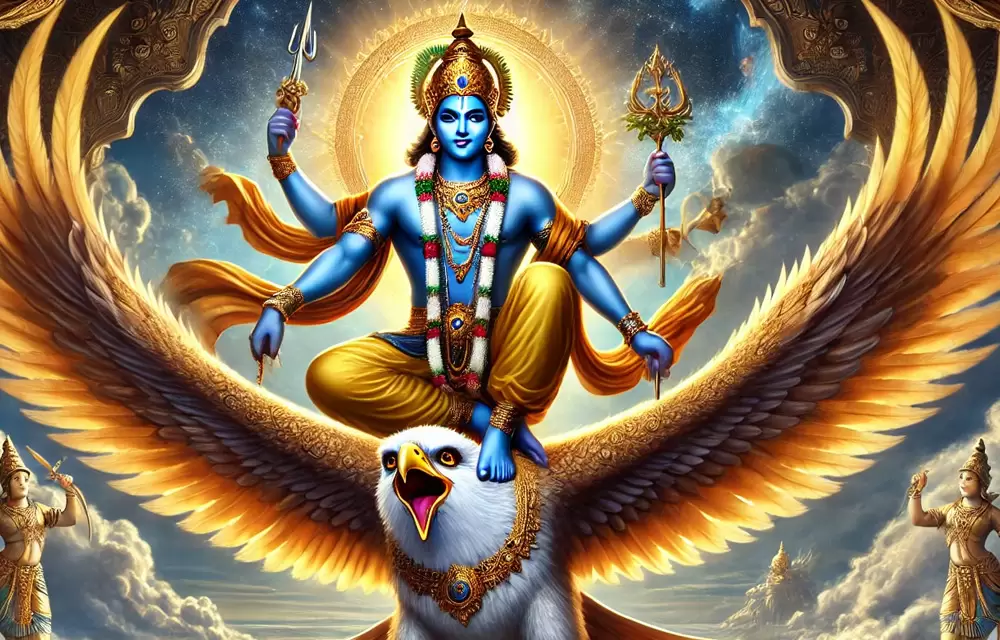
Vishnu's Ten Avatars and the One Question Every NRI Child Eventually Asks
Why the Dashavatara story has stayed the most child-friendly entry into Hindu cosmology — and the question every second-generation NRI child eventually asks the parent who told it to them.
Why the Dashavatara story has stayed the most child-friendly entry into Hindu cosmology — and the question every second-generation NRI child eventually asks the parent who told it to them.
Most second-generation NRI children meet Hindu cosmology through the same story, told by the same person — a grandparent at bedtime, a parent on a long flight, a Sunday-school teacher at the local temple's children's class. The story is the Dashavatara — the ten avatars of Vishnu — and it has held up as the entry-point narrative across generations and continents for reasons that are quietly structural. It is the rare Hindu cosmological text that is both genuinely a story (with characters, conflicts and resolutions) and a serious theological framework (about divine intervention, cosmic balance and the relationship between God and history).
What happens reliably, at some point between ages eight and twelve, is that the child asks the question. The grown-up who has been telling the avatar stories one by one — fish, tortoise, boar, man-lion, dwarf, axe-wielder, prince, cowherd, sage, horseman — eventually hears the child ask: "So when does the next one come?" The question is the moment the child has stepped from receiving the story to engaging with it as a living tradition. What the grown-up does with the question matters.
The ten avatars as a sequence
The Dashavatara is usually presented as a sequence with internal logic. Matsya, the fish, rescues the Vedas from a flood. Kurma, the tortoise, supports a mountain on his back during the churning of the cosmic ocean. Varaha, the boar, lifts the earth out of the depths. Narasimha, the man-lion, ends a demon-king's tyranny over his son-devotee. Vamana, the dwarf, reclaims the worlds from another demon-king through a measured request that grows into cosmic stride. Parashurama, the axe-wielder, rebalances the dharma of his age. Rama, the prince, embodies the householder dharma. Krishna, the cowherd and the Gita's teacher, embodies the relational and philosophical dimensions. Balarama or Buddha (depending on the regional tradition) precedes the last. Kalki, the horseman, is yet to come.
The sequence is not a literal historical chronology. It is a narrative arc that moves from elemental forms (fish, tortoise, boar) through animal-human hybrids (man-lion, dwarf) into fully human incarnations (Parashurama, Rama, Krishna) and ends with a future arrival. Some traditional commentaries read the arc as paralleling the evolution of life itself — from aquatic to amphibious to mammalian to human — and find the modern resonance accidental. Others read it as simply a theological assertion that divine intervention has taken many forms across cosmic time and will take another in the future. Both readings are within the tradition.
Why the story scales
Three features of the Dashavatara explain why it travels into diaspora life with so little adaptation.
First, each avatar is a complete short story. The grown-up who has fifteen minutes at bedtime can tell the Matsya story tonight, the Kurma story tomorrow, and the Varaha story next week without losing thread. The child can hold the whole sequence in memory because the individual stories are episodic.
Second, the avatars connect to the broader cultural inheritance. The Rama story opens the door to the Ramayana; the Krishna story opens the door to the Bhagavata Purana and the Bhagavad Gita; the Parashurama story connects to specific regional traditions and to a particular ethical-warrior frame. The child who knows the avatar sequence is positioned to absorb the larger texts when ready.
Third, the avatars work across the age range. A four-year-old can hear the man-lion story as a cool tale about a king who turns into a lion. A twelve-year-old can re-read it and see the loyalty-to-the-devotee theme. A college student can encounter it again and grapple with the philosophical implications of God-as-protector. The story carries different weights at different ages without changing.
The question
The question — "So when does the next one come?" — is interesting because the tradition has a specific answer and an honest answer at the same time. The specific answer is Kalki, the future avatar prophesied at the end of the present age (Kali Yuga). The honest answer is that the present age is long enough — measured in hundreds of thousands of years in traditional cosmology — that the question of "when" is not practically answerable.
The grown-up's real opportunity in that moment is to use the question to introduce the child to the larger cosmological frame. The tradition organises time into four yugas (Satya, Treta, Dvapara, Kali) of decreasing virtue and increasing degeneration, with each yuga ending at a divine intervention. The current Kali Yuga is, in most reckonings, in its early phase; Kalki's arrival is at the end of the yuga, which is a vast amount of time away. The child has, in the question, opened the door to the cyclical-time framework that distinguishes Hindu cosmology from linear-time frameworks the child may have encountered in school.
What to do with the question
A useful response is to take the question seriously without forcing a resolution. The grown-up can introduce the yuga framework, name Kalki as the future avatar, and acknowledge that the timeframe involved is not the kind of "next week" that the child's question implicitly assumed. Most children handle this comfortably; the long timeframe is part of what makes the framework feel large rather than threatening.
A second useful response is to redirect the question toward the ongoing presence of the tradition rather than the next avatar specifically. Each avatar story has had millennia of commentary; the child who continues to engage with the tradition is in the long lineage of people who have asked similar questions and produced different answers. The "when" question doesn't have to resolve; it can stay open as part of the child's lifelong relationship with the framework.
The diaspora-specific value
The Dashavatara story has a particular value in NRI households because it offers a complete cosmological framework that the child can carry forward independently. A second-generation NRI college student in Boston who has retained the avatar sequence has, in compact form, access to the Vaishnava theological tradition, the major narrative texts, the yuga framework and the divine-intervention theme. They can pick up any of these later in life — through reading, through a temple visit, through a teacher — and have a place to attach the new learning.
Compare this to children who have been given only fragments — a Diwali story here, a Holi story there, no integrating framework — and who later struggle to fit the pieces together. The Dashavatara is one of the most efficient packagings of the larger tradition into a story-form children can absorb, and that efficiency is what has kept it as the default starting point across generations.
A practical pattern for the 2026 NRI household
A pattern that works in 2026 NRI households is to tell the avatar stories deliberately over a single year — perhaps one per month, perhaps grouped around the relevant festivals (Rama Navami for Rama, Janmashtami for Krishna, Narasimha Jayanti for Narasimha). The child encounters the sequence as a sustained narrative arc rather than as scattered references. By the end of the year, the child holds the whole framework.
The question — "when does the next one come?" — will arrive somewhere in the middle of that year. When it does, the grown-up is positioned to respond with the larger framework rather than improvise. That moment is, more often than people realise, the start of the child's independent relationship with the tradition. The avatar sequence has done its job; the framework is in place; the rest of the lifetime can build on it.
You might also like
Purusha Suktam: Complete Guide to the Cosmic Hymn from Rig Veda 10.90
Narayan Suktam: Complete Guide to the Vedic Hymn of the Supreme Vishnu
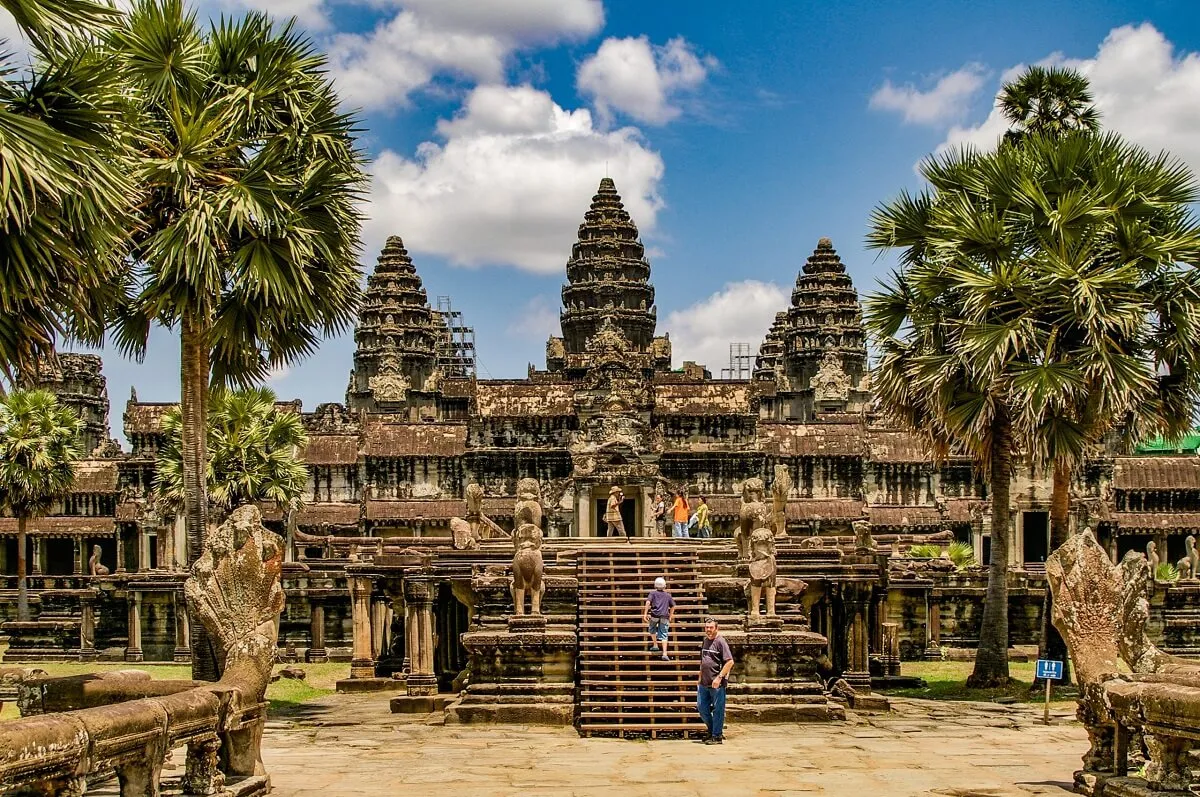
Angkor Wat: Divine Mysteries & Soul-Stirring Miracles of Lord Vishnu's Cosmic Temple