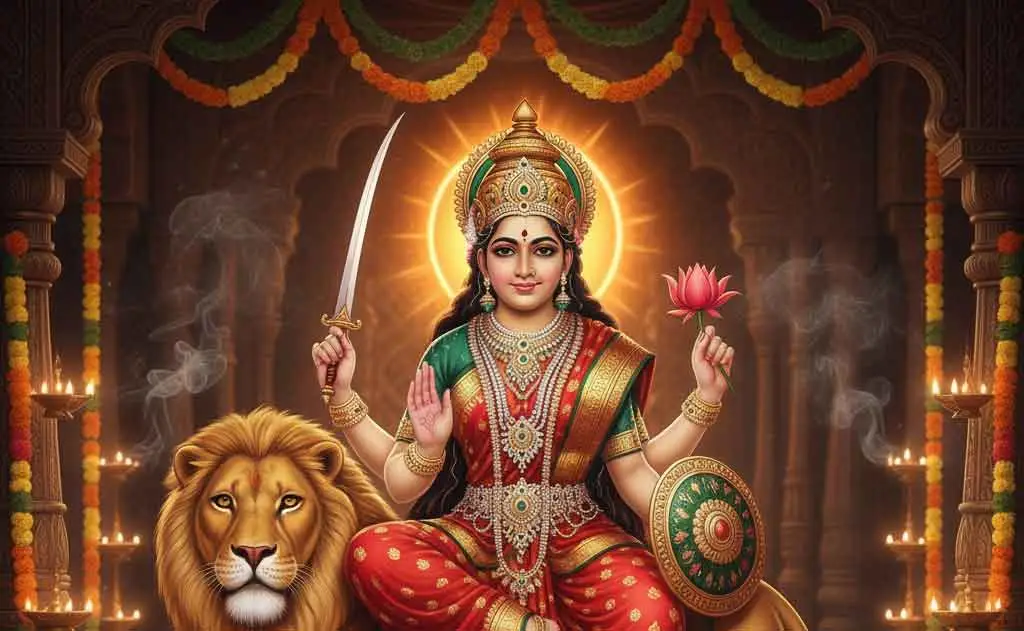
Lakshmi Ashtottara Shatanamavali: 108 Names of Lakshmi in Sanskrit with IAST and Meaning
The Sri Lakshmi Ashtottara Shatanamavali, the 108 names of Goddess Lakshmi beginning 'om prakrityai namah', in full: the dhyana verse and all 108 names in Devanagari and IAST from the sanskritdocuments.org text, with a plain-English meaning for every name and a guide to chanting them at Diwali and on Fridays.
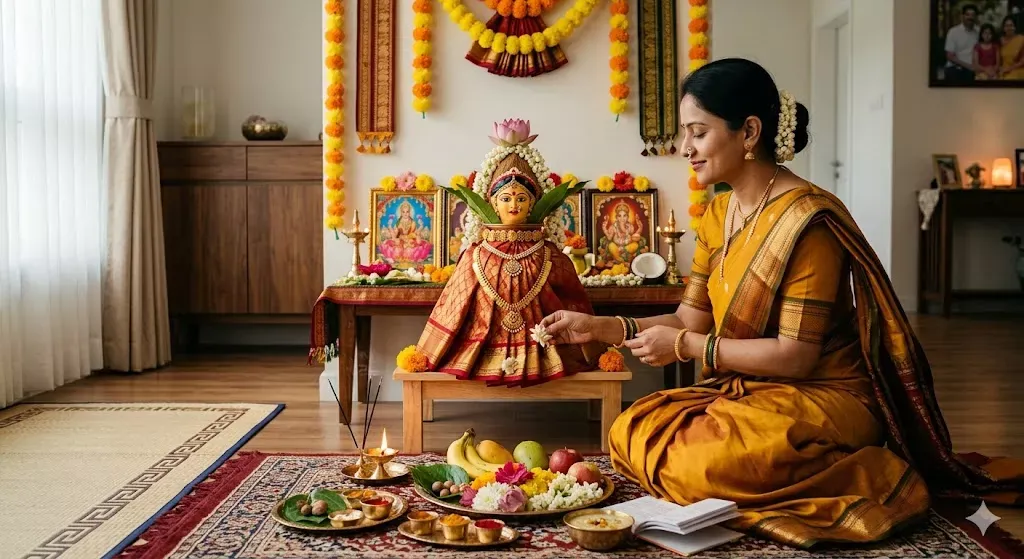
Quick answer: The Lakshmi Ashtottara Shatanamavali is the list of 108 names of Goddess Lakshmi, each offered as 'om ... namah', beginning 'om prakrityai namah' and ending 'om bhuvaneshvaryai namah'. It is chanted during Lakshmi puja, especially on Fridays and at Diwali, with a flower, kumkum or rice offered at each name.
Last updated: 18 October 2026. The Sanskrit on this page comes from the text published by sanskritdocuments.org, converted to Devanagari and IAST by software rather than retyped by hand. The English meanings are our own.
The names show Lakshmi in many aspects: as primal nature and knowledge, as the lotus goddess, as the moon's sister born from the ocean of milk, as Vishnu's consort, as the giver of wealth and grain, and finally as Durga, Kali and the ruler of the worlds. Reading the meanings while you chant turns the list into a short meditation on who Lakshmi is.
How the namavali is used in puja
In archana, the worshipper says each name and offers something small at the same moment: a flower or petal, a pinch of kumkum, a few grains of turmeric rice (akshata) or a lotus seed. The names are in the dative case ('to Prakriti'), so 'om prakrityai namah' means 'Om, salutation to Prakriti'. The dhyana verse is said first, to bring the form of the goddess to mind.
| Part | What it contains |
|---|---|
| Dhyana verses | A description of Lakshmi for meditation, and the prayer 'sarasijanilaye' |
| Names 1 to 36 | Lakshmi as nature, knowledge, the lotus, the earth and nectar |
| Names 37 to 72 | Lakshmi as compassion, the lotus-eyed one, the moon's sister and remover of poverty |
| Names 73 to 108 | Lakshmi as Shri, Varalakshmi, Vishnu's consort, Durga, Kali and Bhuvaneshvari |
The 108 names of Lakshmi with meaning
The names are given in groups of nine, in Devanagari and then IAST, followed by the meaning of each name in that group. In IAST, ā, ī and ū are long vowels, ṇ and ṭ are retroflex sounds, and ś or ṣ is close to 'sh'.
Dhyana verses (meditation before the names)
वन्दे पद्मकरां प्रसन्नवदनां सौभाग्यदां भाग्यदां
हस्ताभ्यां अभयं प्रदां मणिगणैर्नानाविधैर्भूषिताम् ।
भक्ताभीष्ट फलप्रदां हरिहर ब्रह्मादिभिः सेवितां
पार्श्वे पङ्कजशङ्खपद्म निधिभिर्युक्तां सदा शक्तिभिः ॥
सरसिजनिलये सरोजहस्ते धवल तरांशुक गन्धमाल्यशोभे ।
भगवति हरिवल्लभे मनोज्ञे त्रिभुवनभूतिकरि प्रसीद मह्यम् ॥
vande padmakarāṃ prasannavadanāṃ saubhāgyadāṃ bhāgyadāṃ
hastābhyāṃ abhayaṃ pradāṃ maṇigaṇairnānāvidhairbhūṣitām |
bhaktābhīṣṭa phalapradāṃ harihara brahmādibhiḥ sevitāṃ
pārśve paṅkajaśaṅkhapadma nidhibhiryuktāṃ sadā śaktibhiḥ ||
sarasijanilaye sarojahaste dhavala tarāṃśuka gandhamālyaśobhe |
bhagavati harivallabhe manojñe tribhuvanabhūtikari prasīda mahyam ||
Meaning: I worship Lakshmi, lotus in hand, gracious of face, giver of good fortune and prosperity, whose hands grant fearlessness, adorned with many kinds of jewels, who fulfils the wishes of devotees, served by Hari, Hara, Brahma and the other gods, and always attended at her side by the powers who hold the lotus and conch treasures. Goddess who dwells in the lotus, lotus in hand, radiant in pure white garments, fragrance and garlands, beloved of Hari, enchanting one, who brings prosperity to the three worlds: be gracious to me.
Names 1 to 36
Names 1 to 9
ॐ प्रकृत्यै नमः ।
ॐ विकृत्यै नमः ।
ॐ विद्यायै नमः ।
ॐ सर्वभूतहितप्रदायै नमः ।
ॐ श्रद्धायै नमः ।
ॐ विभूत्यै नमः ।
ॐ सुरभ्यै नमः ।
ॐ परमात्मिकायै नमः ।
ॐ वाचे नमः ।
oṃ prakṛtyai namaḥ |
oṃ vikṛtyai namaḥ |
oṃ vidyāyai namaḥ |
oṃ sarvabhūtahitapradāyai namaḥ |
oṃ śraddhāyai namaḥ |
oṃ vibhūtyai namaḥ |
oṃ surabhyai namaḥ |
oṃ paramātmikāyai namaḥ |
oṃ vāce namaḥ |
Meaning: 1 Prakriti: primal nature, the source of all forms. 2 Vikriti: she who appears in many forms. 3 Vidya: knowledge. 4 Sarvabhutahitaprada: who gives welfare to all beings. 5 Shraddha: faith. 6 Vibhuti: splendour and prosperity. 7 Surabhi: the fragrant one, also the wish-granting cow. 8 Paramatmika: the supreme Self. 9 Vak: speech.
Names 10 to 18
ॐ पद्मालयायै नमः ।
ॐ पद्मायै नमः ।
ॐ शुचये नमः ।
ॐ स्वाहायै नमः ।
ॐ स्वधायै नमः ।
ॐ सुधायै नमः ।
ॐ धन्यायै नमः ।
ॐ हिरण्मय्यै नमः ।
ॐ लक्ष्म्यै नमः ।
oṃ padmālayāyai namaḥ |
oṃ padmāyai namaḥ |
oṃ śucaye namaḥ |
oṃ svāhāyai namaḥ |
oṃ svadhāyai namaḥ |
oṃ sudhāyai namaḥ |
oṃ dhanyāyai namaḥ |
oṃ hiraṇmayyai namaḥ |
oṃ lakṣmyai namaḥ |
Meaning: 10 Padmalaya: who dwells in the lotus. 11 Padma: the lotus. 12 Shuchi: the pure. 13 Svaha: the offering made to the gods. 14 Svadha: the offering made to the ancestors. 15 Sudha: nectar. 16 Dhanya: the blessed. 17 Hiranmayi: the golden. 18 Lakshmi: the goddess of good fortune.
Names 19 to 27
ॐ नित्यपुष्टायै नमः ।
ॐ विभावर्यै नमः ।
ॐ अदित्यै नमः ।
ॐ दित्यै नमः ।
ॐ दीप्तायै नमः ।
ॐ वसुधायै नमः ।
ॐ वसुधारिण्यै नमः ।
ॐ कमलायै नमः ।
ॐ कान्तायै नमः ।
oṃ nityapuṣṭāyai namaḥ |
oṃ vibhāvaryai namaḥ |
oṃ adityai namaḥ |
oṃ dityai namaḥ |
oṃ dīptāyai namaḥ |
oṃ vasudhāyai namaḥ |
oṃ vasudhāriṇyai namaḥ |
oṃ kamalāyai namaḥ |
oṃ kāntāyai namaḥ |
Meaning: 19 Nityapushta: ever-flourishing. 20 Vibhavari: the radiant one. 21 Aditi: the boundless mother of the gods. 22 Diti: mother of the daityas, for she is present in all. 23 Dipta: the shining. 24 Vasudha: the earth, giver of wealth. 25 Vasudharini: who holds and bears wealth. 26 Kamala: the lotus goddess. 27 Kanta: the beloved.
Names 28 to 36
ॐ कामाक्ष्यै नमः ।
ॐ क्रोधसम्भवायै नमः ।
ॐ अनुग्रहप्रदायै नमः ।
ॐ बुद्धये नमः ।
ॐ अनघायै नमः ।
ॐ हरिवल्लभायै नमः ।
ॐ अशोकायै नमः ।
ॐ अमृतायै नमः ।
ॐ दीप्तायै नमः ।
oṃ kāmākṣyai namaḥ |
oṃ krodhasambhavāyai namaḥ |
oṃ anugrahapradāyai namaḥ |
oṃ buddhaye namaḥ |
oṃ anaghāyai namaḥ |
oṃ harivallabhāyai namaḥ |
oṃ aśokāyai namaḥ |
oṃ amṛtāyai namaḥ |
oṃ dīptāyai namaḥ |
Meaning: 28 Kamakshi: whose eyes are lovely and fulfil wishes. 29 Krodhasambhava: who arises as power against wrong (the source also gives the readings Kama and Kshirodasambhava, 'born of the ocean of milk'). 30 Anugrahaprada: giver of grace. 31 Buddhi: intelligence. 32 Anagha: the sinless. 33 Harivallabha: beloved of Hari (Vishnu). 34 Ashoka: free from sorrow. 35 Amrita: immortal nectar. 36 Dipta: the shining (this name occurs twice in the list).
Names 37 to 72
Names 37 to 45
ॐ लोकशोकविनाशिन्यै नमः ।
ॐ धर्मनिलयायै नमः ।
ॐ करुणायै नमः ।
ॐ लोकमात्रे नमः ।
ॐ पद्मप्रियायै नमः ।
ॐ पद्महस्तायै नमः ।
ॐ पद्माक्ष्यै नमः ।
ॐ पद्मसुन्दर्यै नमः ।
ॐ पद्मोद्भवायै नमः ।
oṃ lokaśokavināśinyai namaḥ |
oṃ dharmanilayāyai namaḥ |
oṃ karuṇāyai namaḥ |
oṃ lokamātre namaḥ |
oṃ padmapriyāyai namaḥ |
oṃ padmahastāyai namaḥ |
oṃ padmākṣyai namaḥ |
oṃ padmasundaryai namaḥ |
oṃ padmodbhavāyai namaḥ |
Meaning: 37 Lokashokavinashini: who destroys the sorrow of the world. 38 Dharmanilaya: home of dharma. 39 Karuna: compassion. 40 Lokamata: mother of the worlds. 41 Padmapriya: who loves the lotus. 42 Padmahasta: lotus in hand. 43 Padmakshi: lotus-eyed. 44 Padmasundari: lovely as a lotus. 45 Padmodbhava: born from the lotus.
Names 46 to 54
ॐ पद्ममुख्यै नमः ।
ॐ पद्मनाभप्रियायै नमः ।
ॐ रमायै नमः ।
ॐ पद्ममालाधरायै नमः ।
ॐ देव्यै नमः ।
ॐ पद्मिन्यै नमः ।
ॐ पद्मगन्धिन्यै नमः ।
ॐ पुण्यगन्धायै नमः ।
ॐ सुप्रसन्नायै नमः ।
oṃ padmamukhyai namaḥ |
oṃ padmanābhapriyāyai namaḥ |
oṃ ramāyai namaḥ |
oṃ padmamālādharāyai namaḥ |
oṃ devyai namaḥ |
oṃ padminyai namaḥ |
oṃ padmagandhinyai namaḥ |
oṃ puṇyagandhāyai namaḥ |
oṃ suprasannāyai namaḥ |
Meaning: 46 Padmamukhi: lotus-faced. 47 Padmanabhapriya: beloved of Padmanabha (Vishnu). 48 Rama: who gives delight. 49 Padmamaladhara: who wears a lotus garland. 50 Devi: the goddess. 51 Padmini: the lotus lady. 52 Padmagandhini: fragrant as the lotus. 53 Punyagandha: of sacred fragrance. 54 Suprasanna: most gracious.
Names 55 to 63
ॐ प्रसादाभिमुख्यै नमः ।
ॐ प्रभायै नमः ।
ॐ चन्द्रवदनायै नमः ।
ॐ चन्द्रायै नमः ।
ॐ चन्द्रसहोदर्यै नमः ।
ॐ चतुर्भुजायै नमः ।
ॐ चन्द्ररूपायै नमः ।
ॐ इन्दिरायै नमः ।
ॐ इन्दुशीतलायै नमः ।
oṃ prasādābhimukhyai namaḥ |
oṃ prabhāyai namaḥ |
oṃ candravadanāyai namaḥ |
oṃ candrāyai namaḥ |
oṃ candrasahodaryai namaḥ |
oṃ caturbhujāyai namaḥ |
oṃ candrarūpāyai namaḥ |
oṃ indirāyai namaḥ |
oṃ induśītalāyai namaḥ |
Meaning: 55 Prasadabhimukhi: always turned towards blessing. 56 Prabha: radiance. 57 Chandravadana: moon-faced. 58 Chandra: moon-like. 59 Chandrasahodari: sister of the moon, who also rose from the ocean of milk. 60 Chaturbhuja: four-armed. 61 Chandrarupa: of moon-like form. 62 Indira: the splendid one. 63 Indushitala: cool and soothing as the moon.
Names 64 to 72
ॐ आह्लादजनन्यै नमः ।
ॐ पुष्टायै नमः ।
ॐ शिवायै नमः ।
ॐ शिवकर्यै नमः ।
ॐ सत्यै नमः ।
ॐ विमलायै नमः ।
ॐ विश्वजनन्यै नमः ।
ॐ तुष्टायै नमः ।
ॐ दारिद्र्यनाशिन्यै नमः ।
oṃ āhlādajananyai namaḥ |
oṃ puṣṭāyai namaḥ |
oṃ śivāyai namaḥ |
oṃ śivakaryai namaḥ |
oṃ satyai namaḥ |
oṃ vimalāyai namaḥ |
oṃ viśvajananyai namaḥ |
oṃ tuṣṭāyai namaḥ |
oṃ dāridryanāśinyai namaḥ |
Meaning: 64 Ahladajanani: source of joy. 65 Pushta: the well-nourished (the source also gives Pushti, nourishment). 66 Shiva: the auspicious. 67 Shivakari: who brings auspiciousness. 68 Sati: the true and virtuous. 69 Vimala: the spotless. 70 Vishvajanani: mother of the universe. 71 Tushta: the contented (the source also gives Tushti, contentment). 72 Daridryanashini: destroyer of poverty.
Names 73 to 108
Names 73 to 81
ॐ प्रीतिपुष्करिण्यै नमः ।
ॐ शान्तायै नमः ।
ॐ शुक्लमाल्याम्बरायै नमः ।
ॐ श्रियै नमः ।
ॐ भास्कर्यै नमः ।
ॐ बिल्वनिलयायै नमः ।
ॐ वरारोहायै नमः ।
ॐ यशस्विन्यै नमः ।
ॐ वसुन्धरायै नमः ।
oṃ prītipuṣkariṇyai namaḥ |
oṃ śāntāyai namaḥ |
oṃ śuklamālyāmbarāyai namaḥ |
oṃ śriyai namaḥ |
oṃ bhāskaryai namaḥ |
oṃ bilvanilayāyai namaḥ |
oṃ varārohāyai namaḥ |
oṃ yaśasvinyai namaḥ |
oṃ vasundharāyai namaḥ |
Meaning: 73 Pritipushkarini: a lotus pool of love. 74 Shanta: the peaceful. 75 Shuklamalyambara: who wears white garlands and garments. 76 Shri: prosperity and grace. 77 Bhaskari: radiant like the sun. 78 Bilvanilaya: who dwells in the bilva tree. 79 Vararoha: the graceful, finest of women. 80 Yashasvini: the glorious. 81 Vasundhara: the earth, who holds all wealth.
Names 82 to 90
ॐ उदाराङ्गायै नमः ।
ॐ हरिण्यै नमः ।
ॐ हेममालिन्यै नमः ।
ॐ धनधान्यकर्यै नमः ।
ॐ सिद्धये नमः ।
ॐ स्त्रैणसौम्यायै नमः ।
ॐ शुभप्रदायै नमः ।
ॐ नृपवेश्मगतानन्दायै नमः ।
ॐ वरलक्ष्म्यै नमः ।
oṃ udārāṅgāyai namaḥ |
oṃ hariṇyai namaḥ |
oṃ hemamālinyai namaḥ |
oṃ dhanadhānyakaryai namaḥ |
oṃ siddhaye namaḥ |
oṃ straiṇasaumyāyai namaḥ |
oṃ śubhapradāyai namaḥ |
oṃ nṛpaveśmagatānandāyai namaḥ |
oṃ varalakṣmyai namaḥ |
Meaning: 82 Udaranga: of noble form. 83 Harini: the golden one. 84 Hemamalini: who wears a garland of gold. 85 Dhanadhanyakari: giver of wealth and grain. 86 Siddhi: accomplishment. 87 Strainasaumya: of gentle feminine grace. 88 Shubhaprada: giver of good. 89 Nripaveshmagatananda: who brings joy to royal palaces. 90 Varalakshmi: Lakshmi who grants boons.
Names 91 to 99
ॐ वसुप्रदायै नमः ।
ॐ शुभायै नमः ।
ॐ हिरण्यप्राकारायै नमः ।
ॐ समुद्रतनयायै नमः ।
ॐ जयायै नमः ।
ॐ मङ्गळा देव्यै नमः ।
ॐ विष्णुवक्षस्स्थलस्थितायै नमः ।
ॐ विष्णुपत्न्यै नमः ।
ॐ प्रसन्नाक्ष्यै नमः ।
oṃ vasupradāyai namaḥ |
oṃ śubhāyai namaḥ |
oṃ hiraṇyaprākārāyai namaḥ |
oṃ samudratanayāyai namaḥ |
oṃ jayāyai namaḥ |
oṃ maṅgaḻā devyai namaḥ |
oṃ viṣṇuvakṣassthalasthitāyai namaḥ |
oṃ viṣṇupatnyai namaḥ |
oṃ prasannākṣyai namaḥ |
Meaning: 91 Vasuprada: giver of wealth. 92 Shubha: the auspicious. 93 Hiranyaprakara: surrounded by walls of gold. 94 Samudratanaya: daughter of the ocean. 95 Jaya: victory. 96 Mangala Devi: the auspicious goddess. 97 Vishnuvakshassthalasthita: who resides on Vishnu's chest. 98 Vishnupatni: consort of Vishnu. 99 Prasannakshi: whose eyes are gracious.
Names 100 to 108
ॐ नारायणसमाश्रितायै नमः ।
ॐ दारिद्र्यध्वंसिन्यै नमः ।
ॐ देव्यै नमः ।
ॐ सर्वोपद्रव वारिण्यै नमः ।
ॐ नवदुर्गायै नमः ।
ॐ महाकाल्यै नमः ।
ॐ ब्रह्माविष्णुशिवात्मिकायै नमः ।
ॐ त्रिकालज्ञानसम्पन्नायै नमः ।
ॐ भुवनेश्वर्यै नमः ।
oṃ nārāyaṇasamāśritāyai namaḥ |
oṃ dāridryadhvaṃsinyai namaḥ |
oṃ devyai namaḥ |
oṃ sarvopadrava vāriṇyai namaḥ |
oṃ navadurgāyai namaḥ |
oṃ mahākālyai namaḥ |
oṃ brahmāviṣṇuśivātmikāyai namaḥ |
oṃ trikālajñānasampannāyai namaḥ |
oṃ bhuvaneśvaryai namaḥ |
Meaning: 100 Narayanasamashrita: who is united with Narayana. 101 Daridryadhvamsini: destroyer of poverty. 102 Devi: the goddess (this name also occurs twice). 103 Sarvopadravavarini: who wards off every trouble. 104 Navadurga: the nine forms of Durga. 105 Mahakali: the great Kali. 106 Brahmavishnushivatmika: whose Self is Brahma, Vishnu and Shiva. 107 Trikalajnanasampanna: who knows past, present and future. 108 Bhuvaneshvari: ruler of the worlds.
Closing line
इति श्रीलक्ष्म्यष्टोत्तरशत नामावलिः ॥
iti śrīlakṣmyaṣṭottaraśata nāmāvaliḥ ||
Meaning: Thus ends the garland of 108 names of Sri Lakshmi.
When the 108 names of Lakshmi are traditionally chanted
- Diwali Lakshmi Puja: on Sunday 8 November 2026, as the archana after the main puja. See the Diwali 2026 guide, Lakshmi Puja 2026 and the Lakshmi-Ganesh puja vidhi and samagri list.
- Dhanteras: many families begin the Diwali Lakshmi worship two days earlier; see Dhanteras 2026.
- Fridays: Lakshmi's weekly day; see our Friday (Shukravar) and Mahalakshmi guide.
- Kojagari Lakshmi Puja and Varalakshmi Vratam: see Kojagari Lakshmi Puja 2026 and Varalakshmi Vratam 2026.
How to chant the 108 names
- Set up a picture or murti of Lakshmi, light a ghee lamp and keep a plate of flowers, kumkum or akshata within reach.
- Say the dhyana verses once, holding the goddess's form in mind.
- Chant each name clearly, offering a flower, a pinch of kumkum or a few grains of rice at 'namah'.
- After name 108, say the closing line, offer naivedya and an aarti, and sit quietly for a moment.
Children can share the archana by taking turns with groups of nine names. Many families chant the Sri Suktam or the Kanakadhara Stotram before the 108 names on festival days.
Significance
A namavali is a simple, intimate form of worship: one name, one offering, one moment of attention, 108 times. The names of Lakshmi remind the devotee that prosperity in the Hindu view includes knowledge, compassion, purity, contentment and dharma, not only money. Devotees traditionally believe that chanting the names with devotion invites Lakshmi's grace; it is an act of faith, not a guarantee of results.
Also read: Venkateswara Ashtottaram (108 names), Lalita Ashtottara (108 names) and Saraswati Ashtottara (108 names).
Frequently asked questions
What is the Lakshmi Ashtottara Shatanamavali?
Ashtottara shata means 'one hundred and eight' and namavali means 'a garland of names'. It is a list of 108 names of Goddess Lakshmi, each offered with 'om' before it and 'namah' (salutation) after it, for example 'om prakrityai namah'. It is used in puja, with a flower, a pinch of kumkum or a grain of rice offered at each name.
Is the namavali the same as the Lakshmi Ashtottara Shatanama Stotram?
They are closely related. The stotram ('prakritim vikritim vidyam') gives the names in verse; the namavali gives each name separately in the dative form ('prakrityai') with 'namah', ready for archana. This page gives the namavali.
When should the 108 names of Lakshmi be chanted?
Most families chant them on Fridays and during Lakshmi puja at Diwali, Dhanteras, Kojagari (Sharad) Purnima and Varalakshmi Vratam. They can be chanted any day as part of a morning or evening puja.
Why do some names appear twice?
In our source 'diptayai' (the shining) appears at numbers 23 and 36 and 'devyai' (the goddess) at numbers 50 and 102. Such repetitions are found in many traditional namavalis; we give the list as the source has it.
How long does it take to chant the 108 names?
About eight to ten minutes at an easy pace, a little longer if you offer a flower or kumkum with each name. Using a 108-bead mala helps you keep count if you are chanting from memory.
Will chanting the 108 names bring money?
The names praise Lakshmi as the giver of wealth, grain, fame and well-being, and devotees traditionally believe that chanting them with devotion invites her grace. They are an act of worship, not a promise of financial results.
Editor's note (18 October 2026)
The names on this page are taken from Shri Lakshmi Ashtottara Shatanamavali on sanskritdocuments.org (file lakshmi108.itx, encoded and proofread by Sowmya Ramkumar, with further proofreading by Shri Devi Kumar, Sunder Hattangadi, Easwaran and Tanvir Chowdhury), converted from ITRANS to Devanagari and IAST with the indic_transliteration software and checked line by line against the site's Devanagari page. Three typing errors were corrected: in the first dhyana verse 'saubhajnadam bhajnadam' is corrected to सौभाग्यदां भाग्यदां (giver of good fortune and prosperity); in the fourth line of that verse 'pashve' is corrected to पार्श्वे (at her side); and name 88, 'shubhapradaye', is corrected to शुभप्रदायै, the dative form used for every other name. The source also lists alternative forms of five names (nityapushtyai, kamayai, kshirodasambhavayai, pushtyai and tushtyai), which are mentioned in the meanings but not added to the count. The English meanings are our own plain renderings.
Related guides
Share this with family and friends
Send it on WhatsApp, post it, or copy the link.
More from Pooja, Slokas and Mantras
- Narmadashtakam (Sabindu Sindhu) by Adi Shankaracharya: Full Text in Sanskrit with Meaning
- Hari Stotram (Jagajjalapalam) by Swami Brahmananda: Full Text in Sanskrit with Meaning
- Ganeshashtakam (Yato Anantashakteh) from the Ganesha Purana: Full Text with Meaning
- Kashi Vishwanath Ashtakam (Gangataranga Ramaniya Jatakalapam): Full Text with Meaning
- Shivashtakam (Prabhum Prananatham Vibhum Vishvanatham): Full Text with Meaning
You might also like
Vishnu Ashtottara Shatanamavali: 108 Names of Lord Vishnu with Meaning
Saraswati Ashtottara Shatanamavali: 108 Names of Goddess Saraswati with Meaning
Lakshmi Narasimha Karavalamba Stotram (Adi Shankaracharya): Full Text with Meaning