Quick answer: The Venkateswara Ashtottara Shatanamavali is a set of 108 sacred names of Lord Venkateswara (Srinivasa / Balaji / Govinda), the presiding deity of tirumala/" class="auto-interlink" data-interlink="1">Tirumala Tirupati and a form of Bhagavan Vishnu. Each name is chanted in the form 'Om <name> namah', often accompanied by tulsi archana. Devotees recite it on Saturdays, Ekadashi, Vaikuntha Ekadashi, and during Brahmotsavam for the Lord's grace.

The Venkateswara Ashtottara Shatanamavali is one of the most beloved devotional litanies in the Vaishnava tradition. 'Ashtottara Shatanamavali' means 'the garland of 108 names' (ashta-uttara-shata = 108), and this particular garland glorifies Lord Venkateswara, the presiding deity of the sacred hill of Tirumala at Tirupati. Each name is a jewel that reveals one aspect of the Lord's beauty, mercy, and cosmic majesty.

Chanted name by name in the form 'Om <name> namah', this Ashtottara is the heart of the archana offered to Sri Venkateswara Swamy. Millions of devotees who make the pilgrimage to Tirumala, as well as those who worship the Lord at home, recite these 108 names as an act of surrender and love.

Advertisement

Who is Lord Venkateswara?

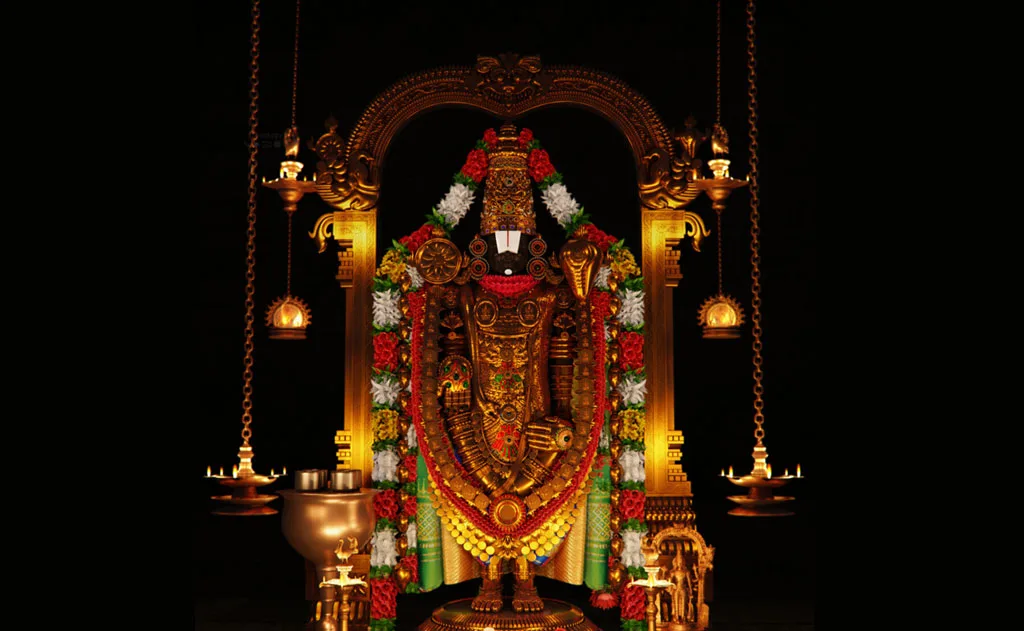
Lord Venkateswara - also known as Srinivasa, Balaji, Govinda, Srihari, and Tirumalesha - is a form of Bhagavan Vishnu who is worshipped as the presiding deity of the seven hills of Tirumala. He is revered as the Kali-yuga daivam, the God who is especially accessible and merciful in the present age, granting refuge to all who take shelter at His feet.

According to Vaishnava tradition, the Lord descended to Tirumala as Srinivasa and made His abode there. His consort at Tirumala is Sri Padmavati Devi (also honoured as Alamelumanga or Alamelu Manga), the form of Goddess Lakshmi. The Lord's shrine at Tirumala is described as the Ananda Nilaya, the abode of bliss, and He is worshipped there as Bhaktavatsala - the one who is tenderly affectionate toward His devotees.

The name 'Venkateswara' is traditionally interpreted to mean the Lord (Ishwara) who burns away (dahati) the sins (venkata) of those who worship Him, freeing devotees from the bondage of karma.

What is the Ashtottara Shatanamavali?

An Ashtottara Shatanamavali is a collection of 108 sacred names of a deity, arranged as a namavali - a 'garland of names' - for recitation during worship. The number 108 is deeply auspicious in Hindu tradition and appears across mantra japa, mala beads, and archana rituals.

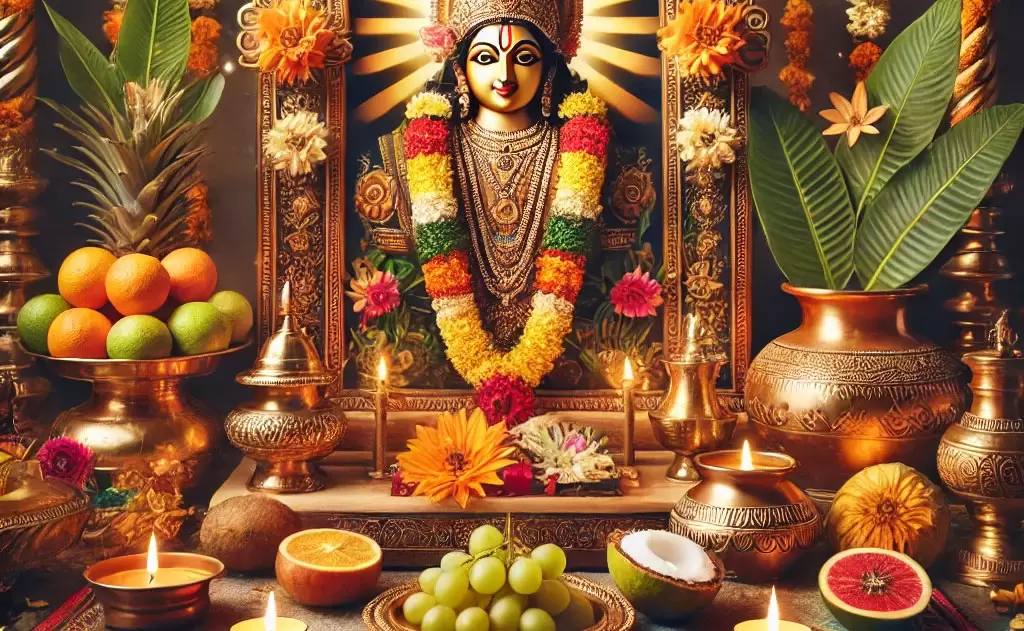
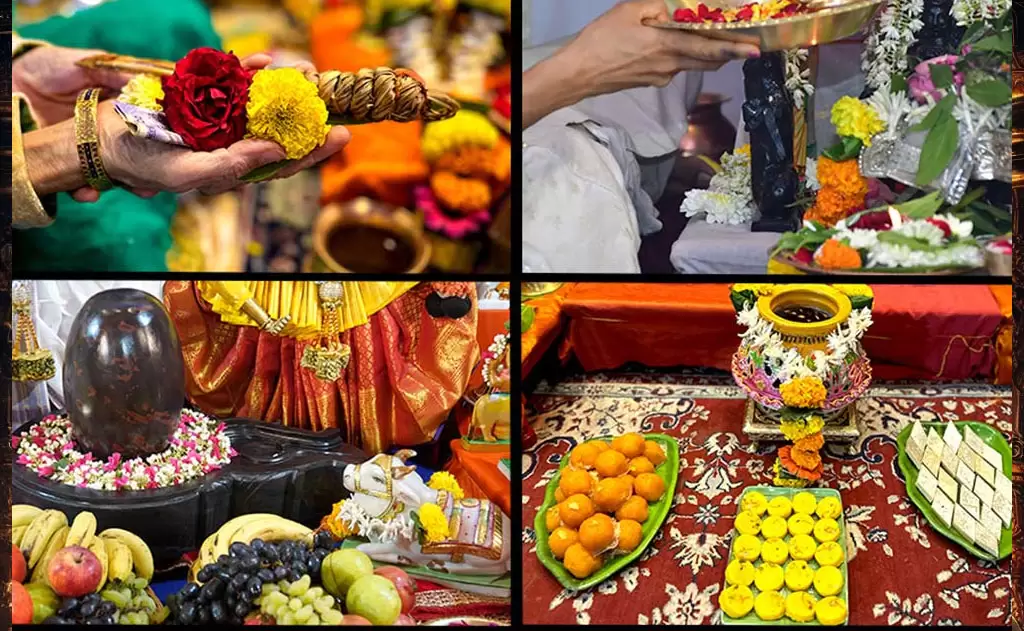
In an archana, the priest or devotee chants each name preceded by the sacred syllable 'Om' and followed by 'namah' (I bow / salutations), while offering tulsi leaves, flowers, or kumkum at the feet of the deity with each name. For Lord Venkateswara, tulsi (holy basil) is especially dear, and the Ashtottara archana with tulsi is a cherished form of worship.

Advertisement

Well-Known Names of Lord Venkateswara with Meanings

Below are some of the widely known and celebrated names from the Venkateswara Ashtottara Shatanamavali, along with their devotional meanings. Each is chanted as 'Om <name> namah'.

NameMeaning / Significance
Om Venkatesaya namahThe Lord of the Venkata hill; the one who removes the sins of devotees
Om Srinivasaya namahThe one in whom Sri (Lakshmi) dwells; the abode of the Goddess of fortune
Om Balajaye namahThe beloved form worshipped as Balaji at Tirumala
Om Govindaya namahThe protector of cows, the earth, and the Vedas; a cherished name of Vishnu
Om Srihaye namahSrihari - Lord Hari accompanied by Sri Lakshmi
Om Padmanabhaya namahThe one from whose navel the lotus of creation arose
Om Seshadrinilayaya namahThe one who resides on Seshadri (the hill of Adishesha), i.e., Tirumala
Om Anantaya namahThe infinite, endless one, beyond all limits
Om Vaikunthanathaya namahThe Lord of Vaikuntha, the supreme divine abode
Om Tirumalesaya namahThe Lord of Tirumala, master of the sacred seven hills
Om Bhaktavatsalaya namahThe one who is tenderly affectionate and loving toward His devotees
Om Anandanilayavasaya namahThe one who dwells in Ananda Nilaya, the abode of bliss
Om Vasudevaya namahThe all-pervading one; the divine son of Vasudeva
Om Purushottamaya namahThe Supreme Person, highest among all beings
Om Narayanaya namahThe refuge of all beings; the one who dwells in the waters
Om Kesavaya namahThe one with beautiful hair; the vanquisher of the demon Kesi
Om Madhavaya namahThe consort of Lakshmi (Ma); the Lord of fortune
Om Achyutaya namahThe infallible, unchanging one who never falls from His glory
Om Janardanaya namahThe one who blesses His devotees and answers their prayers
Om Damodaraya namahThe one bound with a cord around the waist; the merciful Lord
Om Hrishikesaya namahThe master of the senses
Om Trivikramaya namahThe one who measured the three worlds in three strides
Om Sridharaya namahThe bearer of Sri (Lakshmi) upon His chest
Om Sarvesvaraya namahThe Lord of all, the supreme ruler of everything
Om Parabrahmane namahThe Supreme Absolute Reality
Om Jagatpataye namahThe Lord and protector of the entire universe
Om Deenabandhave namahThe friend and refuge of the poor and the helpless
Om Karunakaraya namahThe ocean of compassion, the source of all mercy
Om Sarvapapaharaya namahThe remover of all sins
Om Bhaktapriyaya namahThe one who is dear to His devotees and holds them dear

The full Ashtottara contains 108 names in all, weaving together the Lord's forms, His deeds, His abode at Tirumala, and His endless compassion. Devotees are encouraged to learn the complete namavali from an authorised source such as the Tirumala Tirupati Devasthanams (TTD) publications or a trusted family purohit, so that each name is chanted correctly.

When and How to Chant the Ashtottara

The Venkateswara Ashtottara Shatanamavali can be chanted daily, but certain days are considered especially auspicious for the Lord's worship:

  • Saturdays (Shanivaram), which are traditionally dedicated to Lord Venkateswara / Balaji
  • Ekadashi and, above all, Vaikuntha Ekadashi, the most sacred day associated with Vaikuntha
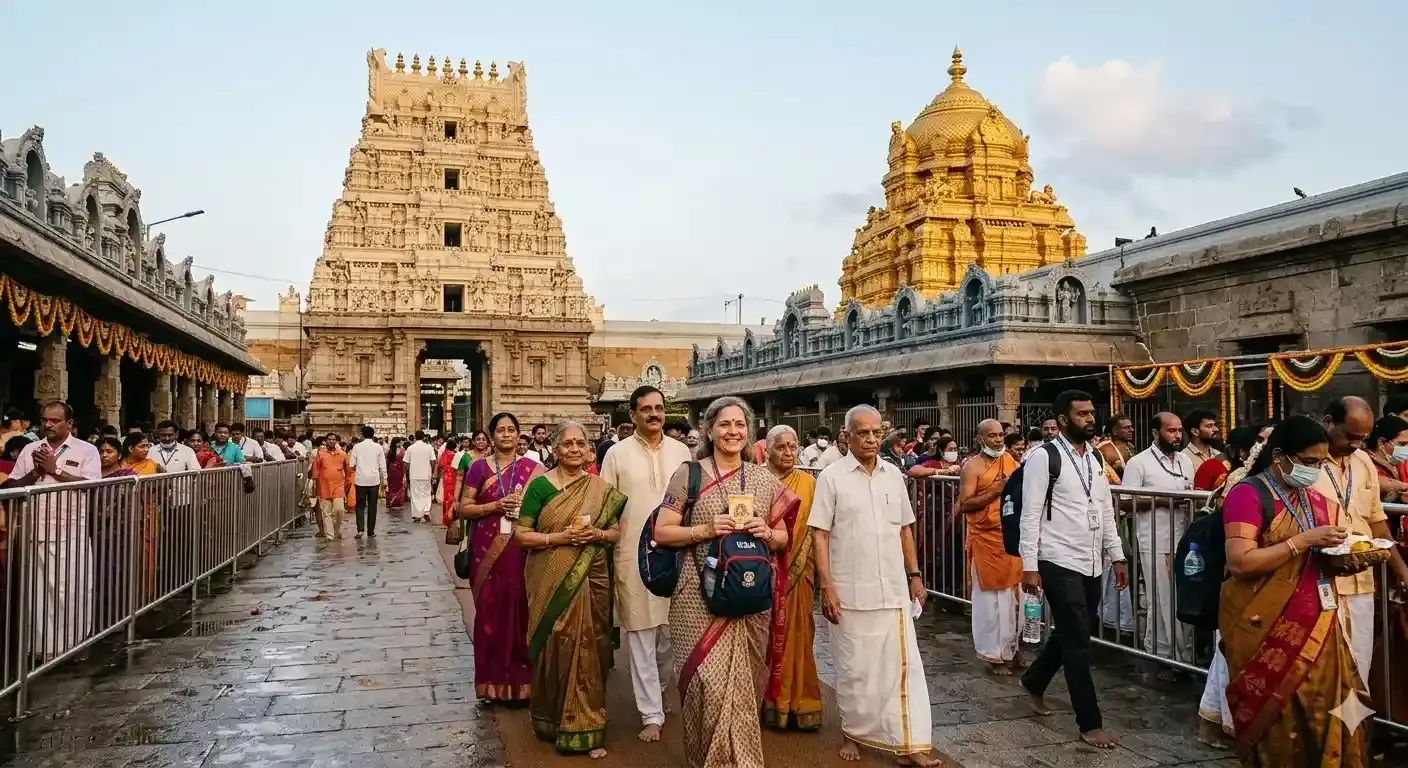
  • During the annual Brahmotsavam festival at Tirumala
  • On Purattasi / month-long Venkateswara observances kept by many devotee families
  • Any occasion of special prayer, thanksgiving, or seeking the Lord's blessings

Simple way to perform the archana at home

  1. Bathe, wear clean clothes, and sit before an image or picture of Lord Venkateswara.
  2. Light a lamp and offer incense; keep tulsi leaves, flowers, or kumkum ready for the archana.
  3. Begin with a prayer to Lord Ganesha and remember Sri Padmavati (Alamelumanga) beside the Lord.
  4. Chant each name in the form 'Om <name> namah', offering a tulsi leaf or flower with each name.
  5. Conclude with the recitation of the Venkateswara or Vishnu Sahasranama if you wish, followed by aarti and namaskaram.

The chanting is done with a calm, devoted mind. It is the bhava - the loving attitude of surrender - that the Lord treasures most, more than perfection of pronunciation. Devotees who cannot chant all 108 names may recite the well-known names above with the same sincerity.

The Devotional Significance and Benefits

In the Vaishnava tradition, remembering the names of the Lord is itself considered a complete form of worship. Reciting the 108 names of Sri Venkateswara is offered as a practice that cultivates devotion, steadies the mind, and turns the heart toward the Lord's feet.

  • It is chanted to seek the Lord's grace, protection, and the removal of obstacles and inner impurities.
  • It fosters bhakti and a sense of surrender (sharanagati) to Sri Venkateswara.
  • It is a beautiful group or family sadhana, uniting devotees in shared worship.
  • It keeps alive the connection to Tirumala for those who cannot make the pilgrimage in person.

These benefits are understood in a devotional spirit - as fruits of faith and the Lord's mercy - rather than as guaranteed material outcomes. The tradition holds that the sincere devotee who takes refuge in Sri Venkateswara is never forsaken, for He is Bhaktavatsala, ever tender toward those who love Him.

Advertisement

Conclusion

The Venkateswara Ashtottara Shatanamavali is a garland of 108 names lovingly strung to adorn the Lord of the Seven Hills. Whether chanted in the sanctum at Tirumala amid the fragrance of tulsi, or softly in one's own home shrine, each 'Om <name> namah' is a step toward the feet of Sri Srinivasa. May the recitation of these sacred names bring peace, devotion, and the abiding grace of Lord Venkateswara to all who chant them. Om Namo Venkatesaya.

Frequently Asked Questions

What is the Venkateswara Ashtottara Shatanamavali?

It is a sacred litany of 108 names (ashtottara shatanama) of Lord Venkateswara - also known as Srinivasa, Balaji, and Govinda - the presiding deity of Tirumala Tirupati and a form of Bhagavan Vishnu. Each name is chanted as 'Om <name> namah', usually with tulsi archana.

Who is Lord Venkateswara?

Lord Venkateswara is a form of Vishnu worshipped on the seven hills of Tirumala as Srinivasa or Balaji. He is revered as the merciful Kali-yuga daivam, and His consort at Tirumala is Sri Padmavati Devi (Alamelumanga), a form of Goddess Lakshmi. His shrine is called Ananda Nilaya, the abode of bliss.

When should the Ashtottara be chanted?

It can be chanted daily, and is considered especially auspicious on Saturdays (associated with Balaji), on Ekadashi and Vaikuntha Ekadashi, and during the annual Brahmotsavam festival at Tirumala. Any time of prayer or thanksgiving is also appropriate.

How is each name recited?

Each of the 108 names is chanted in the form 'Om <name> namah' - for example, 'Om Venkatesaya namah', 'Om Srinivasaya namah'. During an archana, a tulsi leaf, flower, or kumkum is offered at the Lord's feet with each name.

What are some well-known names of Venkateswara?

Widely loved names include Venkatesa, Srinivasa, Balaji, Govinda, Srihari, Padmanabha, Seshadrinilaya, Ananta, Vaikunthanatha, Tirumalesa, Bhaktavatsala, and Anandanilayavasa. Each reveals an aspect of the Lord's beauty, deeds, or His abode at Tirumala.

Why is tulsi used in the Venkateswara archana?

Tulsi (holy basil) is considered especially dear to Lord Vishnu and His forms, including Venkateswara. Offering tulsi leaves with each of the 108 names is a cherished and traditional form of the Ashtottara archana at Tirumala and in devotees' homes.

What are the benefits of chanting the 108 names?

In the devotional tradition, chanting the names is offered as a practice that cultivates bhakti, steadies the mind, and invokes the Lord's grace, protection, and inner purification. These are understood as fruits of faith and divine mercy rather than guaranteed material results.

Where can I find the complete list of 108 names?

The full, authorised namavali can be obtained from Tirumala Tirupati Devasthanams (TTD) publications or from a trusted family purohit or Vaishnava acharya, so that each of the 108 names is learned and chanted correctly.