Navratri Mantras Before Garba: Durga and Amba Prayers, Day-Wise Naam Mantras and a Family Sankalpa
Garba begins with prayer. Here are the canonical Navratri mantras to chant before you step into the circle, from the Navarna mantra and Durga beeja to Sarva Mangala Mangalye, Ya Devi Sarvabhuteshu and Jayanti Mangala Kali, with meanings and sources, the naam mantra for each of the nine forms of Durga, when the Amba aartis are sung, and a simple family sankalpa.
Garba begins with prayer. Here are the canonical Navratri mantras to chant before you step into the circle, from the Navarna mantra and Durga beeja to Sarva Mangala Mangalye, Ya Devi Sarvabhuteshu and Jayanti Mangala Kali, with meanings and sources, the naam mantra for each of the nine forms of Durga, when the Amba aartis are sung, and a simple family sankalpa.
Quick answer: Garba is traditionally danced as worship of Amba, Durga or Shakti, so many families and groups begin with a short prayer and the aarti before the circle starts. Five canonical Navratri mantras suit this moment: the Navarna mantra, the Durga beeja mantra, Sarva Mangala Mangalye, Ya Devi Sarvabhuteshu and Jayanti Mangala Kali, plus the naam mantra of the day's form of Durga. Navratri 2026 runs from Sunday 11 to Monday 19 October in India (Drik Panchang), with Dussehra on Tuesday 20 October.
Before the drums start and the circle forms, there is usually a quiet moment: someone lights the lamp in the Garbo, the Mataji's image is garlanded, and everyone turns to the Goddess for the aarti. Whether you are at a temple in Gujarat, a community hall in New Jersey, or a school gym in Leicester or Toronto, that moment is what makes Garba worship rather than just a dance. This page gives the mantras many devotees chant then, with meanings and sources, and a simple family prayer to say at home before you leave.
Why Garba begins with prayer
As traditionally told, Garba takes its name from the garbha (womb), and the Garbo, a pierced clay pot with a lamp inside, is a symbol of life and of the Devi present within. Dancers circle the Garbo or the Mataji's image, keeping the Goddess at the centre. Read more in our guide to the meaning and spiritual significance of Garba.
Because the dance is an offering, the evening customarily opens with the aarti, and many devotees add a few mantras of their own, at home before leaving or silently at the venue. It sets the intention: the hours of dancing that follow are for Ma Amba.
1. The Navarna mantra
ॐ ऐं ह्रीं क्लीं चामुण्डायै विच्चे॥
Om Aim Hreem Kleem Chamundayai Vichche
Source: the Navarna (nine-syllable) mantra of the Devi, from the Chandi or Durga Saptashati tradition.
Meaning: As traditionally explained, the seed syllables invoke the three great forms of the Goddess honoured in the Devi Mahatmya, Mahasaraswati, Mahalakshmi and Mahakali, and the mantra is offered to Chamunda, the form of Durga who destroyed the demons Chanda and Munda. Interpretations of the individual seed syllables vary between traditions. Many families treat the Navarna as a mantra for japa, learned from a guru or elder, and chant it on a mala during Navratri.
2. The Durga beeja mantra
ॐ दुं दुर्गायै नमः॥
Om Dum Durgayai Namah
Source: the Durga beeja (seed) mantra.
Meaning: "Om, salutations to Durga," with Dum as the seed syllable of Durga. It is short, easy to learn, and often taught to children. Many devotees chant it 11, 21 or 108 times, or simply three times before the aarti.
3. Sarva Mangala Mangalye
सर्वमङ्गलमाङ्गल्ये शिवे सर्वार्थसाधिके। शरण्ये त्र्यम्बके गौरि नारायणि नमोऽस्तु ते॥
Sarva-mangala-mangalye shive sarvartha-sadhike, sharanye tryambake gauri narayani namostu te.
Source: the Devi Mahatmya (Narayani Stuti).
Meaning: "O auspiciousness of all that is auspicious, O consort of Shiva, accomplisher of every aim, giver of refuge, three-eyed Gauri, O Narayani, salutations to you." This verse is among the most widely recited Devi prayers and is a natural choice for the moment before Garba.
4. Ya Devi Sarvabhuteshu
या देवी सर्वभूतेषु शक्तिरूपेण संस्थिता। नमस्तस्यै नमस्तस्यै नमस्तस्यै नमो नमः॥
Ya Devi sarvabhuteshu shakti-rupena samsthita, namastasyai namastasyai namastasyai namo namah.
Source: the Devi Mahatmya (Aparajita Stuti).
Meaning: "To the Goddess who abides in all beings in the form of power (shakti), salutations to her, salutations to her, salutations to her again and again." In the full hymn, the same pattern repeats for many qualities, seeing the Goddess as consciousness, intellect, compassion, peace and mother in every being. It is a beautiful verse to say before dancing in a circle with hundreds of others.
5. Jayanti Mangala Kali
जयन्ती मङ्गला काली भद्रकाली कपालिनी। दुर्गा क्षमा शिवा धात्री स्वाहा स्वधा नमोऽस्तु ते॥
Jayanti mangala kali bhadrakali kapalini, durga kshama shiva dhatri svaha svadha namostu te.
Source: the opening verse of the Argala Stotram, recited with the Durga Saptashati.
Meaning: A string of the Goddess's names: Jayanti (the victorious), Mangala (the auspicious), Kali, Bhadrakali, Kapalini, Durga, Kshama (forbearance), Shiva (the benevolent), Dhatri (the sustainer), Svaha and Svadha (to whom offerings are made). "Salutations to you." Many devotees chant it as a protective prayer during Navratri.
Day-wise naam mantras for the nine forms of Durga
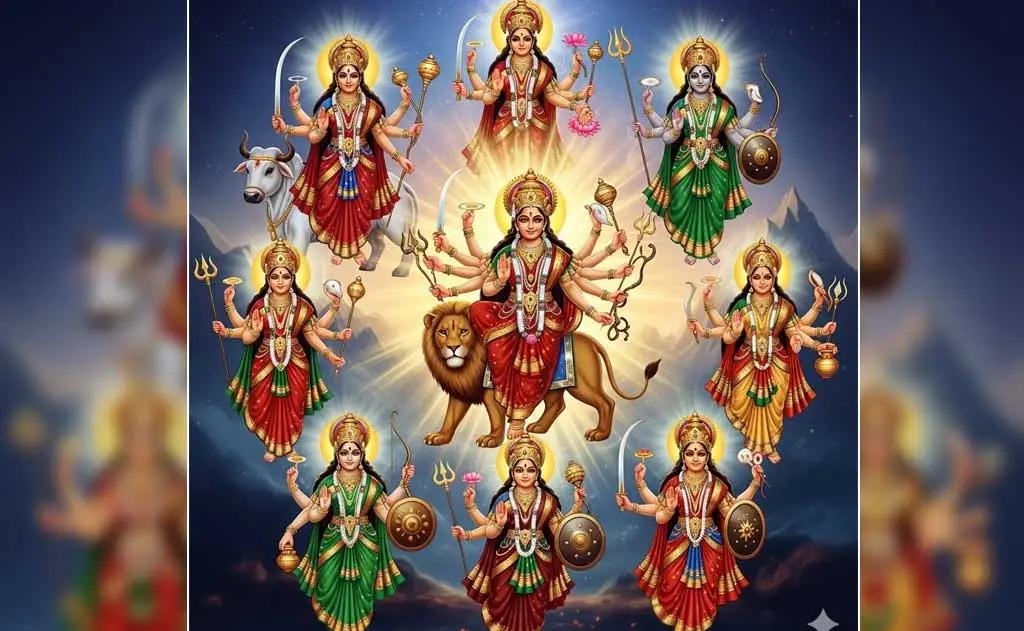
Each of the nine nights honours one form of Durga, the Navadurga. The naam mantra is a simple salutation to the day's form by name, ideal for a short prayer before that night's Garba. Dates below are for India (Drik Panchang). Abroad, Drik lists Durga Ashtami on 18 October and Maha Navami on 19 October in the USA, Canada and the UK; follow your local temple's calendar.
| Day | Date (India) | Form of Durga | Colour of the day |
|---|---|---|---|
| 1 | Sunday 11 October 2026 | Shailaputri | Orange |
| 2 | Monday 12 October 2026 | Brahmacharini | White |
| 3 | Tuesday 13 October 2026 | Chandraghanta | Red |
| 4 | Wednesday 14 October 2026 | Kushmanda | Royal blue |
| 5 | Thursday 15 October 2026 | Skandamata | Yellow |
| 6 | Friday 16 October 2026 | Katyayani | Green |
| 7 | Saturday 17 October 2026 | Kalaratri | Grey |
| 8 | Sunday 18 October 2026 | Mahagauri | Lists differ |
| 9 | Monday 19 October 2026 (Ashtami and Navami in India) | Siddhidatri | Lists differ |
Colours follow the weekday rule on our Navratri 2026 colours list. The naam mantra for each day:
Day 1: Maa Shailaputri (Sunday 11 October 2026 in India), daughter of the mountain (Himavan). Salutations to Devi Shailaputri:
ॐ देवी शैलपुत्र्यै नमः॥
Om Devi Shailaputryai Namah
Day 2: Maa Brahmacharini (Monday 12 October 2026 in India), the Goddess in tapas and steady devotion. Salutations to Devi Brahmacharini:
ॐ देवी ब्रह्मचारिण्यै नमः॥
Om Devi Brahmacharinyai Namah
Day 3: Maa Chandraghanta (Tuesday 13 October 2026 in India), bearing the half-moon shaped like a bell. Salutations to Devi Chandraghanta:
ॐ देवी चन्द्रघण्टायै नमः॥
Om Devi Chandraghantayai Namah
Day 4: Maa Kushmanda (Wednesday 14 October 2026 in India), traditionally described as creating the cosmos with her smile. Salutations to Devi Kushmanda:
ॐ देवी कूष्माण्डायै नमः॥
Om Devi Kushmandayai Namah
Day 5: Maa Skandamata (Thursday 15 October 2026 in India), mother of Skanda (Kartikeya). Salutations to Devi Skandamata:
ॐ देवी स्कन्दमातायै नमः॥
Om Devi Skandamatayai Namah
Day 6: Maa Katyayani (Friday 16 October 2026 in India), the warrior form born, as traditionally told, in the ashram of sage Katyayana. Salutations to Devi Katyayani:
ॐ देवी कात्यायन्यै नमः॥
Om Devi Katyayanyai Namah
Day 7: Maa Kalaratri (Saturday 17 October 2026 in India), the fierce form that destroys darkness and fear. Salutations to Devi Kalaratri:
ॐ देवी कालरात्र्यै नमः॥
Om Devi Kalaratryai Namah
Day 8: Maa Mahagauri (Sunday 18 October 2026 in India), the radiant, pure white form. Salutations to Devi Mahagauri:
ॐ देवी महागौर्यै नमः॥
Om Devi Mahagauryai Namah
Day 9: Maa Siddhidatri (Monday 19 October 2026 in India), giver of siddhi, spiritual accomplishment. Salutations to Devi Siddhidatri:
ॐ देवी सिद्धिदात्र्यै नमः॥
Om Devi Siddhidatryai Namah
For the full dhyana shlokas and rituals of each day, see Navratri day-wise mantras and their significance and the complete 9-day Devi worship guide.
The Amba aartis: Jay Adya Shakti and Om Jai Ambe Gauri
Two aartis to the Goddess are heard most often at Navratri. We name them here but do not reproduce their lyrics, because we have not been able to verify a standard text; use the version your family or temple sings.
- Jay Adya Shakti. The Gujarati aarti of Ambe Ma, the one most commonly sung at Gujarati Garba. In many circles it is sung at the start of the evening, with the lamp plate waved before the Mataji's image, and often again when the night closes. Many people know it by heart from childhood.
- Om Jai Ambe Gauri. The Hindi aarti of Ambe Ma, sung in homes and temples across North India and at many community Navratri events abroad, where families from different regions celebrate together.
At most events, the aarti is the one moment when the music stops and everyone faces the Goddess. Stand still, join the clapping or singing if you know it, and keep phones away. Our Garba for beginners guide covers the rest of the etiquette.
A simple family sankalpa before going to Garba
A sankalpa is a statement of intention made before worship. Families can say this together at the home shrine, after lighting a lamp, before setting out. It is in English so everyone, including children and guests, can join:
"Ma Amba, Mother Durga, on this night of Navratri we come to dance for you. We offer our steps, our songs and our joy at your feet. Keep us mindful, kind to everyone in the circle, and safe on the way there and home. May all beings be well. Jai Mata Di."
Then chant one of the mantras above, perhaps the naam mantra of the day, three times, and offer a flower or a little prasad. That is all. It is a devotional offering, not a bargain: the mantras and sankalpa are said with love for the Goddess, not as a guarantee of any particular result.
Keeping the prayer at the heart of Garba abroad
For families in the USA, UK, Canada and beyond, Garba nights often fall on weekends, many on 10 to 11 and 16 to 18 October in 2026, and in borrowed spaces: school gyms, community halls and temple halls. A few habits help children feel that this is worship:
- Say the sankalpa and a mantra at home before leaving, so the evening starts with the Goddess.
- Arrive in time for the aarti rather than only for the dancing.
- Bow to the Mataji's image or the Garbo when you enter the circle.
- On weeknights when there is no community Garba, light a lamp at home, chant the day's naam mantra and dance a few rounds in the living room.
- Teach one mantra per Navratri; over the years, children learn them all.
For dates, Ghatasthapana and city details, see the Navratri 2026 NRI guide, our city-by-city guides for the USA, the UK and Canada, and the Navratri 2026 Gujarat Garba guide for Garba in its home state.
Also read: Garba 2026 worldwide: all countries.
Frequently asked questions
Which mantra should I chant before Garba?
A simple and widely used choice is the Sarva Mangala Mangalye verse from the Devi Mahatmya, or the Ya Devi Sarvabhuteshu verse, chanted once or three times with folded hands before the Mataji's image. The Durga beeja mantra is short enough for children. Then join the aarti with everyone else before the circle begins.
Which aarti is sung before Garba?
In Gujarati Garba, the aarti of Ambe Ma that begins 'Jay Adya Shakti' is the one most commonly sung, often at the start of the evening and sometimes again at the end. In many North Indian homes and temples, and at many mixed community events abroad, 'Om Jai Ambe Gauri' is sung. Local custom decides which is used and when.
What is the Navarna mantra?
The Navarna mantra is the nine-syllable mantra of the Devi associated with the Chandi or Durga Saptashati tradition. It is given above with transliteration. Many traditions consider it a mantra for japa, ideally learned from a guru or family elder, and it is especially chanted during Navratri.
What is the mantra for each day of Navratri 2026?
Each of the nine nights honours one form of Durga, from Shailaputri on Day 1 (Sunday 11 October 2026 in India) to Siddhidatri on Day 9 (Monday 19 October 2026). The naam mantra for each form, a simple salutation by name, is listed in the day-wise section above.
Can children and non-initiated people chant these mantras?
The naam mantras, the Ya Devi verse and the Sarva Mangala Mangalye verse are commonly chanted by everyone, including children, at home and in temples. For longer japa of the Navarna mantra, many families follow the guidance of a guru or elder. Chant with respect and attention; correct pronunciation improves with practice.
Do I have to chant mantras to join Garba?
No. Garba is open to all, and nobody will ask you to recite anything. Standing respectfully during the aarti is enough. The mantras here are for devotees and families who wish to begin the evening with prayer.
Sources & verification
The five general mantras and the nine naam mantras are given in their canonical form from our verified data; source notes follow each mantra. English meanings are HinduTone's own renderings. Dates are from Drik Panchang for India. We do not reproduce the lyrics of the Jay Adya Shakti or Om Jai Ambe Gauri aartis because we have not verified a standard text.
Editor's note (7 October 2026)
We wrote this guide in October 2026 for Navratri 2026. Customs of when and which mantras and aartis are used before Garba vary by family, community and temple; follow your elders and your temple priest where they differ from this page.
Related guides
- Garba meaning and spiritual significance
- History of Garba: from Gujarat to the world
- Garba vs Dandiya Raas: the difference
- Garba dress guide: chaniya choli, kediyu and jewellery
- Garba for beginners: steps, etiquette and kids
- Dussehra mantras: chant for inner strength and protection
- Dussehra / Vijayadashami 2026
You might also like
Hindu Prayers and Mantras While Waiting for Green Card Approval: A Devotional Guide for Indian Immigrants in the USA
Bhairav Chalisa: Lyrics in Hindi with Meaning, Bhairav Aarti and How to Recite
Ram Chalisa: Lyrics in Hindi with Meaning, Ram Stuti Aarti and How to Recite