
Navratri 2026 Gujarat Garba Guide: Dates (11-19 October), Garbo, Garba vs Dandiya, Ambaji, Pavagadh and What to Wear
Navratri 2026 in Gujarat runs from Sunday 11 to Monday 19 October, with Dussehra on Tuesday 20 October and Sharad Purnima garba on Sunday 25 October. This guide covers the key dates, the garbo lamp at the heart of garba, garba versus dandiya raas, Ambaji and Pavagadh, the garba culture of Ahmedabad, Vadodara and Surat, traditional outfits and Vijay Muhurat.
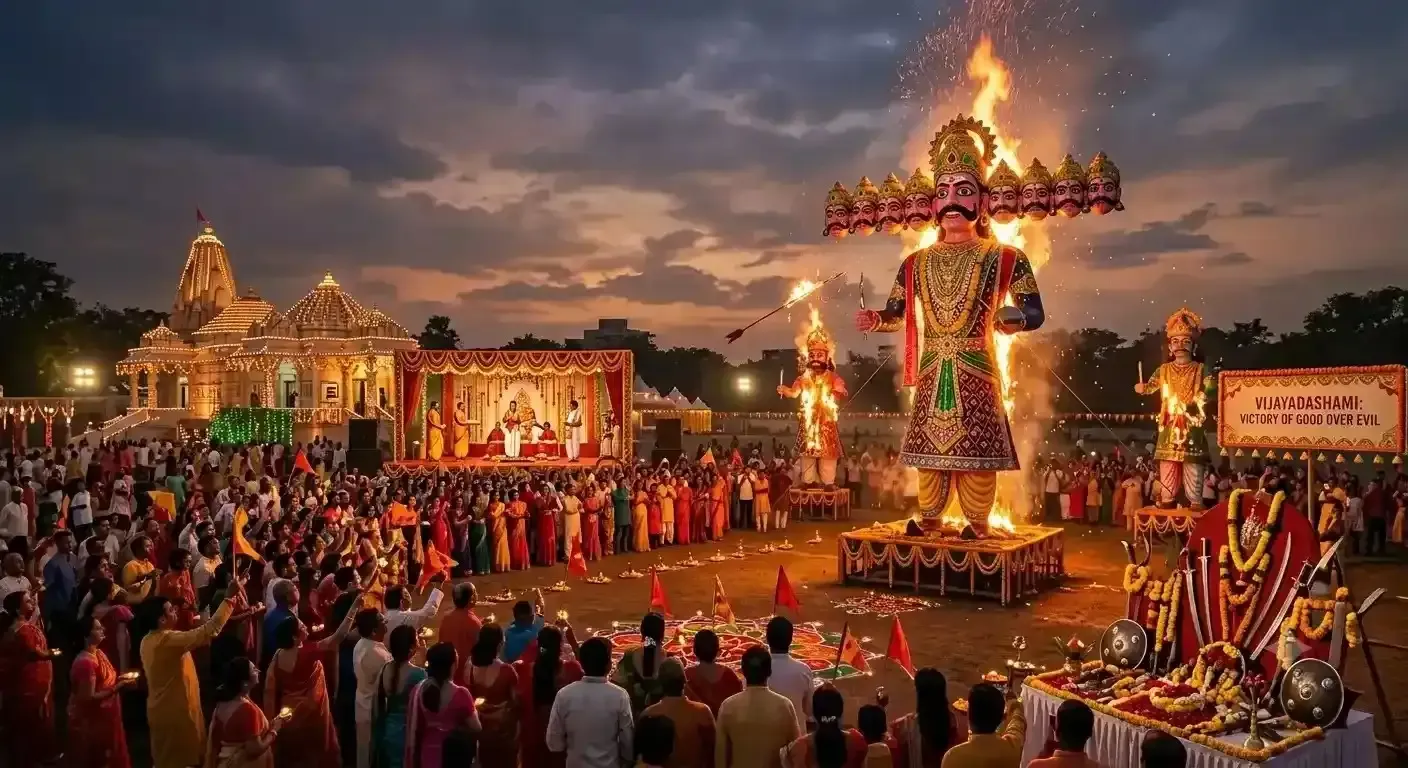
Navratri 2026 in Gujarat runs from Sunday 11 to Monday 19 October, with Dussehra on Tuesday 20 October and Sharad Purnima garba on Sunday 25 October. This guide covers the key dates, the garbo lamp at the heart of garba, garba versus dandiya raas, Ambaji and Pavagadh, the garba culture of Ahmedabad, Vadodara and Surat, traditional outfits and Vijay Muhurat.
Quick answer: Navratri 2026 Gujarat celebrations run for nine nights of garba from Sunday 11 October to Monday 19 October 2026. Ghatasthapana is on Sunday 11 October, Durga Ashtami and Maha Navami both fall on Monday 19 October in India, and Dussehra is on Tuesday 20 October 2026, per Drik Panchang. Across Gujarat, people dance garba around a lit earthen lamp called the garbo, play dandiya raas with sticks, visit the Shakti shrines of Ambaji and Pavagadh, and gather again for garba on Sharad Purnima, Sunday 25 October.
This guide has been restored at its original hindutone.com address. It covers the dates, the meaning of garba, the main pilgrim shrines, city culture, what to wear and the Dussehra muhurat. It does not list specific 2026 events, venues or ticket prices.
Navratri 2026 Gujarat dates
The table below gives the key dates for Navratri and the days after it. All dates are India dates from Drik Panchang, and times are India Standard Time.
| Occasion | Date in 2026 (India) |
|---|---|
| Mahalaya / Sarva Pitru Amavasya | Sat 10 Oct 2026 |
| Ghatasthapana / Navratri begins | Sun 11 Oct 2026 (Navratri 11-19 Oct) |
| Lalita Panchami | Thu 15 Oct 2026 |
| Durga Ashtami and Maha Navami | Mon 19 Oct 2026 |
| Dussehra / Vijayadashami | Tue 20 Oct 2026 |
| Dashami tithi | 12:50 PM IST 20 Oct - 2:11 PM IST 21 Oct |
| Sharad Purnima (Sharad Poonam garba) | Sun 25 Oct 2026 |
| Diwali | Sun 8 Nov 2026 |
Garba is danced on each night of Navratri, from the evening of Ghatasthapana to the night of Navami. In 2026 Ashtami and Navami fall on the same day, so many families will hold their Ashtami havan and Navami rituals on Monday 19 October. Follow your family priest or temple for the exact timing. For the colour of each day, see Navratri 2026 colours: 9 days list.
Navratri in Gujarat: worship of Amba
In Gujarat, Navratri is above all a festival of Amba, the Mother Goddess, worshipped as Ambe Maa, Durga, Kali, Bahuchara and other forms. On the first day, families set up the ghat (a pot of water) and often sow grain in a small bed of soil, which sprouts during the nine days. A lamp is kept burning, and the aarti of the Goddess is sung every evening.
Many devotees fast during Navratri. Some keep a full fast, some eat one meal a day, and many eat only farali (fasting) food, such as sabudana khichdi, potatoes, fruit, milk and dishes made from millet or water chestnut flour. Lalita Panchami, on Thursday 15 October 2026, is an important day of Devi worship in the middle of the festival. For the full nine-day vidhi, see Navratri and Dussehra 2026: complete 9-day Devi worship guide.
The garbo: the lamp at the centre of garba
The word garba is linked with the Sanskrit word garbha, meaning womb. A garbo is an earthen pot with many small holes, and a lamp (deep) burns inside it. It is placed at the centre of the dance, together with an image of the Goddess. The pot is understood as the body, or the womb, and the flame inside is the divine light and the life that the Goddess gives.
Dancers move in circles around the garbo. The circle itself is a symbol of the cycle of time and life, which turns around the still, unchanging Goddess at the centre. In homes and neighbourhoods, women traditionally carry the garbo on their heads on certain nights and dance with it. Garba songs praise Amba and her forms, and many describe her temples, her festivals and her love for her devotees.
In December 2023, UNESCO inscribed the Garba of Gujarat on its Representative List of the Intangible Cultural Heritage of Humanity, recognising it as a living tradition shared across communities.
Garba vs dandiya raas
| Garba | Dandiya raas | |
|---|---|---|
| Main focus | Devotion to the Goddess | Joyful raas linked with Krishna and the gopis |
| Formation | Circles around the garbo or image of the Goddess | Pairs or two facing lines |
| Props | No sticks; claps, turns and footwork | A pair of decorated sticks (dandiya) |
| Common steps | Two-clap and three-clap patterns, and many regional styles | Striking sticks with a partner in rhythm |
| When | Usually first in the evening | Often later in the night |
Most Navratri nights in Gujarat include both. People begin with garba in honour of the Goddess and move on to dandiya raas later. Music ranges from traditional folk songs with dhol and live singers to modern arrangements.
Ambaji, Pavagadh and other Shakti shrines
Navratri is the busiest season at Gujarat's great Devi temples. Many devotees walk to these shrines or visit with their families during the nine days.
- Ambaji: The Ambaji temple in Banaskantha district, near the Gujarat-Rajasthan border, is one of the most important Shakti shrines in India and is regarded by many as a Shakti Peetha. As commonly described, the Goddess is worshipped here through a sacred yantra rather than an idol. Gabbar hill nearby is also visited by pilgrims.
- Pavagadh: The Kalika Mata temple stands on top of Pavagadh hill in Panchmahal district, near Champaner. The Champaner-Pavagadh area is a UNESCO World Heritage Site. Pilgrims climb the hill on foot, and a ropeway serves part of the route.
- Bahucharaji: The temple of Bahuchara Mata at Becharaji in Mehsana district is another major Devi shrine that draws large Navratri crowds.
Crowds can be very heavy during Navratri. Check each temple's official website or the Gujarat government's announcements for current timings, darshan arrangements and travel advice before you go.
Garba culture in Ahmedabad, Vadodara and Surat
Every Gujarati city has its own garba spirit. In Ahmedabad, garba is danced in the old pols (traditional neighbourhoods), in housing societies, and at large organised events. Vadodara is widely known for its love of traditional garba, with large crowds and live folk music. Surat also has a vibrant garba scene in its societies and community grounds. Smaller towns and villages keep older styles alive, often around a temple or the village square.
Broadly, there are two kinds of garba. Sheri garba (street or society garba) is held by neighbours in their own lane or compound, often free and family-centred, with the garbo at the centre. Large organised garba events are held on big grounds, often with passes. If you plan to attend one, check its organiser's official announcements for dates, rules and passes. This guide does not list specific 2026 events.
What to wear for garba
- Chaniya choli: Women traditionally wear a flared, embroidered skirt (chaniya) with a blouse (choli) and a dupatta. Mirror work and bright colours are popular.
- Kediyu: Men traditionally wear a kediyu, a short, flared, often embroidered top, with a dhoti or churidar. Some add a turban (pagdi) or a stole.
- Jewellery: Oxidised or silver-style necklaces, earrings, bangles and anklets are popular with both traditional and modern outfits.
- Practical tips: Choose light fabrics, secure jewellery that will not catch, and comfortable footwear. Carry water, because garba nights are long.
Dussehra 2026 in Gujarat and Vijay Muhurat
Navratri ends with Dussehra on Tuesday 20 October 2026. In Gujarat, Dussehra is famous for eating fafda and jalebi, and many families also do Shastra Puja and vehicle puja. The Vijay Muhurat for the main cities is given below in India Standard Time.
| City | Vijay Muhurat (Tue 20 Oct 2026) |
|---|---|
| Ahmedabad | 2:19-3:05 PM |
| Vadodara | 2:17-3:03 PM |
| Surat | 2:19-3:05 PM |
For more on Gujarat's Dussehra, see Dussehra 2026 in Gujarat. After Dussehra, many Gujaratis gather once more for garba and raas on Sharad Purnima (Sharad Poonam), Sunday 25 October 2026, and eat doodh-pauva in the moonlight.
Garba for Gujarati families abroad
Gujarati communities in the USA, UK, Canada, Australia, East Africa and elsewhere hold some of the largest Navratri gatherings outside India. Check your temple's or community association's official website for its own dates and plans. Use a local panchang for your city, because India's clock times apply to India only. For city guides abroad, see Navratri 2026 in the USA, city by city and Navratri 2026 in Canada, city by city.
Frequently asked questions
When is Navratri 2026 in Gujarat?
Sharad Navratri 2026 runs from Sunday 11 October to Monday 19 October, per Drik Panchang. Ghatasthapana is on Sunday 11 October, Durga Ashtami and Maha Navami both fall on Monday 19 October in India, and Dussehra is on Tuesday 20 October 2026.
What is the difference between garba and dandiya?
Garba is danced in circles around the Goddess or a lit garbo, with clapping, turns and footwork, and no sticks. Dandiya raas is danced in pairs or lines with a pair of decorated sticks, which dancers strike in rhythm. Dandiya is linked with the raas of Krishna. Most Navratri nights in Gujarat include both.
What is a garbo?
A garbo is an earthen pot with small holes, with a lamp (deep) burning inside it. It is placed at the centre of the garba circle. The word garba is linked with 'garbha', the womb, and the lamp inside the pot is understood as the divine light and life within the body.
Is there garba on Sharad Purnima?
Yes. In many parts of Gujarat, people gather for garba and raas on the night of Sharad Purnima, which is on Sunday 25 October 2026. Many families also eat doodh-pauva (flattened rice in milk) in the moonlight that night.
What should I wear for garba?
Women traditionally wear a chaniya choli (a flared, embroidered skirt with a blouse) and a dupatta, with oxidised or silver-style jewellery. Men traditionally wear a kediyu (a short, flared top) with a dhoti or churidar, sometimes with a turban. Comfortable footwear, or bare feet where allowed, helps with long nights of dancing.
What is the Vijay Muhurat on Dussehra 2026 in Gujarat?
For Tuesday 20 October 2026, the Vijay Muhurat is 2:19-3:05 PM in Ahmedabad, 2:17-3:03 PM in Vadodara and 2:19-3:05 PM in Surat. These are India Standard Time values for those cities only.
Editor's note
Editor's note (6 October 2026): This guide has been restored at its original address after the earlier version was lost. Dates are India dates from Drik Panchang, and the Vijay Muhurat values for Ahmedabad, Vadodara and Surat are India Standard Time. The guide deliberately does not name specific 2026 garba events, venues, organisers or pass prices; check official announcements. Temple timings change, so check each temple's official website before visiting.
Related guides
You might also like
October 2026 Festivals State-Wise in India: Dates, Traditions and Where Each Festival Is Biggest
Lalita Panchami 2026: Date (15 October), Upang Lalita Vrat, Puja Vidhi and Significance
Diwali 2026 in Canada, Province by Province: Dates, Lakshmi Puja and Dhanteras Muhurat