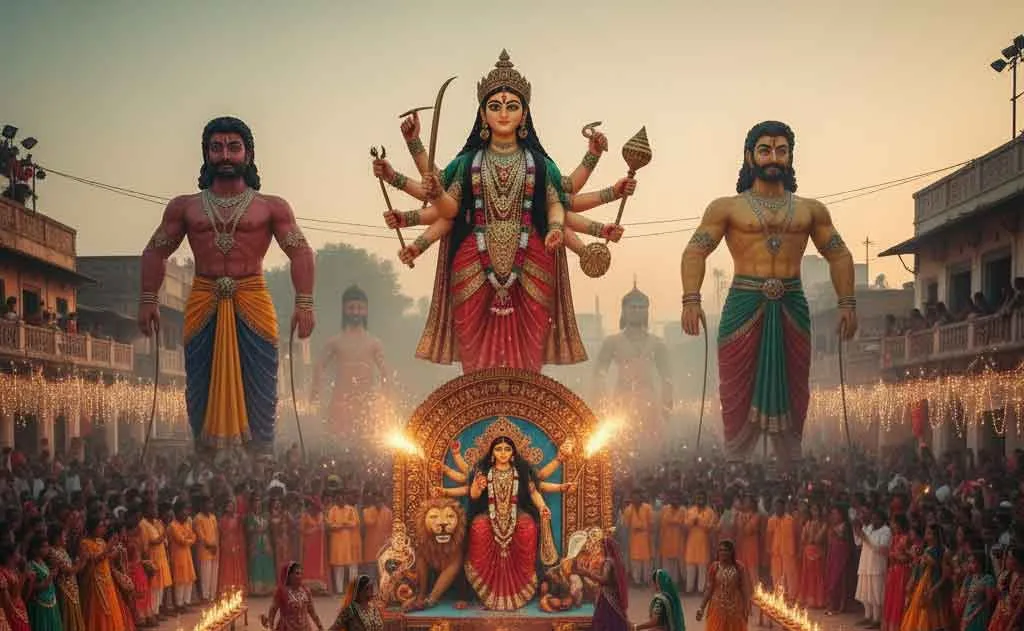
Garba vs Dandiya Raas: The Difference Explained for Navratri 2026
Garba and Dandiya Raas are danced on the same Navratri nights, often in the same hall, but they are not the same dance. This guide explains the difference: Garba's clapping circle around the Devi, Dandiya Raas with decorated sticks and its Krishna association, how a typical evening flows, common steps, a comparison table and stick etiquette for families in India and abroad.
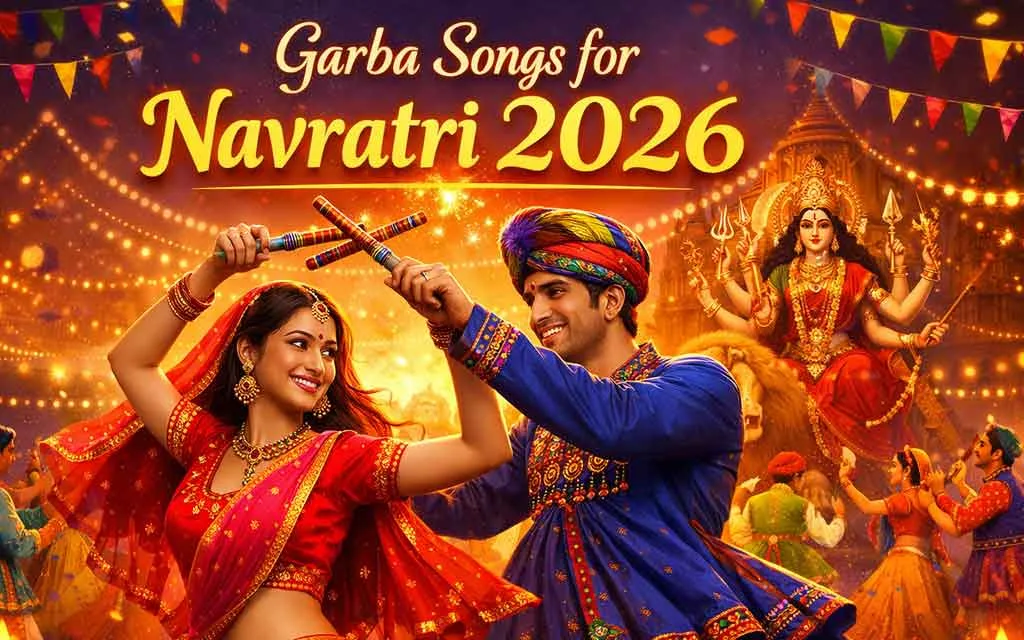
Garba and Dandiya Raas are danced on the same Navratri nights, often in the same hall, but they are not the same dance. This guide explains the difference: Garba's clapping circle around the Devi, Dandiya Raas with decorated sticks and its Krishna association, how a typical evening flows, common steps, a comparison table and stick etiquette for families in India and abroad.
Quick answer: Garba is a circle dance with hand clapping, performed around the Garbo (a lamp in a clay pot) or the Devi's image, as worship of Shakti during Navratri. Dandiya Raas is danced with a pair of decorated sticks, usually in two facing lines or with partners who strike sticks in rhythm, and is associated in tradition with Krishna's Raas with the gopis. At many events the night often begins with aarti, moves into Garba, and turns to Dandiya later. In 2026, Navratri runs from Sunday 11 to Monday 19 October in India, with Dussehra on Tuesday 20 October.
If you have been to a Navratri night, you have probably seen both: a vast clapping circle that swirls around a shrine, and later a field of people facing each other, sticks clicking in perfect time. Many people use the words interchangeably, and the combined term Raas-Garba is everywhere. But the two have different shapes, steps and associations. This guide explains the difference, especially for families and first-timers abroad. For the festival as a whole, see our Navratri 2026 NRI guide.
Garba vs Dandiya Raas at a glance
| Garba | Dandiya Raas | |
|---|---|---|
| Basic form | Circle (or concentric circles) moving around a centre | Pairs or two facing lines; partners rotate |
| Hands | Clapping, flowing hand and arm movements | A pair of decorated sticks (dandiya), struck in rhythm |
| At the centre | The Garbo lamp or Mataji's image | No fixed centre; often danced across the floor |
| Traditional association | Worship of Shakti: Amba, Durga, the Mother | Krishna's Raas Leela with the gopis of Vrindavan |
| Popular symbolic reading | Circle as cycle of time around the unchanging Divine | Sticks as Durga's swords in a mock battle with Mahishasura |
| Typical place in the evening | Often earlier, after the aarti | Often later in the night |
| Beginner difficulty | Easier: follow the circle and clap | Needs timing with a partner |
| Main season | Navratri nights | Navratri, and also weddings and other celebrations |
These are broad patterns. Regions, communities and individual events do things differently, and both dances share much of their music.
Garba: the clapping circle around the Devi
The name Garba is traditionally linked to Garbha, the womb, and to the Garbo, an earthen pot with holes and a lamp burning inside. Dancers move around it, or around an image of Amba, singing or listening to songs in praise of the Mother and clapping in rhythm. As traditionally understood, the lamp stands for the Divine light within all life, and the circle for the cycle of time around an unchanging centre; these are interpretations, and families explain them in their own ways.
Garba is, at heart, devotional. It is usually preceded by aarti, and the centre is treated as sacred: dancers do not cut across it. For the full meaning, read our sibling guide on Garba's meaning and spiritual significance.
Dandiya Raas: sticks, partners and Krishna's Raas
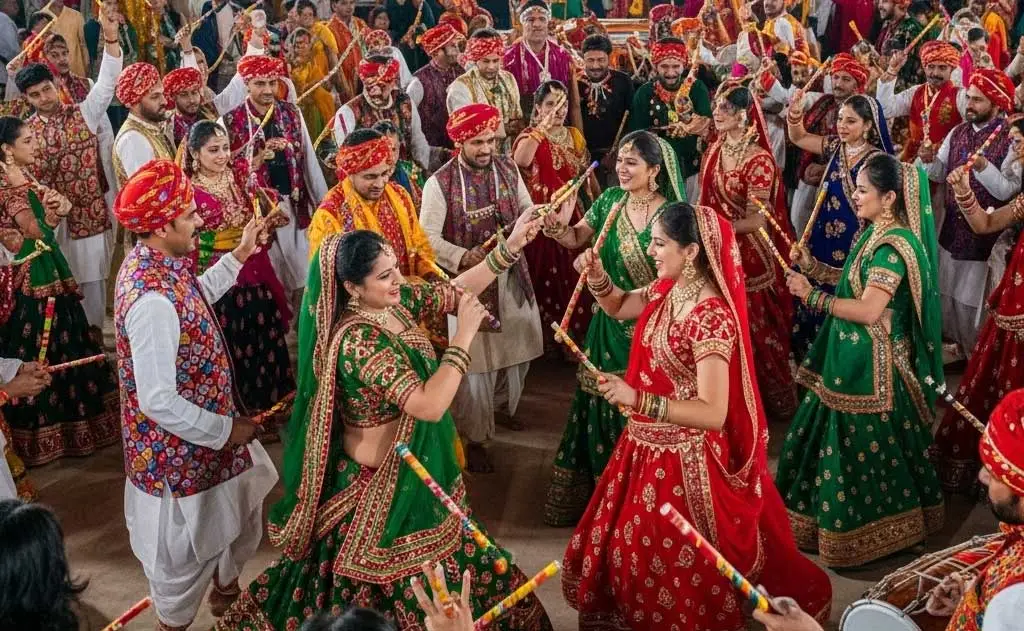
Raas is associated in tradition with Krishna's Raas Leela, the dance of Krishna with the gopis of Vrindavan on moonlit nights. Dandiya Raas is the form danced with a pair of short sticks, often decorated with coloured thread, mirrors or bells. Dancers typically stand in two facing lines or in partners, strike their own sticks and their partner's in set patterns, then move on to the next partner as the lines rotate.
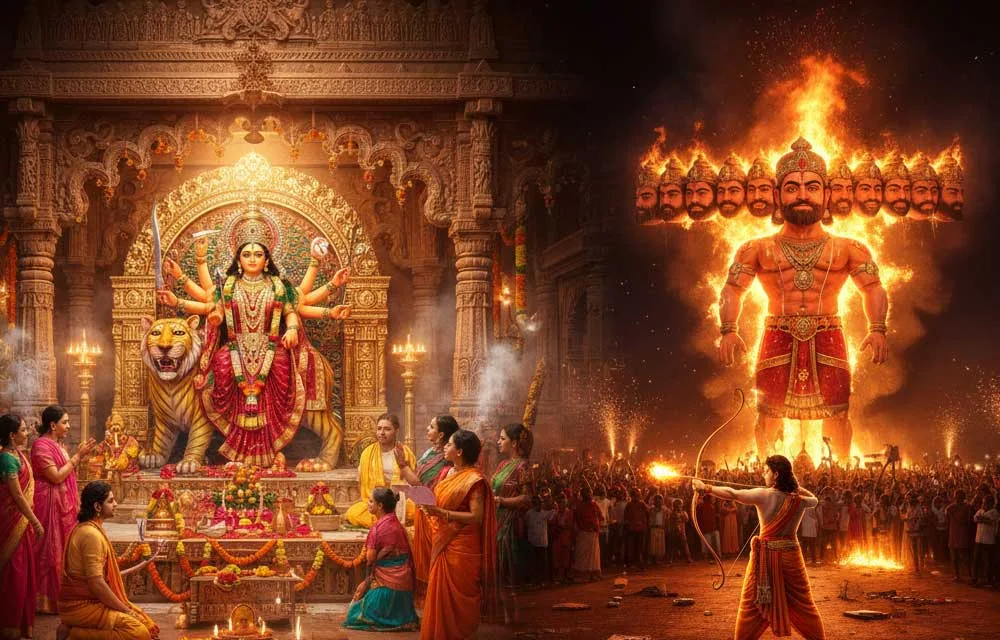
A second, popular reading links Dandiya to the Goddess. Here the sticks are seen as the swords of Durga, and the dance as a mock battle between the Devi and the buffalo-demon Mahishasura, whose defeat Navratri celebrates. This is one widely shared interpretation, not the only one; many dancers hold both ideas at once. For the story itself, see Durga vs Mahishasura and Rama vs Ravana.
How a typical Navratri evening flows
Every organiser runs their night differently, but many evenings, in Gujarat and abroad, often follow a pattern like this:
- Aarti. The night often opens with aarti to Mataji. Music stops, everyone faces the Devi and joins in or stands quietly. Phones away.
- Garba. Slower devotional Garbas first, then the tempo builds. Circles form around the centre, with inner and outer rings at different speeds.
- Dandiya Raas. Later in the night, sticks come out and lines or pairs form, often in a set area of the floor.
- Closing. Many evenings close with another aarti or a short prayer.
Because this is a common pattern and not a rule, keep an eye on the organisers and the singer, and follow what the crowd does.
Common steps, named simply
Step names vary by region and teacher, and new variations appear every year. Some of the most widely used names include:
- Two-clap Garba. A basic step with two claps per cycle as you move forward around the circle; the easiest place to start.
- Three-clap Garba (teen taali). A popular step built around three claps, with a turn or sway between them.
- Dodhiyu. A well-known, livelier Garba step with a bouncing, travelling pattern, often danced as the tempo rises.
- Basic Dandiya strikes. Striking your own sticks together, then your partner's, in a repeating pattern before moving on to the next partner.
Do not worry about getting the names right. Watch the people in front of you for a round, then join. For a step-by-step introduction, see Garba for beginners: steps, etiquette and kids.
Dandiya stick etiquette and safety
Sticks add to the fun and also to the risk, especially in crowded halls. A few simple habits keep everyone safe:
- Keep sticks low and controlled. Strike at chest height or below, never near faces.
- Leave space. Keep an arm's length from the next pair, and do not swing sticks while walking through the crowd.
- Use suitable sticks. Smooth, lightweight sticks without sharp edges or loose decorations. Follow any venue rules on stick types.
- Kids and elders. Children often do better in their own line with an adult, or with lighter or softer sticks. Elders may prefer an outer, slower line or Garba alone.
- Stay out of the Garba circle with sticks. If Garba and Dandiya are happening together, keep sticks in the Dandiya area and away from the centre.
- Put sticks down for aarti. Hold them still or set them aside during prayers.
Raas-Garba abroad: halls, gyms and competitions
Outside India, both dances fill community halls, temple halls and school gyms through Navratri. Many communities hold their main nights on weekends; in 2026 many Garba and Dandiya nights abroad will fall on the weekends of 10-11 and 16-18 October, but always check your local temple or association for its own schedule. City-by-city details are in our guides for the USA, the UK and Canada.
Abroad, Raas-Garba has also become a stage art. University teams and dance groups in several countries train for Raas-Garba competitions, with choreographed routines, live or recorded music and elaborate costumes. These competitions have helped many young people of Indian origin connect with the tradition. The competitive form and the devotional circle sit side by side: a team may compete on one weekend and dance at the temple Garba the next.
Indoor venues abroad often have practical rules too: some ask for indoor-only footwear or bare feet, some restrict Dandiya to a set area, and many are alcohol-free. Read the event information before you go.
Garba, Dandiya and Gujarat's heritage
Both dances come from Gujarat's living culture. In December 2023, the 'Garba of Gujarat' was inscribed on UNESCO's Representative List of the Intangible Cultural Heritage of Humanity. To understand how the tradition grew, read the history of Garba from Gujarat to the world, and for this year's events in the state, our Navratri 2026 Gujarat Garba guide. To dress for the colour of each day, see the Navratri 2026 colours list.
Also read: Garba 2026 worldwide: all countries.
Frequently asked questions
What is the difference between Garba and Dandiya?
Garba is danced in a circle with hand clapping around the Garbo (a lamp in a clay pot) or the Devi's image, as worship of Shakti. Dandiya Raas is danced with a pair of decorated sticks, usually facing a partner and striking sticks in rhythm, and is associated in tradition with Krishna's Raas with the gopis. Both are danced on Navratri nights.
Which comes first, Garba or Dandiya?
At many events the evening often begins with aarti to Mataji, followed by Garba, and Dandiya Raas comes later in the night. This is a common pattern rather than a rule, so follow the organisers and the music.
Is Dandiya only for Navratri?
Dandiya Raas is most closely linked with Navratri, but Raas is also danced at weddings, Sharad Purnima and other celebrations in Gujarat and among Gujarati communities. Garba, in its devotional form, is most closely tied to the nine nights of the Devi.
What do Dandiya sticks symbolise?
In tradition, Dandiya Raas recalls Krishna's Raas Leela with the gopis. One popular interpretation also reads the sticks as the swords of Goddess Durga and the dance as a mock battle between Durga and Mahishasura. Both readings are widely shared; neither is the only correct one.
Can I bring my own Dandiya sticks?
Usually, yes, and many dancers do. Some venues sell or lend sticks, while a few have rules about stick types or limit Dandiya to certain areas for safety. Check with the organiser, and choose sticks that are smooth and not too heavy.
Is Garba harder than Dandiya for beginners?
Most beginners find the basic Garba step easier, because you simply follow the circle and clap. Dandiya needs timing with a partner so the sticks meet safely. Start with Garba, watch a few Dandiya rounds, then join an outer, slower line.
Editor's note (7 October 2026)
We rewrote this guide in October 2026. Navratri and Dussehra dates are from Drik Panchang for India. The order of a Navratri evening, step names and symbolic readings vary between regions, communities and organisers; we describe common patterns and label interpretations as such. We do not list specific events, organisers, venues, prices or competition results.
Related guides
You might also like
Garba for Beginners: Easy Steps, Circle Etiquette and Garba with Kids (Navratri 2026)
Garba Meaning and Spiritual Significance: Why We Dance Garba in Navratri
Navratri 2026 Wishes, Messages, Quotes and Instagram Captions: Day-Wise, Family, Work and Garba