108 Names of Maa Durga (Durga Ashtottara Shatanamavali) with Meaning for Navratri 2026
Sharad Navratri 2026 runs from Sunday 11 to Monday 19 October. Here are the 108 names of Maa Durga (Sri Durga Ashtottara Shatanamavali) in Devanagari and IAST with English meanings, a practical way to chant them in the Om ... Namah form, and the Durga Gayatri and Ya Devi Sarva Bhuteshu verses, all from sanskritdocuments.org texts.
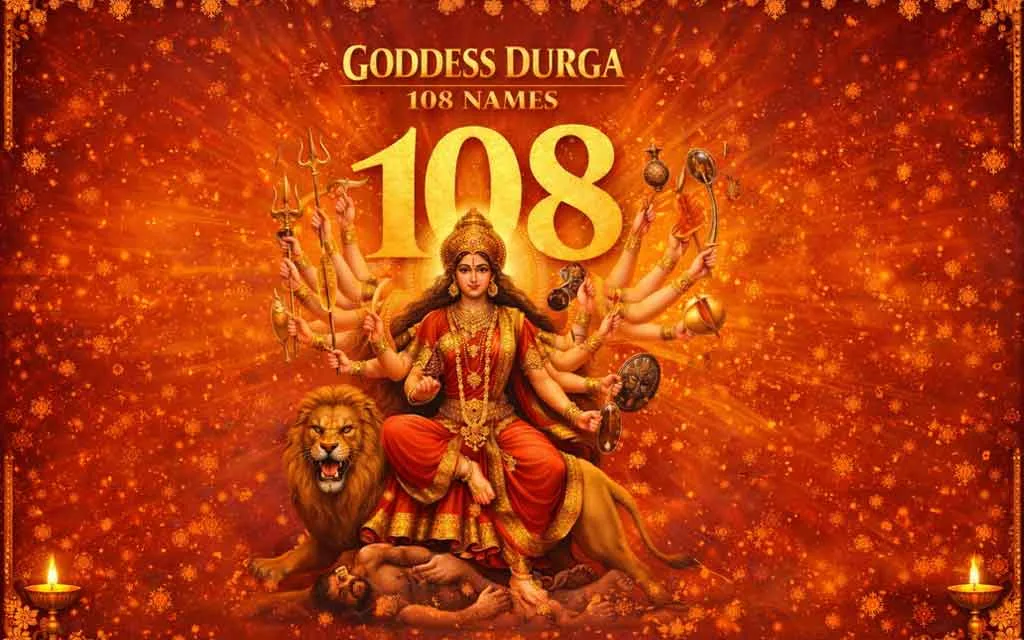
Sharad Navratri 2026 runs from Sunday 11 to Monday 19 October. Here are the 108 names of Maa Durga (Sri Durga Ashtottara Shatanamavali) in Devanagari and IAST with English meanings, a practical way to chant them in the Om .
Quick answer: The 108 names of Maa Durga, the Sri Durga Ashtottara Shatanamavali, begin with Om Satyai Namah, Om Sadhvyai Namah, Om Bhavapritayai Namah and end with Om Brahmavadinyai Namah. Sharad Navratri 2026 runs from Sunday 11 October to Monday 19 October 2026, with Vijayadashami on Tuesday 20 October. The full list with Devanagari, IAST transliteration and English meanings is below.
Last updated: 9 October 2026. The Sanskrit on this page is taken from texts published by sanskritdocuments.org and converted to Devanagari and IAST by software, not retyped by hand.
Chanting the names of the Goddess is one of the simplest ways to keep the nine nights of Navratri. A namavali (garland of names) turns each name into a short salutation, so it suits a busy home: you need a lamp, a quiet ten to fifteen minutes and, if you like, a little kumkum or a few flowers. For the dates and the nine forms of the Devi, see our Navaratri 2026 dates and nine Devi names guide.
About the Durga Ashtottara Shatanamavali
Ashtottara shata means 'one hundred and eight'. This list of names, beginning with Sati, Sadhvi and Bhavaprita, is the namavali form of the Durga Ashtottara Shatanama Stotram, which the sanskritdocuments.org text attributes to the Vishvasara Tantra. In the stotram, Lord Shiva (Ishvara) recites the names to Parvati. The namavali simply takes each name, puts it in the dative case ('to Sati') and frames it as Om ... Namah, 'Om, salutations to ...'.
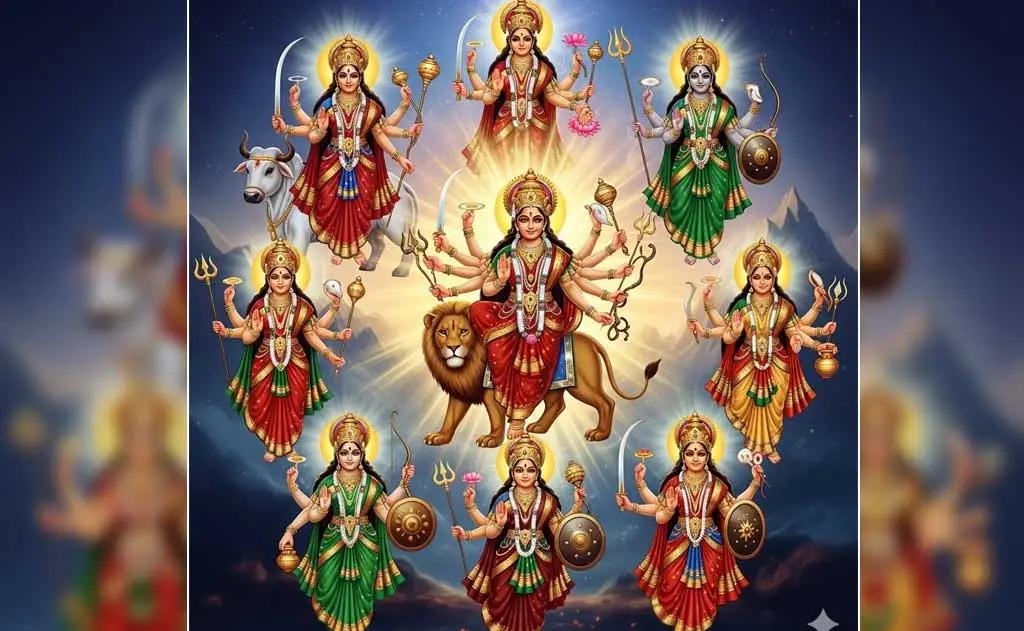
The names move across many sides of the Goddess: her gentle forms (Sati, Sundari, Kumari), her presence as mind, intellect and consciousness (Buddhi, Chittarupa, Chiti), the seven Matrikas (Brahmi, Maheshvari, Aindri, Kaumari, Vaishnavi, Varahi, Chamunda), her victories in the Devi Mahatmya (Mahishasuramardini, Madhukaitabhahantri, Nishumbhashumbhahanani) and her fierce forms (Kalaratri, Bhadrakali, Karali).
All 108 names of Maa Durga with meaning
Each row shows the name as it is chanted in the namavali. The meaning column gives the base name and a short English gloss. Where the sense of a name is uncertain, the literal word meaning is given.
| # | Name (Devanagari) | IAST | Meaning (English) |
|---|---|---|---|
| 1 | ॐ सत्यै नमः | oṃ satyai namaḥ | Sati: the virtuous one; also Sati, daughter of Daksha |
| 2 | ॐ साध्व्यै नमः | oṃ sādhvyai namaḥ | Sadhvi: the pure, good one |
| 3 | ॐ भवप्रीतायै नमः | oṃ bhavaprītāyai namaḥ | Bhavaprita: dear to Bhava (Shiva) |
| 4 | ॐ भवान्यै नमः | oṃ bhavānyai namaḥ | Bhavani: consort of Bhava (Shiva) |
| 5 | ॐ भवमोचन्यै नमः | oṃ bhavamocanyai namaḥ | Bhavamochani: who frees from worldly existence (bhava) |
| 6 | ॐ आर्यायै नमः | oṃ āryāyai namaḥ | Arya: the noble one |
| 7 | ॐ दुर्गायै नमः | oṃ durgāyai namaḥ | Durga: she who is hard to reach; traditionally, the one who removes difficulties |
| 8 | ॐ जयायै नमः | oṃ jayāyai namaḥ | Jaya: victory, the victorious one |
| 9 | ॐ आद्यायै नमः | oṃ ādyāyai namaḥ | Adya: the first, the primordial one |
| 10 | ॐ त्रिनेत्रायै नमः | oṃ trinetrāyai namaḥ | Trinetra: the three-eyed one |
| 11 | ॐ शूलधारिण्यै नमः | oṃ śūladhāriṇyai namaḥ | Shuladharini: bearer of the trident (shula) |
| 12 | ॐ पिनाकधारिण्यै नमः | oṃ pinākadhāriṇyai namaḥ | Pinakadharini: bearer of Pinaka, Shiva's bow |
| 13 | ॐ चित्रायै नमः | oṃ citrāyai namaḥ | Chitra: the wondrous, many-hued one |
| 14 | ॐ चण्डघण्टायै नमः | oṃ caṇḍaghaṇṭāyai namaḥ | Chandaghanta: she of the fierce, loud bell |
| 15 | ॐ महातपायै नमः | oṃ mahātapāyai namaḥ | Mahatapa: of great austerity |
| 16 | ॐ मनोरूपायै नमः | oṃ manorūpāyai namaḥ | Manorupa: whose form is the mind |
| 17 | ॐ बुद्ध्यै नमः | oṃ buddhyai namaḥ | Buddhi: intellect |
| 18 | ॐ अहङ्कारायै नमः | oṃ ahaṅkārāyai namaḥ | Ahankara: the sense of 'I' (the ego principle) |
| 19 | ॐ चित्तरूपायै नमः | oṃ cittarūpāyai namaḥ | Chittarupa: whose form is consciousness (chitta) |
| 20 | ॐ चितायै नमः | oṃ citāyai namaḥ | Chita: literally 'gathered, heaped'; a name linked with chit, consciousness (meaning uncertain) |
| 21 | ॐ चित्यै नमः | oṃ cityai namaḥ | Chiti: consciousness, awareness |
| 22 | ॐ सर्वमन्त्रमय्यै नमः | oṃ sarvamantramayyai namaḥ | Sarvamantramayi: made of all mantras |
| 23 | ॐ सत्तायै नमः | oṃ sattāyai namaḥ | Satta: existence, pure being |
| 24 | ॐ सत्यानन्दस्वरूपिण्यै नमः | oṃ satyānandasvarūpiṇyai namaḥ | Satyanandasvarupini: whose nature is truth and bliss |
| 25 | ॐ अनन्तायै नमः | oṃ anantāyai namaḥ | Ananta: the infinite, endless one |
| 26 | ॐ भाविन्यै नमः | oṃ bhāvinyai namaḥ | Bhavini: the noble lady; she who brings things into being |
| 27 | ॐ भाव्यायै नमः | oṃ bhāvyāyai namaḥ | Bhavya: worthy of contemplation |
| 28 | ॐ भव्यायै नमः | oṃ bhavyāyai namaḥ | Bhavya: the auspicious, excellent one |
| 29 | ॐ अभव्यायै नमः | oṃ abhavyāyai namaḥ | Abhavya: literally 'not of becoming'; beyond the world of becoming (interpretations vary) |
| 30 | ॐ सदागत्यै नमः | oṃ sadāgatyai namaḥ | Sadagati: ever-moving; the constant refuge |
| 31 | ॐ शाम्भव्यै नमः | oṃ śāmbhavyai namaḥ | Shambhavi: consort of Shambhu (Shiva) |
| 32 | ॐ देवमात्रे नमः | oṃ devamātre namaḥ | Devamata: mother of the gods |
| 33 | ॐ चिन्तायै नमः | oṃ cintāyai namaḥ | Chinta: thought, contemplation |
| 34 | ॐ रत्नप्रियायै नमः | oṃ ratnapriyāyai namaḥ | Ratnapriya: fond of gems |
| 35 | ॐ सर्वविद्यायै नमः | oṃ sarvavidyāyai namaḥ | Sarvavidya: all knowledge |
| 36 | ॐ दक्षकन्यायै नमः | oṃ dakṣakanyāyai namaḥ | Dakshakanya: daughter of Daksha |
| 37 | ॐ दक्षयज्ञविनाशिन्यै नमः | oṃ dakṣayajñavināśinyai namaḥ | Dakshayajnavinashini: destroyer of Daksha's sacrifice |
| 38 | ॐ अपर्णायै नमः | oṃ aparṇāyai namaḥ | Aparna: she who gave up even leaves as food during her penance |
| 39 | ॐ अनेकवर्णायै नमः | oṃ anekavarṇāyai namaḥ | Anekavarna: of many colours |
| 40 | ॐ पाटलायै नमः | oṃ pāṭalāyai namaḥ | Patala: rose-red, like the patala flower |
| 41 | ॐ पाटलावत्यै नमः | oṃ pāṭalāvatyai namaḥ | Patalavati: adorned with patala flowers |
| 42 | ॐ पट्टाम्बरपरीधानायै नमः | oṃ paṭṭāmbaraparīdhānāyai namaḥ | Pattambaraparidhana: clothed in silk garments |
| 43 | ॐ कलमञ्जीररञ्जिन्यै नमः | oṃ kalamañjīrarañjinyai namaḥ | Kalamanjiraranjini: delighting with sweet-sounding anklets |
| 44 | ॐ अमेयविक्रमायै नमः | oṃ ameyavikramāyai namaḥ | Ameyavikrama: of immeasurable valour |
| 45 | ॐ क्रूरायै नमः | oṃ krūrāyai namaḥ | Krura: the fierce one (to wrongdoers) |
| 46 | ॐ सुन्दर्यै नमः | oṃ sundaryai namaḥ | Sundari: the beautiful one |
| 47 | ॐ सुरसुन्दर्यै नमः | oṃ surasundaryai namaḥ | Surasundari: most beautiful among the celestials |
| 48 | ॐ वनदुर्गायै नमः | oṃ vanadurgāyai namaḥ | Vanadurga: Durga of the forest |
| 49 | ॐ मातङ्ग्यै नमः | oṃ mātaṅgyai namaḥ | Matangi: Matangi, daughter of sage Matanga |
| 50 | ॐ मतङ्गमुनिपूजितायै नमः | oṃ mataṅgamunipūjitāyai namaḥ | Matangamunipujita: worshipped by sage Matanga |
| 51 | ॐ ब्राह्म्यै नमः | oṃ brāhmyai namaḥ | Brahmi: the power (shakti) of Brahma |
| 52 | ॐ माहेश्वर्यै नमः | oṃ māheśvaryai namaḥ | Maheshvari: the power of Maheshvara (Shiva) |
| 53 | ॐ ऐन्द्र्यै नमः | oṃ aindryai namaḥ | Aindri: the power of Indra |
| 54 | ॐ कौमार्यै नमः | oṃ kaumāryai namaḥ | Kaumari: the power of Kumara (Skanda) |
| 55 | ॐ वैष्णव्यै नमः | oṃ vaiṣṇavyai namaḥ | Vaishnavi: the power of Vishnu |
| 56 | ॐ चामुण्डायै नमः | oṃ cāmuṇḍāyai namaḥ | Chamunda: slayer of Chanda and Munda |
| 57 | ॐ वाराह्यै नमः | oṃ vārāhyai namaḥ | Varahi: the power of Varaha |
| 58 | ॐ लक्ष्म्यै नमः | oṃ lakṣmyai namaḥ | Lakshmi: Lakshmi, fortune and grace |
| 59 | ॐ पुरुषाकृत्यै नमः | oṃ puruṣākṛtyai namaḥ | Purushakriti: who takes a male form |
| 60 | ॐ विमलायै नमः | oṃ vimalāyai namaḥ | Vimala: the stainless, pure one |
| 61 | ॐ उत्कर्षिण्यै नमः | oṃ utkarṣiṇyai namaḥ | Utkarshini: the exalted, uplifting one |
| 62 | ॐ ज्ञानायै नमः | oṃ jñānāyai namaḥ | Jnana: knowledge |
| 63 | ॐ क्रियायै नमः | oṃ kriyāyai namaḥ | Kriya: action |
| 64 | ॐ नित्यायै नमः | oṃ nityāyai namaḥ | Nitya: the eternal one |
| 65 | ॐ बुद्धिदायै नमः | oṃ buddhidāyai namaḥ | Buddhida: giver of understanding |
| 66 | ॐ बहुलायै नमः | oṃ bahulāyai namaḥ | Bahula: the abundant, manifold one |
| 67 | ॐ बहुलप्रेमायै नमः | oṃ bahulapremāyai namaḥ | Bahulaprema: of abundant love |
| 68 | ॐ सर्ववाहनवाहनायै नमः | oṃ sarvavāhanavāhanāyai namaḥ | Sarvavahanavahana: who rides all mounts |
| 69 | ॐ निशुम्भशुम्भहनन्यै नमः | oṃ niśumbhaśumbhahananyai namaḥ | Nishumbhashumbhahanani: slayer of Nishumbha and Shumbha |
| 70 | ॐ महिषासुरमर्दिन्यै नमः | oṃ mahiṣāsuramardinyai namaḥ | Mahishasuramardini: slayer of Mahishasura |
| 71 | ॐ मधुकैटभहन्त्र्यै नमः | oṃ madhukaiṭabhahantryai namaḥ | Madhukaitabhahantri: slayer of Madhu and Kaitabha |
| 72 | ॐ चण्डमुण्डविनाशिन्यै नमः | oṃ caṇḍamuṇḍavināśinyai namaḥ | Chandamundavinashini: destroyer of Chanda and Munda |
| 73 | ॐ सर्वासुरविनाशायै नमः | oṃ sarvāsuravināśāyai namaḥ | Sarvasuravinasha: destroyer of all asuras |
| 74 | ॐ सर्वदानवघातिन्यै नमः | oṃ sarvadānavaghātinyai namaḥ | Sarvadanavaghatini: slayer of all danavas |
| 75 | ॐ सर्वशास्त्रमय्यै नमः | oṃ sarvaśāstramayyai namaḥ | Sarvashastramayi: embodiment of all scriptures |
| 76 | ॐ सत्यायै नमः | oṃ satyāyai namaḥ | Satya: truth |
| 77 | ॐ सर्वास्त्रधारिण्यै नमः | oṃ sarvāstradhāriṇyai namaḥ | Sarvastradharini: bearer of all missiles |
| 78 | ॐ अनेकशस्त्रहस्तायै नमः | oṃ anekaśastrahastāyai namaḥ | Anekashastrahasta: holding many weapons in her hands |
| 79 | ॐ अनेकास्त्रधारिण्यै नमः | oṃ anekāstradhāriṇyai namaḥ | Anekastradharini: bearer of many missiles |
| 80 | ॐ कुमार्यै नमः | oṃ kumāryai namaḥ | Kumari: the maiden |
| 81 | ॐ एककन्यायै नमः | oṃ ekakanyāyai namaḥ | Ekakanya: the one, unique maiden |
| 82 | ॐ कैशोर्यै नमः | oṃ kaiśoryai namaḥ | Kaishori: the adolescent |
| 83 | ॐ युवत्यै नमः | oṃ yuvatyai namaḥ | Yuvati: the young woman |
| 84 | ॐ यत्यै नमः | oṃ yatyai namaḥ | Yati: the ascetic, the renunciant |
| 85 | ॐ अप्रौढायै नमः | oṃ aprauḍhāyai namaḥ | Apraudha: the youthful one, not yet mature |
| 86 | ॐ प्रौढायै नमः | oṃ prauḍhāyai namaḥ | Praudha: the mature one |
| 87 | ॐ वृद्धमात्रे नमः | oṃ vṛddhamātre namaḥ | Vriddhamata: the aged mother |
| 88 | ॐ बलप्रदायै नमः | oṃ balapradāyai namaḥ | Balaprada: giver of strength |
| 89 | ॐ महोदर्यै नमः | oṃ mahodaryai namaḥ | Mahodari: literally 'great-bellied'; read as holding the universe within |
| 90 | ॐ मुक्तकेश्यै नमः | oṃ muktakeśyai namaḥ | Muktakeshi: with flowing, unbound hair |
| 91 | ॐ घोररूपायै नमः | oṃ ghorarūpāyai namaḥ | Ghorarupa: of fearsome form |
| 92 | ॐ महाबलायै नमः | oṃ mahābalāyai namaḥ | Mahabala: of great strength |
| 93 | ॐ अग्निज्वालायै नमः | oṃ agnijvālāyai namaḥ | Agnijvala: flame of fire |
| 94 | ॐ रौद्रमुख्यै नमः | oṃ raudramukhyai namaḥ | Raudramukhi: fierce-faced |
| 95 | ॐ कालरात्र्यै नमः | oṃ kālarātryai namaḥ | Kalaratri: the dark night of time |
| 96 | ॐ तपस्विन्यै नमः | oṃ tapasvinyai namaḥ | Tapasvini: the one devoted to penance |
| 97 | ॐ नारायण्यै नमः | oṃ nārāyaṇyai namaḥ | Narayani: Narayani, the power of Narayana |
| 98 | ॐ भद्रकाल्यै नमः | oṃ bhadrakālyai namaḥ | Bhadrakali: the auspicious Kali |
| 99 | ॐ विष्णुमायायै नमः | oṃ viṣṇumāyāyai namaḥ | Vishnumaya: the maya (creative power) of Vishnu |
| 100 | ॐ जलोदर्यै नमः | oṃ jalodaryai namaḥ | Jalodari: literally 'water-bellied'; one who holds the waters within (interpretations vary) |
| 101 | ॐ शिवदूत्यै नमः | oṃ śivadūtyai namaḥ | Shivaduti: who made Shiva her messenger (Devi Mahatmya, chapter 8) |
| 102 | ॐ कराल्यै नमः | oṃ karālyai namaḥ | Karali: the formidable one |
| 103 | ॐ अनन्तायै नमः | oṃ anantāyai namaḥ | Ananta: the infinite one |
| 104 | ॐ परमेश्वर्यै नमः | oṃ parameśvaryai namaḥ | Parameshvari: the supreme goddess |
| 105 | ॐ कात्यायन्यै नमः | oṃ kātyāyanyai namaḥ | Katyayani: daughter of sage Katyayana |
| 106 | ॐ सावित्र्यै नमः | oṃ sāvitryai namaḥ | Savitri: the power of Savitr, the sun |
| 107 | ॐ प्रत्यक्षायै नमः | oṃ pratyakṣāyai namaḥ | Pratyaksha: the manifest, directly perceived one |
| 108 | ॐ ब्रह्मवादिन्यै नमः | oṃ brahmavādinyai namaḥ | Brahmavadini: who speaks of Brahman |
Name 25 and name 103 are both Ananta (the infinite one); the name appears twice in the source stotram as well. Names 27 and 28 differ by one vowel: Bhavya with a long a (worthy of contemplation) and Bhavya with a short a (auspicious).
How to chant the 108 names
There is no single fixed procedure, and families follow their own custom. A simple, widely used approach is:
- Bathe, light a ghee or oil lamp before a picture or idol of Maa Durga, and sit facing it calmly.
- Begin with a prayer to Lord Ganesha, as most Hindu worship does.
- Chant each name in the Om ... Namah form, for example Om Satyai Namah, Om Sadhvyai Namah, Om Bhavapritayai Namah. Read slowly from the table; accuracy matters more than speed.
- If you wish, do a kumkum archana: offer a small pinch of kumkum (or a flower, or akshata, rice mixed with turmeric) at the Devi's feet at every name.
- Finish with an aarti or a short prayer, and offer naivedya (a simple sweet, fruit or the day's bhog).
Daily or during the nine nights: Many devotees chant the namavali every day of Navratri, from Ghatasthapana on Sunday 11 October to Navami on Monday 19 October 2026. Others keep it for Fridays, for Durga Ashtami, or as part of regular evening prayer through the year. One round of 108 names takes about ten minutes.
Kumkum archana: In many South Indian homes and temples, married and unmarried women alike offer kumkum at each name of the Devi during Navratri, and the kumkum is then shared as prasad. It is traditionally believed to be a way of honouring the Goddess as auspicious and protective. Follow what your family or local temple does.
If Sanskrit is new to you, chant from the IAST column, or simply listen to a recording and repeat. Sincerity is what the tradition stresses most.
Durga Gayatri mantra
The Durga Gayatri is one of the deity Gayatris in the Mahanarayana Upanishad (Taittiriya Aranyaka). Many devotees chant it before or after the 108 names.
कात्यायनाय विद्महे कन्याकुमारि धीमहि ।
तन्नो दुर्गिः प्रचोदयात् ॥
kātyāyanāya vidmahe kanyākumāri dhīmahi |
tanno durgiḥ pracodayāt ||
Meaning: May we know Katyayani; may we meditate on the Kanyakumari (the virgin Goddess); may Durga inspire and guide us.
Ya Devi Sarva Bhuteshu (Devi Mahatmya, chapter 5)
These verses come from the hymn the gods sing in chapter 5 of the Devi Mahatmya (Durga Saptashati). Each verse salutes the Goddess who dwells in all beings in a particular form, and the second line, 'namastasyai namastasyai namastasyai namo namah', repeats the salutation three times. Three of the best-known verses are given here:
As power (shakti), Devi Mahatmya 5.32-34
या देवी सर्वभूतेषु शक्तिरूपेण संस्थिता ।
नमस्तस्यै नमस्तस्यै नमस्तस्यै नमो नमः ॥
yā devī sarvabhūteṣu śaktirūpeṇa saṃsthitā |
namastasyai namastasyai namastasyai namo namaḥ ||
Meaning: To the Devi who dwells in all beings in the form of power, salutations to her, salutations to her, salutations to her, again and again.
As the mother, Devi Mahatmya 5.71-73
या देवी सर्वभूतेषु मातृरूपेण संस्थिता ।
नमस्तस्यै नमस्तस्यै नमस्तस्यै नमो नमः ॥
yā devī sarvabhūteṣu mātṛrūpeṇa saṃsthitā |
namastasyai namastasyai namastasyai namo namaḥ ||
Meaning: To the Devi who dwells in all beings in the form of the mother, salutations to her, again and again.
As peace, Devi Mahatmya 5.47-49
या देवी सर्वभूतेषु शान्तिरूपेण संस्थिता ।
नमस्तस्यै नमस्तस्यै नमस्तस्यै नमो नमः ॥
yā devī sarvabhūteṣu śāntirūpeṇa saṃsthitā |
namastasyai namastasyai namastasyai namo namaḥ ||
Meaning: To the Devi who dwells in all beings in the form of peace, salutations to her, again and again.
Navratri 2026: day-by-day guides
Each day of Navratri honours one of the nine forms of Durga. Our day guides give the naam mantra, colour, bhog and a simple puja vidhi:
- Day 1: Maa Shailaputri (Sunday 11 October)
- Day 2: Maa Brahmacharini (Monday 12 October)
- Day 3: Maa Chandraghanta (Tuesday 13 October)
- Day 4: Maa Kushmanda (Wednesday 14 October)
- Day 5: Maa Skandamata (Thursday 15 October)
- Day 6: Maa Katyayani (Friday 16 October)
- Day 7: Maa Kalaratri (Saturday 17 October)
- Day 8: Maa Mahagauri (Sunday 18 October)
- Day 9: Maa Siddhidatri (Monday 19 October)
More Navratri and Durga reading on HinduTone:
- Navaratri 2026 dates, nine Devi names and puja rituals (the main Navratri guide)
- How to pray to Goddess Durga: mantras, poojas and rituals
- Durga Chalisa with meaning
- Vijayadashami 2026: mantras, Aparajita and Shami puja vidhi (Tuesday 20 October)
Frequently asked questions
What are the 108 names of Durga called?
The 108 names of Durga are called the Durga Ashtottara Shatanamavali (ashtottara shata means 108, namavali means a garland of names). The widely chanted list that begins with Sati, Sadhvi and Bhavaprita comes from the Durga Ashtottara Shatanama Stotram of the Vishvasara Tantra.
How do I chant the 108 names of Durga?
Chant each name in the form Om ... Namah, for example Om Satyai Namah, Om Sadhvyai Namah. Many families chant the full list once a day in front of a lamp or picture of the Devi, and some offer a pinch of kumkum or a flower at every name (kumkum archana).
Can I chant the Durga Ashtottara every day of Navratri 2026?
Yes. Many devotees chant it on all nine days, from Sunday 11 October to Monday 19 October 2026, often in the evening. Others chant it on Fridays, on Ashtami or whenever they wish. There is no single required rule; follow your family or temple custom.
Is the Durga Gayatri the same as the Gayatri Mantra?
No. The Gayatri Mantra is addressed to Savitr. The Durga Gayatri, 'Katyayanaya vidmahe, Kanyakumari dhimahi, tanno Durgih prachodayat', is one of the deity Gayatris found in the Mahanarayana Upanishad of the Taittiriya Aranyaka.
Where does 'Ya Devi Sarva Bhuteshu' come from?
It comes from the hymn of the gods in chapter 5 of the Devi Mahatmya (Durga Saptashati), part of the Markandeya Purana. Each verse salutes the Devi as present in all beings in a particular form, such as power (shakti), mother or peace.
Do I need to be initiated to chant the 108 names?
A namavali is traditionally treated as an open devotional practice that anyone can chant with respect. For longer rituals, homa or specific vows, families usually follow the guidance of their priest or guru.
Editor's note (9 October 2026)
The 108 names are from Sri Durga Ashtottarashatanamavali (durgA108nAmAvali) on sanskritdocuments.org, cross-checked against the Durga Ashtottara Shatanama Stotram (Vishvasara Tantra) on the same site. Two lines were corrected against the stotram: name 16 reads 'manarupayai' in the namavali file and is given as Manorupayai, from the stotram's 'mano' (mind); name 34 carries an editor's query in the file and is given as Ratnapriyayai, as in the stotram verse 'chinta ratnapriya sada'. The Ya Devi verses are from the sanskritdocuments.org Devi Mahatmya / Durga Saptashati text, and the Durga Gayatri from its Mahanarayana Upanishad text. Meanings are standard short glosses; Sanskrit names carry layers of meaning, and your family's or teacher's reading may differ. If you spot an error, please let us know.
You might also like
Lakshmi Ashtottara Shatanamavali — 108 Names of Goddess Lakshmi (with Meanings)
Shiva Ashtottara Shatanamavali — 108 Names of Lord Shiva (with Meanings)
Navratri Mantras Before Garba: Durga and Amba Prayers, Day-Wise Naam Mantras and a Family Sankalpa