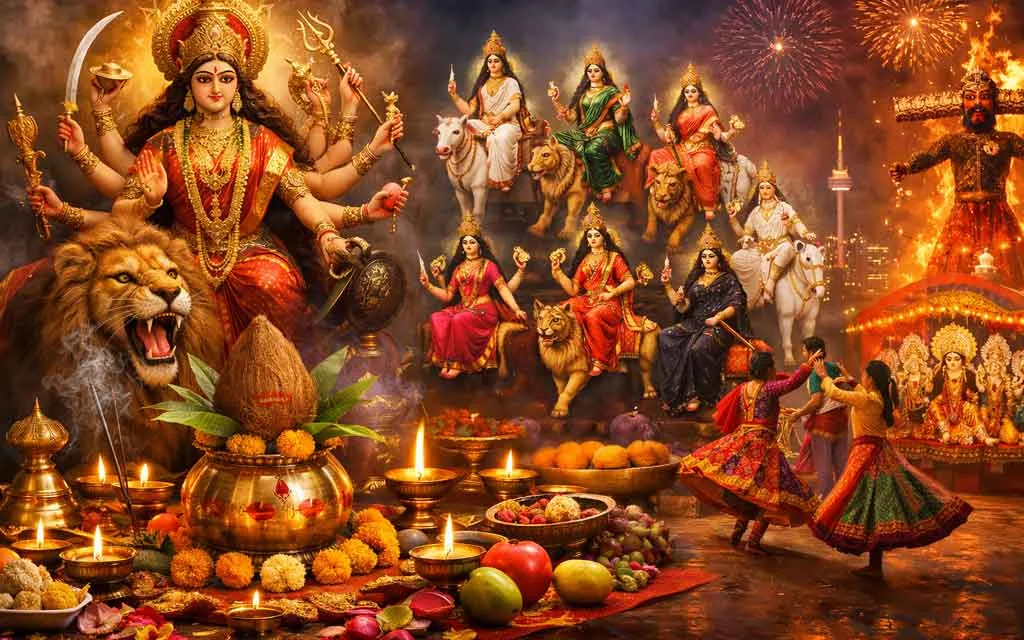
Navratri 2026: Nine Days, Colours, Goddess Names, Mantras, Bhog and Puja Vidhi
Sharad Navratri 2026 runs from Sunday 11 October (Ghatasthapana) to Monday 19 October, when Durga Ashtami and Maha Navami fall together in India, with Dussehra on Tuesday 20 October. Here are the nine days with dates, tithis, Goddess names, colours, customary bhog and mantras, plus puja vidhi, fasting customs, Kanya Puja, regional traditions and NRI dates.
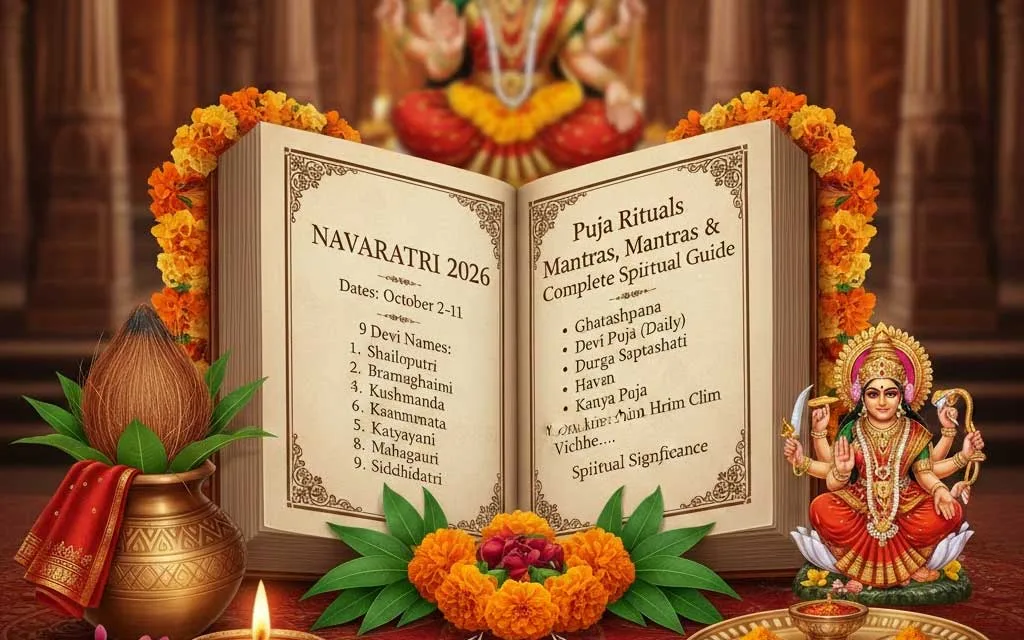
Quick answer: Sharad Navratri 2026 begins with Ghatasthapana on Sunday 11 October 2026 and runs for nine days to Monday 19 October, when Durga Ashtami and Maha Navami both fall in India. Dussehra (Vijayadashami) is on Tuesday 20 October, and Bengal's Vijayadashami and the Mysuru Dasara procession day are on Wednesday 21 October. Dates are from Drik Panchang for Hyderabad (IST).
Last updated: 9 October 2026. This guide brings together the nine days with their dates, tithis, Goddess names, colours, customary bhog and mantras, then the puja vidhi, fasting customs, Kanya Puja, regional traditions and dates for families abroad.
What is Navratri?
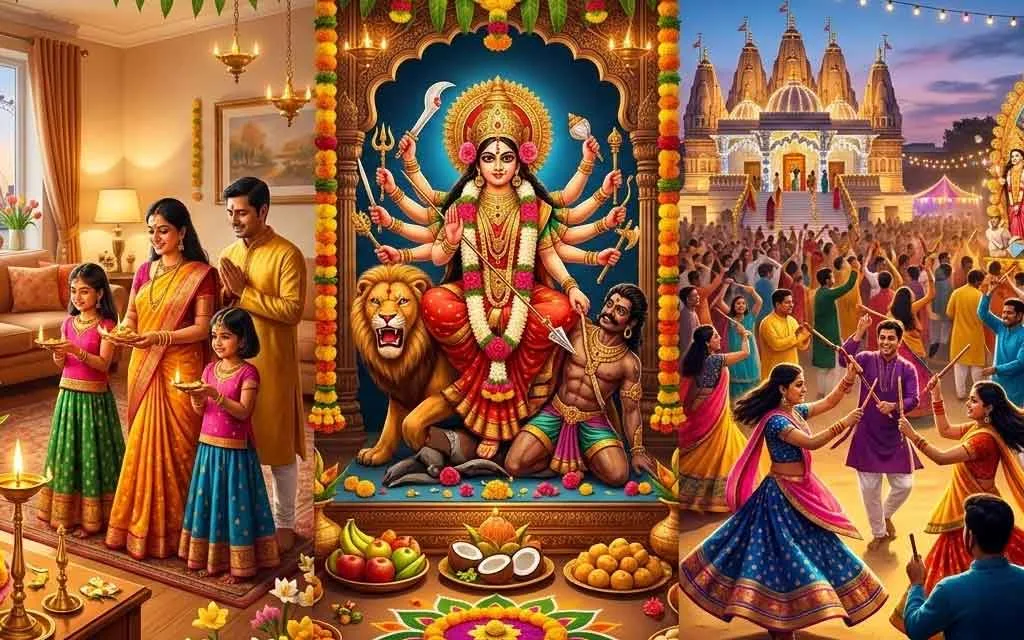
Navratri (also spelled Navaratri or Nava Ratri) is one of the most widely celebrated Hindu festivals in the world. The word comes from the Sanskrit 'nava' (nine) and 'ratri' (night): nine sacred nights. During these nights devotees in India and around the globe worship Goddess Durga in her nine forms, the Navadurga, invoking Shakti, the divine feminine energy that sustains, protects and liberates all of creation.
Sharad Navratri is the best known of the year's Navratris. It falls in the bright fortnight (Shukla Paksha) of the lunar month of Ashwin, in autumn, and ends with Vijayadashami, the day of victory. Whether you are a devoted practitioner, a curious seeker or someone reconnecting with your roots, this guide walks you through each of the nine nights.
Navratri 2026 key dates
| Observance | Date (India, Drik Panchang) |
|---|---|
| Ghatasthapana, Navratri Day 1 | Sunday 11 October 2026 |
| Saddula Bathukamma (Telangana) | Sunday 18 October 2026 |
| Durga Ashtami, Maha Navami, Sandhi Puja | Monday 19 October 2026 |
| Dussehra / Vijayadashami, Ayudha Puja | Tuesday 20 October 2026 |
| Bengal Vijayadashami, Mysuru Dasara, Vidyarambham | Wednesday 21 October 2026 |
Hindu festival days follow the tithi (lunar day) at sunrise, not the civil date. In 2026 the Saptami tithi spans two sunrises in India (17 and 18 October), so Durga Ashtami moves to Monday 19 October, the same day as Maha Navami. Abroad the picture differs: in the USA, Canada and the UK, Drik Panchang lists Durga Ashtami on Sunday 18 October and Maha Navami on Monday 19 October. Families in Australia, New Zealand and the UAE should check their temple's calendar.
The nine days of Navratri 2026 at a glance
The master table below gives each day's date, the tithi at sunrise in India, the Navadurga form, the popular colour of the day, the customary bhog and a link to that day's mantras and puja.
| Day | Date (2026) | Tithi (India) | Goddess | Colour | Bhog | Mantra link |
|---|---|---|---|---|---|---|
| Day 1 | Sunday 11 Oct | Pratipada | Shailaputri | Orange | Cow ghee | Day 1 mantras |
| Day 2 | Monday 12 Oct | Dwitiya | Brahmacharini | White | Sugar or panchamrit | Day 2 mantras |
| Day 3 | Tuesday 13 Oct | Tritiya | Chandraghanta | Red | Milk or kheer | Day 3 mantras |
| Day 4 | Wednesday 14 Oct | Chaturthi | Kushmanda | Royal blue | Malpua | Day 4 mantras |
| Day 5 | Thursday 15 Oct | Panchami | Skandamata | Yellow | Banana | Day 5 mantras |
| Day 6 | Friday 16 Oct | Shashthi | Katyayani | Green | Honey | Day 6 mantras |
| Day 7 | Saturday 17 Oct | Saptami | Kalaratri | Grey | Jaggery | Day 7 mantras |
| Day 8 | Sunday 18 Oct | Saptami at sunrise; Ashtami from 8:27 AM IST | Mahagauri | Varies: purple, pink or peacock green | Coconut | Day 8 mantras |
| Day 9 | Monday 19 Oct | Ashtami till 10:51 AM IST, then Navami (Durga Ashtami and Maha Navami) | Siddhidatri | Varies: purple, pink or peacock green | Sesame (til) or halwa-puri-chana | Day 9 mantras |
About the colours: The colours match our Navratri 2026 colours list. Wearing a colour for each day is a modern custom that became popular in Maharashtra; it is not prescribed in the scriptures. Most lists set Days 1 to 7 by the weekday, so the order changes every year with the weekday on which Navratri begins, and Days 8 and 9 vary between publishers and regions. If your family, temple or Garba group follows a different list, follow theirs.
About the bhog: The offerings are customary, as followed in many North Indian homes. They are not mandatory: any simple, clean offering made with devotion is complete, and many regions have their own prasad traditions (see below).
The nine forms of Maa Durga, day by day
The heart of Navratri is the daily worship of the Navadurga, the nine forms of the Mother Goddess. Each form embodies a divine quality, and together they trace a journey from steadiness and discipline to fearlessness, purity and fulfilment. Mantras below are given in Devanagari with transliteration, as published in our day-by-day guides.
Day 1: Maa Shailaputri (Sunday 11 October 2026)
Colour: Orange. Customary bhog: pure cow ghee. Naam mantra:
ॐ देवी शैलपुत्र्यै नमः॥
Om Devi Shailaputryai Namah
Shailaputri means 'Daughter of the Mountain.' She is the first and foundational form of Durga, riding Nandi the bull, holding a trident and lotus. Worshipping her on Day 1 is traditionally associated with stability, grounding and inner strength. Orange, the colour of the day in the popular list, symbolises energy and new beginnings. Ghatasthapana is done on this day.
Full mantras, story and home puja: Navratri 2026 Day 1: Maa Shailaputri.
Day 2: Maa Brahmacharini (Monday 12 October 2026)
Colour: White. Customary bhog: sugar or panchamrit. Naam mantra:
ॐ देवी ब्रह्मचारिण्यै नमः॥
Om Devi Brahmacharinyai Namah
Brahmacharini is the ascetic form of Parvati, walking barefoot, holding a rudraksha mala and a kamandalu (water pot). She embodies penance, devotion and self-discipline, and devotees pray to her for patience and steadiness in tapas. White, the colour of the day in the popular list, represents purity and peace.
Full mantras, story and home puja: Navratri 2026 Day 2: Maa Brahmacharini.
Day 3: Maa Chandraghanta (Tuesday 13 October 2026)
Colour: Red. Customary bhog: milk or kheer. Naam mantra:
ॐ देवी चन्द्रघण्टायै नमः॥
Om Devi Chandraghantayai Namah
Chandraghanta bears a crescent moon (chandra) shaped like a bell (ghanta) on her forehead. Riding a tiger, with ten arms bearing weapons, she is the embodiment of courage and calm strength. Red, the colour of the day in the popular list, symbolises strength and courage.
Full mantras, story and home puja: Navratri 2026 Day 3: Maa Chandraghanta.
Day 4: Maa Kushmanda (Wednesday 14 October 2026)
Colour: Royal blue. Customary bhog: malpua. Naam mantra:
ॐ देवी कूष्माण्डायै नमः॥
Om Devi Kushmandayai Namah
Kushmanda is described as the one whose gentle smile created the universe. Eight-armed and radiant as the Sun, she rides a lioness, and devotees see her as the source of light and energy. Royal blue, the colour of the day in the popular list, represents vastness and calm.
Full mantras, story and home puja: Navratri 2026 Day 4: Maa Kushmanda.
Day 5: Maa Skandamata (Thursday 15 October 2026)
Colour: Yellow. Customary bhog: banana. Naam mantra:
ॐ देवी स्कन्दमातायै नमः॥
Om Devi Skandamatayai Namah
Skandamata is the mother of Lord Skanda (Kartikeya). With four arms, she holds lotuses and her infant son, and is worshipped for a mother's love, wisdom and protection. Yellow, the colour of the day in the popular list, represents brightness and joy.
Full mantras, story and home puja: Navratri 2026 Day 5: Maa Skandamata.
Day 6: Maa Katyayani (Friday 16 October 2026)
Colour: Green. Customary bhog: honey. Naam mantra:
ॐ देवी कात्यायन्यै नमः॥
Om Devi Katyayanyai Namah
Katyayani is the warrior form, born in the hermitage of the sage Katyayana and, as commonly told, the Goddess who defeated Mahishasura. Riding a lion, she is invoked for courage and the strength to overcome obstacles. Green, the colour of the day in the popular list, represents growth and renewal.
Full mantras, story and home puja: Navratri 2026 Day 6: Maa Katyayani.
Day 7: Maa Kalaratri (Saturday 17 October 2026)
Colour: Grey. Customary bhog: jaggery. Naam mantra:
ॐ देवी कालरात्र्यै नमः॥
Om Devi Kalaratryai Namah
Kalaratri is the most fierce form of Durga, dark in complexion with flowing hair and three eyes, riding a donkey. She destroys darkness and fear, yet she is called Shubhankari, the bestower of auspiciousness. Grey, the colour of the day in the popular list, represents steadiness and quiet strength.
Full mantras, story and home puja: Navratri 2026 Day 7: Maa Kalaratri.
Day 8: Maa Mahagauri (Sunday 18 October 2026)
Colour: purple, pink or peacock green (lists differ). Customary bhog: coconut. Naam mantra:
ॐ देवी महागौर्यै नमः॥
Om Devi Mahagauryai Namah
Mahagauri is dazzling white, symbolising purity and peace. As commonly told, after long tapas her complexion was restored to radiance by Lord Shiva. She is the Ashtami form of the Goddess. In India the Ashtami tithi is present at sunrise only on Monday 19 October, so many families honour Mahagauri together with Siddhidatri that day. Colour lists differ for this day: purple, pink or peacock green are all common.
Full mantras, story and home puja: Navratri 2026 Day 8: Maa Mahagauri.
Day 9: Maa Siddhidatri (Monday 19 October 2026)
Colour: purple, pink or peacock green (lists differ). Customary bhog: sesame (til) or halwa-puri-chana. Naam mantra:
ॐ देवी सिद्धिदात्र्यै नमः॥
Om Devi Siddhidatryai Namah
Siddhidatri is the giver of the siddhis, the spiritual attainments, seated on a lotus and worshipped by sages, gandharvas and celestials. She completes the nine days of worship. In India, Monday 19 October 2026 is both Durga Ashtami and Maha Navami, the usual day for Kanya Puja and Sandhi Puja. Colour lists differ for this final day: purple, pink or peacock green are all common.
Full mantras, story and home puja: Navratri 2026 Day 9: Maa Siddhidatri.
The stories behind Navratri
Durga and Mahishasura
The best-known legend is told in the Devi Mahatmya (also called the Durga Saptashati), part of the Markandeya Purana. Mahishasura, the buffalo demon, had won a boon that made him nearly invincible against gods and men. He drove the Devas from heaven. The Devas combined their divine energies, and from them arose Goddess Durga, armed with the weapons of every god and riding a lion. She battled Mahishasura and his armies, and on the tenth day, Vijayadashami, she slew him and restored dharma.
Lord Rama and the Akal Bodhon
A second tradition links Navratri to the Ramayana. As commonly told, Lord Rama invoked Goddess Durga in autumn, an untimely season for her worship (hence Akal Bodhon, the 'untimely awakening'), before his battle with Ravana. Blessed by the Goddess, he defeated Ravana on the tenth day, celebrated as Dussehra. This story is especially central to Durga Puja in Bengal.
Ghatasthapana 2026: Sunday 11 October
Ghatasthapana (Kalash Sthapana) is the first ritual of Navratri, inviting the Divine Mother into a sacred pot (kalash) for the nine days. It is done on Pratipada, Sunday 11 October 2026, traditionally in the morning while Pratipada prevails.
- Hyderabad (IST): sunrise 6:08 AM; Pratipada lasts until 9:30 PM (Drik Panchang).
- Delhi and other Indian cities: the muhurat window shifts with local sunrise, so check Drik Panchang for your city.
- Abroad: use your own city's sunrise and muhurat, not India's time. Our country guides below give local windows.
We do not print a single all-India muhurat here because it differs by location; your family priest or temple calendar is the best guide.
How to do Ghatasthapana at home
- Choose a clean, quiet space and spread a layer of soil or sand on a plate or wooden plank.
- Sow barley (jau) or wheat seeds in the soil; the sprouts are a sign of growth and prosperity.
- Place a copper or clay kalash filled with clean water (a few drops of Ganga jal if you have it) on the soil.
- Add a betel nut, a coin and a little akshata (unbroken rice) to the water, and arrange five mango or betel leaves around the mouth.
- Place a coconut wrapped in red cloth on top.
- Decorate with flowers, turmeric, kumkum and akshata, light a lamp and invoke the Goddess with 'Om Devi Durgayai Namah' or your family's prayer.
- Offer simple worship each day of the nine days, refreshing the water and flowers.
Living in an apartment or abroad? Our apartment-friendly Navratri puja vidhi adapts every step, including flameless lamps where open flames are not allowed.
Daily Navratri puja essentials
- Light a lamp morning and evening; some families keep an akhand jyoti (continuous lamp) from Pratipada to Navami.
- Offer red flowers such as hibiscus, and the day's bhog.
- Read the Durga Saptashati (in full or a few chapters a day), the Durga Chalisa, or simply chant the Goddess's names.
- Perform aarti with a ghee lamp or camphor.
- Observe the vrat as per your family's tradition and your own health.
- On Ashtami or Navami, perform Kanya Puja and offer halwa, puri and chana as prasad.
Navratri mantras for daily chanting
These widely recited Devi mantras are the same texts used in our day-by-day guides. Chant them after lighting the lamp, 11, 21 or 108 times with a mala, as your tradition suggests.
Om Dum Durgayai Namah
ॐ दुं दुर्गायै नमः॥
Om Dum Durgayai Namah
The short Durga mantra, a simple salutation to the Goddess.
Navarna mantra
ॐ ऐं ह्रीं क्लीं चामुण्डायै विच्चे॥
Om Aim Hreem Kleem Chamundayai Vichche
The nine-syllable mantra of Chamunda, central to Durga Saptashati recitation. Many families learn it from a teacher before regular chanting.
Sarva Mangala Mangalye
सर्वमङ्गलमाङ्गल्ये शिवे सर्वार्थसाधिके। शरण्ये त्र्यम्बके गौरि नारायणि नमोऽस्तु ते॥
Sarva-mangala-mangalye shive sarvartha-sadhike, sharanye tryambake gauri narayani namostu te.
A salutation to the Goddess as the auspiciousness of all that is auspicious, refuge of all.
Ya Devi Sarvabhuteshu
या देवी सर्वभूतेषु शक्तिरूपेण संस्थिता। नमस्तस्यै नमस्तस्यै नमस्तस्यै नमो नमः॥
Ya Devi sarvabhuteshu shakti-rupena samsthita, namastasyai namastasyai namastasyai namo namah.
Salutations again and again to the Goddess who dwells in all beings as power. For more, see our Navratri day-wise mantras guide.
Day-wise bhog: customary offerings to Maa Durga
Bhog (naivedya) is food offered to the Goddess and then shared as prasad. In many North Indian homes each Navadurga form has a customary offering. These are traditions, not rules: offer what you can with a clean heart, and follow your family's custom where it differs.
| Day | Goddess | Customary bhog | Simple idea |
|---|---|---|---|
| 1 | Shailaputri | Pure cow ghee | A lamp lit with ghee, or a ghee-roasted sweet |
| 2 | Brahmacharini | Sugar or panchamrit | Mishri (rock sugar) or panchamrit |
| 3 | Chandraghanta | Milk or kheer | Rice or makhana kheer |
| 4 | Kushmanda | Malpua | Malpua, or kuttu malpua for those fasting |
| 5 | Skandamata | Banana | Ripe bananas or a banana sweet |
| 6 | Katyayani | Honey | Honey on its own or in panchamrit |
| 7 | Kalaratri | Jaggery | Jaggery or a jaggery sweet |
| 8 | Mahagauri | Coconut | A whole coconut or coconut ladoo |
| 9 | Siddhidatri | Sesame (til) or halwa-puri-chana | Til ladoo, or the Kanya Puja meal |
Recipes: Navratri day-wise prasad recipes, Sharad Navratri 2026 day-wise vrat recipes and the Kanya Pujan halwa, puri and chana recipe.
Navratri fasting customs
The Navratri vrat is a spiritual discipline and its form varies a great deal. Some devotees fast on all nine days, some on the first and last days, some on Ashtami only; some take one meal a day, others only fruit and milk. Follow your family's custom.
Foods commonly eaten during the vrat
- Sabudana (tapioca pearls): khichdi, vada or kheer
- Singhare ka atta (water chestnut flour) and kuttu ka atta (buckwheat flour): puri, roti or halwa
- Samak rice (barnyard millet): khichdi or kheer
- Fruits, milk, curd, paneer, nuts and makhana
- Potato, sweet potato, arbi and raw banana
- Sendha namak (rock salt) in place of ordinary salt
Foods commonly avoided
- Ordinary table salt (rock salt is used instead)
- Wheat, rice and other regular grains (in the stricter form of the vrat)
- Meat, eggs and alcohol
- Onion and garlic, in many households
Please note: this section describes religious customs and is not health or medical advice. Children, older people, pregnant women and anyone with a health condition or on medication should speak to their doctor before fasting. Many traditions say a lighter vrat, or simply offering prayers, is just as acceptable to the Mother. For dishes, see our day-wise vrat recipes.
Kanya Puja, Durga Ashtami and Maha Navami
In India, Durga Ashtami and Maha Navami both fall on Monday 19 October 2026 (Drik Panchang). The Ashtami tithi runs until about 10:51 AM IST that day, and Navami follows. Sandhi Puja, the worship at the junction of Ashtami and Navami, falls on the same day. Many families who fast break the vrat after the Ashtami or Navami puja, others on Dashami.
Kanya Puja (Kanya Pujan or Kumari Puja) honours young girls as living forms of the Goddess. Families who follow the tithi in India usually do it on Monday 19 October; in the USA, Canada and the UK many temples keep Ashtami on Sunday 18 October. It typically involves:
- inviting girls (often nine, usually with one young boy as Langur or Bhairav) to the home,
- washing their feet with water as a mark of respect and applying a kumkum tilak,
- offering the meal of suji halwa, puri and black chana,
- giving a small gift such as bangles, a book or a little money, and
- seeking their blessings.
The ritual expresses the vision that Shakti is present in every girl and woman. Full vidhi: Kanya Pujan 2026 date and vidhi.
Vijayadashami 2026 (Dussehra): Tuesday 20 October
Vijayadashami, the tenth day of victory, falls on Tuesday 20 October 2026 in India. It is considered one of the most auspicious days of the year for beginning learning (Vidyarambham), starting new ventures, Ayudha or Shastra Puja (honouring tools and instruments), Aparajita and Shami puja, and the burning of Ravana effigies in North India. In Bengal, Bijoya Dashami with Durga visarjan and Sindoor Khela is on Wednesday 21 October, the same day as the Mysuru Dasara procession.
Read our Dussehra / Vijayadashami 2026 guide and the Vijayadashami 2026 mantras and Aparajita and Shami puja vidhi.
How India celebrates Navratri: regional traditions
Gujarat: Garba and Dandiya Raas
In Gujarat, Navratri nights are for Garba, the circular devotional dance around the Garbo, a lamp-lit earthen pot that stands for the Mother, and for Dandiya Raas with sticks. Gujarat's Garba was inscribed on UNESCO's list of intangible cultural heritage in 2023. See our Navratri in Gujarat guide and the Garba songs for Navratri 2026 playlist.
Kolkata and Bengal: Durga Puja
Bengal celebrates as Durga Puja, with clay images of the Goddess with Lakshmi, Saraswati, Kartik and Ganesha in thousands of pandals. Shashthi is on Friday 16 October 2026, Maha Ashtami with Kumari Puja and Sandhi Puja on Monday 19 October, and Bijoya Dashami on Wednesday 21 October. Day-by-day: Durga Puja 2026 dates in Kolkata.
Mysuru: Dasara
Mysuru's Dasara, the Karnataka state festival, lights up the palace each evening, and ends with the Jamboo Savari procession of Goddess Chamundeshwari on Vijayadashami, Wednesday 21 October 2026. See the Mysore Dasara 2026 guide and the day-by-day schedule.
Telangana: Bathukamma
In Telangana, women arrange seasonal flowers into tall conical Bathukammas and sing and dance around them for nine days, from Engili Pula on Saturday 10 October to Saddula Bathukamma on Sunday 18 October 2026. See Bathukamma 2026 dates.
Tamil Nadu and the South: Golu
In Tamil Nadu, Karnataka and Andhra Pradesh, families set up Golu (Bommai Kolu or Bommala Koluvu), tiered steps of dolls showing gods, epics and village life. Neighbours visit in the evenings, women exchange tambulam, and sundal is offered as prasad. Saraswati Puja and Ayudha Puja honour books and tools, and Vijayadashami marks Vidyarambham. See our Golu 2026 setup guide.
North India: Ramlila and Dussehra
In Delhi, Uttar Pradesh and much of the north, Navratri nights bring Ramlila, dramatic retellings of the Ramayana, ending on Dussehra (Tuesday 20 October 2026) with the burning of effigies of Ravana, Kumbhakarna and Meghnad.
Maharashtra
Maharashtra keeps Ghatasthapana with daily aarti and devotional singing at home and in temples such as those of the Goddess at Tuljapur and Kolhapur, and Mumbai is where the colour-of-the-day custom first became popular.
Planning a temple visit? See Navaratri and Dussehra 2026 temples in India, USA, UK, Canada and Australia.
Navratri 2026 for families abroad
Navratri begins on Sunday 11 October 2026 almost everywhere, so Day 1 falls on a weekend for most families abroad. Remember that tithis, muhurats and even the Ashtami date are local: in the USA, Canada and the UK, Drik Panchang lists Durga Ashtami on Sunday 18 October. Our country guides give local dates, Ghatasthapana windows and Garba listings:
- USA: Navratri 2026 in the USA, city by city
- UK: Navratri 2026 in the UK, city by city
- Canada: Navratri 2026 in Canada, city by city
- Australia: Sharadiya Navratri 2026 Australia guide
- New Zealand: Dussehra 2026 in New Zealand, city by city
- UAE: Navratri 2026 in Dubai and the UAE
- All countries: Navratri 2026 NRI and diaspora guide
Practical tips: keep a small home altar if you cannot reach a temple on weekdays, do the evening puja after work, use flameless diyas where building rules require, and check temple websites for Garba and Durga Puja timings, which often move to the weekends.
A note on respect
Navratri is a living religious festival as well as a cultural celebration, and everyone is welcome to share in its joy. At temples, pandals and Garba nights, dress modestly, remove footwear where asked, stand quietly during aarti, and avoid alcohol or meat at or near the venue. Garba and Dandiya are devotional dances around the Mother, not costume parties, and images of the Goddess should never be used as props. Ask before photographing worship or deities, and remember that customs differ between communities: there is no single right way to keep Navratri.
Continue the nine days
- Navratri 2026 Day 1: Maa Shailaputri (Sunday 11 Oct)
- Navratri 2026 Day 2: Maa Brahmacharini (Monday 12 Oct)
- Navratri 2026 Day 3: Maa Chandraghanta (Tuesday 13 Oct)
- Navratri 2026 Day 4: Maa Kushmanda (Wednesday 14 Oct)
- Navratri 2026 Day 5: Maa Skandamata (Thursday 15 Oct)
- Navratri 2026 Day 6: Maa Katyayani (Friday 16 Oct)
- Navratri 2026 Day 7: Maa Kalaratri (Saturday 17 Oct)
- Navratri 2026 Day 8: Maa Mahagauri (Sunday 18 Oct)
- Navratri 2026 Day 9: Maa Siddhidatri (Monday 19 Oct)
Also see the Navratri 2026 colours list, day-wise vrat recipes, the Garba songs playlist, the temples guide and the Navratri festival hub.
Conclusion
Navratri 2026 is more than a festival of colours, dance and feasting. It is a nine-night invitation from the Divine Mother to turn inward, let go of what no longer serves us and begin again in her grace. Whether you dance Garba in Gujarat, keep Kanya Puja in Delhi, arrange Golu dolls in Chennai, stack Bathukamma flowers in Hyderabad or simply light a lamp and chant her name in an apartment abroad, every sincere act of devotion is received with equal love. Jai Mata Di!
Also read: 108 Names of Maa Durga with meanings.
Also read: Durga Ashtami 2026 in the USA, Durga Ashtami 2026 in Canada and Durga Ashtami 2026 in the UK.
Also read: Mahishasura Mardini Stotram (Aigiri Nandini) with meaning.
Also read: Maharnavami significance: Durga's Navaratri alankarams, Siddhidatri and the 8 and 18 siddhis and Why Ayudha Puja is done during Navaratri.
Also read: Ratri Suktam (Rigveda 10.127) with meaning, Durga Suktam with meaning and Devi Suktam (Rigveda 10.125) with meaning.
Frequently asked questions
When is Navratri in 2026?
Sharad Navratri 2026 begins with Ghatasthapana on Sunday 11 October and runs to Monday 19 October, when Durga Ashtami and Maha Navami are both observed in India. Vijayadashami (Dussehra) is on Tuesday 20 October 2026, and Bengal's Vijayadashami and Mysuru Dasara's main day are on Wednesday 21 October (Drik Panchang, Hyderabad).
What is the Ghatasthapana muhurat for Navratri 2026?
Ghatasthapana is on Sunday 11 October 2026, in the morning while Pratipada prevails. In Hyderabad, sunrise is at 6:08 AM IST and Pratipada lasts until 9:30 PM IST (Drik Panchang). The exact muhurat window differs by city, so check Drik Panchang for your city or ask your priest; outside India, use your local timings, not IST.
What are the 9 colours of Navratri 2026?
By the popular weekday-based list: Day 1 orange, Day 2 white, Day 3 red, Day 4 royal blue, Day 5 yellow, Day 6 green, Day 7 grey, and for Days 8 and 9 the lists differ, with purple, pink or peacock green the common choices. Wearing them is a modern custom, not a scriptural rule, and colour lists vary by year and region.
When are Durga Ashtami, Maha Navami and Kanya Puja in 2026?
In India, Durga Ashtami and Maha Navami both fall on Monday 19 October 2026, and Kanya Puja is usually done that day. In the USA, Canada and the UK, Drik Panchang lists Durga Ashtami on Sunday 18 October and Maha Navami on Monday 19 October. Follow your temple's calendar.
What bhog is offered on each day of Navratri?
By common custom: cow ghee (Day 1), sugar or panchamrit (Day 2), milk or kheer (Day 3), malpua (Day 4), banana (Day 5), honey (Day 6), jaggery (Day 7), coconut (Day 8) and sesame or halwa-puri-chana (Day 9). These are customary, not compulsory; families follow their own tradition.
What can I eat during Navratri fasting?
Many families eat sabudana, singhare (water chestnut) flour, kuttu (buckwheat) flour, samak rice, fruits, milk, curd, nuts, potato and sweet potato, with rock salt. Customs vary widely by family and region. This is religious custom, not health advice: anyone with a health condition should speak to their doctor before fasting.
Is Navratri the same as Navaratri?
Yes. Navratri, Navaratri, Navarathri and Nava Ratri are spellings of the same nine-night festival of the Goddess.
Sources
- Drik Panchang day panchang for Hyderabad (IST), October 2026: tithis, sunrise and festival dates, via our 2026 Hindu calendar data.
- Drik Panchang festival listings for the USA, Canada and the UK: Durga Ashtami and Maha Navami dates abroad.
- Devi Mahatmya (Durga Saptashati), Markandeya Purana: the Mahishasura legend and the Ya Devi Sarvabhuteshu verses.
- UNESCO Intangible Cultural Heritage list, 2023: Garba of Gujarat.
- HinduTone day-by-day Navratri 2026 guides, for the mantras (Devanagari and transliteration) and customary bhog.
Editor's note (9 October 2026)
This guide was updated on 9 October 2026 with a nine-day master table, Ghatasthapana details, day-wise bhog, fasting customs, Kanya Puja dates, regional traditions, dates for families abroad and sources. Ashtami and Kanya Puja dates were corrected to Monday 19 October for India. Dates are from Drik Panchang for Hyderabad; local timings differ, so please confirm with your temple or family priest. Colours and bhog follow popular custom and lists vary.
Share this with family and friends
Send it on WhatsApp, post it, or copy the link.
More from Festivals
- Sivakasi Firecrackers: History of India's Fireworks Town, Standard Fireworks and the SWAS, STAR and SAFAL Green Crackers
- Diwali Crackers: History, Types and the Meaning Behind Fireworks, and What Every Hindu Should Know
- Stories Behind Diwali: 7 Sacred Hindu Stories, Their Spiritual Meaning and Lessons for Life
- Hindu Temple Events in the UK, November 2026: Diwali, Annakut, Skanda Sashti and Kalyanam at Official Temple Calendars
- Hindu Temple Events in Canada, November 2026: Diwali, Annakut and Karthika Observances at Official Temple Calendars
You might also like
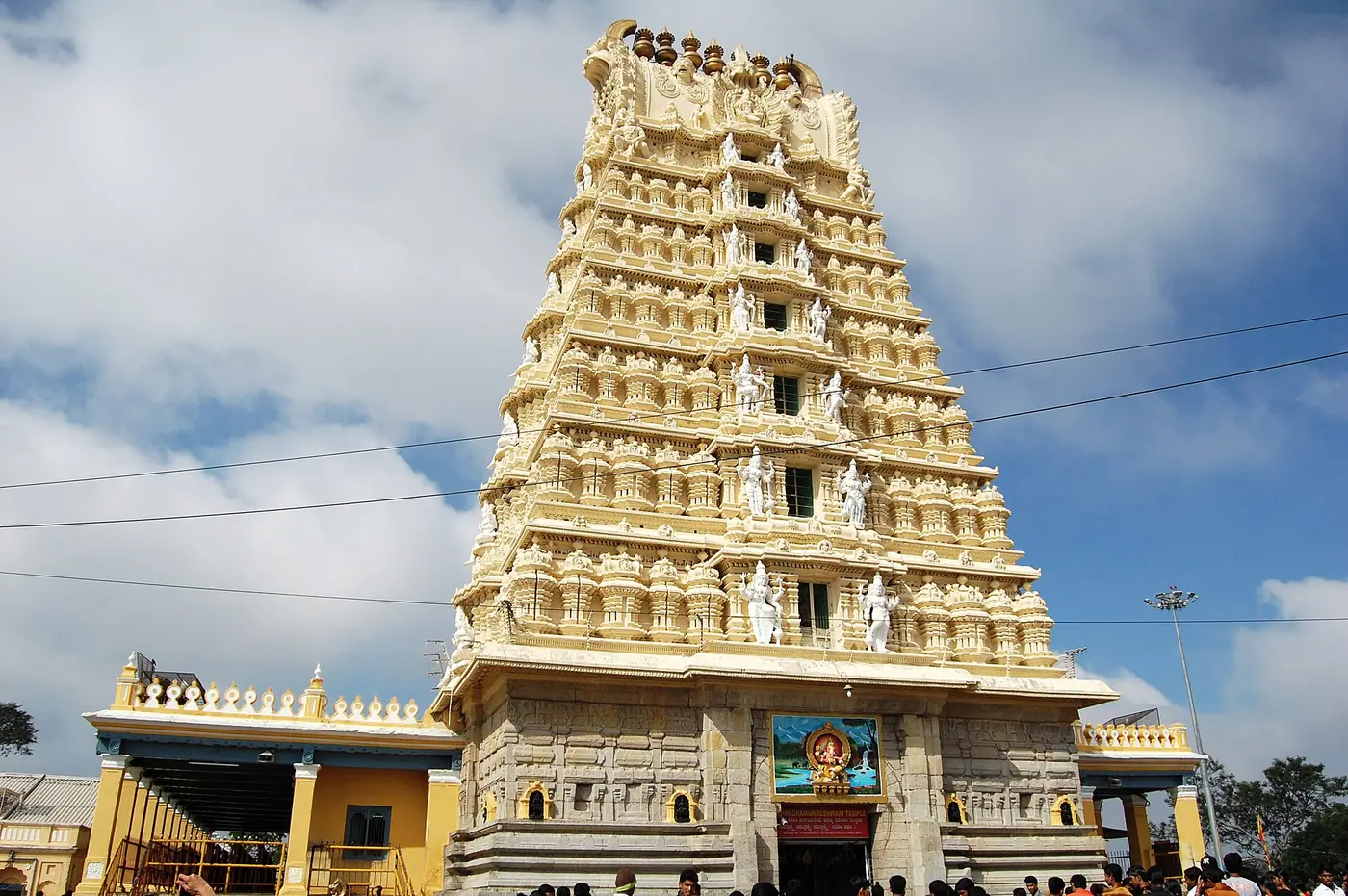
Durga Navaratri 2026 — The Complete Devotional Guide
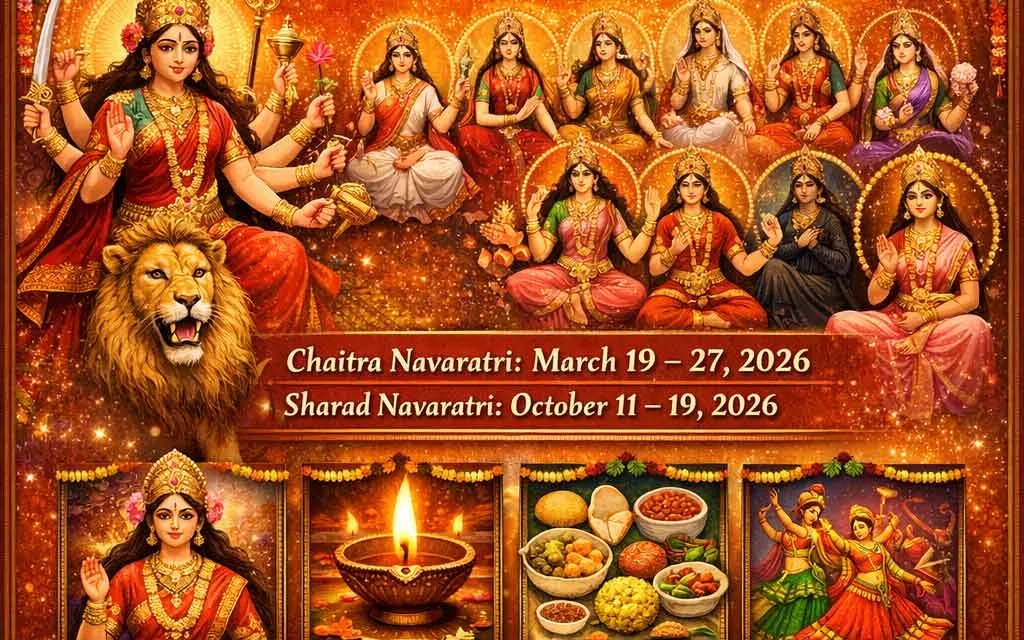
Navaratri 2026: Dates, Importance, Daily Poojas & Complete Celebration Guide
Navaratri 2026: A Complete Guide for Hindus in the UK – Dates, Poojas, Significance & Celebration Tips