
Hindu Calendar
9 articles
The Hindu calendar is not a single system but a family of related calendars used across India and the diaspora. Most North Indian and Telugu, Kannada and Marathi households follow lunisolar reckonings in which months are counted by the moon, while Tamil, Malayali, Bengali and Odia traditions often rely on solar months. Eras such as Vikram Samvat and Shalivahana Shaka are used side by side.
Understanding the calendar helps families make sense of why festivals move against the Gregorian year, why the same festival can fall on different days in different regions, and why an extra month is occasionally added. Concepts such as tithi, paksha, nakshatra and the panchang are the building blocks devotees rely on when planning vratams, pujas and family ceremonies.
On this page you will find plain-language explanations of the lunar and solar months, how tithis and the two fortnights work, the role of Adhik Maas, regional differences between amanta and purnimanta systems, and our yearly festival calendars for India and major cities abroad. Related reading covers the panchang, tithis and Adhik Maas.
Start Here



Latest Articles

Hindu Calendar October 2026: Festivals, Dates, Rituals and Significance (Navratri, Dussehra, Sharad Purnima, Karwa Chauth)
The complete Hindu calendar for October 2026: daily tithi, nakshatra and sunrise for every day from 10 to 31 October…
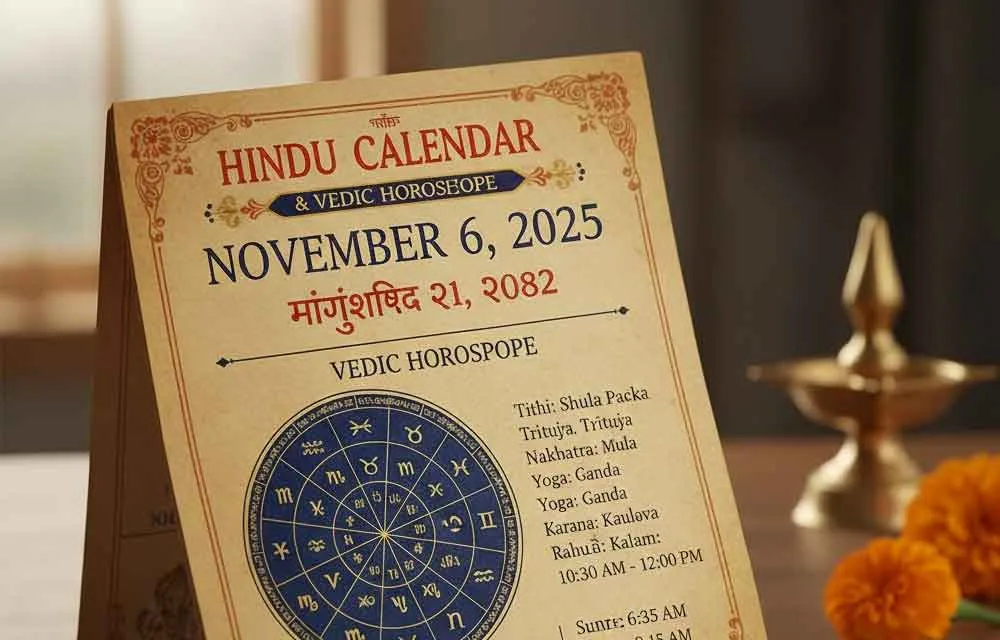
Hindu Calendar & Vedic Horoscope for November 6, 2025
Thursday, November 6, 2025 🌟 Hindu Calendar Overview 📅 Panchang Elements for November 6, 2025 ✨ Day Significance This…

Complete Hindu Calendar Horoscope – September 6th, 2025
📅 Hindu Calendar Details Date: Saturday, September 6th, 2025 Tithi: Krishna Paksha Chaturdashi (14th day of waning…

This Week's Hindu Calendar Astrology Predictions for All Moon Signs (August 17-23, 2025)
Welcome to your comprehensive weekly Hindu horoscope for August 17-23, 2025 (Shravana Masam, Vikram Samvat 2082)…

FAQs
How does the Hindu calendar work?
The Hindu calendar is mainly lunisolar: months follow the Moon, while an extra month is added from time to time to keep in step with the solar year. Each day is described by five elements, called the panchang: tithi, vara (weekday), nakshatra, yoga and karana.
What is the difference between Amanta and Purnimanta calendars?
In the Amanta system, used in much of South and West India, a month ends on the new moon. In the Purnimanta system, common in North India, it ends on the full moon. Festival dates stay the same, but the month name for the waning fortnight differs.
Why do Hindu festival dates change every year?
Most festivals are fixed by tithi, a lunar day, rather than by a date in the Gregorian calendar. Since lunar months are shorter than solar months, festivals move around, usually within a few weeks. Local sunrise also matters, so check our panchang for your city.
What are the twelve Hindu months?
The lunar months are Chaitra, Vaishakha, Jyeshtha, Ashadha, Shravana, Bhadrapada, Ashvin, Kartika, Margashirsha, Pausha, Magha and Phalguna. In Tamil Nadu, Kerala and some other regions, solar months based on the Sun's entry into each zodiac sign are used instead.