Mahishasura Mardini Stotram (Aigiri Nandini): Full Sanskrit Lyrics, IAST and Meaning
Aigiri Nandini, the Mahishasura Mardini Stotram, in full: all 21 verses in Devanagari and IAST from the sanskritdocuments.org text, with our own plain-English meaning for each verse, a note on who wrote it, and how and when it is traditionally recited during Navratri and Durga Ashtami.
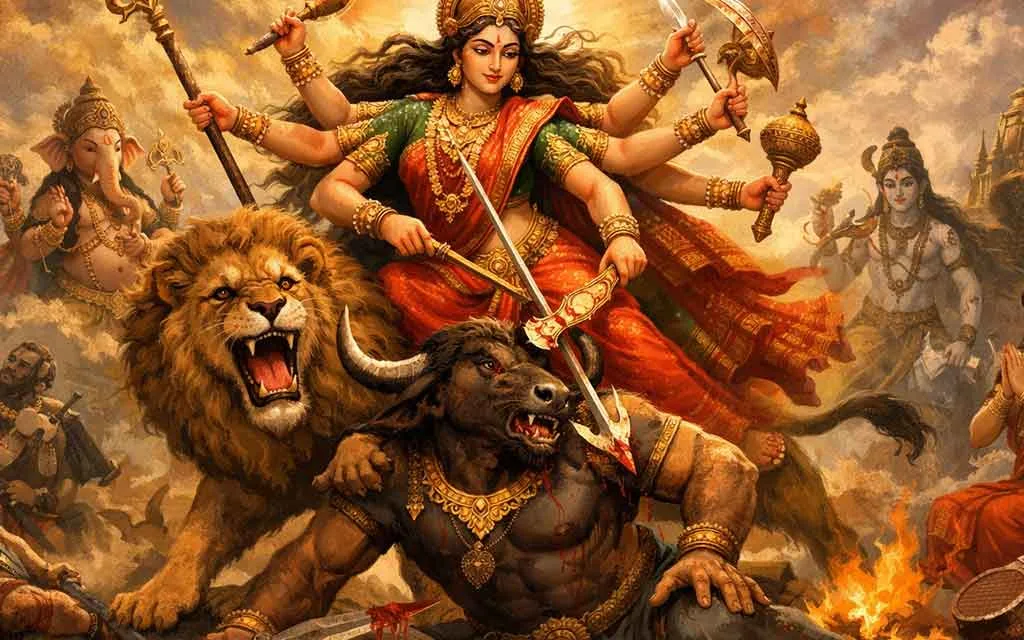
Quick answer: Aigiri Nandini, the Mahishasura Mardini Stotram, is a Sanskrit hymn of 21 verses praising Goddess Durga as the slayer of the buffalo demon Mahishasura. Every verse ends 'jaya jaya he mahishasuramardini ramyakapardini shailasute'. It is traditionally attributed to Adi Shankaracharya, though the attribution is debated, and it is recited above all during Navratri and on Durga Ashtami.
Last updated: 18 October 2026. The Sanskrit on this page comes from the text published by sanskritdocuments.org, converted to Devanagari and IAST by software rather than retyped by hand. The English meanings are our own.
The hymn is famous for its sound as much as its sense: long compound words, rolling internal rhymes and drum-like syllables that make it a favourite for group singing in temples and homes. Its verses move from the Goddess's home in the mountains to her battles with the demons of the Devi Mahatmya, then to her grace, beauty and compassion, and end with a personal prayer for refuge.
Who wrote the Mahishasura Mardini Stotram?
Popular tradition attributes the hymn to Adi Shankaracharya, and many printed books and recordings carry his name. The attribution is debated. The sanskritdocuments.org text presents these verses as part of a longer hymn, the Bhagavati Padya Pushpanjali Stotram, credited to Ramakrishna Kavi, numbering them 7 to 27, and notes that the hymn does not appear in the standard collections of Shankaracharya's works. The same source notes that part of it is also found in the Shiva Rahasya. We present it as a beloved traditional hymn and leave the question open, as scholars do.
| Part | What it covers |
|---|---|
| Verses 1 to 3 | The Goddess as daughter of the mountain, mother of the world and destroyer of Madhu and Kaitabha |
| Verses 4 to 8 | Her battles: Chanda and Munda, Dhumralochana, Raktabija, Shumbha and Nishumbha |
| Verses 9 to 17 | Her dance, music, beauty and radiance, and the devotion of Suratha and Samadhi |
| Verses 18 to 21 | The fruit of worshipping her feet and a personal prayer for compassion |
| Closing verse | Phalashruti for one who recites the hymn daily |
Aigiri Nandini lyrics with meaning
Each verse appears in Devanagari, then IAST transliteration, then a plain-English meaning. Many lines are long chains of names and puns, so the meanings give the sense rather than a word-for-word rendering. In IAST, ā, ī and ū are long vowels, ṅ is 'ng', ṇ and ṭ are retroflex sounds, and ś or ṣ is close to 'sh'.
Verses 1 to 7: the goddess and the battle
Verse 1
अयि गिरिनन्दिनि नन्दितमेदिनि विश्वविनोदिनि नन्दनुते
गिरिवरविन्ध्यशिरोधिनिवासिनि विष्णुविलासिनि जिष्णुनुते ।
भगवति हे शितिकण्ठकुटुम्बिनि भूरिकुटुम्बिनि भूरिकृते
जय जय हे महिषासुरमर्दिनि रम्यकपर्दिनि शैलसुते ॥ १॥
ayi girinandini nanditamedini viśvavinodini nandanute
girivaravindhyaśirodhinivāsini viṣṇuvilāsini jiṣṇunute |
bhagavati he śitikaṇṭhakuṭumbini bhūrikuṭumbini bhūrikṛte
jaya jaya he mahiṣāsuramardini ramyakapardini śailasute || 1||
Meaning: Daughter of the mountain, you who gladden the earth and delight the whole universe, praised by Nandi; you who live on the summit of the great Vindhya mountain, who shine in Vishnu's play and are praised by Indra; goddess, wife of the blue-throated Shiva, mother of a vast family, doer of countless deeds. Refrain: victory, victory to you, slayer of Mahishasura, goddess with lovely braided hair, daughter of the mountain.
Verse 2
सुरवरवर्षिणि दुर्धरधर्षिणि दुर्मुखमर्षिणि हर्षरते
त्रिभुवनपोषिणि शङ्करतोषिणि किल्बिषमोषिणि घोषरते ।
दनुजनिरोषिणि दितिसुतरोषिणि दुर्मदशोषिणि सिन्धुसुते
जय जय हे महिषासुरमर्दिनि रम्यकपर्दिनि शैलसुते ॥ २॥
suravaravarṣiṇi durdharadharṣiṇi durmukhamarṣiṇi harṣarate
tribhuvanapoṣiṇi śaṅkaratoṣiṇi kilbiṣamoṣiṇi ghoṣarate |
danujaniroṣiṇi ditisutaroṣiṇi durmadaśoṣiṇi sindhusute
jaya jaya he mahiṣāsuramardini ramyakapardini śailasute || 2||
Meaning: You who shower blessings on the gods, who overpower the demons Durdhara and Durmukha and delight in joy; who nourish the three worlds, please Shankara and wash away sin; whose anger falls on the demon hosts, who dry up the pride of the arrogant, daughter of the ocean. Refrain: victory, victory to you, slayer of Mahishasura, goddess with lovely braided hair, daughter of the mountain.
Verse 3
अयि जगदम्ब मदम्ब कदम्बवनप्रियवासिनि हासरते
शिखरिशिरोमणितुङ्गहिमालयशृङ्गनिजालयमध्यगते ।
मधुमधुरे मधुकैटभगञ्जिनि कैटभभञ्जिनि रासरते
जय जय हे महिषासुरमर्दिनि रम्यकपर्दिनि शैलसुते ॥ ३॥
ayi jagadamba madamba kadambavanapriyavāsini hāsarate
śikhariśiromaṇituṅgahimālayaśṛṅganijālayamadhyagate |
madhumadhure madhukaiṭabhagañjini kaiṭabhabhañjini rāsarate
jaya jaya he mahiṣāsuramardini ramyakapardini śailasute || 3||
Meaning: Mother of the world, my own mother, who loves to dwell in the kadamba forest and delights in laughter; whose home is on the peaks of the lofty Himalaya, crown-jewel of mountains; sweet as honey, destroyer of Madhu and Kaitabha, who delights in the circle dance. Refrain: victory, victory to you, slayer of Mahishasura, goddess with lovely braided hair, daughter of the mountain.
Verse 4
अयि शतखण्डविखण्डितरुण्डवितुण्डितशुण्डगजाधिपते
रिपुगजगण्डविदारणचण्डपराक्रमशुण्ड मृगाधिपते ।
निजभुजदण्डनिपातितखण्डविपातितमुण्डभटाधिपते
जय जय हे महिषासुरमर्दिनि रम्यकपर्दिनि शैलसुते ॥ ४॥
ayi śatakhaṇḍavikhaṇḍitaruṇḍavituṇḍitaśuṇḍagajādhipate
ripugajagaṇḍavidāraṇacaṇḍaparākramaśuṇḍa mṛgādhipate |
nijabhujadaṇḍanipātitakhaṇḍavipātitamuṇḍabhaṭādhipate
jaya jaya he mahiṣāsuramardini ramyakapardini śailasute || 4||
Meaning: You who cut into a hundred pieces the trunks and heads of the enemy's lordly elephants; whose lion, lord of beasts, is fierce and mighty in tearing apart the temples of those elephants; who with the strength of your own arms struck down the demon commanders such as Chanda and Munda. Refrain: victory, victory to you, slayer of Mahishasura, goddess with lovely braided hair, daughter of the mountain.
Verse 5
अयि रणदुर्मदशत्रुवधोदितदुर्धरनिर्जरशक्तिभृते
चतुरविचारधुरीणमहाशिवदूतकृतप्रमथाधिपते ।
दुरितदुरीहदुराशयदुर्मतिदानवदूतकृतान्तमते
जय जय हे महिषासुरमर्दिनि रम्यकपर्दिनि शैलसुते ॥ ५॥
ayi raṇadurmadaśatruvadhoditadurdharanirjaraśaktibhṛte
caturavicāradhurīṇamahāśivadūtakṛtapramathādhipate |
duritadurīhadurāśayadurmatidānavadūtakṛtāntamate
jaya jaya he mahiṣāsuramardini ramyakapardini śailasute || 5||
Meaning: You who hold an invincible power, risen to destroy enemies drunk with battle; who made the wise and great Shiva your messenger; whose resolve brought death to the demon's envoy of wicked mind and evil intent. Refrain: victory, victory to you, slayer of Mahishasura, goddess with lovely braided hair, daughter of the mountain.
Verse 6
अयि शरणागतवैरिवधूवरवीरवराभयदायकरे
त्रिभुवनमस्तकशूलविरोधिशिरोधिकृतामलशूलकरे ।
दुमिदुमितामरदुन्दुभिनादमहोमुखरीकृततिग्मकरे
जय जय हे महिषासुरमर्दिनि रम्यकपर्दिनि शैलसुते ॥ ६॥
ayi śaraṇāgatavairivadhūvaravīravarābhayadāyakare
tribhuvanamastakaśūlavirodhiśirodhikṛtāmalaśūlakare |
dumidumitāmaradundubhinādamahomukharīkṛtatigmakare
jaya jaya he mahiṣāsuramardini ramyakapardini śailasute || 6||
Meaning: You whose hand grants fearlessness even to enemy warriors when their wives come to you for refuge; whose hand holds a spotless trident against those who threaten the three worlds; whose blazing radiance is made to resound by the beating of the gods' drums. Refrain: victory, victory to you, slayer of Mahishasura, goddess with lovely braided hair, daughter of the mountain.
Verse 7
अयि निजहुँकृतिमात्रनिराकृतधूम्रविलोचनधूम्रशते
समरविशोषितशोणितबीजसमुद्भवशोणितबीजलते ।
शिवशिव शुम्भनिशुम्भमहाहवतर्पितभूतपिशाचरते
जय जय हे महिषासुरमर्दिनि रम्यकपर्दिनि शैलसुते ॥ ७॥
ayi nijahum̐kṛtimātranirākṛtadhūmravilocanadhūmraśate
samaraviśoṣitaśoṇitabījasamudbhavaśoṇitabījalate |
śivaśiva śumbhaniśumbhamahāhavatarpitabhūtapiśācarate
jaya jaya he mahiṣāsuramardini ramyakapardini śailasute || 7||
Meaning: You who with a single 'hum' destroyed Dhumralochana and his hundreds of warriors; who in battle dried up the blood of Raktabija and of every Raktabija born from it; who, in the great battle with Shumbha and Nishumbha, satisfied the hungry spirits of the battlefield. Refrain: victory, victory to you, slayer of Mahishasura, goddess with lovely braided hair, daughter of the mountain.
Verses 8 to 17: the warrior and the dancer
Verse 8
धनुरनुषङ्गरणक्षणसङ्गपरिस्फुरदङ्गनटत्कटके
कनकपिशङ्गपृषत्कनिषङ्गरसद्भटशृङ्गहतावटुके ।
कृतचतुरङ्गबलक्षितिरङ्गघटद्बहुरङ्गरटद्बटुके
जय जय हे महिषासुरमर्दिनि रम्यकपर्दिनि शैलसुते ॥ ८॥
dhanuranuṣaṅgaraṇakṣaṇasaṅgaparisphuradaṅganaṭatkaṭake
kanakapiśaṅgapṛṣatkaniṣaṅgarasadbhaṭaśṛṅgahatāvaṭuke |
kṛtacaturaṅgabalakṣitiraṅgaghaṭadbahuraṅgaraṭadbaṭuke
jaya jaya he mahiṣāsuramardini ramyakapardini śailasute || 8||
Meaning: You whose bracelets flash as you draw the bow in every moment of battle; whose golden arrows and quivers strike down proud warriors; whose fourfold army fills the battlefield with the clamour of countless young fighters. Refrain: victory, victory to you, slayer of Mahishasura, goddess with lovely braided hair, daughter of the mountain.
Verse 9
सुरललनाततथेयितथेयितथाभिनयोत्तरनृत्यरते
हासविलासहुलासमयि प्रणतार्तजनेऽमितप्रेमभरे ।
धिमिकिटधिक्कटधिकटधिमिध्वनिधीरमृदङ्गनिनादरते
जय जय हे महिषासुरमर्दिनि रम्यकपर्दिनि शैलसुते ॥ ९॥
suralalanātatatheyitatheyitathābhinayottaranṛtyarate
hāsavilāsahulāsamayi praṇatārtajane'mitapremabhare |
dhimikiṭadhikkaṭadhikaṭadhimidhvanidhīramṛdaṅganinādarate
jaya jaya he mahiṣāsuramardini ramyakapardini śailasute || 9||
Meaning: You who delight in the dance of the heavenly women, with its rhythmic beats and expressive gestures; you who are full of laughter and play and overflow with boundless love for those who bow to you in distress; you who delight in the deep sound of the mridanga drum. Refrain: victory, victory to you, slayer of Mahishasura, goddess with lovely braided hair, daughter of the mountain.
Verse 10
जय जय जप्यजये जयशब्दपरस्तुतितत्परविश्वनुते
झणझणझिञ्झिमिझङ्कृतनूपुरसिञ्जितमोहितभूतपते ।
नटितनटार्धनटीनटनायकनाटितनाट्यसुगानरते
जय जय हे महिषासुरमर्दिनि रम्यकपर्दिनि शैलसुते ॥ १०॥
jaya jaya japyajaye jayaśabdaparastutitatparaviśvanute
jhaṇajhaṇajhiñjhimijhaṅkṛtanūpurasiñjitamohitabhūtapate |
naṭitanaṭārdhanaṭīnaṭanāyakanāṭitanāṭyasugānarate
jaya jaya he mahiṣāsuramardini ramyakapardini śailasute || 10||
Meaning: Victory, victory to you, worthy of japa, victorious one, praised by the whole universe with cries of victory; you who enchant Shiva, lord of beings, with the jingling of your anklets; you who delight in the dance and song of the Lord of Dance, half of whose form is the goddess. Refrain: victory, victory to you, slayer of Mahishasura, goddess with lovely braided hair, daughter of the mountain.
Verse 11
अयि सुमनःसुमनः सुमनः सुमनः सुमनोहरकान्तियुते
श्रितरजनीरजनीरजनीरजनीरजनीकरवक्त्रवृते ।
सुनयनविभ्रमरभ्रमरभ्रमरभ्रमरभ्रमराधिपते
जय जय हे महिषासुरमर्दिनि रम्यकपर्दिनि शैलसुते ॥ ११॥
ayi sumanaḥsumanaḥ sumanaḥ sumanaḥ sumanoharakāntiyute
śritarajanīrajanīrajanīrajanīrajanīkaravaktravṛte |
sunayanavibhramarabhramarabhramarabhramarabhramarādhipate
jaya jaya he mahiṣāsuramardini ramyakapardini śailasute || 11||
Meaning: You who shine with the beauty of lovely flowers and lovely minds; whose face is like the moon that lights the night; whose beautiful, darting eyes are like black bees, queen of the bees. Refrain: victory, victory to you, slayer of Mahishasura, goddess with lovely braided hair, daughter of the mountain.
Verse 12
सहितमहाहवमल्लमतल्लिकमल्लितरल्लकमल्लरते
विरचितवल्लिकपल्लिकमल्लिकझिल्लिकभिल्लिकवर्गवृते ।
सितकृतफुल्लसमुल्लसितारुणतल्लजपल्लवसल्ललिते
जय जय हे महिषासुरमर्दिनि रम्यकपर्दिनि शैलसुते ॥ १२॥
sahitamahāhavamallamatallikamallitarallakamallarate
viracitavallikapallikamallikajhillikabhillikavargavṛte |
sitakṛtaphullasamullasitāruṇatallajapallavasallalite
jaya jaya he mahiṣāsuramardini ramyakapardini śailasute || 12||
Meaning: You who delight in the contests of the mighty in the great battle; who are surrounded by forest women adorned with creepers, jasmine and wild flowers; who glow with fresh blossoms and tender red shoots. Refrain: victory, victory to you, slayer of Mahishasura, goddess with lovely braided hair, daughter of the mountain.
Verse 13
अविरलगण्डगलन्मदमेदुरमत्तमतङ्गजराजपते
त्रिभुवनभूषणभूतकलानिधिरूपपयोनिधिराजसुते ।
अयि सुदतीजनलालसमानसमोहनमन्मथराजसुते
जय जय हे महिषासुरमर्दिनि रम्यकपर्दिनि शैलसुते ॥ १३॥
aviralagaṇḍagalanmadameduramattamataṅgajarājapate
tribhuvanabhūṣaṇabhūtakalānidhirūpapayonidhirājasute |
ayi sudatījanalālasamānasamohanamanmatharājasute
jaya jaya he mahiṣāsuramardini ramyakapardini śailasute || 13||
Meaning: You whose bearing is as majestic as a great elephant in its prime; daughter of the king, jewel of the three worlds, beautiful as the moon, ocean of grace; you who charm even the god of love. Refrain: victory, victory to you, slayer of Mahishasura, goddess with lovely braided hair, daughter of the mountain.
Verse 14
कमलदलामलकोमलकान्तिकलाकलितामलभाललते
सकलविलासकलानिलयक्रमकेलिचलत्कलहंसकुले ।
अलिकुलसङ्कुलकुवलयमण्डलमौलिमिलद्बकुलालिकुले
जय जय हे महिषासुरमर्दिनि रम्यकपर्दिनि शैलसुते ॥ १४॥
kamaladalāmalakomalakāntikalākalitāmalabhālalate
sakalavilāsakalānilayakramakelicalatkalahaṃsakule |
alikulasaṅkulakuvalayamaṇḍalamaulimiladbakulālikule
jaya jaya he mahiṣāsuramardini ramyakapardini śailasute || 14||
Meaning: Your forehead is lovely with the soft, spotless lustre of lotus petals; you are the home of every art and grace, moving like a flock of royal swans at play; your hair is crowned with bakula flowers, with bees swarming among blue lilies. Refrain: victory, victory to you, slayer of Mahishasura, goddess with lovely braided hair, daughter of the mountain.
Verse 15
करमुरलीरववीजितकूजितलज्जितकोकिलमञ्जुमते
मिलितमिलिन्दमनोहरगुञ्जितरञ्जितशैलनिकुञ्जगते ।
निजगुणभूतमहाशबरीगणसद्गुणसम्भृतकेलितले
जय जय हे महिषासुरमर्दिनि रम्यकपर्दिनि शैलसुते ॥ १५॥
karamuralīravavījitakūjitalajjitakokilamañjumate
militamilindamanoharaguñjitarañjitaśailanikuñjagate |
nijaguṇabhūtamahāśabarīgaṇasadguṇasambhṛtakelitale
jaya jaya he mahiṣāsuramardini ramyakapardini śailasute || 15||
Meaning: You whose flute's sweet music puts the cuckoo to shame; who wander in mountain groves made lovely by the humming of bees; who play among your companions, the forest women rich in good qualities. Refrain: victory, victory to you, slayer of Mahishasura, goddess with lovely braided hair, daughter of the mountain.
Verse 16
कटितटपीतदुकूलविचित्रमयूखतिरस्कृतचन्द्ररुचे
प्रणतसुरासुरमौलिमणिस्फुरदंशुलसन्नखचन्द्ररुचे ।
जितकनकाचलमौलिपदोर्जितनिर्जरकुञ्जरकुम्भकुचे
जय जय हे महिषासुरमर्दिनि रम्यकपर्दिनि शैलसुते ॥ १६॥
kaṭitaṭapītadukūlavicitramayūkhatiraskṛtacandraruce
praṇatasurāsuramaulimaṇisphuradaṃśulasannakhacandraruce |
jitakanakācalamaulipadorjitanirjarakuñjarakumbhakuce
jaya jaya he mahiṣāsuramardini ramyakapardini śailasute || 16||
Meaning: You whose yellow silk at the waist outshines the moon; whose toenails glow like moons with the light of the jewels on the crowns of gods and demons bowing at your feet; whose radiance surpasses the golden mountain. Refrain: victory, victory to you, slayer of Mahishasura, goddess with lovely braided hair, daughter of the mountain.
Verse 17
विजितसहस्रकरैकसहस्रकरैकसहस्रकरैकनुते
कृतसुरतारकसङ्गरतारकसङ्गरतारकसूनुसुते ।
सुरथसमाधिसमानसमाधिसमाधिसमाधिसुजातरते
जय जय हे महिषासुरमर्दिनि रम्यकपर्दिनि शैलसुते ॥ १७॥
vijitasahasrakaraikasahasrakaraikasahasrakaraikanute
kṛtasuratārakasaṅgaratārakasaṅgaratārakasūnusute |
surathasamādhisamānasamādhisamādhisamādhisujātarate
jaya jaya he mahiṣāsuramardini ramyakapardini śailasute || 17||
Meaning: You who are praised by the thousand-rayed sun, whose brilliance you surpass; mother of the son who led the gods to victory against Taraka; you who were pleased by the deep devotion of King Suratha and the merchant Samadhi. Refrain: victory, victory to you, slayer of Mahishasura, goddess with lovely braided hair, daughter of the mountain.
Verses 18 to 21: refuge and prayer
Verse 18
पदकमलं करुणानिलये वरिवस्यति योऽनुदिनं सुशिवे
अयि कमले कमलानिलये कमलानिलयः स कथं न भवेत् ।
तव पदमेव परम्पदमेवनुशीलयतो मम किं न शिवे
जय जय हे महिषासुरमर्दिनि रम्यकपर्दिनि शैलसुते ॥ १८॥
padakamalaṃ karuṇānilaye varivasyati yo'nudinaṃ suśive
ayi kamale kamalānilaye kamalānilayaḥ sa kathaṃ na bhavet |
tava padameva parampadamevanuśīlayato mama kiṃ na śive
jaya jaya he mahiṣāsuramardini ramyakapardini śailasute || 18||
Meaning: Compassionate, auspicious one: whoever worships your lotus feet every day, how could he not become a home of good fortune? Since I hold your feet alone to be the highest state, what could I lack? Refrain: victory, victory to you, slayer of Mahishasura, goddess with lovely braided hair, daughter of the mountain.
Verse 19
कनकलसत्कलसिन्धुजलैरनुसिञ्चिनुते गुण रङ्गभुवं
भजति स किं न शचीकुचकुम्भतटीपरिरम्भसुखानुभवम् ।
तव चरणं शरणं करवाणि नतामरवाणिनिवासि शिवं
मृडानि सदा मयि देहि शिवं
जय जय हे महिषासुरमर्दिनि रम्यकपर्दिनि शैलसुते ॥ १९॥
kanakalasatkalasindhujalairanusiñcinute guṇa raṅgabhuvaṃ
bhajati sa kiṃ na śacīkucakumbhataṭīparirambhasukhānubhavam |
tava caraṇaṃ śaraṇaṃ karavāṇi natāmaravāṇinivāsi śivaṃ
mṛḍāni sadā mayi dehi śivaṃ
jaya jaya he mahiṣāsuramardini ramyakapardini śailasute || 19||
Meaning: Whoever bathes your sacred courtyard with golden water, does he not taste the joys of heaven? I take refuge at your feet, you to whom the gods bow and in whom speech dwells. Mridani, always grant me what is good. Refrain: victory, victory to you, slayer of Mahishasura, goddess with lovely braided hair, daughter of the mountain.
Verse 20
तव विमलेन्दुकुलं वदनेन्दुमलं सकलं ननु कूलयते
किमु पुरुहूतपुरीन्दुमुखीसुमुखीभिरसौ विमुखीक्रियते ।
मम तु मतं शिवनामधने भवतीकृपया किमुत क्रियते
जय जय हे महिषासुरमर्दिनि रम्यकपर्दिनि शैलसुते ॥ २०॥
tava vimalendukulaṃ vadanendumalaṃ sakalaṃ nanu kūlayate
kimu puruhūtapurīndumukhīsumukhībhirasau vimukhīkriyate |
mama tu mataṃ śivanāmadhane bhavatīkṛpayā kimuta kriyate
jaya jaya he mahiṣāsuramardini ramyakapardini śailasute || 20||
Meaning: Your spotless moon-like face surely outshines the moon itself; does it not leave the moon-faced women of Indra's city turned away? In my view, treasure of Shiva's name, what cannot be achieved by your grace? Refrain: victory, victory to you, slayer of Mahishasura, goddess with lovely braided hair, daughter of the mountain.
Verse 21
अयि मयि दीनदयालुतया कृपयैव त्वया भवितव्यमुमे
अयि जगतो जननी कृपयासि यथासि तथाऽनुमितासि रते ।
यदुचितमत्र भवत्युररीकुरुतादुरुतापमपाकुरुते
जय जय हे महिषासुरमर्दिनि रम्यकपर्दिनि शैलसुते ॥ २१॥
ayi mayi dīnadayālutayā kṛpayaiva tvayā bhavitavyamume
ayi jagato jananī kṛpayāsi yathāsi tathā'numitāsi rate |
yaducitamatra bhavatyurarīkurutādurutāpamapākurute
jaya jaya he mahiṣāsuramardini ramyakapardini śailasute || 21||
Meaning: Uma, you must be kind to me, compassionate to the helpless; mother of the world, as compassionate as you are, so you are known to be. Do what is fitting here, and take away my great suffering. Refrain: victory, victory to you, slayer of Mahishasura, goddess with lovely braided hair, daughter of the mountain.
Closing verse (phalashruti)
स्तुतिमितस्तिमितः सुसमाधिना नियमतोऽयमतोऽनुदिनं पठेत् ।
परमया रमयापि निषेव्यते परिजनोऽरिजनोऽपि च तं भजेत् ॥ २८॥
stutimitastimitaḥ susamādhinā niyamato'yamato'nudinaṃ paṭhet |
paramayā ramayāpi niṣevyate parijano'rijano'pi ca taṃ bhajet || 28||
Meaning: Whoever recites this hymn every day, with a calm mind and steady discipline, is served by the supreme goddess of fortune herself, and is honoured by friends and even by former enemies. Like all phalashrutis, this is a traditional statement of faith.
When the Mahishasura Mardini Stotram is traditionally recited
- Navratri: on all nine nights, often after the evening aarti. See our Navaratri 2026 dates and the nine Devi forms.
- Durga Ashtami and Maha Navami: the peak days of Durga worship. Maha Ashtami falls on Monday 19 October 2026 in India; see Maha Ashtami 2026, Durga Ashtami 2026 in the USA and the Durgashtami and Navami puja sankalpam.
- Vijayadashami: the day of victory; see Dussehra and Vijayadashami 2026.
- Tuesdays and Fridays: days many families keep for the Goddess, especially at the evening lamp.
How to recite Aigiri Nandini
- Sit before a picture or murti of Durga, facing east or north if you can, and light a lamp. Red flowers and kumkum are traditional offerings to the Goddess.
- Begin with a short prayer to Ganesha, then recite the 21 verses at an even pace, letting the refrain carry the rhythm.
- If you are learning, start with verses 1 to 3; once the metre is familiar the later verses follow the same pattern.
- Close with the phalashruti verse, an aarti if you wish, and a moment of silence.
A full recitation takes about twelve to fifteen minutes. In group singing one person often leads each verse while everyone joins the refrain, which is an easy way for children to take part. Many families pair it with the Durga Chalisa or the 108 names of Durga during Navratri.
Significance
Aigiri Nandini holds together the two faces of the Goddess that Navratri celebrates: the fierce warrior who destroys Mahishasura and his generals, and the gentle mother who dances, smiles and shelters those who come to her. Devotees traditionally believe that reciting it with devotion brings courage, protection and peace of mind. These are expressions of faith rather than guaranteed results; the closing prayer itself asks only for the Goddess's compassion.
Also read: Durga Suktam with meaning and Devi Suktam (Rigveda 10.125).
Also read: Argala Stotram with meaning and Devi Kavacham with meaning.
Frequently asked questions
Who wrote Aigiri Nandini?
It is traditionally attributed to Adi Shankaracharya, but that attribution is debated. The sanskritdocuments.org text, which we follow, presents these 21 verses as verses 7 to 27 of the Bhagavati Padya Pushpanjali Stotram of Ramakrishna Kavi, and notes that the hymn is absent from the standard collections of Shankaracharya's works. Many devotees still know it as Shankara's hymn.
How many verses does Aigiri Nandini have?
The popular hymn has 21 verses, each ending with the refrain 'jaya jaya he mahishasuramardini ramyakapardini shailasute'. The longer source text adds six opening verses and three closing verses; we give the 21 verses and the first closing verse.
When is the Mahishasura Mardini Stotram recited?
Above all during Navratri, especially on Durga Ashtami and Maha Navami, and on Vijayadashami. Many families also recite it on Tuesdays and Fridays, at the evening lamp, and whenever they want to remember the Goddess as protector.
Is this the same as the Mahalaya radio programme 'Mahishasuramardini'?
No. The famous dawn programme broadcast in Bengal on Mahalaya, also called Mahishasuramardini, is a different work: a montage of verses from the Chandi (Devi Mahatmya), songs and narration. Aigiri Nandini is a separate Sanskrit hymn.
What does 'Mahishasura Mardini' mean?
It means 'she who crushed Mahishasura', the buffalo demon. The story of Durga's victory over Mahishasura is told in the Devi Mahatmya and is remembered at Navratri and Dussehra as the victory of good over evil.
Does chanting Aigiri Nandini bring guaranteed results?
No hymn can promise results. Devotees traditionally believe that reciting it with devotion brings the Goddess's protection, courage and peace of mind, and the closing verse speaks of grace for those who recite it daily. These are expressions of faith.
Editor's note (18 October 2026)
The text on this page is taken from the Mahishasura Mardini Stotram on sanskritdocuments.org (file mahisha.itx, proofread by Sunder Hattangadi and Rajani Arjun Shankar), converted from ITRANS to Devanagari and IAST with the indic_transliteration software and checked line by line against the site's Devanagari page. The source gives each verse two numbers (1 to 21 within the popular hymn, 7 to 27 within the longer stotram); we keep the inner numbering. Two typographical corrections: a doubled closing bracket after a variant reading in verse 10, and a stray bracket after the number of verse 17, were removed. Where the source offers alternative readings in brackets (for example 'nandinute' in verse 1, 'dhimidhimitamara' in verse 6 and 'kalayannanu' in verse 20), we give the main reading; in verse 9 the source adds a whole alternative line, and in verse 15 a second version of the third line, which we have not used. Verse 19 has an extra half-line ('mridani sada mayi dehi shivam') in the source, kept as given. The six opening and two final verses of the longer stotram are not reproduced. The English meanings are our own plain renderings.
Related guides
Share this with family and friends
Send it on WhatsApp, post it, or copy the link.
More from Pooja, Slokas and Mantras
- Sri Durga Parameshwari Stotram: Sanskrit Verses, Meaning and Devotional Significance
- Sri Venkatesa Vijayarya Saptavibhakti Stotram: Full Text in Telugu, Sanskrit and IAST with Meaning
- Deeparadhana: Significance of Lighting the Lamp, Deepam Jyoti Parabrahma Meaning, Oil and Wicks
- Narmadashtakam (Sabindu Sindhu) by Adi Shankaracharya: Full Text in Sanskrit with Meaning
- Hari Stotram (Jagajjalapalam) by Swami Brahmananda: Full Text in Sanskrit with Meaning
You might also like
Yantra vs Mantra vs Tantra — What Is the Difference? | Complete Hindu Guide
Maha Mrityunjaya Mantra for Hindus
Powerful Mantras for Students & Parents Before Joining School