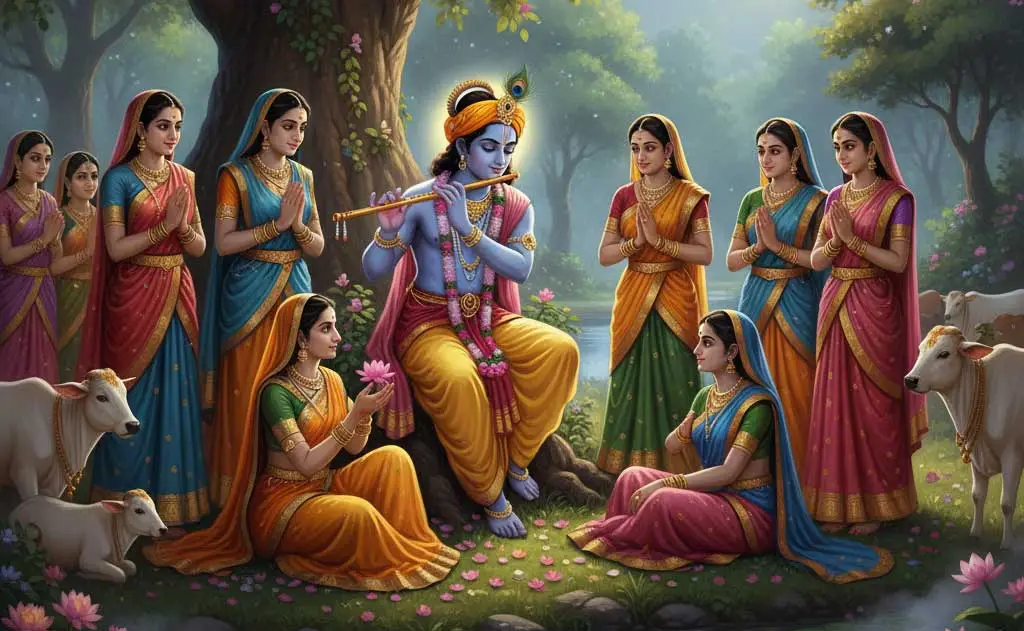
Durga Chalisa (Namo Namo Durge Sukh Karani): Full Lyrics with Meaning
The Durga Chalisa, which begins 'Namo namo Durge sukh karani', is a forty-verse Hindi hymn to the Divine Mother whose poet names himself Devidas. Here is the complete sanskritdocuments.org text in Devanagari and IAST with our own plain-English meaning of every chaupai, and guidance on reciting it on Tuesdays, Fridays and in Navratri.
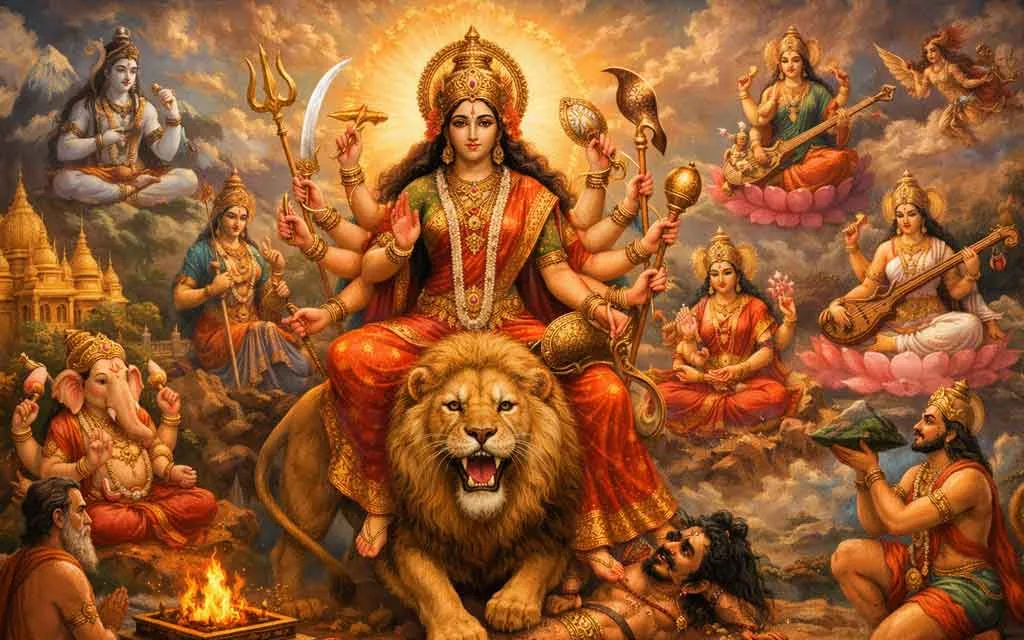
Quick answer: The Durga Chalisa is a forty-verse Hindi hymn to Maa Durga that begins 'Namo namo Durge sukh karani, namo namo Ambe dukh harani'. The poet names himself Devidas in the last verse. It is traditionally recited on Tuesdays and Fridays, through the nine nights of Navratri and on Durga Ashtami, and takes about eight minutes.
Last updated: 18 October 2026. The Hindi text on this page comes from the edition published by sanskritdocuments.org, converted to Devanagari and IAST by software rather than retyped by hand. The English meanings are our own.
The Durga Chalisa is sung in homes and temples across North India and by Hindu families worldwide. It praises the Mother as the formless light behind all things, then as Annapurna, Gauri, Saraswati and Lakshmi, as the ten Mahavidyas, and as the warrior who defeated Mahishasura, Shumbha and Nishumbha. It ends with a simple, personal prayer for help.
About the Durga Chalisa
Like other Chalisas, it is written in chaupais, four-quarter verses printed here as one line with a mid-line danda. The language is Hindi with Awadhi forms, so the IAST reads 'tumhārī' and 'bhaī' rather than Sanskrit forms. The Chalisa names some of the Goddess's great seats of worship: Hinglaj, Nagarkot and Jwala (Jwalamukhi).
| Chaupais | Theme |
|---|---|
| 1 to 8 | The Mother's form, light and power; Annapurna and Gauri |
| 9 to 16 | Her forms as Saraswati, Narasimha, Lakshmi and the Mahavidyas |
| 17 to 27 | Her lion, weapons and victories; her shrines at Nagarkot and Jwala |
| 28 to 34 | Shakti as the power behind yoga; the Shankaracharya story |
| 35 to 41 | The devotee's prayer and the poet's signature |
Durga Chalisa lyrics with meaning
Each chaupai appears in Devanagari, then IAST transliteration, then a plain-English meaning that stays close to the Hindi. In IAST, a line over a vowel (ā, ī, ū) marks a long vowel, ṃ marks nasalisation, and ś or ṣ is close to 'sh'.
Chaupais 1 to 8: the Mother's form and power
Chaupai 1
नमो नमो दुर्गे सुख करनी । नमो नमो अम्बे दुःख हरनी ॥
namo namo durge sukha karanī | namo namo ambe duḥkha haranī ||
Meaning: Salutations, salutations to you, Durga, giver of happiness; salutations, salutations to you, Mother Amba, remover of sorrow.
Chaupai 2
निरंकार है ज्योति तुम्हारी । तिहूं लोक फैली उजियारी ॥
niraṃkāra hai jyoti tumhārī | tihūṃ loka phailī ujiyārī ||
Meaning: Your light is beyond form, and its brightness spreads through the three worlds.
Chaupai 3
शशि ललाट मुख महा विशाला । नेत्र लाल भृकुटी विकराला ॥
śaśi lalāṭa mukha mahā viśālā | netra lāla bhṛkuṭī vikarālā ||
Meaning: The moon shines on your forehead and your face is vast; your eyes are red and your frown is fearsome.
Chaupai 4
रूप मातु को अधिक सुहावे । दरश करत जन अति सुख पावे ॥
rūpa mātu ko adhika suhāve | daraśa karata jana ati sukha pāve ||
Meaning: Mother, your form is most beautiful; those who see you are filled with joy.
Chaupai 5
तुम संसार शक्ति लय कीना । पालन हेतु अन्न धन दीना ॥
tuma saṃsāra śakti laya kīnā | pālana hetu anna dhana dīnā ||
Meaning: You hold all the power of the world, and you give food and wealth to sustain it.
Chaupai 6
अन्नपूरना हुई जग पाला । तुम ही आदि सुन्दरी बाला ॥
annapūranā huī jaga pālā | tuma hī ādi sundarī bālā ||
Meaning: As Annapurna you nourish the world; you are the primordial, beautiful young Goddess.
Chaupai 7
प्रलयकाल सब नाशन हारी । तुम गौरी शिव शंकर प्यारी ॥
pralayakāla saba nāśana hārī | tuma gaurī śiva śaṃkara pyārī ||
Meaning: At the time of dissolution you bring everything to an end; you are Gauri, beloved of Shiva Shankara.
Chaupai 8
शिव योगी तुमरे गुण गावें । ब्रह्मा विष्णु तुम्हें नित ध्यावें ॥
śiva yogī tumare guṇa gāveṃ | brahmā viṣṇu tumheṃ nita dhyāveṃ ||
Meaning: Shiva and the yogis sing your praises, and Brahma and Vishnu meditate on you every day.
Chaupais 9 to 16: her many forms
Chaupai 9
रूप सरस्वती को तुम धारा । दे सुबुद्धि ऋषि मुनिन उबारा ॥
rūpa sarasvatī ko tuma dhārā | de subuddhi ṛṣi munina ubārā ||
Meaning: You took the form of Saraswati, gave wisdom and uplifted the sages.
Chaupai 10
धरयो रूप नरसिंह को अम्बा । प्रगट भई फाड़ कर खम्बा ॥
dharayo rūpa narasiṃha ko ambā | pragaṭa bhaī phār̤a kara khambā ||
Meaning: Mother Amba, you took the form of Narasimha and appeared by bursting open the pillar.
Chaupai 11
रक्षा करि प्रहलाद बचायो । हिरणाकुश को स्वर्ग पठायो ॥
rakṣā kari prahalāda bacāyo | hiraṇākuśa ko svarga paṭhāyo ||
Meaning: You protected and saved Prahlada and sent Hiranyakashipu to heaven.
Chaupai 12
लक्ष्मी रूप धरा जग माहीं । श्री नारायण अंग समाही ॥
lakṣmī rūpa dharā jaga māhīṃ | śrī nārāyaṇa aṃga samāhī ||
Meaning: You took the form of Lakshmi in the world and dwell as one with Sri Narayana.
Chaupai 13
क्षीरसिंधु में करत विलासा । दया सिन्धु दीजै मन आसा ॥
kṣīrasiṃdhu meṃ karata vilāsā | dayā sindhu dījai mana āsā ||
Meaning: You delight in the ocean of milk. Ocean of compassion, fulfil the hope of my heart.
Chaupai 14
हिंगलाज में तुम्हीं भवानी । महिमा अमित न जात बखानी ॥
hiṃgalāja meṃ tumhīṃ bhavānī | mahimā amita na jāta bakhānī ||
Meaning: At Hinglaj you are Bhavani; your glory is boundless and beyond words.
Chaupai 15
मातंगी अरु धूमावति माता । भुवनेश्वरी बगला सुखदाता ॥
mātaṃgī aru dhūmāvati mātā | bhuvaneśvarī bagalā sukhadātā ||
Meaning: You are Mother Matangi and Dhumavati, and Bhuvaneshvari and Bagala, who give happiness.
Chaupai 16
श्री भैरव तारा जग तारिणि । छिन्न भाल भव दुःख निवारिणि ॥
śrī bhairava tārā jaga tāriṇi | chinna bhāla bhava duḥkha nivāriṇi ||
Meaning: You are Bhairavi, and Tara who carries the world across; as Chhinnamasta you remove the sorrows of worldly life.
Chaupais 17 to 27: her victories and sacred seats
Chaupai 17
केहरी वाहन सोह भवानी । लांगुर वीर चलत अगवानी ॥
keharī vāhana soha bhavānī | lāṃgura vīra calata agavānī ||
Meaning: Bhavani, you ride the lion, and the brave Langur (Hanuman) walks ahead of you.
Chaupai 18
कर में खप्पर खड्ग विराजे । जाको देख काल डर भाजे ॥
kara meṃ khappara khaḍga virāje | jāko dekha kāla ḍara bhāje ||
Meaning: The skull-bowl and the sword shine in your hands; seeing you, even death runs in fear.
Chaupai 19
सोहे अस्त्र और त्रिशूला । जाते उठत शत्रु हिय शूला ॥
sohe astra aura triśūlā | jāte uṭhata śatru hiya śūlā ||
Meaning: Weapons and the trident adorn you; at their sight the enemy's heart aches with dread.
Chaupai 20
नगर कोटि में तुम्हीं विराजत । तिहूं लोक में डंका बाजत ॥
nagara koṭi meṃ tumhīṃ virājata | tihūṃ loka meṃ ḍaṃkā bājata ||
Meaning: You are enthroned at Nagarkot, and your victory drum sounds through the three worlds.
Chaupai 21
शुम्भ निशुम्भ दानव तुम मारे । रक्त बीज शंखन संहारे ॥
śumbha niśumbha dānava tuma māre | rakta bīja śaṃkhana saṃhāre ||
Meaning: You slew the demons Shumbha and Nishumbha and destroyed Raktabija and his countless doubles.
Chaupai 22
महिषासुर नृप अति अभिमानी । जेहि अघ भार मही अकुलानी ॥
mahiṣāsura nṛpa ati abhimānī | jehi agha bhāra mahī akulānī ||
Meaning: Mahishasura, the demon king, was very proud, and the earth groaned under the weight of his sins.
Chaupai 23
रूप कराल कालिका धारा । सेन सहित तुम तिहि संहारा ॥
rūpa karāla kālikā dhārā | sena sahita tuma tihi saṃhārā ||
Meaning: You took the terrible form of Kalika and destroyed him along with his army.
Chaupai 24
परी गाढ़ सन्तन पर जब जब । भई सहाय मातु तुम तब तब ॥
parī gār̤ha santana para jaba jaba | bhaī sahāya mātu tuma taba taba ||
Meaning: Whenever hard times fell on the good, Mother, you came to their help.
Chaupai 25
अमरपुरी अरु बासव लोका । तब महिमा सब रहे अशोका ॥
amarapurī aru bāsava lokā | taba mahimā saba rahe aśokā ||
Meaning: The city of the gods and the realm of Indra stay free of sorrow through your glory.
Chaupai 26
ज्वाला में है ज्योति तुम्हारी । तुम्हें सदा पूजें नर नारी ॥
jvālā meṃ hai jyoti tumhārī | tumheṃ sadā pūjeṃ nara nārī ||
Meaning: Your light burns at Jwala (Jwalamukhi), and men and women worship you always.
Chaupai 27
प्रेम भक्ति से जो यश गावे । दुःख दारिद्र निकट नहिं आवे ॥
prema bhakti se jo yaśa gāve | duḥkha dāridra nikaṭa nahiṃ āve ||
Meaning: Sorrow and poverty do not come near those who sing your glory with love and devotion.
Chaupais 28 to 34: the power of Shakti
Chaupai 28
ध्यावे तुम्हें जो नर मन लाई । जन्ममरण ताकौ छुटि जाई ॥
dhyāve tumheṃ jo nara mana lāī | janmamaraṇa tākau chuṭi jāī ||
Meaning: Whoever meditates on you with a focused mind is freed from birth and death.
Chaupai 29
जोगी सुर मुनि कहत पुकारी । योग न हो बिन शक्ति तुम्हारी ॥
jogī sura muni kahata pukārī | yoga na ho bina śakti tumhārī ||
Meaning: Yogis, gods and sages proclaim that without your power there is no yoga.
Chaupai 30
शंकर आचारज तप कीनो । काम अरु क्रोध जीति सब लीनो ॥
śaṃkara ācāraja tapa kīno | kāma aru krodha jīti saba līno ||
Meaning: Shankaracharya performed austerities and conquered desire and anger.
Chaupai 31
निशिदिन ध्यान धरो शंकर को । काहु काल नहिं सुमिरो तुमको ॥
niśidina dhyāna dharo śaṃkara ko | kāhu kāla nahiṃ sumiro tumako ||
Meaning: Day and night he meditated on Shankara, but never once remembered you.
Chaupai 32
शक्ति रूप को मरम न पायो । शक्ति गई तब मन पछतायो ॥
śakti rūpa ko marama na pāyo | śakti gaī taba mana pachatāyo ||
Meaning: He did not grasp the secret of Shakti; when his strength left him, he regretted it.
Chaupai 33
शरणागत हुई कीर्ति बखानी । जय जय जय जगदम्ब भवानी ॥
śaraṇāgata huī kīrti bakhānī | jaya jaya jaya jagadamba bhavānī ||
Meaning: He took refuge in you and praised your glory: victory, victory, victory to Jagadamba Bhavani.
Chaupai 34
भई प्रसन्न आदि जगदम्बा । दई शक्ति नहिं कीन विलम्बा ॥
bhaī prasanna ādi jagadambā | daī śakti nahiṃ kīna vilambā ||
Meaning: The primordial Mother of the world was pleased and gave him strength without delay.
Chaupais 35 to 41: the devotee's prayer
Chaupai 35
मोको मात कष्ट अति घेरो । तुम बिन कौन हरे दुःख मेरो ॥
moko māta kaṣṭa ati ghero | tuma bina kauna hare duḥkha mero ||
Meaning: Mother, great hardship surrounds me; who but you can remove my sorrow?
Chaupai 36
आशा तृष्णा निपट सतावै । मोह मदादिक सब विनशावै ॥
āśā tṛṣṇā nipaṭa satāvai | moha madādika saba vinaśāvai ||
Meaning: Hope and craving torment me, and delusion, pride and the like wear me down.
Chaupai 37
शत्रु नाश कीजै महारानी । सुमिरों इकचित तुम्हें भवानी ॥
śatru nāśa kījai mahārānī | sumiroṃ ikacita tumheṃ bhavānī ||
Meaning: Great Queen, destroy my enemies; with a single mind I remember you, Bhavani.
Chaupai 38
करो कृपा हे मात दयाला । ऋद्धिसिद्धि दे करहु निहाला ॥
karo kṛpā he māta dayālā | ṛddhisiddhi de karahu nihālā ||
Meaning: Compassionate Mother, be kind to me; grant me prosperity and success and fill me with joy.
Chaupai 39
जब लगी जियौ दया फल पाऊं । तुम्हारो यश मैं सदा सुनाऊं ॥
jaba lagī jiyau dayā phala pāūṃ | tumhāro yaśa maiṃ sadā sunāūṃ ||
Meaning: As long as I live, may I receive the fruit of your mercy and always tell of your glory.
Chaupai 40
दुर्गा चालीसा जो जन गावे । सब सुख भोग परमपद पावे ॥
durgā cālīsā jo jana gāve | saba sukha bhoga paramapada pāve ||
Meaning: Whoever sings the Durga Chalisa enjoys every happiness and reaches the highest state.
Chaupai 41
देवीदास शरण निज जानी । करहु कृपा जगदम्ब भवानी ॥
devīdāsa śaraṇa nija jānī | karahu kṛpā jagadamba bhavānī ||
Meaning: Knowing himself to be in your refuge, Devidas prays: be gracious, Jagadamba Bhavani.
Closing cry
श्री दुर्गामाता की जय ॥
śrī durgāmātā kī jaya ||
Meaning: Victory to Mother Shri Durga!
When Durga Chalisa is traditionally recited
- Tuesdays: many devotees worship both Hanuman and Durga on Tuesdays. See our Tuesday puja guide.
- Fridays: Friday is sacred to the Goddess as Lakshmi and Durga. See our Friday (Shukravar) guide.
- Navratri: the Chalisa is recited on each of the nine nights, along with the 108 names of Maa Durga. For dates and the nine forms, see our Navaratri 2026 guide.
- Durga Ashtami and daily prayer: on Ashtami, and every day for those who keep it as part of regular worship.
How to recite the Durga Chalisa
- Bathe and sit before a picture or murti of Maa Durga. A red cloth, red flowers and a little kumkum are traditional, but not required.
- Light a ghee or oil lamp and some incense, and begin with a short prayer to Lord Ganesha.
- Recite the forty-one chaupais slowly, reading the meaning once in a while so the words stay alive for you.
- Finish with 'Shri Durgamata ki jai', an aarti such as 'Jai Ambe Gauri', and a simple offering of fruit or sweets.
Some devotees recite the Chalisa daily for forty days, or three or eleven times on Navratri days. Any steady practice, kept with sincerity, is in keeping with the tradition. For a fuller set of Durga prayers, see Navratri mantras and Durga prayers.
Significance
The Chalisa holds two pictures of the Goddess side by side: the gentle Mother who feeds the world as Annapurna and the fierce warrior who rides the lion with sword and trident. Both are her compassion, one nourishing and the other protecting. Devotees traditionally believe that reciting it brings courage, removes fear and invites the Mother's protection; the closing verses speak of joy and the highest state. These are expressions of faith rather than promises of particular results.
Also read: Aigiri Nandini (Mahishasura Mardini Stotram).
Also read: Bhavani Ashtakam with meaning.
Also read: Durgashtakam (katyayani mahamaye).
Frequently asked questions
Who wrote the Durga Chalisa?
The poet names himself Devidas in the last chaupai ('Devidas sharan nij jani'), and the sanskritdocuments.org text lists Devidasa as the author. Little else is known about him. The Chalisa is in simple Hindi with Awadhi forms, like most Chalisas.
When should Durga Chalisa be recited?
Tuesdays and Fridays are the days most associated with the Goddess, and the Chalisa is recited on all nine nights of Navratri, on Durga Ashtami and by many devotees every day. Morning or evening, after a bath and before a lamp, is the usual practice.
How many verses are in the Durga Chalisa?
Chalisa means forty. The text here has forty chaupais plus a forty-first in which the poet names himself, followed by the cry 'Shri Durgamata ki jai'. Unlike the Hanuman Chalisa, this text has no opening or closing doha.
Can I recite Durga Chalisa during Navratri 2026?
Yes. Sharad Navratri 2026 runs from Sunday 11 October to Monday 19 October, with Durga Ashtami and Maha Navami on Monday 19 October (India) and Vijayadashami on Tuesday 20 October. Many families recite the Chalisa every evening of the nine nights.
What is the story of Shankaracharya in the Durga Chalisa?
Chaupais 30 to 34 tell, as the Chalisa presents it, of Shankaracharya worshipping only Shiva, losing his strength, and regaining it when he praised the Goddess. The story makes a devotional point: Shiva and Shakti are inseparable, and power (shakti) is the Mother's gift.
What are the benefits of Durga Chalisa?
The closing verses say that those who sing it with devotion are freed from sorrow and reach the highest state. Devotees traditionally believe it brings the Mother's protection, courage and peace. These are statements of faith, not guarantees of particular results.
Editor's note (18 October 2026)
The Durga Chalisa text on this page is taken from the 'mula patha' (original text) section of Shri Durga Chalisa on sanskritdocuments.org (file durga40.itx), converted from ITRANS to Devanagari and IAST with the indic_transliteration software. The same page also prints a second version of the text with translation, and we used it to correct three obvious typing slips in the mula patha: 'lilata' in chaupai 3 is given as lalata (ललाट, forehead); 'prlayakala' in chaupai 7 as pralayakala (प्रलयकाल); and 'adha' in chaupai 22 as agha (अघ, sin). We kept the mula patha's 'hiranakusha' (Hiranyakashipu) in chaupai 11. The aarti 'Jai Ambe Gauri' printed after the Chalisa in the source is not reproduced here. Printed editions differ slightly in spelling; if your family follows a particular book, follow it. The English meanings are our own plain renderings, and the hymn is presented as an act of devotion with no promise of particular results.
Related guides
Share this with family and friends
Send it on WhatsApp, post it, or copy the link.
More from Pooja, Slokas and Mantras
- Narmadashtakam (Sabindu Sindhu) by Adi Shankaracharya: Full Text in Sanskrit with Meaning
- Hari Stotram (Jagajjalapalam) by Swami Brahmananda: Full Text in Sanskrit with Meaning
- Ganeshashtakam (Yato Anantashakteh) from the Ganesha Purana: Full Text with Meaning
- Kashi Vishwanath Ashtakam (Gangataranga Ramaniya Jatakalapam): Full Text with Meaning
- Shivashtakam (Prabhum Prananatham Vibhum Vishvanatham): Full Text with Meaning
You might also like
Powerful Mantras for Students & Parents Before Joining School
Powerful Hindu Mantras for Purushottam Maas 2026: Vishnu Bhakti, Chanting Guide & Global Devotion
Shiva Sahasranama : Every Hindu need to chant