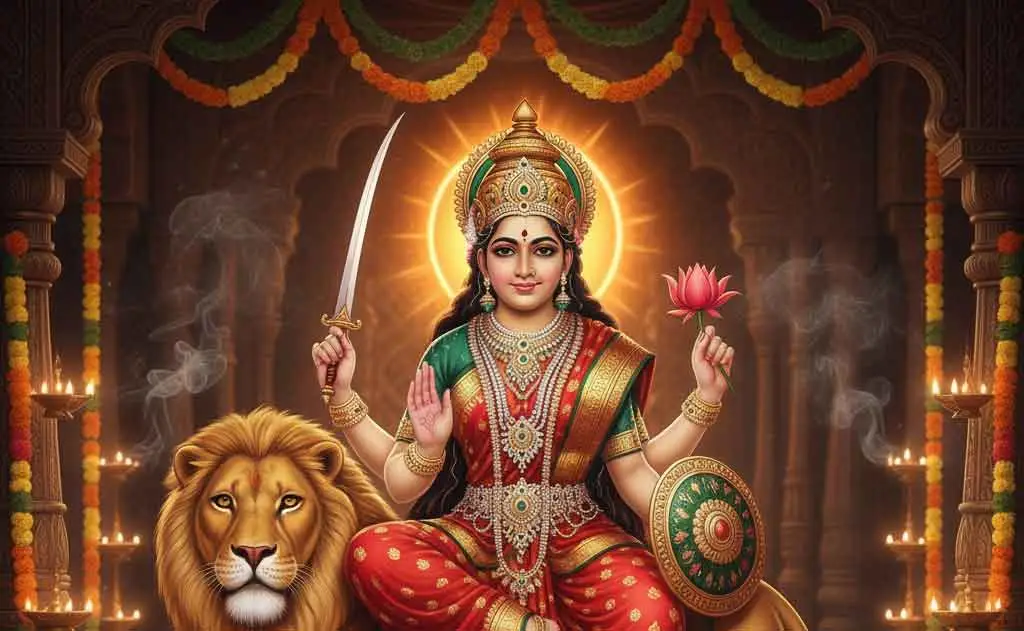
Narmadashtakam (Sabindu Sindhu) by Adi Shankaracharya: Full Text in Sanskrit with Meaning
The Narmadashtakam beginning 'sabindusindhususkhalattarangabhangaranjitam' is the eight-verse hymn to the river goddess Narmada in which every verse ends 'tvadiya-pada-pankajam namami devi narmade', I bow to your lotus feet, O goddess Narmada. Here is the full text with its phalashruti in Devanagari and IAST from sanskritdocuments.org, which names Shankaracharya as the composer, with our own plain-English meaning and how it is recited at the river and at home.
Quick answer: The Narmadashtakam beginning 'sabindusindhususkhalattaraṅgabhaṅgarañjitaṃ' is a hymn of 8 verses to the river goddess Narmada with a phalashruti. Every verse ends 'tvadīyapādapaṅkajaṃ namāmi devi narmade' ('O goddess Narmada, I bow to your lotus feet'). The text on sanskritdocuments.org names Shankaracharya as its composer. It is recited at the river, on Narmada Jayanti and during the Kartik baths.
Last updated: 21 October 2026. The Sanskrit below is the text published by sanskritdocuments.org (file narmadaa8.itx, encoded by Savithri D. and proofread by Savithri D. and D.K.M. Kartha), converted to Devanagari and IAST by software from the source, with no word typed by hand and no letter changed. Our own plain-English meaning follows every verse.
Narmadashtakam: full text with meaning
Each verse appears in Devanagari and then in IAST transliteration, followed by its meaning. The long compounds describe the river and its gifts; the refrain is a simple bow.
The river that removes sin and fear (verses 1 to 4)
Verse 1
सबिन्दुसिन्धुसुस्खलत्तरङ्गभङ्गरञ्जितं
द्विषत्सु पापजातजातकारिवारिसंयुतम् ।
कृतान्तदूतकालभूतभीतिहारिवर्मदे
त्वदीयपादपङ्कजं नमामि देवि नर्मदे ॥ १॥
sabindusindhususkhalattaraṅgabhaṅgarañjitaṃ
dviṣatsu pāpajātajātakārivārisaṃyutam |
kṛtāntadūtakālabhūtabhītihārivarmade
tvadīyapādapaṅkajaṃ namāmi devi narmade || 1||
Meaning: You who are made lovely by the play of gently rippling waves, flowing with spray towards the sea; whose waters stand as an enemy to the whole brood of sins; giver of an armour that takes away the fear of Death's messengers, of Time and of evil spirits: O goddess Narmada, I bow to your lotus feet.
Verse 2
त्वदम्बुलीनदीनमीनदिव्यसम्प्रदायकं
कलौ मलौघभारहारिसर्वतीर्थनायकम् ।
सुमच्छकच्छनक्रचक्रवाकचक्रशर्मदे
त्वदीयपादपङ्कजं नमामि देवि नर्मदे ॥ २॥
tvadambulīnadīnamīnadivyasampradāyakaṃ
kalau malaughabhārahārisarvatīrthanāyakam |
sumacchakacchanakracakravākacakraśarmade
tvadīyapādapaṅkajaṃ namāmi devi narmade || 2||
Meaning: You who grant a divine state even to the humble fish that rest in your waters; in the Kali age the leader of all holy places (tirthas), removing the weight of the mass of impurities; giver of joy to the fish, the tortoises, the crocodiles and the flocks of chakravaka birds: O goddess Narmada, I bow to your lotus feet.
Verse 3
महागभीरनीरपूरपापधूतभूतलं
ध्वनत्समस्तपातकारिदारितापदाचलम् ।
जगल्लये महाभये मृकण्डुसूनुहर्म्यदे
त्वदीयपादपङ्कजं नमामि देवि नर्मदे ॥ ३ ॥
mahāgabhīranīrapūrapāpadhūtabhūtalaṃ
dhvanatsamastapātakāridāritāpadācalam |
jagallaye mahābhaye mṛkaṇḍusūnuharmyade
tvadīyapādapaṅkajaṃ namāmi devi narmade || 3 ||
Meaning: You whose deep and abundant waters wash the sins from the earth; whose roaring flood breaks the mountains of misfortune, the enemy of all wrongdoing; who gave a dwelling place to the son of Mrikandu (the sage Markandeya) at the great and fearful dissolution of the world: O goddess Narmada, I bow to your lotus feet.
Verse 4
गतं तदैव मे भयं त्वदम्बु वीक्षितं यदा
मृकण्डुसूनुशौनकासुरारिसेवितं सदा ।
पुनर्भवाब्धिजन्मजं भवाब्धिदुःखवर्मदे
त्वदीयपादपङ्कजं नमामि देवि नर्मदे ॥ ४॥
gataṃ tadaiva me bhayaṃ tvadambu vīkṣitaṃ yadā
mṛkaṇḍusūnuśaunakāsurārisevitaṃ sadā |
punarbhavābdhijanmajaṃ bhavābdhiduḥkhavarmade
tvadīyapādapaṅkajaṃ namāmi devi narmade || 4||
Meaning: My fear left me the very moment I saw your waters, ever served by the son of Mrikandu (Markandeya), by Shaunaka and by the gods; giver of an armour against the sorrow of the ocean of existence, the sorrow born of the ocean of rebirth: O goddess Narmada, I bow to your lotus feet.
The river of the sages and the gods (verses 5 to 8)
Verse 5
अलक्ष्यलक्षकिन्नरामरासुरादिपूजितं
सुलक्षनीरतीरधीरपक्षिलक्षकूजितम् ।
वसिष्ठशिष्टपिप्पलादिकर्दमादिशर्मदे
त्वदीयपादपङ्कजं नमामि देवि नर्मदे ॥ ५॥
alakṣyalakṣakinnarāmarāsurādipūjitaṃ
sulakṣanīratīradhīrapakṣilakṣakūjitam |
vasiṣṭhaśiṣṭapippalādikardamādiśarmade
tvadīyapādapaṅkajaṃ namāmi devi narmade || 5||
Meaning: You who are worshipped by countless unseen Kinnaras, gods, Asuras and others; whose calm banks with their fine waters ring with the songs of countless birds; giver of joy to Vasishtha, Pippalada, Kardama and the other noble sages: O goddess Narmada, I bow to your lotus feet.
Verse 6
सनत्कुमारनाचिकेतकश्यपात्रिषट्पदैः
धृतं स्वकीयमानसेषु नारदादिषट्पदैः ।
रवीन्दुरन्तिदेवदेवराजकर्मशर्मदे
त्वदीयपादपङ्कजं नमामि देवि नर्मदे ॥ ६॥
sanatkumāranāciketakaśyapātriṣaṭpadaiḥ
dhṛtaṃ svakīyamānaseṣu nāradādiṣaṭpadaiḥ |
ravīndurantidevadevarājakarmaśarmade
tvadīyapādapaṅkajaṃ namāmi devi narmade || 6||
Meaning: You who are held in their minds, like bees at a lotus, by Sanatkumara, Nachiketa, Kashyapa, Atri and by Narada and the other bee-like sages; giver of blessing to the deeds of the Sun, the Moon, Rantideva and Indra, king of the gods: O goddess Narmada, I bow to your lotus feet.
Verse 7
अलक्षलक्षलक्षपापलक्षसारसायुधं
ततस्तु जीवजन्तुतन्तुभुक्तिमुक्तिदायकम् ।
विरिञ्चिविष्णुशंकरस्वकीयधामवर्मदे
त्वदीयपादपङ्कजं नमामि देवि नर्मदे ॥ ७॥
alakṣalakṣalakṣapāpalakṣasārasāyudhaṃ
tatastu jīvajantutantubhuktimuktidāyakam |
viriñciviṣṇuśaṃkarasvakīyadhāmavarmade
tvadīyapādapaṅkajaṃ namāmi devi narmade || 7||
Meaning: You who are the weapon against sins seen and unseen, by the hundreds of thousands; who then give both worldly good and liberation to the whole web of living beings; giver of the armour that is the very abode of Brahma, Vishnu and Shankara: O goddess Narmada, I bow to your lotus feet.
Verse 8
अहो धृतं स्वनं श्रुतं महेशकेशजातटे
किरातसूतबाडबेषु पण्डिते शठे नटे ।
दुरन्तपापतापहारि सर्वजन्तुशर्मदे
त्वदीयपादपङ्कजं नमामि देवि नर्मदे ॥ ८॥
aho dhṛtaṃ svanaṃ śrutaṃ maheśakeśajātaṭe
kirātasūtabāḍabeṣu paṇḍite śaṭhe naṭe |
durantapāpatāpahāri sarvajantuśarmade
tvadīyapādapaṅkajaṃ namāmi devi narmade || 8||
Meaning: Ah, the sound is heard and held on your bank that was born from the locks of Mahesha (Shiva), by people of every walk of life alike: forest hunters, charioteers, priests, the learned, the wicked and actors; remover of the heat of grievous sins, giver of happiness to all creatures: O goddess Narmada, I bow to your lotus feet.
Phalashruti (verse 9)
Verse 9 (phalashruti)
इदं तु नर्मदाष्टकं त्रिकालमेव ये सदा
पठन्ति ते निरन्तरं न यान्ति दुर्गतिं कदा ।
सुलभ्यदेहदुर्लभं महेशधामगौरवं
पुनर्भवा नरा न वै विलोकयन्ति रौरवम् ॥ ९॥
idaṃ tu narmadāṣṭakaṃ trikālameva ye sadā
paṭhanti te nirantaraṃ na yānti durgatiṃ kadā |
sulabhyadehadurlabhaṃ maheśadhāmagauravaṃ
punarbhavā narā na vai vilokayanti rauravam || 9||
Meaning: Phalashruti: those who always recite this Narmadashtakam at the three junctions of the day never meet with misfortune; they gain the glory of Mahesha's abode, so hard to reach even with a human body, and such people are not born again and never see Raurava (a hell of the Puranas).
Colophon
इति श्रीमत्परमहंसपरिव्राजकाचार्यस्य
श्रीगोविन्दभगवत्पूज्यपादशिष्यस्य
श्रीमच्छंकरभगवतः कृतौ
नर्मदाष्टकं सम्पूर्णम् ॥
iti śrīmatparamahaṃsaparivrājakācāryasya
śrīgovindabhagavatpūjyapādaśiṣyasya
śrīmacchaṃkarabhagavataḥ kṛtau
narmadāṣṭakaṃ sampūrṇam ||
Meaning: Thus ends the Narmadashtakam, a work of the revered Shankara Bhagavatpada, the paramahamsa and wandering teacher, disciple of the revered Govinda Bhagavatpada.
The Narmada in the hymn
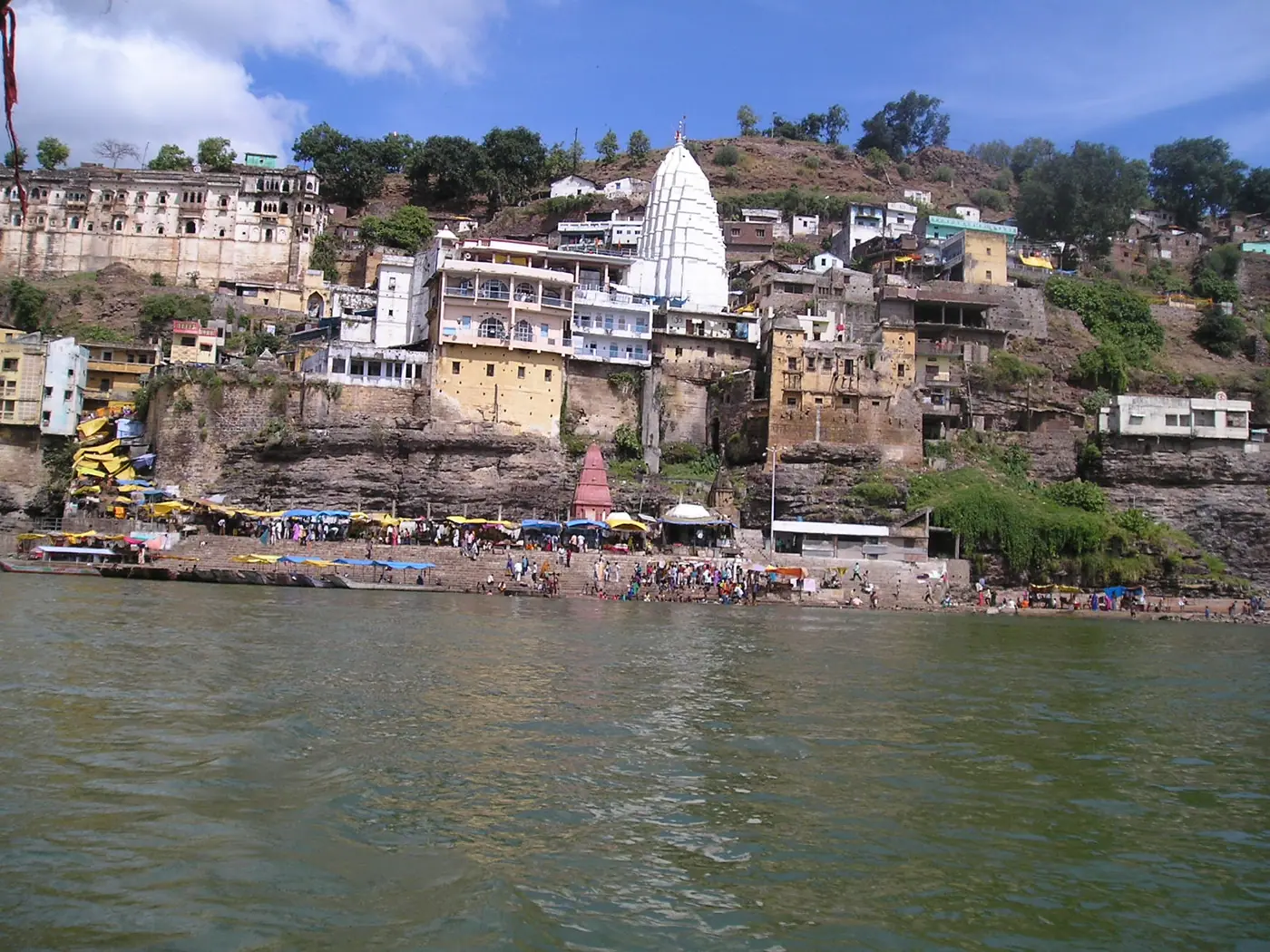
The Narmada rises at Amarkantak in Madhya Pradesh and flows west to the Arabian Sea through Madhya Pradesh and Gujarat. In the Puranic tradition she is born from Shiva, which is why verse 8 speaks of 'the bank born from Mahesha's locks', and the smooth stones of her bed are worshipped as Narmadeshwar (bana) lingas. On an island in the river stands Omkareshwar, one of the twelve Jyotirlingas, with Mamaleshwar on the opposite bank.
| Verse | What the river gives or who honours her |
|---|---|
| 1 | armour against fear of death and of Time; waters that are the enemy of sin |
| 2 | a divine state even for fish; chief of the tirthas in the Kali age |
| 3 | washes sin from the earth; shelter for Markandeya at the dissolution |
| 4 | fear leaves at the sight of her water; armour against the sorrow of rebirth |
| 5 | worshipped by Kinnaras, gods and Asuras; joy to Vasishtha, Pippalada, Kardama |
| 6 | held in mind by Sanatkumara, Nachiketa, Kashyapa, Atri, Narada |
| 7 | worldly good and liberation for all beings; the abode of Brahma, Vishnu, Shiva |
| 8 | heard by people of every walk of life; happiness for all creatures |
Verses 3 and 4 recall the sage Markandeya, the son of Mrikandu, who in the Puranic stories lives through the great dissolution of the world. The hymn says the Narmada gave him a dwelling place even then, so it praises her as a river that endures when everything else is dissolved.
When to recite the Narmadashtakam
- At the river: before or after a bath in the Narmada, and at each halt of the Narmada Parikrama, the walking pilgrimage along both banks.
- On Narmada Jayanti: Magha Shukla Saptami, when the river is worshipped with lamps at Amarkantak, Omkareshwar and Jabalpur.
- During Kartik: the North Indian month of Kartik runs from Tuesday 27 October to Tuesday 24 November 2026; see the guides to Kartik Snan and Deepdaan and Kartik Purnima 2026.
- At home, daily: the phalashruti names the three junctions of the day: morning, noon and evening.
How to recite it at home
- After your bath, light a lamp and keep a small vessel of water before it; a Narmadeshwar linga, if your family has one, can be placed beside it.
- Recite the eight verses steadily; the long compounds become easier after a few readings of the IAST.
- Add the phalashruti (verse 9), offer the water to a tulsi or other plant, and close with a bow.
- On a longer day, add the Ganga Stotram, the Lingashtakam or the Hari Stotram.
Pronunciation help
- The metre is panchachamara: strict short-long pairs, 'sa-BIN-du-SIN-dhu-SUS-kha-LAT', sixteen syllables to a line.
- Break each long compound at the hyphens of the meaning: 'sabindu-sindhu-suskhalat-taraṅga-bhaṅga-rañjitaṃ'.
- ṅ and ñ are nasals before the following consonant; kṣ (as in 'vīkṣitaṃ') is said 'ksh'; ṛ (as in 'mṛkaṇḍu') is a short 'ri'.
Traditional beliefs about the Narmadashtakam
The hymn itself praises the Narmada as a giver of 'armour' (varma) against fear and sorrow. Devotees traditionally believe that reciting it with faith:
- brings the same devotion as a bath in the river for those who cannot reach it;
- steadies the mind against fear, as verse 4 describes;
- honours the river as a living goddess, a value that also asks us to keep her waters clean.
These are matters of faith, not guarantees of protection, health or any other result.
Tips for NRI families
- Tell the river's story. Show children Amarkantak, Omkareshwar and the Gulf of Khambhat on a map and trace the river west while you read the verses.
- Learn the refrain first. Children can join 'namāmi devi narmade' from the first day.
- Keep water clean. Offer the puja water to a plant, not a drain, and never put plastic or flowers in rivers or lakes abroad; follow local rules.
- Plan a visit. Omkareshwar is about 80 km from Indore; check the temple's official website for current darshan timings.
For the food and fasting rules many families keep in this month, see Karthika Masam rules 2026. For another of Shankaracharya's best-loved hymns, read Bhaja Govindam.
Frequently asked questions
Who composed the Narmadashtakam?
The sanskritdocuments.org text names Shankaracharya in its Author field, and its colophon calls it a work of 'Shankara Bhagavatpada, disciple of Govinda Bhagavatpada'. That is the traditional attribution to Adi Shankaracharya, whose guru Govinda Bhagavatpada is linked by tradition with the banks of the Narmada.
What does the refrain 'namami devi narmade' mean?
'Tvadiya-pada-pankajam namami devi narmade' means 'O goddess Narmada, I bow to your lotus feet'. Every verse first describes the river and what it gives, then ends with this salutation.
When is the Narmadashtakam recited?
At the river, during the Narmada Parikrama and at Omkareshwar and Maheshwar; on Narmada Jayanti (Magha Shukla Saptami); and by many devotees during the river baths of Kartik, which in 2026 runs from Tuesday 27 October to Kartik Purnima on Tuesday 24 November in the North Indian calendar. At home it can be recited daily, as the phalashruti suggests, at the three junctions of the day.
Can I recite it if I do not live near the Narmada?
Yes. The hymn is a prayer to the river as a goddess, and families everywhere recite it at the morning bath or the evening lamp. Some keep a small bowl of water beside the lamp and offer it to a plant afterwards.
What is the metre of the Narmadashtakam?
Panchachamara: sixteen syllables per line in strict short-long pairs (da-DUM, da-DUM...). It is the same metre as the Shiva Tandava Stotram, which is why the two hymns sound alike.
What does the phalashruti promise?
It says that those who recite the hymn at the three times of the day are spared misfortune, attain Shiva's abode and are not reborn. This is the traditional praise of the hymn and an expression of faith; it is not a guarantee of any worldly or spiritual result.
Editor's note (21 October 2026)
This page was published on 21 October 2026 at the address readers and search engines were already requesting. The Sanskrit is the text of Narmadashtakam 1 on sanskritdocuments.org (file narmadaa8.itx), whose Author field names Shankaracharya and whose colophon calls it a work of Shankara Bhagavatpada, disciple of Govinda Bhagavatpada. The source writes kṣa with the ITRANS letter x ('vīxitaṃ', 'alaxya'); converted by software it reads क्ष as usual. Verse 2 is printed 'sumacchakaccha-' and verse 3 is numbered '|| 3 ||' with spaces; both are kept as printed. sanskritdocuments.org lists two other hymns called Narmadashtakam (by Maheshvarananda Sarasvati, and one beginning 'devasura supavani'); they are different texts, so there is no second copy of this one to compare with, and no letter is changed. The meanings are our own; in verse 8 we render the list of listeners as 'people of every walk of life'. Kartik dates are from Drik Panchang for India.
Related guides
Share this with family and friends
Send it on WhatsApp, post it, or copy the link.
You might also like
Ardhanarishvara Stotram (Champeya Gaurardha Sharirakayai) by Adi Shankaracharya: Full Text with Meaning
Shatpadi Stotram (Vishnu Shatpadi, Avinayam Apanaya Vishno) by Adi Shankaracharya: Full Text with Meaning
Ganga Stotram (Devi Sureshvari Bhagavati Gange) by Adi Shankaracharya: Full Text with Meaning