Ganga Stotram (Devi Sureshvari Bhagavati Gange) by Adi Shankaracharya: Full Text with Meaning
The Ganga Stotram, 'devi sureshvari bhagavati gange', is Adi Shankaracharya's hymn to the river goddess Ganga. Here are all 14 verses in Devanagari and IAST from sanskritdocuments.org, with our own verse-by-verse meaning, when it is traditionally recited (Ganga Dussehra, Kartik Purnima, a holy dip) and how to recite it at home.
The Ganga Stotram, 'devi sureshvari bhagavati gange', is Adi Shankaracharya's hymn to the river goddess Ganga. Here are all 14 verses in Devanagari and IAST from sanskritdocuments.
Quick answer: The Ganga Stotram is a hymn of 14 verses to the river goddess Ganga, traditionally ascribed to Adi Shankaracharya. It begins 'devi sureshvari bhagavati gange' ('O Goddess, queen of the gods, blessed Ganga') and asks her to wash away sin and carry the devotee across the ocean of worldly life. It is recited during a holy dip, at Ganga Dussehra and Kartik Purnima, and in daily worship.
Last updated: 20 October 2026. The Sanskrit below is the complete text published by sanskritdocuments.org (file gangastotra.itx, transliterated and proofread by Siva Pandyaram; colophon: composed by Shri Shankaracharya), converted to Devanagari and IAST by software from the source, with no word typed by hand; one word the source adds after verse 9 is moved to the editor's note. Our own plain-English meaning follows every verse.
Ganga Stotram: full text with meaning
Each verse appears in Devanagari and then in IAST transliteration, followed by its meaning. The rhyming endings ('gaṅge', 'taraṅge') carry the hymn's song-like rhythm.
Ganga, river of the gods (verses 1 to 4)
Verse 1
देवि सुरेश्वरि भगवति गङ्गे त्रिभुवनतारिणि तरलतरङ्गे ।
शङ्करमौलिविहारिणि विमले मम मतिरास्तां तव पदकमले ॥ १॥
devi sureśvari bhagavati gaṅge tribhuvanatāriṇi taralataraṅge |
śaṅkaramaulivihāriṇi vimale mama matirāstāṃ tava padakamale || 1||
Meaning: O Goddess, queen of the gods, blessed Ganga, who carry the three worlds across, with your restless waves; you who play on Shankara's head, pure one: may my mind rest at your lotus feet.
Verse 2
भागीरथि सुखदायिनि मातस्तव जलमहिमा निगमे ख्यातः ।
नाऽहं जाने तव महिमानं पाहि कृपामयि मामज्ञानम् ॥ २॥
bhāgīrathi sukhadāyini mātastava jalamahimā nigame khyātaḥ |
nā'haṃ jāne tava mahimānaṃ pāhi kṛpāmayi māmajñānam || 2||
Meaning: O Bhagirathi, giver of happiness, Mother, the greatness of your waters is proclaimed in the Vedas. I do not know your greatness; compassionate one, protect me in my ignorance.
Verse 3
हरिपदपाद्यतरङ्गिणि गङ्गे हिमविधुमुक्ताधवलतरङ्गे ।
दूरीकुरु मम दुष्कृतिभारं कुरु कृपया भवसागरपारम् ॥ ३॥
haripadapādyataraṅgiṇi gaṅge himavidhumuktādhavalataraṅge |
dūrīkuru mama duṣkṛtibhāraṃ kuru kṛpayā bhavasāgarapāram || 3||
Meaning: O Ganga, river that flows from the feet of Hari, whose waves are white as snow, the moon and pearls: take away the burden of my misdeeds, and in your kindness carry me across the ocean of worldly life.
Verse 4
तव जलममलं येन निपीतं परमपदं खलु तेन गृहीतम् ।
मातर्गङ्गे त्वयि यो भक्तः किल तं द्रष्टुं न यमः शक्तः ॥ ४॥
tava jalamamalaṃ yena nipītaṃ paramapadaṃ khalu tena gṛhītam |
mātargaṅge tvayi yo bhaktaḥ kila taṃ draṣṭuṃ na yamaḥ śaktaḥ || 4||
Meaning: Whoever has drunk your pure water has surely reached the highest abode. O Mother Ganga, Yama, the lord of death, cannot even look at one who is devoted to you.
Ganga, uplifter of the fallen (verses 5 to 9)
Verse 5
पतितोद्धारिणि जाह्नवि गङ्गे खण्डितगिरिवरमण्डितभङ्गे ।
भीष्मजननि हे मुनिवरकन्ये पतितनिवारिणि त्रिभुवनधन्ये ॥ ५॥
patitoddhāriṇi jāhnavi gaṅge khaṇḍitagirivaramaṇḍitabhaṅge |
bhīṣmajanani he munivarakanye patitanivāriṇi tribhuvanadhanye || 5||
Meaning: O Jahnavi, Ganga, uplifter of the fallen, whose waves are adorned as they break upon the great mountains; mother of Bhishma, daughter of the great sage Jahnu; you who turn back the fallen, blessed in the three worlds.
Verse 6
कल्पलतामिव फलदाम् लोके प्रणमति यस्त्वां न पतति शोके ।
पारावारविहारिणि गङ्गे विमुखयुवतिकृततरलापाङ्गे ॥ ६॥
kalpalatāmiva phaladām loke praṇamati yastvāṃ na patati śoke |
pārāvāravihāriṇi gaṅge vimukhayuvatikṛtataralāpāṅge || 6||
Meaning: Whoever bows to you, who give fruit in this world like the wish-fulfilling creeper, does not fall into sorrow. O Ganga, who play in the ocean, your quick waves are like the sidelong glances of a young woman turning away.
Verse 7
तव चेन्मातः स्रोतः स्नातः पुनरपि जठरे सोऽपि न जातः ।
नरकनिवारिणि जाह्नवि गङ्गे कलुषविनाशिनि महिमोत्तुङ्गे ॥ ७॥
tava cenmātaḥ srotaḥ snātaḥ punarapi jaṭhare so'pi na jātaḥ |
narakanivāriṇi jāhnavi gaṅge kaluṣavināśini mahimottuṅge || 7||
Meaning: O Mother, one who has bathed in your stream is not born again in a womb. O Jahnavi, Ganga, who keep away hell, destroyer of impurity, lofty in your greatness.
Verse 8
पुनरसदङ्गे पुण्यतरङ्गे जय जय जाह्नवि करुणापाङ्गे ।
इन्द्रमुकुटमणिराजितचरणे सुखदे शुभदे भृत्यशरण्ये ॥ ८॥
punarasadaṅge puṇyataraṅge jaya jaya jāhnavi karuṇāpāṅge |
indramukuṭamaṇirājitacaraṇe sukhade śubhade bhṛtyaśaraṇye || 8||
Meaning: Victory, victory to you, Jahnavi, holy-waved one beyond compare, whose glance is compassion; whose feet shine with the jewels of Indra's crown; giver of happiness and good, refuge of those who serve you.
Verse 9
रोगं शोकं तापं पापं हर मे भगवति कुमतिकलापम् ।
त्रिभुवनसारे वसुधाहारे त्वमसि गतिर्मम खलु संसारे ॥ ९॥
rogaṃ śokaṃ tāpaṃ pāpaṃ hara me bhagavati kumatikalāpam |
tribhuvanasāre vasudhāhāre tvamasi gatirmama khalu saṃsāre || 9||
Meaning: Take away my illness, grief, distress and sin, O blessed one, and the whole crowd of my wrong thoughts. Essence of the three worlds, necklace of the earth, you truly are my refuge in this worldly life.
Living near Ganga, and the phalashruti (verses 10 to 14)
Verse 10
अलकानन्दे परमानन्दे कुरु करुणामयि कातरवन्द्ये ।
तव तटनिकटे यस्य निवासः खलु वैकुण्ठे तस्य निवासः ॥ १०॥
alakānande paramānande kuru karuṇāmayi kātaravandye |
tava taṭanikaṭe yasya nivāsaḥ khalu vaikuṇṭhe tasya nivāsaḥ || 10||
Meaning: O Alakananda, supreme bliss, compassionate one honoured by the distressed, be kind. One who lives near your banks lives, truly, in Vaikuntha.
Verse 11
वरमिह नीरे कमठो मीनः किं वा तीरे शरटः क्षीणः ।
अथवा श्वपचो मलिनो दीनस्तव न हि दूरे नृपतिकुलीनः ॥ ११॥
varamiha nīre kamaṭho mīnaḥ kiṃ vā tīre śaraṭaḥ kṣīṇaḥ |
athavā śvapaco malino dīnastava na hi dūre nṛpatikulīnaḥ || 11||
Meaning: Better to be a tortoise or a fish in your waters, or a frail lizard on your bank, or even a poor, unwashed person living on the margins of society near you, than a man of royal birth far away from you.
Verse 12
भो भुवनेश्वरि पुण्ये धन्ये देवि द्रवमयि मुनिवरकन्ये ।
गङ्गास्तवमिमममलं नित्यं पठति नरो यः स जयति सत्यम् ॥ १२॥
bho bhuvaneśvari puṇye dhanye devi dravamayi munivarakanye |
gaṅgāstavamimamamalaṃ nityaṃ paṭhati naro yaḥ sa jayati satyam || 12||
Meaning: O ruler of the world, holy and blessed goddess in liquid form, daughter of the great sage: the person who recites this pure hymn to Ganga every day is truly victorious.
Verse 13
येषां हृदये गङ्गाभक्तिस्तेषां भवति सदा सुखमुक्तिः ।
मधुराकान्तापञ्झटिकाभिः परमानन्दकलितललिताभिः ॥ १३॥
yeṣāṃ hṛdaye gaṅgābhaktisteṣāṃ bhavati sadā sukhamuktiḥ |
madhurākāntāpañjhaṭikābhiḥ paramānandakalitalalitābhiḥ || 13||
Meaning: Those in whose hearts there is devotion to Ganga always have happiness and liberation. These verses are in the sweet, lovely pajjhatika metre, full of supreme bliss and grace.
Verse 14
गङ्गास्तोत्रमिदं भवसारं वाञ्छितफलदम् विमलं सारम् ।
शङ्करसेवकशङ्कररचितं पठति सुखीस्तव इति च समाप्तः ॥ १४॥
gaṅgāstotramidaṃ bhavasāraṃ vāñchitaphaladam vimalaṃ sāram |
śaṅkarasevakaśaṅkararacitaṃ paṭhati sukhīstava iti ca samāptaḥ || 14||
Meaning: This Ganga Stotram, the essence that carries us across worldly life, giver of what is desired, pure and true, was composed by Shankara, the servant of Shankara (Shiva). Whoever recites it becomes happy. Thus the hymn ends.
Colophon
॥ इति श्रीमच्छङ्कराचार्यविरचितं गङ्गास्तोत्रं सम्पूर्णम् ॥
|| iti śrīmacchaṅkarācāryaviracitaṃ gaṅgāstotraṃ sampūrṇam ||
Meaning: Thus ends the Ganga Stotram composed by Shri Shankaracharya.
Ganga in the hymn
The hymn gathers the stories of the river in a few words: she flows from the feet of Vishnu (verse 3), plays on the head of Shiva (verse 1), was brought down by King Bhagiratha (Bhagirathi, verse 2), was swallowed and released by the sage Jahnu (Jahnavi, verses 5 and 7), was the mother of Bhishma (verse 5), and in the Himalaya flows as the Alakananda (verse 10). Read more in our article on Ganga, a symbol of purity and devotion.
| Verse | Prayer |
|---|---|
| 1 to 3 | may my mind rest at your feet; protect me; carry me across |
| 4 and 7 | those who drink your water or bathe in you are freed from death and rebirth |
| 5 and 6 | uplifter of the fallen; whoever bows to you does not fall into sorrow |
| 8 and 9 | take away illness, grief, distress, sin and wrong thoughts |
| 10 and 11 | to live near Ganga is to live in Vaikuntha; nearness matters more than birth |
| 12 to 14 | the merit of reciting the hymn; the metre; the composer |
When is it traditionally recited?
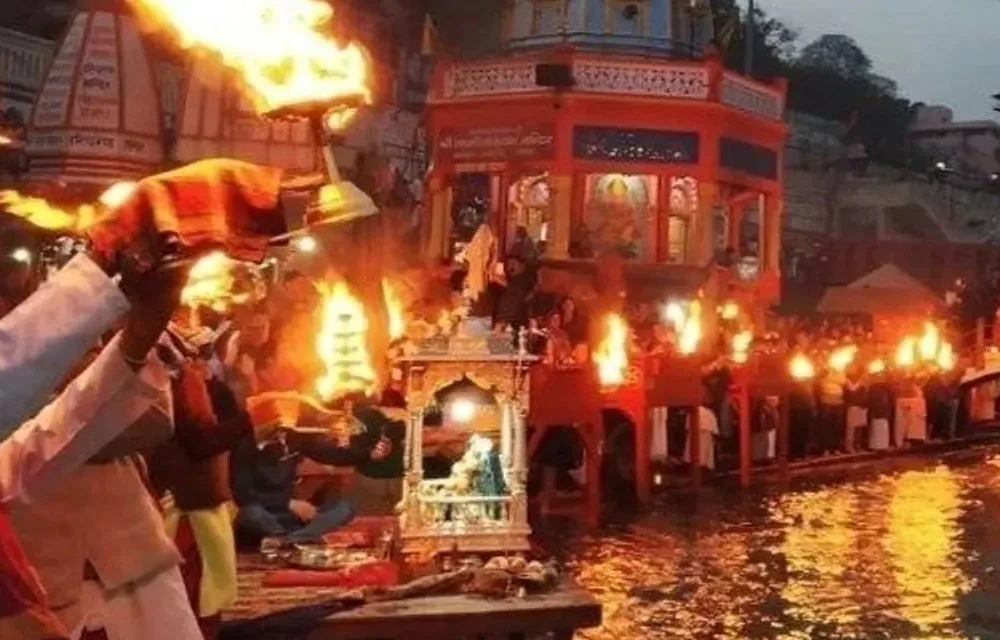
- During a holy dip: at the Ganga, at any river or even at home while bathing, with the thought of Ganga.
- At Kartik Purnima and Dev Deepavali: Kartik Purnima falls on Tuesday 24 November 2026 in India, the day of the great Kartik snan and of Dev Deepawali in Varanasi.
- At Ganga Dussehra: the festival of Ganga's descent in the month of Jyeshtha; see the Ganga Dussehra 2026 guide.
- On Deepavali morning: in South India the oil bath at dawn is called Ganga snanam, and many families say this hymn then.
- On Mondays: with Shiva worship, since Ganga flows from his matted hair. See our guide to Monday in Hinduism and the Monday rituals guide for NRI families.
How to recite it at home
- Fill a small vessel (kalasha) with water, add a few drops of Ganga jal if you have it, and place a flower on it.
- Light a lamp before an image of Shiva or of Ganga.
- Recite the 14 verses slowly; the refrain-like endings can be sung together.
- Sprinkle a little of the water on yourself and around the home at the end, or add it to your bath the next morning.
Pronunciation help
- ṅg in 'gaṅge' is the 'ng' of 'finger'; a line over a vowel (ā, ī, ū) means it is held twice as long.
- jāhnavi is said 'jaah-na-vi'; ś and ṣ are both 'sh' sounds; c is always 'ch'.
- Each line has a strong four-beat rhythm: 'devi sureśvari | bhagavati gaṅge | tribhuvanatāriṇi | taralataraṅge'.
Traditional beliefs about the Ganga Stotram
Verses 12 to 14 say that one who recites the hymn daily is victorious and happy, and that devotion to Ganga brings happiness and liberation. Devotees traditionally believe that reciting it with faith:
- brings inner purification, like a holy dip;
- eases grief and wrong thoughts, as verse 9 prays;
- keeps the memory of the sacred river alive in homes far from India.
These are matters of faith, not guarantees. Verse 9 asks Ganga to take away illness, but the hymn is a prayer, not a cure or a substitute for medical care.
Tips for NRI families
- Keep a little Ganga jal. Many families bring a sealed bottle from India for pujas; the hymn can be recited over it.
- Visit in person. On a trip to Varanasi, the hymn is a lovely companion to the evening aarti and a visit to Kashi Vishwanath.
- Other Shankara hymns. Pair it with the Shiva Manasa Puja, the Vishnu Shatpadi, the Annapurna Stotram or the Devi Aparadha Kshamapana Stotram; read more about Adi Shankaracharya.
Frequently asked questions
Who composed the Ganga Stotram?
Adi Shankaracharya, by tradition. The colophon on sanskritdocuments.org reads 'composed by Shri Shankaracharya', and the last verse says the hymn was composed by 'Shankara, the servant of Shankara (Shiva)'. The file itself has no separate Author field.
How many verses does it have?
Fourteen in our source: twelve verses of prayer, a verse naming the metre (pajjhatika), and a closing verse that names the composer and the merit of reciting it.
When is it traditionally recited?
During a holy dip in the Ganga or any river, at Ganga Dussehra in the month of Jyeshtha, at Kartik Purnima (Tuesday 24 November 2026 in India) and Dev Deepavali, at the evening Ganga aarti, and by many families during Shiva worship on Mondays.
What does verse 11 mean?
It says it is better to be a tortoise, a fish, a lizard or even the poorest, most neglected person living near the Ganga than to be born a prince far away from her. The verse uses an old Sanskrit word for people pushed to the edge of society; we render it neutrally. Its point is that nearness to the sacred river matters more than birth or rank.
Can I recite it without visiting the Ganga?
Yes. Families abroad recite it while bathing, before a puja with a small vessel of water, or when they keep Ganga jal at home. Verse 12 says that whoever recites it daily is victorious, wherever they are.
How long does it take?
About 4 to 5 minutes for all 14 verses. The rhythm is like a song and is easy to learn.
Editor's note (20 October 2026)
This page was published on 20 October 2026 at the address readers and search engines were already requesting. The Sanskrit is the full text of the Ganga Stotram on sanskritdocuments.org (file gangastotra.itx, transliterated and proofread by Siva Pandyaram; the file has no Author field; colophon: composed by Shri Shankaracharya; verse 14: composed by Shankara, the servant of Shankara). After the number of verse 9 the source adds the word 'gatirmaya', an alternative reading of 'gatir mama' (my refuge) in the same line; we have moved it here and print the verse as the source's main text has it. No letter of the hymn is changed. Verse 13 names the metre in the source spelling 'pañjhaṭikā' (pajjhatika), kept as printed. In verse 11 the source uses an old word for people at the margins of society; our meaning renders it neutrally. sanskritdocuments.org has many other Ganga hymns (for example one from the Brahmavaivarta Purana, gangAstotram2.itx); they are different texts. The meanings are our own.
Related guides
You might also like
Ardhanarishvara Stotram (Champeya Gaurardha Sharirakayai) by Adi Shankaracharya: Full Text with Meaning
Shatpadi Stotram (Vishnu Shatpadi, Avinayam Apanaya Vishno) by Adi Shankaracharya: Full Text with Meaning
Keelaka Stotram (Kilakam) of the Durga Saptashati: Full Text with Meaning