
Tamil Deepavali 2026 (Sunday 8 November): Ganga Snanam Before Sunrise, Deepavali Lehiyam, New Clothes and Thalai Deepavali for Newlyweds
Tamil Deepavali 2026 falls on Sunday 8 November, on Naraka Chaturdashi at dawn. Drik Panchang gives Chennai's oil-bath window as 05:06 AM to 06:05 AM. Here is how the morning unfolds in a Tamil home, from the Ganga snanam and Deepavali lehiyam to new clothes, Thalai Deepavali for newlyweds, and how it differs from North Indian Diwali.
Tamil Deepavali 2026 falls on Sunday 8 November, on Naraka Chaturdashi at dawn. Drik Panchang gives Chennai's oil-bath window as 05:06 AM to 06:05 AM.
Quick answer: Tamil Deepavali 2026 is on Sunday 8 November 2026. Tamil Nadu keeps Deepavali on Naraka Chaturdashi at dawn. The festival begins with an oil bath (Ganga snanam) before sunrise, followed by new clothes, a family prayer, sweets and crackers. Drik Panchang gives Chennai's oil-bath window as 05:06 AM to 06:05 AM. Chaturdashi tithi runs from 10:47 AM on Saturday 7 November to 11:27 AM on Sunday 8 November.
Last updated: 10 October 2026. Dates are from Drik Panchang (Hyderabad reference calendar, with Chennai, New York and Singapore pages checked). Muhurat windows depend on your city, so confirm locally.
Our Diwali in Tamil Nadu guide explains the Narakasura legend and the oil bath in depth. This page is a practical 2026 companion. It covers the Deepavali morning hour by hour, the lehiyam, the new-clothes customs, Thalai Deepavali for newly married couples, and what Tamil families abroad need to know about the date.
Tamil Deepavali 2026 at a glance
| Item | 2026 detail |
|---|---|
| Tamil Deepavali (India) | Sunday, 8 November 2026 |
| Tithi | Ashwina Krishna Chaturdashi (amanta), 10:47 AM on 7 Nov to 11:27 AM on 8 Nov |
| Oil bath window, Chennai | 05:06 AM to 06:05 AM (Drik Panchang) |
| Oil bath window, Hyderabad | 05:19 AM to 06:18 AM (Drik Panchang) |
| Sunrise, Hyderabad | 06:18 AM |
| Same day in India | Diwali, Lakshmi Puja, Kedara Gowri Vratam, Kamala Jayanti |
| Karthigai Deepam (Tamil Nadu's own lamp festival) | Tuesday, 24 November 2026 |
For the full day's panchangam, see Panchangam 8 November 2026.
Why Tamil Nadu celebrates on Chaturdashi morning
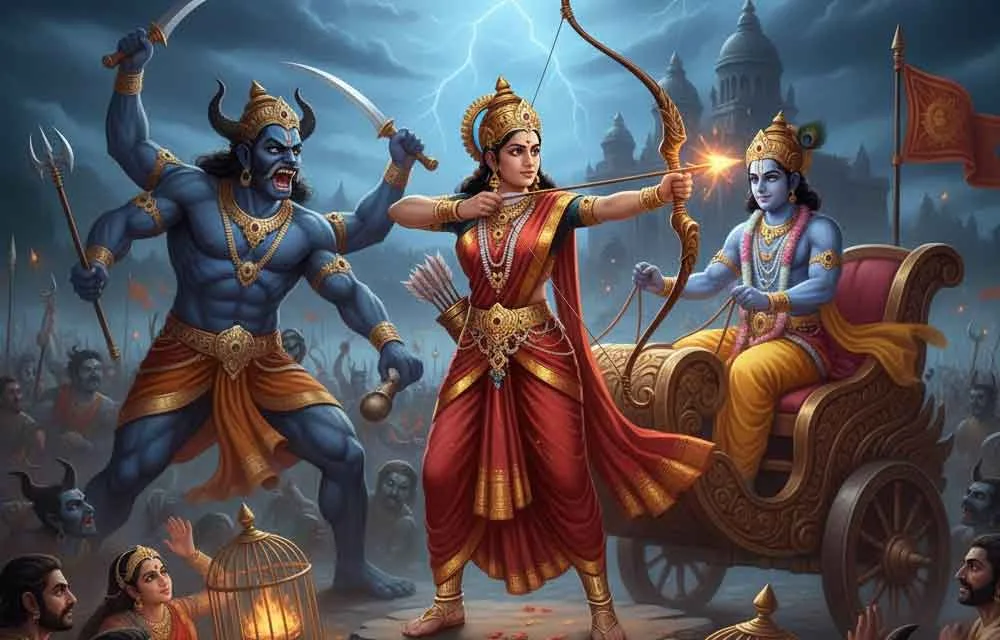
Across most of North India, the main Diwali night is Amavasya, when Lakshmi Puja is done in the evening. Tamil Nadu marks the festival a few hours earlier, at dawn on Chaturdashi. That is the morning when, as traditionally told, Lord Krishna and Satyabhama defeated the demon Narakasura. Drik Panchang puts it simply: Tamil Nadu observes Deepavali during Chaturdashi tithi at dawn, while most of India observes it when Amavasya prevails just after sunset.
The story, told in many Tamil homes, says Narakasura asked that his death be remembered with lights and celebration rather than mourning. So the day starts in darkness, with lamps and an early bath. For the full legend, read Satyabhama and Narakasura Vadha.
In 2026 the two observances share a date in India. Chaturdashi is current at sunrise on Sunday 8 November, and Amavasya begins at 11:27 AM, so it is current at sunset. A Tamil family in Chennai can take its Ganga snanam at 5:30 AM, and a Gujarati or Punjabi neighbour can do Lakshmi Puja that evening, on the same Sunday.
The Deepavali morning, step by step
1. Wake before dawn (around 4 to 5 AM)
Many families wake well before the oil-bath window. Lamps go up at the doorway and the puja shelf, and a fresh kolam is often drawn at the entrance the night before or very early in the morning.
2. The oil bath: Ganga snanam
The eldest woman or man of the house warms sesame oil (nallennai), sometimes with a few pepper corns or a betel leaf. They place a few drops on each person's head, starting with the youngest or with the head of the family, depending on the household. Everyone then bathes in hot water, using shikakai or a herbal bath powder to wash out the oil.
- It is traditionally believed that on this dawn Lakshmi resides in the oil and the Ganga in the water. Hence the name Ganga snanam.
- The well-known greeting of the day is 'Ganga snanam aachaa?' (Have you had your Ganga bath?), asked of neighbours and relatives instead of a simple hello.
- Children are usually bathed first so that they can get to the crackers.
Drik Panchang notes that this bath is done while Chaturdashi prevails and before sunrise. Families who cannot manage the exact window still take the oil bath early in the morning. The intention matters more than the minute.
3. Deepavali lehiyam
After the bath, many Tamil homes give each person a small spoonful of Deepavali lehiyam, also called Deepavali marundhu. It is a dark, thick, sweet-spicy paste. Family recipes commonly include dry ginger (sukku), black pepper, ajwain (omam), coriander seeds, jaggery and ghee, cooked down slowly. The idea, passed down through grandmothers, is to prepare the stomach for a day of murukku, adhirasam and sweets.
Recipes differ from home to home and many families now buy it ready-made from sweet shops. It is a festive custom, not a medicine. Anyone with a health condition, a pregnancy or a young child should check with a doctor before trying spice-heavy preparations.
4. New clothes and blessings
New clothes (puthu thuni) are bought in the weeks before Deepavali. On the night before, many families keep them on a plate at the puja shelf, often with a small dab of turmeric or kumkum on a corner of the fabric. After the bath, everyone changes into the new clothes and touches the feet of elders for blessings. Children often get money or small gifts.
5. Prayer, sweets and crackers
The family offers lamps, flowers and the prepared sweets to the household deities, often with Lord Krishna or Lord Ganesha remembered first. Crackers follow in the early morning light, then a festive breakfast and visits to relatives. For the classic snacks, see our Tamil Deepavali recipes: murukku, adhirasam, ribbon pakoda and rava laddu.
Some families, particularly in parts of Tamil Nadu and among Tamil communities abroad, also keep the Kedara Gowri fast, which in 2026 falls on the same day. See Kedar Gauri Vrat 2026 (Kedara Gowri Nombu).
Thalai Deepavali: the first Deepavali after marriage
Thalai Deepavali (literally 'head' or 'first' Deepavali) is the first Deepavali a couple celebrates after their wedding. It is one of the most looked-forward-to family occasions in Tamil homes, and customs vary between families and districts. The common pattern is:
- The bride's parents invite the newly married couple, and usually the groom's close family, to their home for Deepavali.
- The couple arrives a day or two before. The bride's family welcomes them, often with an aarti at the doorway.
- On Deepavali morning, the elders apply oil to the couple's heads and bless them before the Ganga snanam.
- The couple wears new clothes gifted by the bride's family: often a silk saree for the bride and a veshti and shirt for the groom.
- The couple seeks the blessings of elders from both sides, lights the first crackers together and shares a festive meal with both families.
- Many families visit a temple together later in the day.
Gifts are a matter of family custom and the family's means. There is no fixed list and no obligation, and many families today keep the day simple. What matters is the welcome, the blessings and the time the two families spend together.
Thalai Deepavali when the couple lives abroad
Many young Tamil couples are in the USA, the UK, Singapore, Australia or the Gulf in their first year of marriage. Some families arrange for the couple to fly home. Others plan a video call at the oil-bath hour, so elders can 'apply' the oil and bless the couple from Chennai or Madurai. Others save the formal celebration for the next visit home. If parents are visiting the couple abroad, the home ritual can be done in the couple's own flat. Just keep in mind that the local date can differ from India's (see below).
How Tamil Deepavali differs from North Indian Diwali
| Tamil Deepavali | North Indian Diwali | |
|---|---|---|
| Main moment | Before sunrise on Naraka Chaturdashi | Evening of Amavasya (Pradosh kaal) |
| Story most told | Krishna and Satyabhama defeat Narakasura | Rama returns to Ayodhya; Lakshmi Puja |
| Central ritual | Oil bath (Ganga snanam), new clothes | Lakshmi and Ganesha puja, rows of diyas |
| Food focus | Lehiyam, murukku, adhirasam, sweets | Mithai, kheel-batashe, family dinner |
| Length | Mainly one day | Five days, Dhanteras to Bhai Dooj |
| The big lamp festival | Karthigai Deepam (24 Nov 2026) | Diwali night itself |
These are broad patterns, not rules. Many Tamil homes also do a Lakshmi puja on Deepavali evening, and Narakasura's defeat is remembered across South India. In Andhra Pradesh and Telangana, Naraka Chaturdashi and Deepavali night are often two distinct moments, as our Telugu Deepavali 2026 guide explains. Kerala's customs are covered in Deepavali 2026 in Kerala. For the full five days, see the Diwali 2026 complete guide.
Tamil Deepavali 2026 abroad: date by region
The oil bath is tied to Chaturdashi at sunrise, so the date abroad depends on where you are. Do not convert India's times; use your own city's panchang.
| Place | Tamil Deepavali / oil-bath morning | Basis |
|---|---|---|
| India (Chennai, Madurai, Coimbatore) | Sunday 8 November | Drik Panchang |
| Singapore | Sunday 8 November, oil bath 5:45 AM to 6:46 AM | Drik Panchang (Singapore) |
| Malaysia (Kuala Lumpur) | Sunday 8 November | Chaturdashi at local sunrise (HinduTone calendar data) |
| USA (New York) | Saturday 7 November, oil bath 5:00 AM to 6:33 AM | Drik Panchang (New York) |
| UK (London) and Canada (Toronto) | Saturday 7 November | Chaturdashi at local sunrise (HinduTone calendar data) |
Many families abroad still keep the celebration on the weekend or alongside their temple's programme, and that is perfectly fine. For North American timings, see Narak Chaturdashi 2026 in the USA and in Canada.
Singapore and Malaysia
Singapore's Ministry of Manpower lists Deepavali on Sunday 8 November 2026. It notes that Monday 9 November will be a public holiday for those whose rest day falls on 8 November; check the MOM public holidays page for how this applies to you. Deepavali is also a public holiday in most Malaysian states; check your state's official list. For local events and muhurats, see Deepavali 2026 in Singapore, Malaysia and Dubai and Lakshmi Puja muhurat 2026 in Malaysia.
A simple Deepavali morning checklist
- The night before: buy or make the lehiyam, keep new clothes on the puja plate, draw the kolam, warm-test the geyser.
- Set an alarm for about an hour before your city's oil-bath window.
- Light the doorway and puja lamps first.
- Warm sesame oil gently. Test the temperature on your wrist before applying it to children's heads.
- After the bath: lehiyam, new clothes, elders' blessings, prayer, then sweets.
- Crackers only under adult supervision, in an open space, following local rules and time limits. Keep a bucket of water nearby.
- Greet friends and neighbours: 'Ganga snanam aachaa?' and 'Iniya Deepavali nalvazhthukkal!' (Happy Deepavali!)
Frequently asked questions
When is Tamil Deepavali in 2026?
Tamil Deepavali 2026 is on Sunday 8 November in India, on Naraka Chaturdashi at dawn. Chaturdashi tithi runs from 10:47 AM on 7 November to 11:27 AM on 8 November, and Drik Panchang gives Chennai's oil-bath window as 05:06 AM to 06:05 AM.
What is Ganga snanam on Deepavali?
Ganga snanam is the oil bath taken before sunrise on Tamil Deepavali morning. Elders apply warm sesame oil (nallennai) to each family member's head, and everyone bathes in hot water. It is traditionally believed that on this dawn the water carries the purity of the Ganga, which is why people greet each other with 'Ganga snanam aachaa?' (Have you had your Ganga bath?).
What is Deepavali lehiyam?
Deepavali lehiyam, also called Deepavali marundhu, is a thick, spiced digestive paste eaten in small amounts on Deepavali morning, usually after the oil bath and before the sweets. Family recipes commonly use dry ginger, pepper, ajwain, jaggery and ghee. It is a home tradition, not a medicine; anyone with a health condition should check with their doctor.
What is Thalai Deepavali?
Thalai Deepavali is a newly married couple's first Deepavali. Traditionally the couple celebrates it at the bride's parents' home, where they receive new clothes, take the oil bath with the elders' blessings and share the first festive meal with both families.
Is Tamil Deepavali the same day as North Indian Diwali in 2026?
In India, yes. In 2026 Naraka Chaturdashi is current at sunrise on Sunday 8 November and Amavasya is current at sunset the same day, so Tamil Deepavali in the morning and Lakshmi Puja in the evening fall on the same calendar date.
When should Tamil families in the USA, UK or Canada do the oil bath?
Abroad the tithi falls differently. Drik Panchang lists Tamil Deepavali for New York on Saturday 7 November 2026, with the oil-bath window from 5:00 AM to 6:33 AM local time. Our calendar data also shows Chaturdashi at sunrise on Saturday 7 November in London and Toronto. In Singapore and Kuala Lumpur it is Sunday 8 November, as in India.
Editor's note (10 October 2026)
Dates and muhurat windows are from Drik Panchang pages for Hyderabad, Chennai, New York and Singapore, and from HinduTone's calendar data for other cities, checked on 10 October 2026. The holiday note is from Singapore's Ministry of Manpower. Customs such as the lehiyam and Thalai Deepavali vary from family to family; we describe them as commonly practised, not as fixed rules. See Drik Panchang's Tamil Deepavali page for your own city.
You might also like
Deepavali 2026 in Kerala: Naraka Chaturdashi Oil Bath, Community Traditions and Thrikarthika
Deepavali 2026 in Singapore, Malaysia and Dubai: Little India Light-Up and Festival Village, Brickfields Bazaar Move, Dubai Festival of Lights
Bhai Dooj 2026 in Singapore, Malaysia and New Zealand: Wednesday 11 November, the Same Day as India, with Aparahna Tilak Times for 9 Cities