
Satyabhama and Narakasura Vadha: The Victory of Good Over Evil
The story of Narakasura Vadha as commonly told, with Krishna and Satyabhama, the release of 16,100 women and the origin of the festival of lights, plus Naraka Chaturdashi dates for 2026 in India and abroad, customs and FAQs.
Last updated: 31 October 2026
Quick answer: Narakasura Vadha is the story of how Krishna, with Satyabhama beside him, defeated the tyrant Narakasura and freed 16,100 captive women. The victory is remembered on Naraka Chaturdashi, the day before the Diwali Lakshmi Puja in much of India. In 2026 Drik Panchang lists Naraka Chaturdashi on Sunday 8 November in India, together with Diwali; in the USA, Canada, the UK and most of Europe, the Chaturdashi at local sunrise is Saturday 7 November.
Naraka Chaturdashi 2026 at a glance
| Detail (India, IST) | 2026 |
|---|---|
| Naraka Chaturdashi (Drik) | Sunday 8 November 2026, together with Diwali, Lakshmi Puja and Kali Puja |
| Tithi | Krishna Chaturdashi: from 10:47 AM on Sat 7 Nov to 11:27 AM on Sun 8 Nov |
| Kali Chaudas, Hanuman Puja | Saturday 7 November 2026 (Drik) |
| Abhyanga snan | Early morning, before or around sunrise, on the Chaturdashi day; confirm local timing |
| Nakshatra on 8 November | Swati |
| Tamil Deepavali | Sunday 8 November 2026 |
Source: Drik Panchang (Hyderabad reference, IST). We do not list a muhurat clock time; check Drik for your city. For a city-wise abhyanga snan time, see our Naraka Chaturdashi 2026 guide.
Naraka Chaturdashi 2026 by country
Because Chaturdashi ends late on the morning of 8 November India time, the date abroad depends on whether the tithi is in force at local sunrise.
| Country | Naraka Chaturdashi | Chaturdashi at local sunrise |
|---|---|---|
| India | Sun 8 Nov | Yes (until 11:27 AM) |
| USA, Canada, UK, Germany, Europe | Sat 7 Nov | Yes, on 7 Nov; Amavasya at sunrise on 8 Nov |
| UAE, South Africa | Sun 8 Nov | Yes, on 8 Nov |
| Singapore, Malaysia | Sun 8 Nov | Yes, on 8 Nov |
| Australia (Sydney) | Sun 8 Nov | Yes, on 8 Nov |
This follows the tithi at local sunrise, as in our Diwali 2026 5-day calendar. Temples abroad may keep the festival on another day, so ask yours. The table is HinduTone's reading of Drik tithi times, not a panchangam ruling. Never convert India's clock times; British Columbia, Alberta and Manitoba keep permanent daylight time from November 2026.
Diwali week 2026 (India, Drik)
| Date | Observance |
|---|---|
| Thu 5 Nov | Govatsa Dwadashi, Rama Ekadashi |
| Fri 6 Nov | Dhanteras, Yama Deepam |
| Sat 7 Nov | Kali Chaudas, Hanuman Puja, Masik Shivaratri |
| Sun 8 Nov | Naraka Chaturdashi, Diwali (Lakshmi Puja), Kali Puja |
| Tue 10 Nov | Govardhan Puja, Bali Pratipada |
| Wed 11 Nov | Bhai Dooj |
Related: Dhanteras 2026, Diwali 2026 and Lakshmi Puja 2026.
How the story is told: Bhagavata and regional versions
The story has many tellings. In the Bhagavata Purana (Canto 10), Krishna travels to Pragjyotishapura on Garuda with Satyabhama, destroys the fortress, defeats Mura and his allies, and slays Narakasura with his Sudarshana chakra, then frees the captive women. The telling in which Satyabhama shoots the final arrow, and in which Narakasura can be slain only by his mother Bhudevi, appears in later and regional versions, including the South Indian tradition that associates Naraka Chaturdashi with Satyabhama. We give both below. Details differ between texts; read this page as a retelling of a living tradition rather than a single source.
Who Was Narakasura?
Narakasura was the son of Bhudevi (Mother Earth) and either Lord Varaha (the boar incarnation of Vishnu) or the demon Hiranyaksha, according to different versions of the Puranas. Despite his divine or semi-divine lineage, Narakasura became a powerful and tyrannical demon king who ruled the kingdom of Pragjyotishapura (present-day Assam).
Narakasura's Atrocities
Intoxicated with power and strength, Narakasura committed numerous heinous acts:
- He imprisoned 16,100 young women in his palace against their will
- He stole the celestial earrings of Aditi, the mother of the gods
- He forcibly took the divine umbrella of Varuna, the rain god
- He seized the magnificent crown of Mandara from Indra's palace
- He terrorized the heavens, defeating and humiliating the devas
- He conquered and oppressed countless kingdoms on Earth
- He performed severe penances to obtain boons that made him nearly invincible
His reign of terror became unbearable for both celestial beings and mortals alike.
The Devas' Plea to Lord Krishna
Unable to defeat Narakasura, the devas approached Lord Krishna in Dwaraka, seeking his divine intervention. They narrated the demon's countless atrocities and begged for relief from his tyranny. Lord Krishna, the protector of dharma and destroyer of evil, agreed to confront Narakasura.
Satyabhama's Role
Satyabhama, one of Krishna's principal queens and an incarnation of Bhudevi (Mother Earth), played a crucial role in this divine mission. According to the scriptures, there was a divine reason for her involvement:
The Prophecy
Narakasura had received a boon from Lord Brahma that he could only be killed by his own mother. Since Narakasura was born from Bhudevi, only she had the power to end his life. Satyabhama, being an incarnation of Bhudevi, was destined to be the instrument of his destruction.
Satyabhama's Determination
When Satyabhama learned about Narakasura's crimes, especially his mistreatment of women, she was filled with righteous anger. She requested Krishna to take her with him to battle, expressing her desire to participate in the demon's destruction. Krishna, recognizing the divine plan and respecting her warrior spirit, agreed.
The Epic Battle
The Journey to Pragjyotishapura
Krishna and Satyabhama mounted Garuda, the divine eagle and Krishna's vehicle, and flew toward Narakasura's kingdom. The demon's capital was heavily fortified with seven layers of defensive barriers, including mountains, fire, water, and wind.
Breaking Through the Defenses
With his divine powers, Krishna systematically destroyed each barrier. The demon's formidable army, consisting of thousands of soldiers and powerful generals, emerged to stop them. A fierce battle ensued, with Krishna decimating the opposition with his Sudarshana Chakra and other divine weapons.
The Confrontation with Narakasura
When Narakasura himself entered the battlefield, he came armed with powerful celestial weapons. The battle between Krishna and Narakasura shook the three worlds. The demon used every weapon in his arsenal, but Krishna countered each attack effortlessly.
Satyabhama's Decisive Strike
During the intense combat, there are two versions of what transpired:
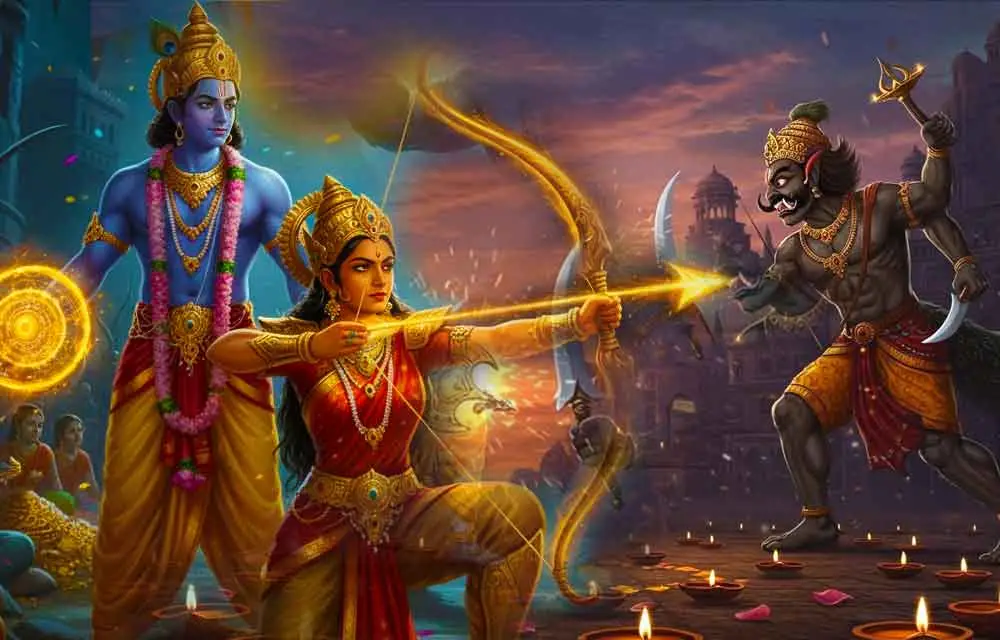
Version 1: Krishna, appearing to be momentarily overcome by Narakasura's weapons, fell unconscious. Seeing her beloved husband apparently wounded, Satyabhama was consumed with fury. She took up the bow and arrows herself and fought with extraordinary skill and determination. When the moment came, she shot the fatal arrow that pierced Narakasura's heart.
Version 2: Krishna, knowing the prophecy, deliberately took a supporting role, allowing Satyabhama to wield the weapons. He guided her aim, and together they ensured the demon's destruction, with Satyabhama delivering the killing blow.
Narakasura's Redemption
As Narakasura lay dying, struck down by his own mother's incarnation, a profound transformation occurred. The veil of demonic influence lifted from his consciousness, and he realized the gravity of his sins. He fell at Krishna's feet, seeking forgiveness.
With his last breath, Narakasura made two requests:
- That his death anniversary be celebrated with lights and joy rather than mourning
- That his son Bhagadatta be spared and allowed to rule righteously
Krishna, in his infinite compassion, granted both wishes. This is why the day of Narakasura's death is celebrated as a festival of lights and victory, known as Naraka Chaturdashi.
The Liberation of the Captive Women
After Narakasura's death, Krishna and Satyabhama liberated the 16,100 women imprisoned in his palace. These women, though innocent victims, faced the harsh reality of being stigmatized by society. Understanding their plight and honoring their dignity, Lord Krishna married all of them, granting them the honored status of his queens and restoring their respect in society.
This act demonstrated Krishna's commitment to justice and his rejection of discriminatory social norms that punished victims rather than perpetrators.
The Recovery of Divine Treasures
Krishna and Satyabhama recovered all the stolen celestial items:
- Aditi's earrings were returned to the mother of gods
- Varuna received back his divine umbrella
- Indra regained his crown from Mount Mandara
- All other treasures were restored to their rightful owners
The heavens rejoiced, and the devas showered flowers upon Krishna and Satyabhama, praising their victory.
Spiritual Significance
The Symbolism of Narakasura
Narakasura represents the demon of ego, lust, greed, and attachment that resides within every individual. His seven defensive barriers symbolize the seven layers of ignorance that prevent spiritual awakening. His tyranny represents how unchecked negative qualities can dominate one's life and harm others.
Satyabhama as Shakti
Satyabhama's role emphasizes the power of divine feminine energy (Shakti) in destroying evil. She represents the active, dynamic aspect of divinity that takes decisive action against injustice. Her participation shows that spiritual liberation requires both divine grace (Krishna) and determined effort (Satyabhama).
The Victory of Dharma
The story illustrates that no matter how powerful evil becomes or how many boons protect it, dharma (righteousness) ultimately prevails. It teaches that divine intervention occurs when evil crosses all limits and that the universe has a self-correcting mechanism.
Redemption and Compassion
Narakasura's final redemption shows that even the worst sinners can find forgiveness through genuine repentance. Krishna's compassion toward the dying demon teaches the importance of mercy and the possibility of transformation at any moment.
The Festival of Naraka Chaturdashi
The story is remembered on Naraka Chaturdashi, the Chaturdashi before the Diwali Amavasya. Customs vary by region:
- Tamil Nadu, Andhra Pradesh, Telangana and Karnataka: an early-morning oil bath (abhyanga snan) before sunrise, followed by new clothes, sweets and temple visits. In Tamil Nadu this is the main Deepavali morning.
- Maharashtra and Goa: an early bath with fragrant oil and ubtan, followed by Diwali sweets and family visits.
- North and West India: the same Chaturdashi is Roop Chaudas and Kali Chaudas, with Hanuman Puja or Kali worship at night.
- Assam: Pragjyotishapura, where Narakasura is said to have ruled, is identified with the region around Guwahati; Kamakhya is a well-known Shakti peetha there.
Common elements everywhere are lamps, a bath at dawn, cleaning the house and sharing food. The legend is usually read as a reminder that ego and cruelty fall, and that survivors of harm deserve dignity and protection.
Lessons from the story
- Power without restraint leads to its own end.
- Courage and compassion belong together, as Satyabhama and Krishna show.
- Survivors of harm should be protected and honoured rather than blamed.
- Even a fallen person can repent: Narakasura's last request was that his death be remembered with lights, not grief.
- Ego, greed and attachment are the Narakasura within each of us.
Celebrating safely
- Follow local rules on firecrackers; many cities restrict them. See our
- cracker safety guide
- .
- Use oil lamps on stable trays, away from curtains and children's clothes. In apartments, LED lamps are a safe alternative.
- If you take an oil bath, warm the oil gently and test it on your hand first; avoid it on broken skin.
- Choose eco-friendly, low-smoke options, especially for children and elders with breathing problems.
Frequently asked questions
When is Naraka Chaturdashi in 2026?
Per Drik Panchang, Naraka Chaturdashi is on Sunday 8 November 2026 in India, the same day as Diwali. The Chaturdashi tithi runs from 10:47 AM IST on 7 November to 11:27 AM IST on 8 November. At local sunrise it falls on Saturday 7 November in the USA, Canada, the UK, Germany and the rest of Europe, and on 8 November in the UAE, Singapore, Malaysia, South Africa and Australia.
Who killed Narakasura, Krishna or Satyabhama?
The Bhagavata Purana says Krishna slew him with the Sudarshana chakra, with Satyabhama beside him. In later and regional tellings, Satyabhama delivers the fatal arrow because only his mother, Bhudevi, whom she is held to incarnate, could kill him.
Why is Narakasura's death celebrated with lights?
According to the legend, the dying Narakasura repented and asked that his death be remembered with lights and joy rather than mourning. Krishna granted the wish, which is why Naraka Chaturdashi is a festival of lamps.
How is Naraka Chaturdashi celebrated?
Devotees take an early-morning oil bath (abhyanga snan), light lamps, wear new clothes and share sweets. Customs differ by region. Firecrackers are traditional in many places, but local rules and safety come first.
What is the spiritual meaning of Narakasura Vadha?
Narakasura is seen as the ego, greed and attachment within each person, and Satyabhama as Shakti, the divine feminine that acts against injustice. The story teaches that dharma prevails and that sincere repentance can lead to redemption.
Is Naraka Chaturdashi the same as Choti Diwali or Kali Chaudas?
They fall on the same Krishna Chaturdashi. Naraka Chaturdashi is the South Indian name, Choti Diwali and Roop Chaudas are North Indian names, and Kali Chaudas is observed on the Chaturdashi night. In 2026 Drik lists Kali Chaudas on Saturday 7 November and Naraka Chaturdashi on Sunday 8 November, because the two rules look at different times of the day.
Why does the date differ abroad?
Abhyanga snan is a dawn custom, so many calendars look at the tithi at local sunrise. In the Americas, the UK and Europe sunrise on 7 November has Chaturdashi, while by 8 November Amavasya has begun. Ask your temple or priest which day it follows.
Editor's note
Editor's note (31 October 2026): We updated this retelling on 31 October 2026. Changes: an at-a-glance table with the Chaturdashi span from Drik Panchang, a date-by-country table, the Diwali week timeline, a note on the Bhagavata and regional versions of the story, regional customs, safety tips and seven FAQs. The India dates are from Drik Panchang; dates abroad are HinduTone's reading of the tithi at local sunrise. The story is presented as commonly told, and versions differ between texts and regions. Customs vary by region and family. No particular benefit is promised from any observance.
Related 2026 guides
Share this with family and friends
Send it on WhatsApp, post it, or copy the link.
More from Diwali 2026
- Goa Diwali 2026: Burning Large Effigies of Narakasura Marks Lord Krishna’s Victory Over Evil
- Diwali 2026 in Pune: Laxmi Pujan Muhurat, Padwa, Bhau Beej, Dagdusheth, Diwali Pahat and Cracker Rules
- Diwali 2026 in Delhi: Lakshmi Puja Muhurat, Green Cracker Timings, Temples and Markets
- Diwali 2026 in Kochi: Deepavali Date, Lakshmi Puja Time, Temples and Mattancherry Traditions
- Diwali 2026 in Warsaw, Poland: Lakshmi Puja Time, Hindu Temples and Community Guide
You might also like
The Complete Story of Satyabhama: Birth, Divine Love, and Victory Over Narakasura
Diwali 2026 in New Zealand: Auckland and Wellington's Indian Festivities, Puja Times and Temples
Diwali in Japan 2026: Hindu Traditions, Japanese Life, Lakshmi Puja Times and Temples